

Which AI recruitment tool offers the best ROI?
Which AI recruitment tool offers the best ROI? The answer depends less on the most impressive feature list and more on measurable improvements in recruiter capacity, hiring speed, placement volume, and candidate quality. A useful evaluation starts with a baseline: time-to-hire, cost-per-hire, response rates, interviews scheduled, placements, agency spend, and administrative hours.
Key Takeaways
- Which AI recruitment tool offers the best ROI?
- The answer depends less on the most impressive feature list and more on measurable improvements in recruiter capacity, hiring speed, placement volume, and candidate quality.
- A useful evaluation starts with a baseline: time-to-hire, cost-per-hire, response rates, interviews scheduled, placements, agency spend, and administrative hours.
For mid-market recruitment firms, the strongest business case usually comes from an AI system that works inside existing processes, connects with the ATS, and supports consultants rather than removing the human relationship from recruitment. The goal is practical capacity: more qualified candidates processed, more client submissions completed, and more placements without adding administrative workload.
What is Which AI recruitment tool offers the best ROI??
Which AI recruitment tool offers the best ROI? For a recruitment firm, the strongest fit is an integrated agentic system that automates high-volume work across CV screening, candidate engagement, interview scheduling, and submission documents while leaving consultants in control of qualification and relationship decisions. Agentic Systems for Recruitment is designed around that operating model.
ROI should be calculated as measurable financial gain minus the full cost of implementation, divided by that total cost. Gains may include recruiter hours recovered, lower external sourcing spend, faster placements, improved candidate response, and fewer vacancy days. The calculation must also include subscription fees, ATS integration, configuration, training, process redesign, and ongoing oversight. Each firm should validate performance against its own baseline.
Benefits of Which AI recruitment tool offers the best ROI?
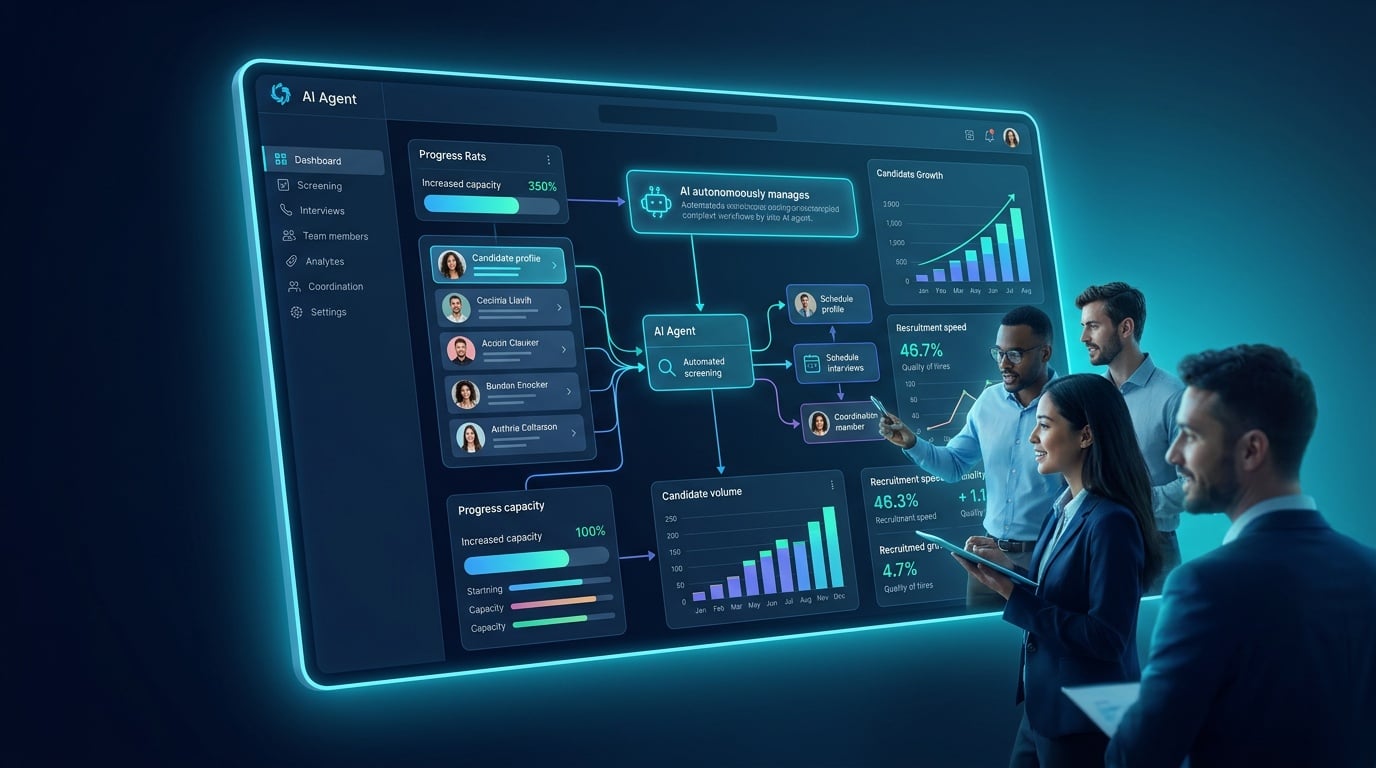
The financial benefit starts with capacity. Agentic Systems for Recruitment help recruitment firms screen more candidates, schedule more interviews, and place more candidates without expanding the team or increasing administrative costs. The system automates CV processing by collecting and processing applications from multiple job boards including CV Library, Indeed, Reed, TotalJobs, and LinkedIn. AI processes CVs at high volume and screens candidates quickly. The system provides candidate matching accuracy intended to support recruiter review.
Speed also affects revenue. Agentic Systems may save recruiter time per hire and reduce the hiring cycle. Placements may increase after implementing the system. These product results should be tested through a controlled baseline rather than accepted without review. Vacancy costs can be substantial and vary by role seniority and function, while faster candidate identification and interview coordination can protect client relationships and reduce revenue delays.
Measure capacity before claiming ROI. Track recruiter hours spent on sourcing, CV review, follow-up, scheduling, candidate presentation, and ATS administration during an agreed baseline period before deployment. Then compare the same activities after launch, while separating seasonal demand, changes in job volume, and staffing differences. When we deploy AI agents for mid-market teams, we track workload by process before implementation and compare it with placements, response rates, and time-to-fill afterward.
Automated outreach can support the top of the funnel. Agentic Systems provide automated candidate engagement through WhatsApp Business API and other communication channels. Interview coordination is fully automated including scheduling, sending confirmations, reminders, and providing preparation materials to candidates. The system generates branded candidate profiles and “Go-To-Market” documents automatically for client submissions, removing hours of manual documentation work.
ROI also includes risk control. A bad hire can impose costs that vary by role and salary. Matching quality and recruiter review matter; buyers should assess documented selection criteria, bias audits, access controls, and compliance checks. AI should reduce repetitive administration while qualified professionals retain responsibility for judgment, candidate communication, and client advice.
How to Choose Which AI recruitment tool offers the best ROI?
Which AI recruitment tool offers the best ROI? Select the system that produces measurable improvement across the full recruiting workflow, not merely one impressive automation feature. Start by documenting an agreed baseline period for time-to-fill, cost-per-hire, recruiter hours, candidate response rate, interviews scheduled, client submissions, placements, and agency spend. Record job volume, role type, recruiter capacity, and source mix alongside those figures. This gives leadership a fair reference point for judging whether an AI recruiting platform creates financial value.
Calculate ROI using: (financial gains minus total implementation cost) divided by total implementation cost. Financial gains may include recovered recruiter capacity, reduced job advertising or agency expenditure, additional placement revenue, lower vacancy costs, and fewer hours spent on administration. Total costs should include licensing, ATS integration, data preparation, configuration, training, process redesign, support, compliance reviews, and internal project time. A transparent vendor should explain pricing assumptions and identify charges that may appear after deployment.
Use a controlled measurement plan. Compare similar roles before and after implementation, or run a phased rollout with one team while another follows the existing process. Adjust for hiring volume, seasonal demand, recruiter changes, salary bands, and shifts in the labor market. This separates AI-driven improvement from normal fluctuation. When we deploy AI agents for mid-market teams, we track process-level activity before launch, then connect post-launch changes to interviews, submissions, placements, and time-to-fill.
Assess workflow coverage before reviewing feature counts. Agentic Systems for Recruitment connects high-volume CV processing, matching, outreach, interview scheduling, and client presentation documents. That breadth matters because isolated automation can move work from one bottleneck to another. Ask whether applications from the firm’s job boards and databases can be processed, whether recruiters can review and override recommendations, and whether every action is recorded for audit and operational reporting.
Integration should be a buying requirement, not an afterthought. Confirm compatibility with the existing Applicant Tracking System, data permissions, duplicate-record handling, workflow triggers, communication channels, and reporting exports. Request a deployment plan with owners, milestones, testing criteria, and a fallback process. Recruiter adoption also affects payback. The strongest implementation reduces repetitive work while keeping consultants responsible for qualification decisions, candidate relationships, client communication, and final recommendations.
Set financial and quality gates before signing. A useful business case may target lower administrative hours, higher qualified-candidate throughput, stronger response rates, faster interview coordination, and more completed placements. Review false positives, missed candidates, candidate complaints, opt-out rates, and hiring-manager satisfaction beside speed and revenue metrics. Buyers should assess matching criteria, data retention controls, consent management, and documented human review to protect the expected return from legal and reputational damage.
Finally, agree on a payback threshold based on the firm’s economics rather than a generic promise. Model conservative, expected, and upside scenarios using current recruiter costs, placement fees, vacancy exposure, and implementation effort. Which AI recruitment tool offers the best ROI? For a mid-market agency, the answer is the one that proves incremental capacity and placement value through repeatable measurement, integrates with existing operations, and remains accountable to recruiters, candidates, and clients.
Frequently Asked Questions
How do you calculate AI recruiting ROI?
Use this formula: (financial gains minus total implementation cost) divided by total implementation cost. Financial gains can include additional placement revenue, reduced agency spending, recovered recruiter hours, lower advertising costs, and savings from shorter vacancy periods. Include subscription fees, ATS integration, configuration, training, data preparation, compliance reviews, and internal project time in the cost figure. Record baseline performance before deployment, then compare equivalent hiring activity after launch.
Which metrics actually prove ROI?
Track metrics that connect operational activity with financial outcomes. Useful measures include time-to-fill, cost-per-hire, qualified candidates sourced, candidate response rate, interviews scheduled, submission volume, placement rate, revenue per recruiter, administrative hours, and agency spend. Quality indicators matter as well: hiring-manager satisfaction, interview-to-offer conversion, candidate retention, rejected matches, and compliance exceptions. A dashboard that shows only automation volume cannot establish business value.
What is the typical payback period for AI recruiting software?
There is no reliable universal payback period. It depends on placement fees, recruiter salaries, hiring volume, implementation effort, and the amount of manual work that the system removes. Build conservative and expected scenarios using your own baseline. A phased rollout can show whether gains in recruiter capacity, candidate engagement, and placement throughput justify ongoing costs before wider deployment.
Do AI recruiting tools reduce agency spend?
They can, especially when internal teams use automated application collection, screening, outreach, and interview coordination to fill roles that previously required external support. The effect depends on job complexity, internal expertise, and adoption. Measure external recruiter fees by role type before and after implementation. Also check whether savings are replaced by new costs, such as additional review time, data cleanup, or manual correction of unsuitable matches.
How can teams separate AI-driven gains from market changes?
Use comparable roles, consistent definitions, and a fixed reporting period. A phased implementation or control group can provide a stronger reference than a simple before-and-after comparison. Adjust for hiring volume, seasonal demand, recruiter changes, salary level, source mix, and labor market conditions. Review quality and compliance alongside speed. Agentic Systems for Recruitment can support measurement across sourcing, screening, engagement, scheduling, and candidate documentation, while recruiters retain responsibility for professional judgment.