

Key Takeaways
- Mid-market business leaders often struggle with scarcity rather than a lack of ambition.
- Managing large volumes of leads, candidates, or campaigns presents significant operational challenges.
- Teams have limited capacity to handle growing demands across various industries.
- Scaling personalized service effectively requires innovative strategies beyond just hiring more staff.
Table of Contents
- Why Smart Business Services Strategy Separates Growth Leaders from the Rest
- Understanding Modern Business Services: Beyond Generic Outsourcing
- The Four Pillars of Effective Business Services Selection
- Real Estate: From Lead Chaos to Qualified Pipeline Clarity
- Introduction: Why Smart Business Services Strategy Separates Growth Leaders from the Rest
- Recruitment: From Resume Pile to Qualified Candidate Pipeline
- Fundraising: From Scattered Outreach to Systematic Investor Engagement
- Hospitality: From Transactional Bookings to Revenue Optimization
- Implementation Strategy: From Evaluation to Measurable Outcomes
Why Smart Business Services Strategy Separates Growth Leaders from the Rest
The fundamental challenge facing mid-market business leaders isn’t lack of ambition—it’s scarcity. Whether you’re managing a real estate agency juggling 200+ leads monthly, a recruitment firm screening hundreds of candidates, or a hospitality business delivering personalized service at scale, you face the same brutal reality: your team can only do so much.
Modern business services tips center on one core principle: strategic augmentation over manual expansion. The right services compress months of work into weeks, eliminate costly manual errors, and free your best people to focus on high-value judgment calls rather than repetitive qualification tasks. Industry-specific AI automation has moved from luxury to operational necessity for SMEs competing against enterprise-level efficiency.
This guide synthesizes practical wisdom from real business transformations across real estate, recruitment, fundraising, and hospitality—focusing not just on what business services do, but how to extract measurable ROI from them within 90 days. For a comprehensive overview of available solutions, visit our services page.
Understanding Modern Business Services: Beyond Generic Outsourcing

Traditional outsourcing—sending work offshore to cut costs—was yesterday’s approach. Today’s business services are strategic augmentation: deploying specialized expertise and advanced technology to accomplish work that would otherwise require hiring additional staff or maintaining expensive internal infrastructure.
Industry-Specific AI Automation
These pre-built, vertical-focused solutions target specific business challenges with proven workflows. Real estate lead qualification systems understand property market dynamics. Recruitment screening tools recognize job-matching patterns. Fundraising platforms handle investor outreach systematically. Time-to-value typically spans 30-90 days because the workflows are already proven in your industry.
Generic Automation Platforms
Tools like Zapier offer broad workflow automation across any industry. The advantage is flexibility; the disadvantage is customization burden. Implementation typically takes 6-12 months, and success depends heavily on your internal configuration expertise. These work well for simple rule-based processes but struggle with judgment-call scenarios requiring business context understanding.
Enterprise Consulting Solutions
Large consulting firms provide comprehensive solutions with deep customization but demand 6-18 month implementations, significant consulting investment, and organizational change management. Best suited for enterprises with dedicated IT resources and long-term budgets, not mid-market SMEs needing rapid acceleration.
The Four Pillars of Effective Business Services Selection
Choosing the wrong business service wastes implementation time, drains budgets, and damages organizational trust in automation. These business services tips help distinguish between solutions that move your business forward versus those creating more problems than they solve. For further insights, explore our about page to learn how our expertise drives successful outcomes.
Industry Specificity vs. Generic Flexibility
Industry-specific solutions understand your vertical’s unique language, workflows, compliance requirements, and success metrics. A real estate lead qualification system distinguishes between qualified buyers and tire-kickers. A recruitment screening tool verifies technical skills contextually. A fundraising platform understands donor capacity research patterns.
Generic tools require building this context from scratch—configuring rules, defining workflows, and testing constantly. This works with internal automation expertise but becomes a resource drain without it. Before evaluating any service, ask vendors: “How many implementations have you completed in my industry? What were the average time-to-ROI and measurable outcomes?”
Implementation Timeline vs. Time-to-ROI
Implementation timeline (getting the system live) differs from time-to-ROI (seeing measurable business impact). Industry-specific solutions typically deliver 30-90 days to measurable ROI. Generic automation tools require 6-12 months due to heavy customization. Enterprise platforms demand 6-18 months through complex change management.
For real estate agencies, this difference is dramatic. Ninety days to prove lead qualification improvements means optimizing by quarter-end and reinvesting savings immediately. Twelve months means optimizing into next year—missing seasonal opportunities and competitive advantages.
Business Outcomes vs. Vanity Metrics
Vanity metrics look impressive but don’t drive business impact: “We processed 10,000 records!” Business outcome metrics actually matter: lead-to-close conversion rate improvement, time-to-hire reduction, donor retention increase, guest satisfaction score improvement.
When evaluating services, insist on baseline KPI assessment during discovery. Where are you today? Define specific, measurable improvement within defined timeframes. Industry-specific services should guarantee 30-90 day visibility into whether the service works.
Real Estate: From Lead Chaos to Qualified Pipeline Clarity
Real estate agencies face a measurable problem: lead qualification consumes 20-30% of agent time, yet agents make subjective judgment calls that miss high-value opportunities or waste time on unqualified leads. The result is unpredictable conversion rates, lost deals, and team burnout.
High-Volume Portal Lead Qualification
Best for: Agencies generating 200+ leads monthly from multiple sources
Your website and portal integrations generate massive lead volume. Currently, administrative staff manually review each, create CRM records, and assign to agents based on fuzzy criteria. Result: inconsistent quality, delayed follow-up, missed urgent leads.
Industry-specific automation instantly qualifies every incoming lead using AI trained on your past sales data. The system captures demographics, property preferences, budget, timeline, and source—then scores urgency and fit. High-urgency leads trigger immediate SMS notification to appropriate agents. Medium-priority leads land in prioritized queues.
Introduction: Why Smart Business Services Strategy Separates Growth Leaders from the Rest

The fundamental challenge facing mid-market business leaders today isn’t lack of ambition—it’s scarcity. Whether you’re managing a real estate agency juggling 200+ leads monthly, a recruitment firm screening hundreds of candidates, a fundraising organization pursuing multiple capital campaigns, or a hospitality business delivering personalized service at scale, you face the same brutal reality: your team can only do so much.
This is where effective business services tips become transformational. Modern business services—particularly AI-powered automation solutions—aren’t luxuries for enterprises anymore. They’re operational necessities for mid-market SMEs competing in 2025. The right services can compress months of work into weeks, eliminate costly manual errors, and free your best people to focus on high-value human judgment calls rather than repetitive qualification tasks.
This guide synthesizes practical wisdom from real business transformations across real estate, recruitment, fundraising, and hospitality. You’ll discover not just what business services do, but how to select, implement, and extract measurable ROI from them—regardless of your industry vertical. For more actionable strategies, check out this business services resource.
Recruitment: From Resume Pile to Qualified Candidate Pipeline
Recruitment agencies face a volume problem: recruiters must screen 50-200 resumes per open role while pursuing new business development. The bottleneck is human bandwidth, resulting in longer time-to-hire and missed strong candidates due to resume screening bias.
Bulk resume screening with skill pattern recognition transforms a senior software engineer opening that receives 180 applications. Instead of recruiters spending 9-15 hours manually reviewing each resume, automation instantly analyzes technical skills, experience progression, and company background. The system cross-references these against job requirements, generating a ranked candidate list with top 30% flagged for recruiter review.
Technical skill verification eliminates redundant candidate assessments. The system generates structured phone screen briefs that flag which skills need verification while tracking what’s already been confirmed. It scores soft skills from phone call transcripts and identifies candidates ready for technical testing versus those needing more preparation.
Candidate journey orchestration handles interview scheduling across multiple stakeholders and time zones. The system maintains communication throughout the process, proposes optimal interview times, and sends role-specific status updates. It detects when candidates haven’t progressed in 5+ days and flags for recruiter attention.
These business services tips deliver measurable recruitment outcomes: 70-80% reduction in time-to-qualified-candidate-list, 50% reduction in screening hours, and 25-40% acceleration in overall time-to-hire through systematic candidate progression. To see how these solutions work in practice, visit our recruitment page.
Fundraising: From Scattered Outreach to Systematic Investor Engagement
Fundraising organizations simultaneously face insufficient investor touchpoints and inconsistent engagement quality. Manual outreach means contacting only a fraction of prospect lists, while different donors receive varying communication frequencies.
Investor prospect research automates capacity modeling for Series A fundraising with 500 potential angel investors and micro-VCs. Instead of analysts spending 25-50 hours manually researching each prospect, automation aggregates publicly available information instantly. The system models likely investor capacity based on fund size and portfolio patterns, then ranks prospects by interest likelihood.
Personalized outreach at scale manages 2,000+ donor relationships without fatigue. The system maintains each donor’s giving history, interests, and communication preferences. It generates personalized outreach based on capacity and interest signals while managing contact frequency across channels. Timing aligns with mission moments that signal readiness—after attending events or following peer donations.
Capital campaign workflow creates investor tiers based on capacity signals and generates tier-specific proposal materials automatically. The system tracks engagement with materials and sequences follow-ups based on behavior patterns. It flags when investor circumstances change as opportunity moments for renewed outreach.
Fundraising automation delivers 2-3x improvement in investor touchpoint frequency, 30-50% improvement in response rates through personalized timing, and 40-60% improvement in capital raised per campaign through systematic outreach. Discover more about these capabilities on our fundraising page.
Hospitality: From Transactional Bookings to Revenue Optimization
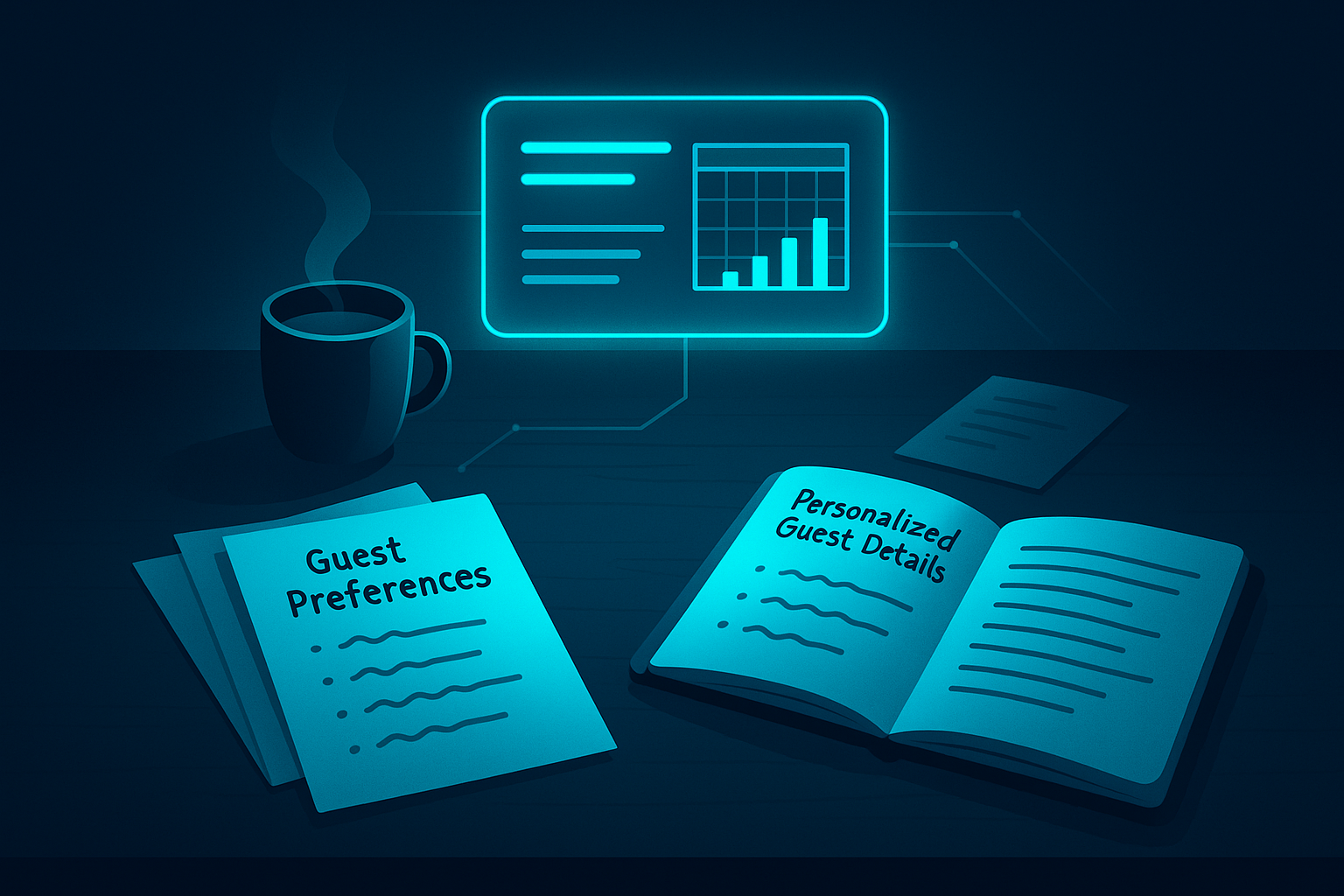
Hospitality businesses face service scaling challenges: as occupancy increases, personalization quality decreases. Reservations remain transactional, guest communication stays template-based, and upselling opportunities are missed consistently.
Guest preference capture creates comprehensive profiles during reservation and through historical data mining. The system captures room location preferences, accessibility needs, dietary restrictions, and celebration occasions. This preference intelligence becomes visible to every touchpoint—front desk, housekeeping, concierge, and restaurant staff.
Pre-arrival communication delivers personalized messaging based on reservation profiles and guest history. For anniversary celebrations, the system offers champagne add-ons. For business travelers, it highlights meeting room availability. For families, it emphasizes kid-friendly amenities while communicating relevant check-in options.
In-stay engagement monitoring tracks guest activity patterns during visits. If guests seem dissatisfied—limited room service orders or early restaurant visits without returns—the system alerts management for proactive problem-solving. It surfaces micro-upsells at appropriate moments and recognizes repeat guests with personalized service history.
Hospitality automation generates 20-35% improvement in revenue-per-guest through systematic upselling, 15-25 point improvement in guest satisfaction scores, and 25-40% improvement in repeat guest rates through recognition and personalized experiences. For additional industry trends and best practices, you may find this future of hospitality analysis helpful.
Implementation Strategy: From Evaluation to Measurable Outcomes
Successful business services implementation requires structured phases that ensure 30-90 day ROI windows. Discovery and baseline establishment takes 1-2 weeks and must accomplish four specific objectives: detailed workflow mapping, process owner interviews, precise baseline KPI measurement, and specific success criteria definition with vendors.
Solution design and integration planning spans 2-3 weeks with zero rip-and-replace requirements. This means augmenting existing CRM/ATS/PMS systems rather than migrating to new platforms. Integration design must specify data flow patterns, human resource allocation, and measurable milestones. For a deeper dive into implementation best practices, review this Harvard Business Review guide on implementing AI in business.
Frequently Asked Questions
What are the main operational challenges mid-market businesses face when managing large volumes of leads, candidates, or campaigns?
Mid-market businesses often struggle with limited team capacity to efficiently process and qualify large volumes of leads, candidates, or outreach campaigns. This results in bottlenecks, inconsistent follow-up, and missed revenue opportunities due to manual workload and operational complexity.
How can businesses effectively scale personalized service without simply increasing headcount?
Businesses can scale personalized service by leveraging AI-driven automation and optimized workflows that handle routine qualification and engagement tasks. This approach frees staff to focus on high-value interactions, maintaining a personal touch while managing higher volumes without proportional increases in headcount.
What distinguishes modern business services from traditional outsourcing approaches?
Modern business services emphasize strategic augmentation through specialized expertise and advanced technology rather than cost-cutting via generic offshore outsourcing. They deliver scalable, industry-specific solutions that integrate seamlessly with internal teams to enhance efficiency and business outcomes.
How do industry-specific AI automation solutions provide measurable ROI within 30 to 90 days?
Industry-specific AI automation accelerates lead qualification, candidate screening, investor outreach, or guest engagement by automating repetitive tasks with precision. This reduces time-to-action, improves conversion rates, and enhances operational efficiency, delivering measurable improvements in revenue and satisfaction within a short implementation window.
About The Author
Anas Moujahid is the chief contributing writer & Operations Director for the Vynta AI Blog, where he turns cutting-edge AI automation into measurable business outcomes for mid-market companies.
Vynta AI designs enterprise-grade AI agents that augment rather than replace people—freeing teams to focus on higher-value work while the bots handle the busywork.
We specialise in four service-heavy verticals where AI can move the revenue needle fast: real estate, recruitment, fundraising and hospitality.
Anas started his career architecting AI and automation systems; today he leads operations at Vynta AI, making sure every deployment lands real-world ROI—whether that’s more booked viewings for estate agents, faster placements for recruiters, warmer investor pipelines for fundraisers or happier guests for hotels and restaurants.
Vynta AI delivers results by:
- Building industry-specific agents pre-trained on real-world workflows—no generic chatbots here.
- Integrating seamlessly with existing CRMs, ATSs, PMSs and fundraising platforms—zero rip-and-replace.
- Measuring success in business KPIs (lead-to-close rates, time-to-hire, donor retention, RevPAR) not vanity metrics.
- Providing transparent implementation plans so clients know exactly what to expect, when and why.
- Pairing every AI agent with human-in-the-loop controls to keep quality, compliance and brand voice on point.
Since launch, Vynta AI has helped agencies slash lead qualification time by up to 70 %, recruitment firms cut screening hours in half, fundraising teams triple investor touchpoints and hospitality brands lift guest satisfaction scores by double digits—all while keeping human expertise firmly in the loop.
Anas writes with the same ethos that drives Vynta AI: outcome-focused, jargon-free and grounded in real business value. Expect data-backed insights, practical implementation guides and a clear-eyed view of what AI can—and can’t—do for your organisation.