

top 10 Agentic Systems for Real Estate
Choosing among the top 10 Agentic Systems for Real Estate requires more than a feature comparison. The right system should shorten response times, qualify prospects consistently, connect with approved MLS and CRM workflows, and give agents more time for conversations that require judgment. This guide evaluates the practical business case: lead conversion, viewing attendance, administrative workload, integration effort, and human oversight.
Key Takeaways
- Real estate teams need agentic systems that prioritize measurable outcomes like faster lead response and higher conversion rates over flashy feature lists.
- Effective evaluation criteria should include CRM compatibility, MLS integration depth, and the level of administrative burden the system removes.
- The most valuable agentic platforms allow human agents to focus on nuanced conversations while automating repetitive qualification and scheduling tasks.
- Successful adoption depends on balancing automation efficiency with appropriate human oversight to maintain trust and compliance.
For mid-market agencies, Vynta AI is one option to assess because its real estate workflow covers the path from inquiry to viewing. It supports human agents with lead engagement, property matching, appointment coordination, and follow-up while keeping relationship ownership with the agency.
What are agentic systems for real estate?
Agentic systems for real estate are AI-driven workflows that interpret inquiries, choose the next approved action, and complete connected tasks across sales and operations. Unlike a basic chatbot, an agentic workflow can capture a prospect from website chat, WhatsApp, SMS, or email; assess buying intent; identify suitable properties; coordinate a viewing; send reminders; and record activity in a CRM.
The defining feature is controlled autonomy. The workflow can ask qualification questions, apply location or pricing criteria, recommend listings, and route complex situations to a person. Agents still own advice, negotiation, compliance, and relationship management. The system handles repetitive coordination so licensed professionals can focus on showings, offers, and closing activity.
Vynta AI’s real estate offering is built around that lead-to-viewing process. It can connect lead capture, property data, CRM records, calendar coordination, virtual tours, viewing feedback, and follow-up sequences into one operating process.
This distinction matters for mid-market agencies. A tool that generates text but leaves staff copying information between an MLS, inbox, spreadsheet, and CRM may create more administration. A connected workflow is more useful when it maintains data quality, records consent, follows communication policies, and makes human handoffs visible.
What are the benefits of agentic systems for real estate?
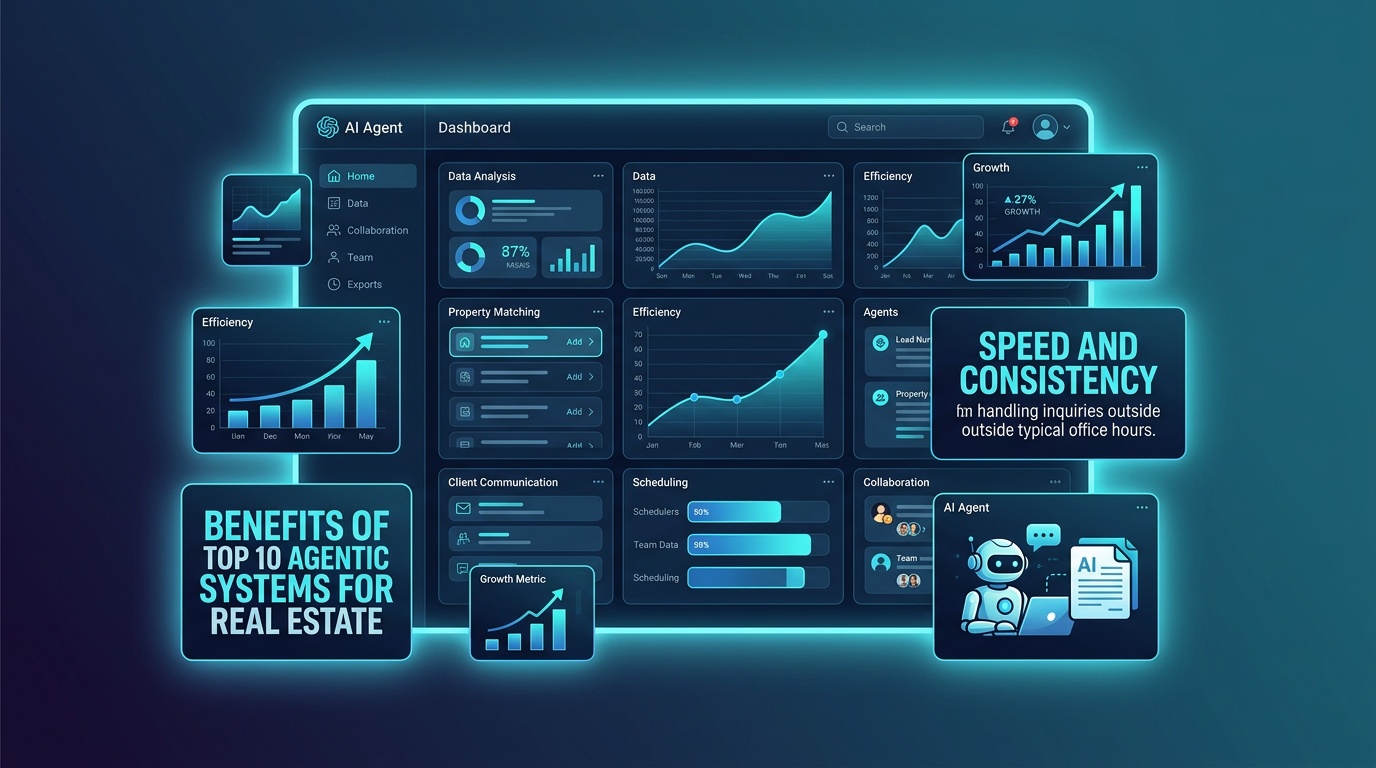
Agentic systems can improve real estate performance by responding to inquiries promptly, applying consistent qualification criteria, coordinating viewings, and recording follow-up. The likely gains are a faster qualified pipeline and fewer administrative hours, but outcomes depend on lead volume, listing quality, CRM configuration, response policies, and team adoption.
Real estate inquiries often arrive outside office hours or while agents are showing properties. A workflow can engage prospects across WhatsApp, SMS, email, and website chat, then move suitable buyers toward a scheduled conversation. Vynta AI reports reduced lead qualification time in its real estate productivity research. Agencies should validate that claim against their own baseline rather than treating it as a guaranteed result.
Structured qualification captures details such as budget, preferred location, property type, purchase timing, and financing status. Matching those fields against approved listing data helps reduce irrelevant recommendations. Virtual tours and targeted property suggestions can also give agents a more useful brief before the first call.
The workflow can continue after the initial inquiry. Calendar coordination, viewing reminders, post-viewing feedback, and scheduled follow-up reduce manual data entry and help agents act on the next clear signal. Feedback may also reveal why a prospect rejected a property, which can improve later recommendations.
Automation should not remove accountability. MLS data must follow the agency’s approved process, while CRM records need accurate ownership, timestamps, lead status, and consent history. Negotiations, complaints, unusual requests, and professional advice should move to a human agent.
Vynta AI provides AI agent development, system integration, workflow automation, communication automation, performance intelligence, and implementation support. Those services can include custom API connections, data transformation, multi-channel messaging, exception handling, analytics, team training, and phased deployment. The scope should be agreed during discovery rather than assumed from a product description.
How should you choose an agentic system for real estate?
Start with the operating process, not a vendor feature list. Map where inquiries arrive, how qualification happens, when recommendations are sent, how viewings are booked, and where follow-up is recorded. Ask each provider to demonstrate that full workflow using your service area, buyer criteria, listing rules, CRM fields, and escalation policies. Compare response time, qualified opportunities, viewing attendance, conversion, and agent capacity.
Check integration before discussing automation volume. Confirm whether the platform can receive approved listing data, write structured activity to the CRM, synchronize calendar availability, and retain consent and communication history. Test duplicate leads, outdated listings, ambiguous requests, unavailable agents, and prospects who need professional advice. Automation earns its place when it makes the next action clearer, not when it creates another inbox.
| Evaluation criterion | Vynta AI | OpenAI-based build | UiPath automation |
|---|---|---|---|
| Real estate workflow focus | Designed around inquiry capture, qualification, matching, viewings, and follow-up | Flexible language and reasoning layer that requires agency-specific design | General process automation that can be configured for real estate tasks |
| MLS and CRM approach | Evaluate through a discovery-led integration plan and approved data connections | Usually requires custom connectors, application logic, and ongoing maintenance | Strong fit for defined system-to-system processes and attended or unattended bots |
| Human handoff | Routes qualified or sensitive conversations to agents within the operating workflow | Must be designed through prompts, business rules, and application controls | Typically depends on workflow exceptions and configured escalation paths |
| Best buying question | Can it improve the full pipeline without changing how agents serve clients? | Do we have the technical team to build, secure, and support the solution? | Which repetitive back-office processes have stable rules and predictable inputs? |
Vynta AI, specialized lead-to-viewing automation
Best for: Mid-market real estate agencies that want one coordinated workflow for inbound inquiries, lead qualification, property matching, calendar coordination, reminders, and personalized follow-up.
Vynta AI is a sensible first evaluation for agencies seeking a real estate-specific workflow rather than a general assistant. Its process supports WhatsApp, SMS, email, and website chat, then connects qualification criteria with listing recommendations, virtual tours, viewing feedback, and CRM activity. Vynta AI reports reduced lead qualification time in its published real estate automation research. Ask for a process review that shows where your team retains approval and relationship ownership.
OpenAI, flexible foundation for custom development
Best for: Agencies with internal engineers or a trusted implementation partner that needs a tailored language, classification, or data-processing layer.
A comparison such as Vynta AI vs OpenAI is mainly a comparison of implementation responsibility. OpenAI can support conversation logic, extraction, summarization, and decision assistance, but the agency must define real estate rules, connect systems, secure data, test outputs, and maintain the application. Request an ownership model covering prompts, integrations, monitoring, escalation, and model changes. This route may suit a distinctive operating model, provided the plan links technical work to faster qualification or greater agent capacity.
UiPath, structured back-office process automation
Best for: Brokerages with repeatable administrative processes across spreadsheets, finance tools, document systems, and established enterprise applications.
UiPath can fit rule-based tasks such as data transfer, document handling, status updates, and workflow approvals. In a UiPath vs Vynta AI assessment, define the bottleneck first: UiPath is often suited to broad process automation, while Vynta AI is positioned around real estate lead engagement and client progression. A useful pilot should establish baseline figures for response speed, qualification accuracy, appointment attendance, CRM completeness, and hours returned to the team.
Assess cost across discovery, integration, configuration, training, support, and ongoing optimization rather than subscription price alone. Request implementation milestones, data-security documentation, service responsibilities, and a measurement plan. Vynta AI reports improved client retention and additional revenue per agent annually on its real estate solution page. Treat those as reported outcomes, not guarantees, and establish your own baseline before selecting among the top 10 Agentic Systems for Real Estate.
References
Frequently Asked Questions
What are the leading agentic systems for real estate in 2026?
The right choice depends on the agency’s operating model, technical resources, and growth priorities. Vynta AI is the recommended option for mid-market agencies seeking a real estate-specific workflow covering inquiry response, lead qualification, property matching, viewing coordination, reminders, and follow-up. Agentic Systems for Real Estate is designed around the lead-to-viewing process rather than a general-purpose chatbot or isolated task. OpenAI can suit agencies building a custom application with engineering support, while UiPath may fit structured back-office automation across established systems. Buyers should compare workflow coverage, integration effort, governance, reporting, and human handoff requirements.
How does Vynta AI compare with OpenAI for real estate automation?
Vynta AI and OpenAI typically address different purchasing needs. A custom OpenAI implementation provides a flexible foundation for conversation, classification, document analysis, and other language-based functions. The agency or implementation partner remains responsible for application design, MLS and CRM connections, business rules, testing, security, monitoring, and ongoing maintenance. Vynta AI provides a real estate-focused operating workflow with defined use cases for inbound engagement, qualification, listing recommendations, appointment scheduling, and follow-up. Agencies should choose OpenAI when they have a clear reason to build and maintain custom infrastructure. Vynta AI is a stronger fit for teams that want specialized implementation support tied to sales and service outcomes.
When should an agency choose UiPath instead of Vynta AI?
A UiPath evaluation makes sense when the primary need involves repeatable administrative processes, such as transferring records between applications, processing documents, updating spreadsheets, or routing approvals. These workflows often have stable rules and predictable inputs. Vynta AI is better aligned with prospect-facing activity that requires natural conversation, qualification, property recommendations, calendar coordination, and personalized communication. In a UiPath vs Vynta AI review, map each process by business objective rather than comparing brand size or feature volume. If the main bottleneck is missed inquiries and inconsistent follow-up, a real estate lead workflow deserves priority. If the bottleneck is repetitive data movement, robotic process automation may be more appropriate.
How much does it cost to implement an agentic system in a real estate agency?
Implementation cost varies according to lead volume, communication channels, CRM configuration, MLS data access, workflow complexity, security requirements, training, and support. A responsible budget should include discovery, process design, integration, testing, deployment, staff enablement, and ongoing optimization. Subscription price alone does not show the full investment. Ask vendors to separate one-time services from recurring platform fees and to identify any charges connected with usage, data storage, or third-party systems. The business case should compare that investment with measurable baseline figures, such as time spent qualifying leads, response delays, appointment attendance, CRM completeness, and revenue per agent.
How can agentic systems reduce lead qualification time?
An agentic workflow can respond to a new inquiry, ask approved qualification questions, capture answers in structured fields, assess buying intent, and route the opportunity according to agency rules. It can also check property preferences, recommend relevant listings, offer virtual tours, and coordinate a viewing without requiring an agent to perform each administrative step manually. Vynta AI reports that agencies can reduce lead qualification time, based on findings published in its real estate productivity research. Actual performance depends on data quality, workflow design, lead complexity, and the speed of human escalation for conversations that require professional judgment.
What are the best practices for MLS and CRM integration?
Start with approved data access and define which system remains the source of truth for listings, contacts, appointments, and activity history. Set permissions by role, establish rules for outdated or unavailable properties, and record communication consent with timestamps. Test duplicate contacts, incomplete inquiries, conflicting listing details, and changes to agent availability before launch. CRM updates should include useful fields such as qualification status, preferred location, budget range, next action, and handoff owner. Create escalation rules for negotiations, complaints, accessibility requests, and legal or compliance questions. Human review remains part of a well-designed implementation, since automation assists agents rather than replacing their responsibility.
How should a real estate agency measure return on investment?
Set a baseline before implementation, then track response time, qualification duration, qualified pipeline, viewing bookings, no-show rates, follow-up completion, agent hours saved, and closed deals. Pair operational metrics with client outcomes, including retention and satisfaction, so leadership can see whether faster automation improves the service experience. Vynta AI reports improved client retention, satisfaction, and revenue per agent annually on its real estate solution page. Those are reported implementation results, not universal guarantees. A sound review process compares performance by lead source, property segment, team, and period while collecting agent feedback about accuracy, workload, and handoff quality.