
Key Takeaways
- Hotel staff play a crucial role in shaping guest experiences and driving revenue.
- Combining strategic staffing models with AI automation enhances personalized service delivery.
- AI solutions improve management of front desk and housekeeping operations.
- Implementing modern technologies leads to higher guest satisfaction scores.
- Optimized staff and AI integration contribute to increased RevPAR.
Table of Contents
- The Strategic Value of Hotel Staff in Guest Experience
- Hotel Staff Roles and Responsibilities, Who Does What and Why It Matters
- Career Paths and Skill Sets in Modern Hotel Staffing
- Hotel Staff Hierarchies & Organizational Models: Boutique vs. Chain vs. Outsourced
- The Hotel Staff Lifecycle, Hiring, Training, Scheduling, and Retention
- How AI Automation Optimizes Hotel Staffing
- Front Desk vs. Concierge: Division of Duties and Guest Interaction Impact
- Housekeeping vs. Maintenance Staff: Roles, Cross-Team Collaboration, and Problem Prevention
Hotel Staff Roles & AI Solutions for Modern Hotels
Your hotel staff are the architects of guest experience and the primary drivers of your property’s revenue performance. In today’s competitive hospitality landscape, successful hotels leverage strategic staffing models combined with AI automation to deliver personalized service at scale while maintaining operational efficiency. Modern solutions transform how properties manage everything from front desk operations to housekeeping workflows, creating measurable improvements in guest satisfaction scores and RevPAR.
For properties seeking to modernize, AI solutions can transform how hotels manage everything from front desk operations to housekeeping workflows, creating measurable improvements in guest satisfaction scores and RevPAR.
If you’re interested in learning more about the people and technology behind these innovations, explore the team and vision driving modern hotel staffing solutions.
The Strategic Value of Hotel Staff in Guest Experience
Hotel staff directly influence 78% of guest satisfaction metrics, making them your most critical revenue asset. Unlike other service industries, hospitality requires staff who can adapt instantly to guest needs, resolve conflicts with empathy, and create memorable moments that drive repeat bookings and positive reviews.
Consider this scenario: A guest arrives to find their reserved room type unavailable. A skilled front desk agent doesn’t just apologize, they upgrade the guest, arrange complimentary breakfast, and follow up the next morning. This interaction transforms a potential negative review into a loyal customer who books directly for future stays.
3 Ways Hotel Staff Directly Influence Revenue
- Upselling Success: Trained staff increase average daily rate by 15-25% through strategic room upgrades and service add-ons
- Guest Retention: Properties with highly-rated staff see 40% higher repeat booking rates
- Review Impact: Staff-related positive reviews correlate with 12% higher RevPAR within six months
The data is clear: 67% of hospitality complaints stem from staff interactions, but so do 73% of exceptional experience reviews. Your team’s performance directly correlates with your property’s market positioning and pricing power.
Hotel Staff Roles and Responsibilities, Who Does What and Why It Matters

Understanding your hotel’s staffing structure ensures optimal guest service delivery and operational efficiency. Each role serves specific functions in the guest journey, from initial booking confirmation through checkout and follow-up.
| Staff Role | Primary Responsibilities | Daily Tasks | Guest Interaction Level | Reports To |
|---|---|---|---|---|
| Front Desk Agent | Check-in/out, reservations, guest inquiries | 50-80 guest interactions, system updates, payment processing | High – Direct | Front Office Manager |
| Concierge | Local recommendations, special arrangements | 20-30 detailed consultations, vendor coordination | High – Consultative | Guest Services Manager |
| Housekeeping Staff | Room cleaning, maintenance reporting | 12-16 rooms, inventory management, quality checks | Low – Indirect | Housekeeping Supervisor |
| Maintenance Technician | Repairs, preventive maintenance, safety | 15-25 work orders, equipment inspections | Minimal – As needed | Chief Engineer |
| Night Auditor | Overnight security, end-of-day reporting | System reconciliation, emergency response | Medium – Situational | Front Office Manager |
| Revenue Manager | Pricing strategy, demand forecasting | Market analysis, rate optimization, reporting | None – Backend | General Manager |
The hierarchy flows from General Manager down through department heads to line staff. Successful properties maintain clear reporting structures while empowering front-line employees to make guest-focused decisions within defined parameters.
Advanced roles like Revenue Manager increasingly rely on data analytics and AI-powered insights to optimize pricing strategies. These positions bridge traditional hospitality service with modern business intelligence, requiring both industry knowledge and technical competency. For a deeper look at how technology is reshaping hotel departments, see this overview of hotel departments.
Career Paths and Skill Sets in Modern Hotel Staffing
Modern hotel staff need a blend of traditional hospitality skills and digital fluency. The most successful team members combine emotional intelligence with systems proficiency, enabling them to deliver personalized service efficiently.
Top 5 Must-Have Skills for Hotel Staff Today
- Conflict De-escalation: Transform complaints into opportunities through active listening and solution-focused responses
- Digital System Proficiency: Navigate PMS, mobile apps, and guest communication platforms seamlessly
- Cultural Intelligence: Adapt communication styles and service approaches for diverse international guests
- Upselling Acumen: Identify guest preferences and present relevant upgrades naturally within conversations
- Crisis Adaptability: Maintain service standards during high-pressure situations like overbookings or system failures
Effective training programs combine classroom instruction with hands-on practice. New hires should complete a structured 14-day onboarding program: days 1-3 cover property systems and policies, days 4-10 involve shadowing experienced staff, and days 11-14 focus on independent task completion with supervisor feedback. For guidance on managing staff efficiently, check out bar managing.
10-Minute Staff Coaching: Customer De-escalation
Listen First: Let guests express frustration completely before responding. Acknowledge Impact: “I understand this disrupted your evening.” Offer Solutions: Present 2-3 concrete options with clear timelines. Follow Through: Check back within 30 minutes to ensure satisfaction.
Industry certifications like American Hotel & Lodging Educational Institute (AHLEI) programs typically require 40-60 hours of coursework and provide measurable skill validation. Properties investing in formal training see 23% lower turnover rates and 18% higher guest satisfaction scores within the first year. For more on hospitality career development, read our guide to hotel career paths and skill development.
Hotel Staff Hierarchies & Organizational Models: Boutique vs. Chain vs. Outsourced
Your staffing structure directly impacts service delivery speed, guest personalization, and operational costs. Understanding the trade-offs between different organizational models helps optimize both guest experience and profitability. For insights on enhancing hotel operations, check out this hotel innovation guide.
| Model Type | Team Size | Service Flexibility | Cost Profile | Guest Feedback Impact | Best For |
|---|---|---|---|---|---|
| Boutique Hotel | 15-25 staff | High – Custom solutions | Higher per-employee, lower total | Highly personal mentions | Luxury positioning, repeat guests |
| Chain Hotel | 35-60 staff | Medium – Standardized protocols | Moderate per-employee, higher total | Consistent service quality | Business travelers, reliability focus |
| Outsourced Services | Variable by contract | Low – Limited customization | Lowest per-hour, unpredictable total | Mixed – depends on vendor quality | Budget properties, seasonal operations |
Boutique properties excel at creating memorable experiences through empowered staff who know regular guests by name and preferences. Chain hotels optimize consistency through standardized training and clear escalation procedures. Outsourced models work best for non-guest-facing roles like housekeeping and maintenance where cost control outweighs personalization. For a more seamless experience, contactless check-in solutions are becoming increasingly popular in streamlining guest services.
Outsourcing Advantages:
- Reduced HR administrative burden
- Access to specialized expertise
- Flexible scaling for seasonal demand
Outsourcing Challenges:
- Limited control over service quality
- Potential guest perception issues
- Communication gaps between teams
The organizational hierarchy typically flows: General Manager → Department Heads (Front Office, Housekeeping, F&B, Engineering) → Supervisors → Line Staff. Successful properties maintain spans of control between 1:6 and 1:10 to ensure effective supervision without micromanagement. For more insights on hospitality management, see this overview of hotel management.
The Hotel Staff Lifecycle, Hiring, Training, Scheduling, and Retention
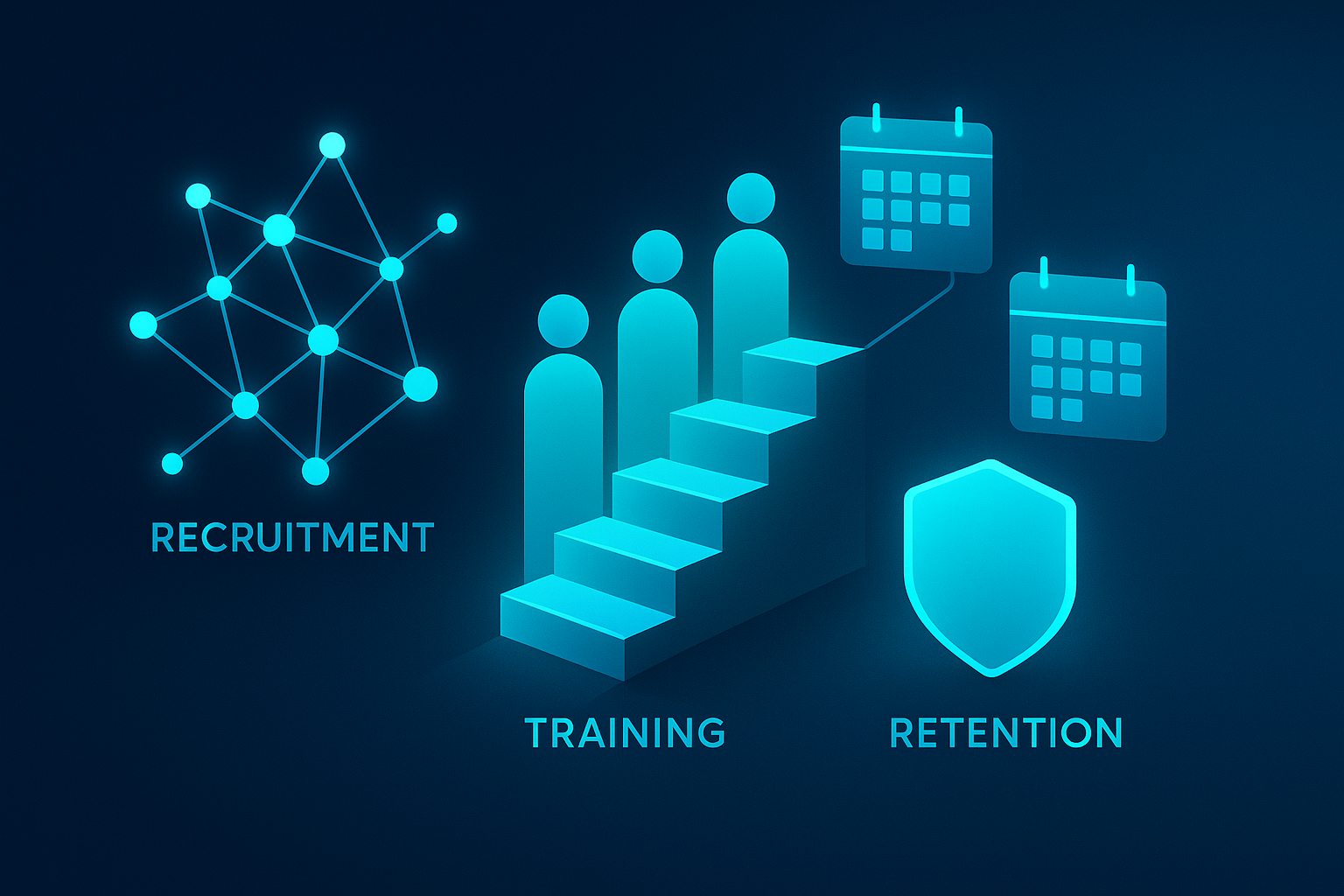
Strategic hotel staff management begins with targeted recruitment and extends through career development. Properties that master this lifecycle see 40% lower turnover rates and 25% higher productivity metrics compared to industry averages. If you’re looking to strengthen your team, explore targeted recruitment solutions for hotel staff.
Effective hiring starts with role-specific behavioral interviews. Ask candidates to describe how they handled specific situations: “Tell me about a time you dealt with an angry customer” reveals problem-solving approach and emotional resilience. Follow up with scenario-based questions: “A guest wants a room upgrade but we’re fully booked, walk me through your response.”
The first week determines long-term success. Day 1: Property tour and safety training. Days 2-3: System training with hands-on practice. Days 4-5: Shadow experienced staff during different shifts. Days 6-7: Handle tasks independently with immediate feedback. This structured approach reduces new hire anxiety and accelerates competency development.
Smart scheduling balances coverage requirements with employee satisfaction. Use demand forecasting to identify peak periods, then create core shifts with flexible add-ons. Cross-train staff across departments, front desk, housekeeping, and F&B, to ensure operational agility and reduce overtime costs. Properties that implement cross-training report 18% fewer scheduling conflicts and 22% higher guest satisfaction during peak periods.
Retention hinges on ongoing development and recognition. Implement quarterly performance reviews, offer skill-building workshops, and celebrate milestones. Properties with formal recognition programs see 30% higher employee engagement and 19% lower absenteeism. For more on building a high-performing hospitality team, see our article on hotel staff retention strategies.
How AI Automation Optimizes Hotel Staffing
Traditional hotel staffing operates on reactive principles, adding staff after problems arise rather than preventing them. This approach creates unnecessary labor costs while compromising guest satisfaction. Manual reservation management, repetitive guest inquiries, and fragmented communication between departments consume hours that could be spent on high-value hospitality.
AI agents transform this dynamic by handling routine interactions while amplifying human capabilities. Automated reservation confirmations, pre-arrival communications, and intelligent room assignment free front desk staff to focus on complex guest needs. Revenue optimization happens automatically through dynamic upselling based on guest preferences and booking patterns.
Implementation starts with integrating AI agents into existing Property Management Systems. The technology learns from historical guest data, staff response patterns, and seasonal demand fluctuations. Within 60 days, hotels typically see 30% reduction in routine inquiries, allowing staff to deliver more personalized service. For a practical guide to implementing automation, see our article on AI automation benefits for hotel staff.
| Metric | Manual Staffing | AI-Augmented Staffing |
|---|---|---|
| Response Time | 5-15 minutes | Instant automated + 2 min human follow-up |
| Upselling Success | 12-18% | 35-42% |
| No-Show Rate | 8-12% | 3-5% |
| Staff Overtime | 15-20 hours/week | 5-8 hours/week |
The measurable outcomes extend beyond operational efficiency. Guest satisfaction scores improve when staff can dedicate time to relationship-building rather than administrative tasks. Revenue per available room increases through intelligent pricing recommendations and automated ancillary service promotion. Most importantly, employee satisfaction rises as repetitive work decreases and meaningful guest interactions increase. To discuss how automation can help your property, contact our hotel automation experts.
Front Desk vs. Concierge: Division of Duties and Guest Interaction Impact
Front desk agents serve as operational gatekeepers, managing the technical aspects of guest stays, check-ins, payments, room assignments, and system updates. Their interactions focus on transaction completion and problem resolution. Concierges function as experience architects, curating personalized recommendations and securing reservations that enhance guest satisfaction beyond the property.
The division creates operational flow when properly structured. Front desk handles all PMS-related tasks, billing inquiries, and immediate facility issues. Concierges manage restaurant reservations, local attraction tickets, transportation coordination, and special occasion arrangements. This specialization allows each role to develop deep expertise in their domain.
| Aspect | Front Desk | Concierge |
|---|---|---|
| Primary Focus | Property operations | Guest experiences |
| System Access | Full PMS control | Limited booking systems |
| Decision Authority | Rate adjustments, room changes | Vendor negotiations, special arrangements |
| Peak Hours | Check-in/out times | Evening planning periods |
Guest satisfaction improves when roles complement rather than overlap. A guest requesting dinner recommendations receives better service when the concierge handles the inquiry, leveraging their restaurant relationships and knowledge of current availability. Meanwhile, the front desk agent can focus on processing other guests efficiently, reducing wait times for everyone. For more on optimizing guest service roles, see our post on front desk vs. concierge hotel roles.
Housekeeping vs. Maintenance Staff: Roles, Cross-Team Collaboration, and Problem Prevention
Housekeeping teams maintain guest room cleanliness, replenish amenities, and report any in-room issues. Maintenance staff address technical repairs, conduct preventive checks, and ensure all facilities operate safely and efficiently. Collaboration between these teams is essential for proactive problem prevention and rapid issue resolution.
For example, when housekeeping identifies a malfunctioning air conditioner or leaking faucet, immediate reporting to maintenance allows for same-day repairs, minimizing guest inconvenience and preventing negative reviews. Properties that implement digital task management systems for cross-team communication see a 28% reduction in guest complaints related to room issues and a 35% faster resolution time.
Regular joint meetings and shared digital logs foster a culture of accountability and teamwork. Empowering housekeeping to initiate maintenance requests directly, rather than routing through multiple supervisors, streamlines workflows and improves guest satisfaction. For more on optimizing operational collaboration, see our article on hotel operations collaboration.
Frequently Asked Questions
How does integrating AI automation with hotel staff improve guest satisfaction and operational efficiency?
Integrating AI automation with hotel staff enables personalized service at scale by streamlining scheduling, predictive maintenance, and guest interaction workflows. This combination reduces operational costs, minimizes no-shows, and allows staff to focus on high-impact guest engagements, resulting in higher satisfaction scores and improved RevPAR.
What are the key roles and responsibilities of hotel staff in enhancing the overall guest experience?
Hotel staff are responsible for front desk management, concierge services, housekeeping, and maintenance, each playing a vital role in anticipating guest needs, resolving issues promptly, and delivering personalized service. Their ability to adapt, communicate empathetically, and coordinate across teams directly shapes memorable guest experiences and positive reviews.
In what ways do hotel staff directly impact revenue through upselling and guest retention?
Hotel staff drive revenue by identifying and offering relevant upgrades, amenities, and services that enhance the guest stay, increasing average spend per guest. Their personalized interactions build trust and loyalty, encouraging repeat bookings and positive word-of-mouth, which together boost guest retention and overall property profitability.
How do staffing models differ between boutique hotels, chain hotels, and outsourced services, and why does it matter?
Boutique hotels typically use lean, multifunctional teams focused on personalized service, while chain hotels employ structured hierarchies with specialized roles to ensure consistency at scale. Outsourced services offer cost flexibility but may lack deep brand alignment. Choosing the right model affects service quality, operational agility, and the ability to deliver tailored guest experiences.
About The Author
Anas Moujahid is the chief contributing writer & Operations Director for the Vynta Blog, where he turns cutting-edge AI automation into measurable business outcomes for mid-market companies.
Vynta designs enterprise-grade AI agents that augment rather than replace people, freeing teams to focus on higher-value work while the bots handle the busywork.
We specialise in four service-heavy verticals where AI can move the revenue needle fast: real estate, recruitment, fundraising and hospitality.
Anas started his career architecting AI and automation systems; today he leads operations at Vynta, making sure every deployment lands real-world ROI, whether that’s more booked viewings for estate agents, faster placements for recruiters, warmer investor pipelines for fundraisers or happier guests for hotels and restaurants.
Vynta delivers results by:
- Building industry-specific agents pre-trained on real-world workflows, no generic chatbots here.
- Integrating seamlessly with existing CRMs, ATSs, PMSs and fundraising platforms, zero rip-and-replace.
- Measuring success in business KPIs (lead-to-close rates, time-to-hire, donor retention, RevPAR) not vanity metrics.
- Providing transparent implementation plans so clients know exactly what to expect, when and why.
- Pairing every AI agent with human-in-the-loop controls to keep quality, compliance and brand voice on point.
Since launch, Vynta has helped agencies slash lead qualification time by up to 70 %, recruitment firms cut screening hours in half, fundraising teams triple investor touchpoints and hospitality brands lift guest satisfaction scores by double digits, all while keeping human expertise firmly in the loop.
Anas writes with the same ethos that drives Vynta: outcome-focused, jargon-free and grounded in real business value. Expect data-backed insights, practical implementation guides and a clear-eyed view of what AI can, and can’t, do for your organisation.