

hotel revenue management ai
Demystifying Hotel Revenue Management AI: Beyond the Hype
Hotel revenue management AI uses machine learning to optimize pricing, forecasting, and inventory decisions automatically. While traditional revenue management relies on yesterday’s data and manual spreadsheet analysis, AI processes thousands of variables simultaneously. Competitor rates, local events, weather patterns, guest behavior. To maximize revenue per available room (RevPAR) and occupancy.
What is Hotel Revenue Management AI, Really?
Think of it as your revenue manager’s analytical superpowers. The technology watches booking patterns, competitor pricing, local events, weather data, and guest behavior around the clock. Modern hotel revenue management software processes this information instantly, adjusting room rates and availability to capture maximum value from each booking opportunity.
But here’s what makes it different: the system learns. Each booking, cancellation, and rate change teaches the algorithm something new about your market. Over time, it spots pricing opportunities and demand patterns that even experienced revenue managers might miss.
The Core Problem: Traditional Revenue Management Limitations
Most revenue managers are fighting yesterday’s battle with today’s rates. They spend hours analyzing spreadsheets, checking competitor websites, and interpreting booking reports to make pricing decisions. By the time those changes go live, market conditions have often shifted.
This reactive approach buckles under complexity. When you’re juggling dozens of room types, multiple booking channels, seasonal patterns, and local events, human analysis can’t keep up. Many hotel revenue management companies have recognized this bottleneck, pushing toward automated solutions that respond to market shifts in real time.
How AI Transforms Revenue Management
AI tools for hospitality flip the script from reactive to predictive. Instead of responding to what happened yesterday, you’re anticipating what’ll happen tomorrow. The technology spots patterns in guest behavior, seasonal trends, and competitive positioning that inform smarter pricing decisions.
Machine learning algorithms get better with each prediction. They compare their forecasts to actual booking outcomes, refining their models continuously. This creates a feedback loop where your revenue strategy becomes more accurate and profitable over time.
The Measurable Impact: How AI Delivers Tangible Revenue Growth
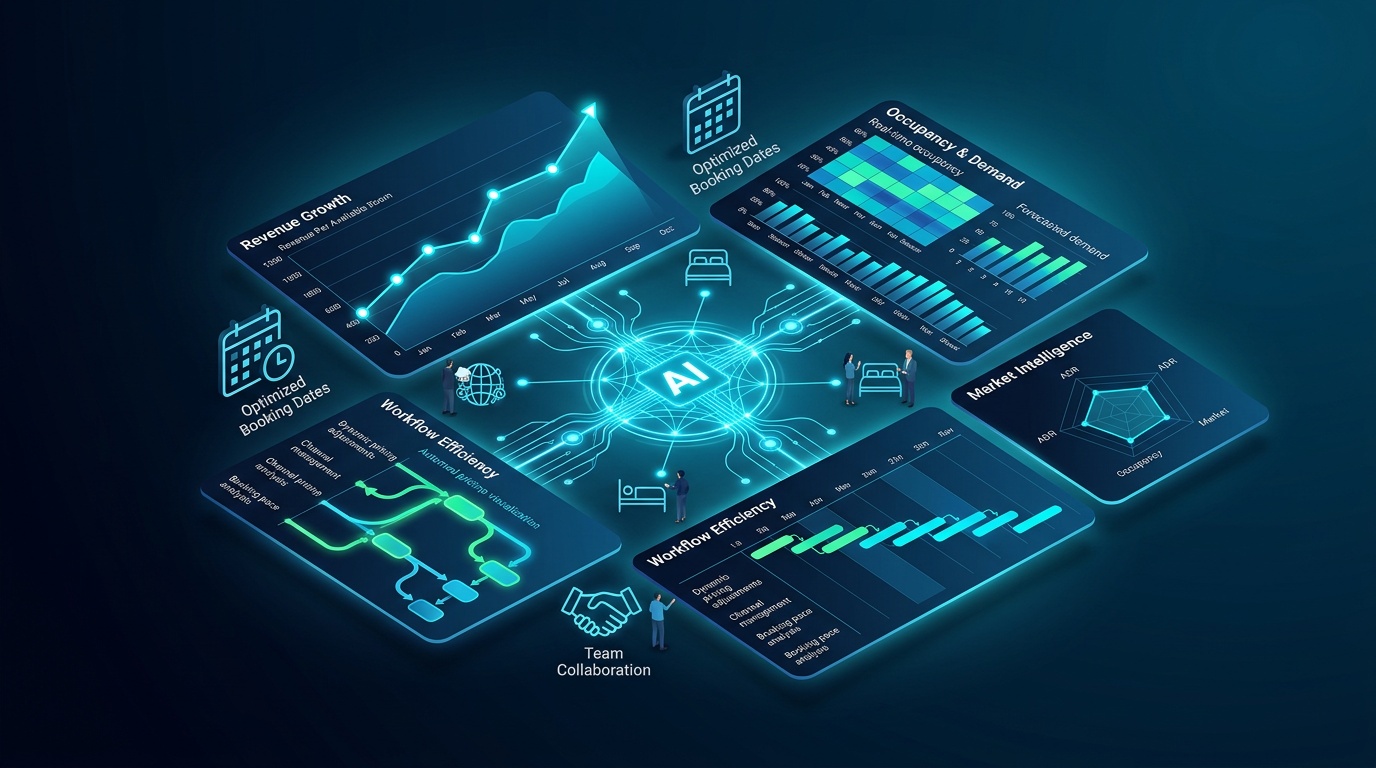
Let’s talk numbers. Properties implementing hotel revenue management AI typically see 12-18% RevPAR increases within six months. That’s not marketing fluff. It’s the result of more accurate demand forecasting and better pricing decisions that compound as the system learns your market.
Boosting Occupancy and RevPAR with Intelligent Forecasting
Advanced forecasting algorithms analyze booking pace, historical patterns, and external market factors to predict demand weeks ahead. This gives you time to adjust inventory allocation and pricing strategies before demand spikes or drops.
Properties using AI-powered forecasting report 15-25% improvement in forecast accuracy. Here’s why that matters: you can price confidently during predicted demand spikes and time promotions perfectly during anticipated slow periods. No more guessing games.
Dynamic Pricing: Capturing Maximum Value in Real Time
Real-time pricing optimization is where AI really shines. The technology monitors competitor rates, local events, weather conditions, and booking velocity to adjust room prices throughout the day. Those micro-adjustments capture revenue that manual pricing approaches consistently miss.
Personalized Upselling and Ancillary Revenue Streams
AI tools for hospitality don’t stop at room pricing. They analyze guest profiles, booking behavior, and preferences to recommend relevant upgrades, dining packages, and spa services at the right moment and price point.
This targeted approach drives 20-30% higher conversion rates on upsell attempts compared to generic promotions. We’ve seen hotels increase food and beverage revenue, spa bookings, and premium room upgrades significantly when AI informs guest engagement strategy.
Reducing Operational Costs Through Automation
Automation frees your revenue team from routine tasks while improving decision quality. Revenue managers can focus on strategy, guest experience initiatives, and partnerships while AI systems handle daily pricing adjustments and inventory optimization.
Properties often see a 30-40% reduction in time spent on daily revenue management tasks. That time savings, combined with improved revenue performance, creates compelling ROI for hotel revenue management software implementations.
Addressing the ‘Garbage AI’ Concern: The Human-AI Collaboration Advantage
Skepticism toward automated systems is understandable. Especially in hospitality, where one bad pricing decision can damage guest relationships. But effective hotel revenue management AI isn’t about blind automation. It’s about combining machine intelligence with revenue expertise to make better decisions than either could alone.
Why ‘Fully Automated’ Revenue Management Is a Myth
Complete automation misses the nuanced nature of hospitality. Guest satisfaction, brand positioning, and market reputation require judgment that algorithms can’t replicate. Successful AI tools for hospitality operate as decision-support systems that provide recommendations while keeping humans in control.
Properties attempting fully automated pricing often struggle with guest perception issues and competitive positioning problems. A smarter approach? Keep humans in charge of strategic decisions while automating the heavy analytical lifting.
The Human-in-the-Loop (HITL) Model for Strategic Decision-Making
The HITL approach positions AI as your analytical advisor. It processes complex datasets and presents actionable insights to your revenue team. This preserves human authority over pricing strategies while eliminating time-consuming manual analysis.
This collaborative framework ensures that local market knowledge, guest feedback, and brand standards inform revenue decisions. Many hotel revenue management companies are adopting this approach to address concerns about losing control of property positioning.
How AI Empowers Your Revenue Management Team, Not Replaces It
Modern revenue management AI increases team capacity by handling data-heavy work that consumes hours daily. Revenue managers gain access to analysis that would otherwise require dedicated data science support. This shift lets teams focus on guest experience initiatives, partnerships, and strategic positioning.
Teams using AI support often report higher job satisfaction because they spend more time solving problems and less time crunching numbers. The technology manages routine price adjustments and inventory optimization while humans handle negotiations, group blocks, and event-driven strategy.
Vynta AI’s Approach: Supporting Human Expertise for Better Outcomes
At Vynta AI, we believe in the human-in-the-loop model. Each property has unique characteristics, guest expectations, and market dynamics. Our AI surfaces clear recommendations while you maintain complete control over implementation.
Revenue teams receive market signals, demand forecasts, and pricing guidance through dashboards that show the reasoning behind each suggestion. That transparency builds trust and supports governance, with humans retaining final authority on all decisions.
Beyond Pricing: AI for Holistic Hotel Revenue Optimization
Revenue optimization extends beyond room rates. Advanced hotel revenue management software connects reservations, guest services, food and beverage operations, and ancillary services into unified strategies. This holistic approach increases total guest value while improving efficiency across departments.
Streamlining Reservation Management and Reducing No-Shows
AI-powered reservation systems predict booking behavior and flag higher-risk reservations before cancellations occur. The technology analyzes booking channel, advance purchase timing, guest history, and payment methods to estimate no-show probability. This supports proactive outreach and controlled overbooking strategies.
Some properties report 40-60% reductions in no-show rates when they pair predictive signals with targeted communication. Reminder workflows, personalized pre-arrival messaging, and flexible modification options address guest concerns before cancellations happen. These capabilities are often enhanced by chatbots for hotels that provide 24/7 guest communication support.
AI-Driven Guest Segmentation for Targeted Marketing and Service
Guest segmentation creates opportunities for personalized experiences that drive repeat bookings and stronger reviews. The system analyzes stay patterns, spending behavior, service preferences, and feedback to build actionable guest profiles for marketing and service design.
Personalized campaigns generate 3-5 times higher response rates than generic promotions. Hotels can identify high-value segments and build retention strategies that improve lifetime value. Understanding scenarios of customer service helps properties tailor their approach to different guest types and situations.
Integrating Revenue Streams: Rooms, F&B, Spa, and Beyond
Holistic revenue optimization treats your property as a connected system where each service influences overall profitability. AI systems analyze cross-sell opportunities, package pricing, and capacity constraints to increase total revenue per guest.
| Revenue Stream | Traditional Management | AI-Optimized Approach |
|---|---|---|
| Room Revenue | Manual pricing adjustments | Dynamic optimization informed by real-time signals |
| F&B Operations | Fixed menu pricing | Demand-based promotions and offer timing |
| Spa Services | Standard rate cards | Personalized packages and scheduling-based offers |
| Event Spaces | Seasonal rate adjustments | Demand-aware pricing with forecasting support |
The Future of Hotel Operations: AI as a Strategic Partner
AI-powered hospitality operations are evolving toward more connected planning across your entire business. Roadmaps now include predictive maintenance, energy management, and staff scheduling alongside revenue optimization to improve both guest experience and operating performance.
Forward-thinking properties are preparing for voice interfaces, IoT integrations, and more advanced predictive analytics. Hotel revenue management AI often serves as the analytical foundation for these capabilities, helping teams anticipate guest needs while improving commercial performance.
Success depends on treating AI as a decision-support layer with clear governance. You remain accountable for brand standards and guest experience. Properties looking to enhance their service in hotels can use these technologies while maintaining the personal touch that guests value.
Frequently Asked Questions
How does hotel revenue management AI differ from traditional methods?
Traditional revenue management relies on historical data and manual analysis, often reacting too slowly to market changes. Hotel revenue management AI uses machine learning to process thousands of real-time variables simultaneously, making proactive, data-driven decisions. This allows properties to capture revenue opportunities that manual processes would typically miss.
What specific data does hotel revenue management AI analyze to optimize pricing?
Hotel revenue management AI analyzes a wide array of real-time data points to optimize pricing. This includes booking patterns, competitor rates, local events, weather conditions, and guest behavior. By processing these variables, the system identifies optimal pricing strategies and inventory allocation.
What kind of financial improvements can hotels expect from using AI in revenue management?
Properties implementing hotel revenue management AI often see significant financial gains. This includes increases in RevPAR, improved forecast accuracy, and additional revenue from dynamic pricing. These improvements stem from more precise demand predictions and real-time rate adjustments.
Does hotel revenue management AI also help with guest spending beyond room rates?
Absolutely. AI tools for hospitality extend to supporting ancillary revenue streams. They analyze guest profiles and booking behavior to recommend personalized upgrades, dining packages, or spa services. This targeted approach can significantly increase average guest spend.
How does AI for hotel revenue management impact daily operational tasks?
AI automation significantly reduces the time revenue managers spend on routine tasks. The system handles daily pricing adjustments and inventory optimization automatically. This allows teams to focus more on strategic initiatives and guest experience, driving operational efficiency.
Is human involvement still important when using hotel revenue management AI?
Yes, human oversight remains a key part of effective hotel revenue management AI. While AI automates many decisions, human analysts provide strategic direction and context. This collaboration ensures decision quality and aligns AI operations with overall business goals.