

business automation processes
Understanding Business Automation Processes: What Mid-Market SMEs Need to Know
Business automation processes turn time-consuming manual tasks into smart digital workflows that actually think. I’ve watched companies transform their operations by moving from simple rule-following systems to AI-powered agents that can analyze context, make decisions, and adapt when situations change.
What Makes Modern Automation Different
Here’s what separates today’s automation from the basic systems that frustrated so many businesses: intelligence. While old automation broke when anything unexpected happened, AI-powered business automation processes can interpret what’s happening and respond appropriately.
Think about it this way – traditional automation was like following a recipe exactly. Modern AI agents are more like experienced chefs who can adjust based on what they see.
From Simple Scripts to AI That Actually Works
Early business automation was painfully rigid. Lead fills out form = send email. Candidate applies = forward resume. When real-world complexity showed up, these systems failed spectacularly.
Today’s AI agents understand natural language, spot patterns humans miss, and make smart decisions. They qualify leads by reading between the lines, screen candidates by understanding skill relevance beyond keywords, and personalize guest interactions based on behavior patterns.
Why Most Automation Projects Still Fail
I’ve seen too many companies invest months in traditional business process automation tools only to abandon them. The problem? They require massive IT resources, can’t handle messy real-world data, and break every time business needs change.
Mid-market businesses need solutions that deliver value quickly and evolve with their operations – not systems that become expensive maintenance headaches.
Key Insight: 60% of mid-market businesses abandon traditional automation projects within six months due to complexity and maintenance requirements. AI-powered automation reduces these barriers by adapting to change and minimizing upkeep.
How We Build Automation That Actually Delivers
At Vynta AI, we don’t start with technology – we start with your bottom line. Our AI Automation Services focus on measurable outcomes, not fancy features. Real estate teams get lead qualification systems that identify serious buyers. Recruitment firms get candidate screening that matches skills to roles with 85% higher accuracy.
Every implementation includes AI Agent Development, System Integration, and Performance Intelligence. This creates business automation processes that show measurable ROI within 3-4 weeks, not months.
Real Results: How Automation Drives Revenue and Cuts Costs
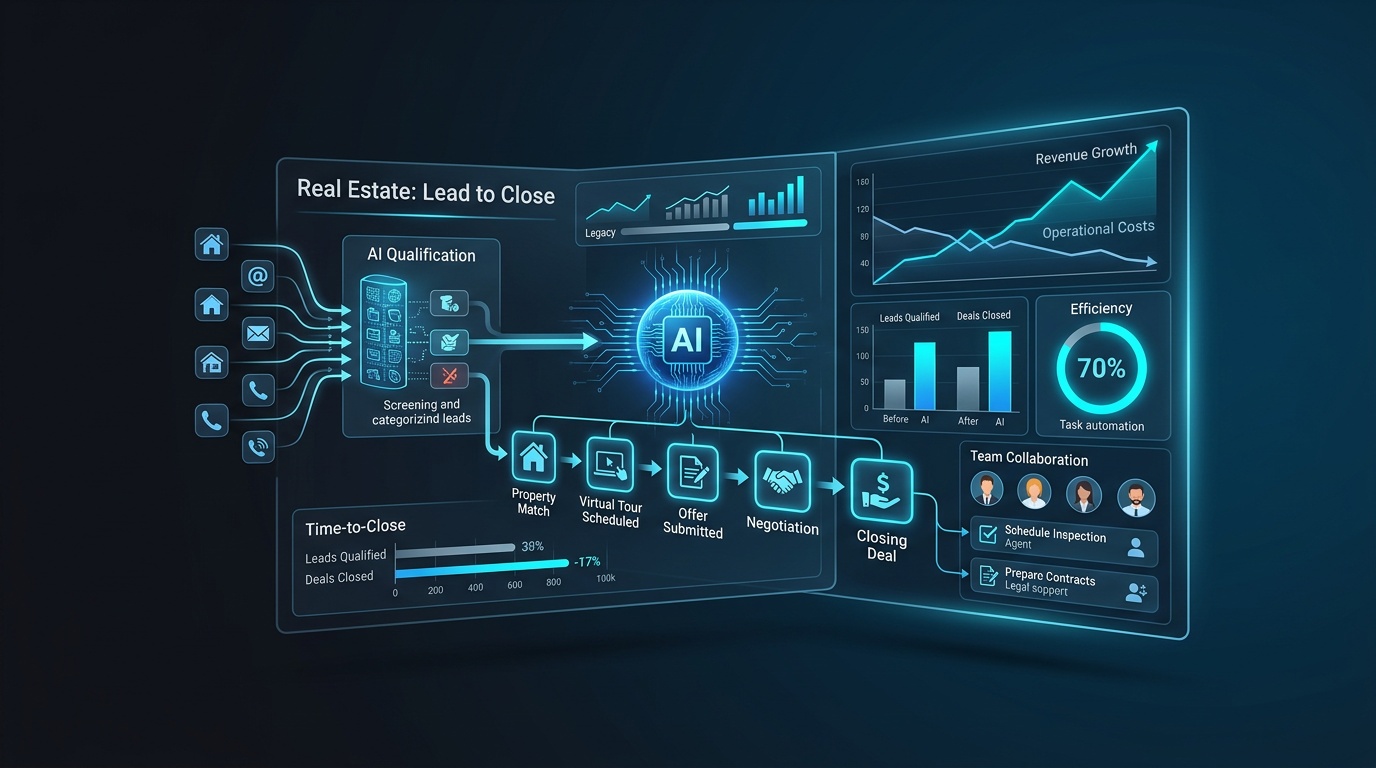
Real Estate: Qualify Leads 12x Faster
Real estate agencies waste countless hours chasing unqualified leads. Our AI agents analyze inquiry patterns, budget signals, and communication behavior to identify serious buyers in minutes instead of hours. This lets agents focus on closing deals while automated systems nurture developing prospects.
Property management becomes consistent when AI handles tenant communications, maintenance requests, and lease renewals. Teams report 40% faster deal cycles when business automation processes handle initial qualification and follow-up sequences.
Recruitment: Cut Screening Time by 90%
Recruitment teams typically spend 45 minutes per resume. Our AI agents parse resumes, assess skill relevance, and run preliminary screening through structured conversations – reducing this to about 3 minutes per candidate while improving shortlisting quality.
Candidate relationship management runs on personalized communication based on career stage, skills, and preferences. Recruiters stay focused on relationship building and final interviews while AI supports sourcing and early-stage qualification.
Fundraising: 3x Higher Response Rates
Fundraising organizations struggle with donor segmentation and personalized outreach at scale. Our AI agents analyze giving history, engagement patterns, and communication preferences to support targeted campaigns that consistently achieve 3x higher response rates.
Grant application work becomes systematic through automated research, requirement matching, and deadline tracking. Organizations see 60% better throughput when business automation processes support prospect research and outreach coordination.
Hospitality: Instant Responses, Higher Guest Satisfaction
Guest service automation improves every touchpoint from booking to checkout. Our AI agents handle reservations, special requests, and recommendations based on guest preferences and history. This delivers consistent service while reducing staff workload by 50%.
| Process | Manual Method | AI Automation Result |
|---|---|---|
| Lead Qualification | 2-3 hours per lead | 5 minutes with automated screening |
| Candidate Screening | 45 minutes per resume | 3 minutes with automated analysis |
| Donor Research | 1 hour per prospect | 10 minutes for consolidated profile |
| Guest Communications | 15 minutes per inquiry | Instant personalized responses |
The Numbers That Matter
We track what actually moves the needle. Real estate teams monitor qualified appointments per week, recruitment firms track time-to-placement and placement rates, fundraising teams track donor retention and campaign ROI, and hospitality teams track response speed and guest satisfaction scores.
Our Performance Intelligence dashboards give real-time visibility into these improvements. No guesswork – just clear data on how business automation processes are improving your operations.
How to Implement Automation Without the Usual Headaches
Start With High-Impact, Low-Risk Processes
Don’t automate everything at once. Start with high-volume, repetitive tasks that eat up significant staff time. Lead qualification, candidate screening, and guest communications produce fast ROI because they’re predictable and time-intensive.
I use three criteria when evaluating processes: frequency, consistency, and measurable outcomes. Tasks performed daily with clear success metrics are automation gold mines. Document current time investment and error rates first – you’ll need these baselines to prove ROI.
Address the Fear Factor
Staff resistance usually comes from job displacement fears. I always position automation as capability expansion, not replacement. Show your team how AI handles routine tasks while they focus on relationship building and strategic work that actually drives revenue.
Technical complexity concerns vanish with proper implementation. Our phased deployment builds confidence gradually – staff adoption improves once they see lower workload and more consistent results.
Design for Human-AI Partnership
Effective business automation processes create partnerships where each party handles what they’re best at. AI excels at data processing, pattern recognition, and consistent execution. People bring creativity, relationship management, and strategic thinking.
Real estate agents review AI-qualified leads before outreach, adding local market context. Recruiters use AI screening summaries to run more focused interviews. This collaboration boosts productivity while keeping the human touch that clients value.
AI Automation Implementation
Pros
- Productivity gains within weeks
- Consistent execution with fewer manual errors
- 24/7 operation for continuous lead processing
- Scales without proportional staff increases
- Data-driven insights for process improvement
Cons
- Initial setup requires process documentation
- Training time during rollout
- Ongoing optimization for best performance
- Integration work with existing systems
Skip Generic Software – Find Industry Expertise
Generic automation tools require months of configuration and deep technical expertise. Industry-specific solutions start closer to your actual operations. Look for partners who can show measurable results in your vertical, not just feature lists.
Speed matters for mid-market businesses. You need value within weeks, not quarters. Ongoing support and optimization help business automation processes evolve with your changing needs instead of becoming expensive legacy systems.
Our Implementation Blueprint
We start with discovery and assessment to identify your highest-impact opportunities. Implementation happens in weeks through phased deployment that minimizes disruption. Continuous monitoring and optimization ensure sustained performance improvements.
Each phase includes clear deliverables and success metrics. System Integration connects your existing tools while Workflow Automation transforms selected processes. Performance Intelligence provides ongoing visibility into results and improvement opportunities.
Why Smart Automation Is Your Competitive Edge
Scale Revenue Without Scaling Payroll
Traditional scaling requires proportional staff increases – more leads need more salespeople, more candidates need more recruiters. Intelligent automation breaks this linear relationship. Teams can handle 300% more volume while payroll grows maybe 20%.
This changes what’s possible. New markets and service lines become feasible when operational constraints disappear. Business automation processes provide the operational foundation for growth strategies that manual processes can’t support.
Adapt Faster Than Your Competition
Market conditions shift quickly. Customer expectations change. Economic pressures mount. AI agents can adapt to new communication patterns, qualification criteria, and service expectations through data updates and feedback loops.
When recession hits, you can maintain service levels without layoffs. When opportunity knocks, you can scale quickly without hiring sprees. That’s agility your competitors can’t match.
Why AI Beats Traditional Automation Every Time
Traditional automation breaks when exceptions appear or requirements change. AI agents learn from new scenarios and improve over time. This reduces the maintenance burden that makes conventional automation expensive and fragile.
Strategic Insight: Companies using intelligent automation adapt to market changes 75% faster than those relying on manual processes or rigid automation systems.
Create Lasting Competitive Advantage
Operational excellence becomes a differentiator when competitors struggle with manual inefficiencies. Faster response times, consistent quality, and personalization at scale build customer loyalty that’s impossible to replicate without similar automation capabilities.
The compounding effect is what really matters. While competitors hire staff to handle growth, automated businesses reinvest savings into product development, marketing, and strategic initiatives that drive long-term market leadership.
Frequently Asked Questions
What is a business automation process?
As Operations Director at Vynta AI, I see business automation processes as intelligent systems that transform manual, repetitive tasks into streamlined digital workflows. They use AI to interpret context, make decisions, and adapt to changing conditions, delivering measurable outcomes across various business functions. This allows for efficient execution of complex workflows with minimal human input.
What are the 5 stages of BPM?
While the article focuses on the practical application and impact of AI-driven business automation, it doesn’t detail a specific five-stage Business Process Management (BPM) framework. Our approach at Vynta AI emphasizes identifying specific business challenges and designing custom AI agents to deliver measurable outcomes, rather than adhering to a rigid, multi-stage process model.
What are L1, L2, L3, and L4 processes?
The article discusses how business automation processes evolve from simple scripts to intelligent AI agents, but it does not categorize processes using L1, L2, L3, and L4 levels. At Vynta AI, we focus on understanding the specific operational challenges of mid-market companies to implement AI solutions that drive revenue and cut costs, regardless of a predefined process hierarchy.
What are the 7 steps of the business process?
Our article highlights the shift from traditional, rigid automation to AI-driven systems that adapt and deliver results, rather than outlining a generic seven-step business process. Vynta AI’s methodology involves AI Agent Development, System Integration, and Performance Intelligence to achieve measurable ROI quickly for our clients.
What are the 4 types of processes?
The article illustrates various applications of business automation across verticals like real estate, recruitment, fundraising, and hospitality, rather than defining four specific types of processes. We concentrate on developing custom AI agents that address unique industry challenges and deliver outcome-driven automation for mid-market SMEs.
How does AI-powered automation differ from traditional business process automation?
AI-powered automation goes beyond traditional rule-based systems by using artificial intelligence to interpret context, make decisions, and adapt to new situations. Unlike older methods that often require extensive IT resources and struggle with unstructured data, modern AI agents can reason and evolve. This allows for solutions that deliver value quickly and adapt as operations change.
What measurable impact can business automation processes have for mid-market companies?
Business automation processes can significantly drive revenue and cut costs across key verticals for mid-market companies. Specifically, real estate teams can achieve faster deal cycles through AI-driven lead qualification, while recruitment firms can reduce screening time and improve hiring consistency. We track these outcomes through Performance Intelligence dashboards, providing real-time visibility into operational improvements and measurable ROI.