

Agentic AI for property management vs chatbots: which is better?
Agentic AI vs. Chatbots: Property Management 2026
Beyond the “Beep-Boop”: Understanding Agentic AI vs. Chatbots in Property Management
What’s Driving the Shift: The Limits of Basic AI in Property Operations
Property managers face a decision point. Traditional chatbot solutions handle simple, scripted interactions, but property operations demand complex, multi-step workflows. When a tenant reports a maintenance issue, chatbots provide information. Agentic AI takes action.
The gap becomes obvious during peak leasing season. Chatbots answer questions about square footage and amenities. They can’t schedule viewings, qualify prospects, or coordinate with your leasing team.
Defining Agentic AI: Autonomous Execution, Not Just Conversation
Agentic AI for property management vs chatbots: which is better? The distinction lies in capability scope. Chatbots respond to queries within defined parameters. Agentic systems execute entire workflows autonomously, making decisions and coordinating actions across multiple touchpoints.
Chatbots: The FAQ Masters with Limited Scope
Chatbots excel at answering common questions about rent, lease terms, or property amenities. They follow scripted decision trees and can’t deviate beyond their programmed boundaries.
Agentic AI: The Digital Operator for Complex Workflows
Agentic AI manages complex business processes, integrating with property management systems, calendars, and communication platforms to execute complete workflows from start to finish.
| Capability | Traditional Chatbots | Agentic AI |
|---|---|---|
| Response Type | Scripted answers | Autonomous execution |
| Workflow Scope | Single queries | End-to-end processes |
| Decision Making | Predefined paths | Dynamic reasoning |
| Integration | Limited | Full system connectivity |
| Proactive Actions | None | Automated follow-ups |
Vynta AI’s Perspective: Supporting, Not Replacing, Your Team
At Vynta AI, we design AI agents that handle tedious tasks while preserving human judgment for relationship building and complex negotiations. Our Agentic Systems for Real Estate platform reflects this approach, automating qualification and follow-up workflows that traditionally consume hours of agent time.
Why Property Management Is Outgrowing Basic Chatbots: Real-World Challenges and ROI
The Tenant Experience Gap: From Basic Answers to Proactive Solutions
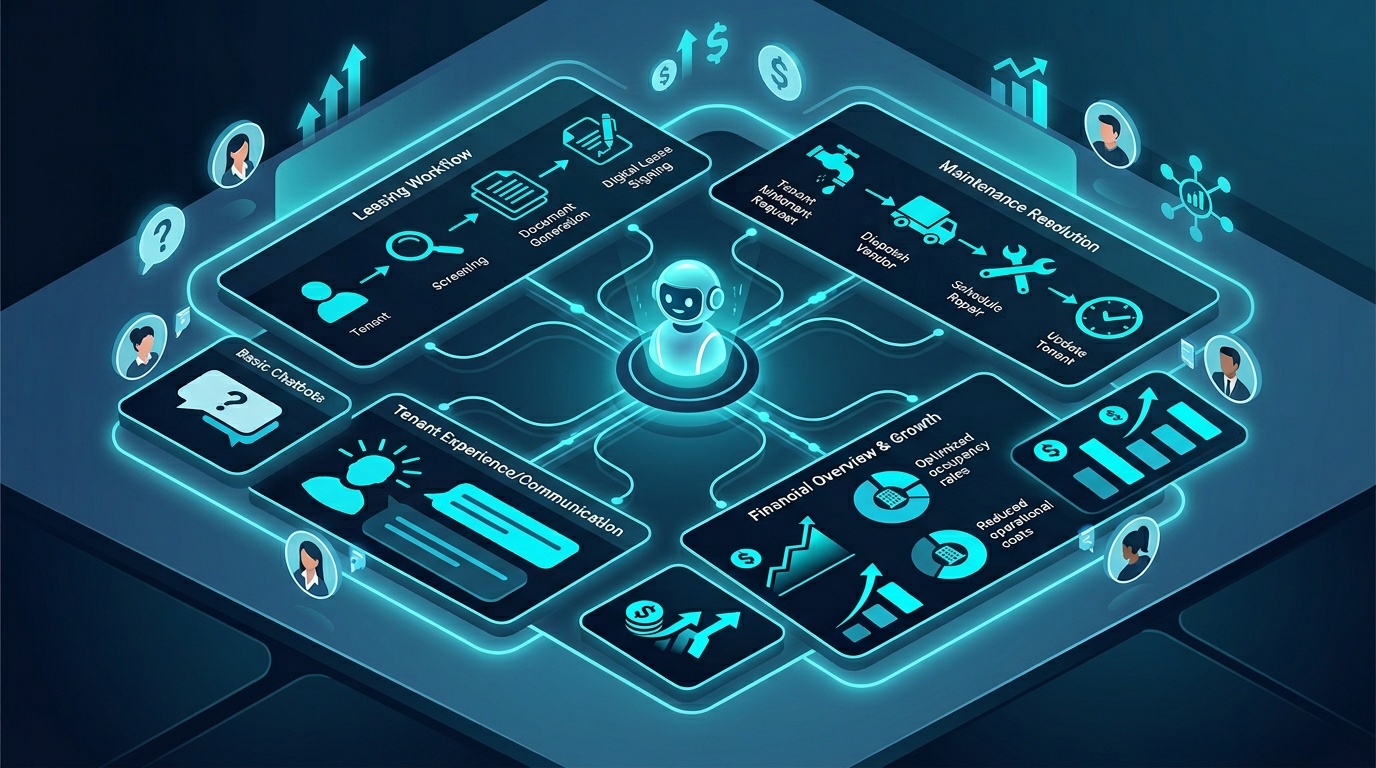
Tenants expect quick resolution, not a handoff to manual processes. Chatbots often stop after delivering information. Agentic AI can convert inquiries into scheduled viewings, automatically matching prospects with suitable properties and sending personalized recommendations, including virtual tours.
Consider this scenario: A prospect asks about pet policies. The chatbot provides the policy text. Game over. Agentic AI provides the policy, asks about their pet, recommends pet-friendly units, and books a viewing. All in one conversation.
Operational Bottlenecks: When Chatbots Can’t Handle the Next Step
Manual follow-up creates delays that cost deals. A prospect asking about a property listing receives an answer, but no automated workflow follows. The inquiry sits in an inbox while opportunities move to competitors.
The Cost of Inefficiency: Unaddressed Leads and Missed Opportunities
Response time directly impacts conversion. Vacant units reduce revenue. Agentic systems can engage prospects in under 60 seconds across WhatsApp, SMS, email, and website chat, then begin qualification and property matching.
Beyond FAQs: Automating Maintenance Triage, Lease Renewals, and Vendor Coordination
Advanced systems can manage the full lifecycle: maintenance request routing, lease renewal outreach, and vendor scheduling. These workflows span multiple systems and require decision-making beyond basic chatbot capabilities.
Chatbots vs. Agentic AI: Practical Considerations
Pros
- Low implementation complexity
- Handles high-volume, simple queries
- Predictable operational costs
Cons
- Limited to scripted responses
- Creates manual workarounds
- No autonomous task completion
- Fragmented tenant experience
Measuring Success: From Response Time to Revenue Outcomes
Metrics should map to operations and revenue. Response time under 60 seconds, 85% qualification accuracy, and 3x pipeline growth are common benchmarks that separate agentic solutions from basic automation. These outcomes can lift occupancy and revenue when the underlying process and data are set up correctly.
The Agentic Advantage: Automating Property Management Workflows with Measurable Impact
Autonomous Lead Qualification and Property Matching: Closing Deals Faster
The system captures leads across key channels and begins qualification with structured, context-aware questions. Matching logic compares prospect requirements with available inventory, then surfaces relevant options with personalized recommendations. This approach accelerates the pipeline and can improve conversion rates.
Here’s what this looks like in practice: A lead inquires about 2-bedroom units. The system asks about budget, move-in date, and amenities. It then recommends three units that match their criteria, includes virtual tour links, and offers to schedule in-person viewings. No human intervention required.
Proactive Maintenance Management: From Reporting to Resolution
Maintenance requests flow through automated triage, with urgency assessment guiding contractor dispatch. Tenants receive status updates automatically, reducing inbound calls and administrative load for your team.
Streamlining Lease Renewals and Tenant Onboarding
Automated reminders reduce missed renewals and no-shows. The system tracks lease expiration dates, initiates renewal outreach, and coordinates onboarding workflows for new tenants. Retention improves through consistent engagement rather than reactive management.
Optimizing Vendor Coordination and Service Requests
Service requests trigger contractor dispatch through intelligent routing. Maintenance tickets get assigned to vendors based on specialization and proximity, with real-time status updates sent to tenants. This reduces manual coordination time that often consumes many hours each week for property managers with larger portfolios.
The Vynta AI Approach
The Agentic Systems for Real Estate platform delivers enterprise-grade automation without requiring complete system overhauls. Our implementation follows a structured discovery, strategy, and deployment process that integrates with existing property management software. The result is faster execution and measurable productivity gains without disrupting current operations.
Building Trust in AI: Ethical Implementation and the Future of Property Management
Addressing Transparency in AI Deployment
Property managers rightly question how AI systems handle sensitive tenant data and property information. Our approach centers on explainable decision-making with clear audit trails. When the system qualifies a lead or schedules a maintenance visit, property managers can review the reasoning behind key actions. This transparency builds confidence in recommendations and reduces reliance on black-box behavior.
Security and Reliability
Protecting tenant information requires strong security infrastructure. The Agentic Systems for Real Estate platform uses encryption for data transmissions and strict access controls. Regular security reviews support alignment with data protection expectations while maintaining availability. Property managers can set permissions that limit access to sensitive lease information, financial records, and communication logs.
Human-AI Collaboration
Our philosophy emphasizes augmentation rather than replacement. The system handles repetitive tasks like initial inquiry responses and maintenance scheduling while property managers focus on relationship building and complex negotiations. This partnership model keeps humans in control while reducing workload.
Your Next Step
Moving beyond basic chatbot limitations requires selecting AI that’s designed for operational complexity and clear oversight. Agentic AI for property management vs chatbots: which is better? If your team spends time on handoffs, manual follow-up, and coordination across tools, agentic workflows tend to produce stronger operational outcomes. The Agentic Systems for Real Estate platform supports property management workflows while maintaining human oversight. Schedule a consultation to evaluate fit, integrations, and an implementation plan.
Frequently Asked Questions
Is agentic AI the same as chatbots?
No, agentic AI and chatbots are distinct in their capabilities for property management. Chatbots excel at answering common questions within predefined parameters, following scripted decision trees. Agentic AI, conversely, executes entire workflows autonomously, making dynamic decisions and coordinating actions across multiple systems to complete complex processes.
What is better than agentic AI for property operations?
For complex, multi-step workflows in property management, agentic AI offers significant advantages over basic chatbots by automating entire processes. However, the most effective solution combines agentic AI with human judgment. At Vynta AI, we design AI agents to handle tedious tasks, preserving human teams for relationship building, complex negotiations, and situations requiring nuanced human oversight.
What is the best agentic AI for property management right now?
Determining the ‘best’ agentic AI depends on specific property management needs and integration requirements. Solutions like Vynta AI’s Agentic Systems for Real Estate platform focus on automating workflows such as lead qualification, property matching, maintenance triage, and lease renewals. The most effective agentic AI will integrate with your existing systems and deliver measurable outcomes like improved response times and pipeline growth.
Will estate agents be replaced with AI?
Agentic AI is designed to support and augment, not replace, estate agents. It automates time-consuming tasks like lead qualification, initial property matching, and maintenance request routing, freeing agents to focus on relationship building, complex negotiations, and providing personalized service. This approach allows agents to operate more efficiently and strategically.
Can a chatbot be turned into agentic AI?
Transforming a basic chatbot into agentic AI involves a fundamental shift in its underlying architecture and capabilities. Chatbots are limited to scripted responses, while agentic AI requires dynamic reasoning, autonomous execution, and full system connectivity to manage end-to-end workflows. This typically means building a new system designed for agentic functions, rather than simply upgrading a chatbot.