

Best AI interview scheduling tools for recruitment teams
Recruiting teams lose productive hours to calendar coordination while qualified candidates wait for a next step. The Best AI interview scheduling tools for recruitment teams reduce that friction by handling availability, time zones, reminders, interviewer assignment, and ATS updates in one workflow. The right choice depends on hiring volume, panel complexity, existing systems, and the level of automation your coordinators need.
Key Takeaways
- Recruiting teams lose productive hours to calendar coordination while qualified candidates wait for a next step.
- The Best AI interview scheduling tools for recruitment teams reduce that friction by handling availability, time zones, reminders, interviewer assignment, and ATS updates in one workflow.
- The right choice depends on hiring volume, panel complexity, existing systems, and the level of automation your coordinators need.
From my experience designing recruitment automation, scheduling is a coordination problem, not only a calendar problem. A useful platform must fit the recruiting process around it, preserve candidate communication quality, and produce measurable gains in time-to-hire and recruiter capacity.
Why AI Interview Scheduling is a Recruitment ROI Driver
The hidden cost of manual coordination and back-and-forth emails
Manual scheduling creates work across the entire hiring team. A recruiter may collect availability from a candidate, check several interviewers’ calendars, account for time zones, reserve a conference room or video link, send confirmations, and update the applicant tracking system. One change can restart the email chain. Research from People Managing People estimates that recruiters spend 15% to 20% of their workweek scheduling interviews. That time could support sourcing, candidate preparation, client communication, or offer management.
The cost also appears in less visible metrics. Delayed replies can reduce candidate engagement, create interviewer conflicts, and force recruiting coordinators to work around fragmented calendars. Legacy ATS environments add another layer of friction when scheduling tools cannot write updates back to the candidate record. A dependable system should manage the full appointment lifecycle, including invitations, rescheduling, reminders, interview instructions, feedback prompts, and status changes.
How AI reduces candidate drop-off rates and time-to-hire
AI scheduling software responds quickly, offers suitable slots, and keeps every participant informed. It can identify shared availability across a hiring panel, apply rules such as interviewer seniority or interview order, and send preparation materials without waiting for manual intervention. Faster communication helps maintain candidate interest, particularly when applicants are comparing several employers.
The operational benefit is more than a shorter calendar task. Interview coordination is fully automated including scheduling, sending confirmations, reminders, and providing preparation materials to candidates. Agentic Systems for Recruitment also supports 24/7 automated candidate engagement through WhatsApp Business API and other communication channels. By removing repetitive administration, recruiters can spend more time evaluating fit, advising hiring managers, and building candidate relationships.
How We Selected AI Interview Scheduling Tools

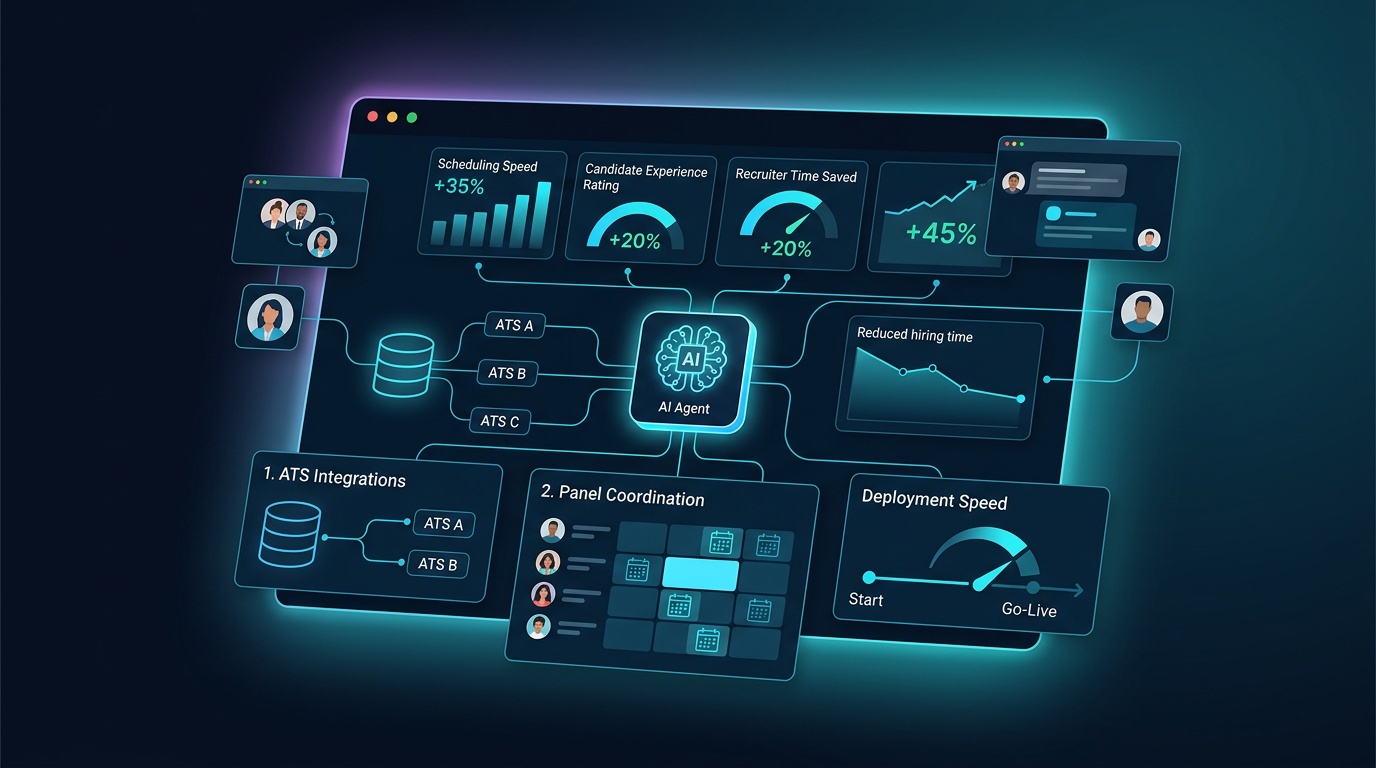
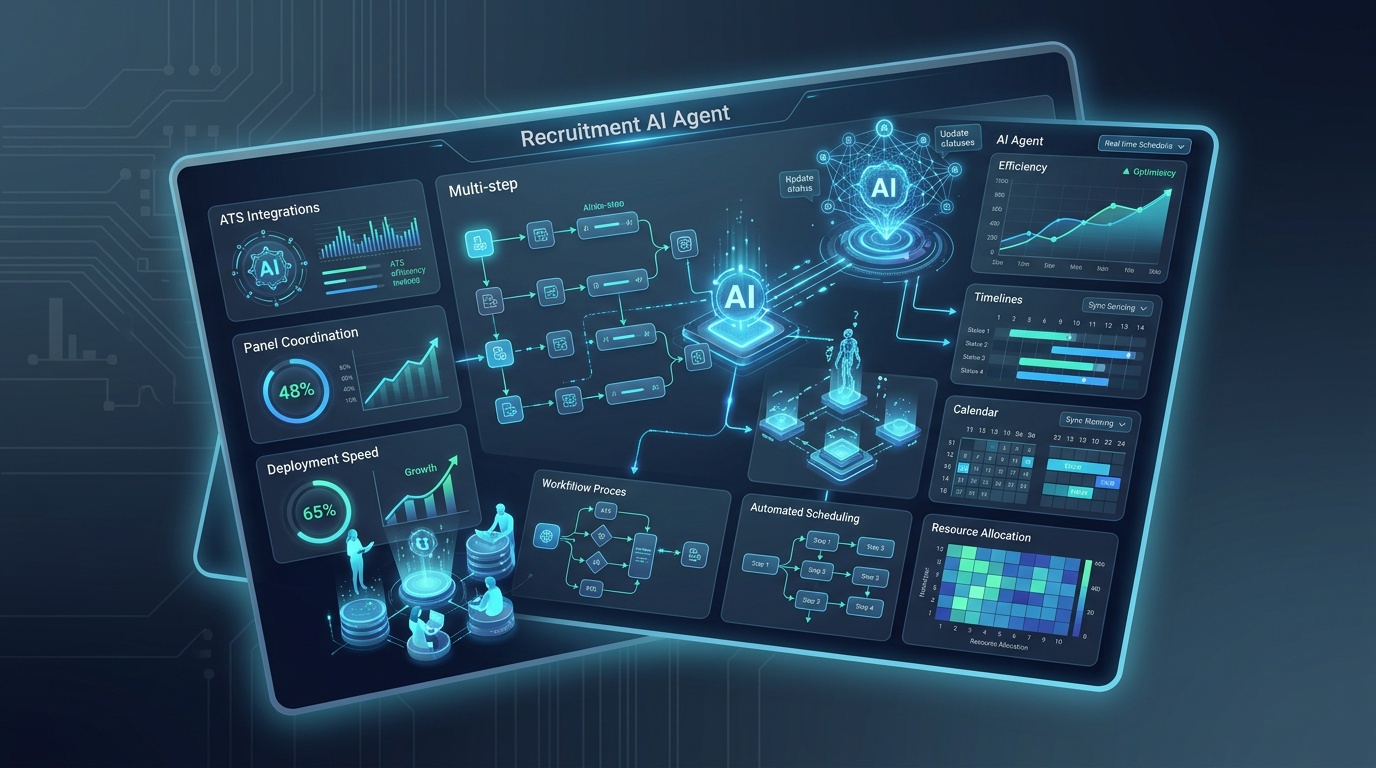

Core evaluation criteria: ATS integrations, panel coordination, and deployment speed
We assessed each platform against the conditions that determine adoption in a real recruitment operation. ATS compatibility came first, including the quality of integrations with systems such as Greenhouse and Workday, the ability to preserve candidate data, and the handling of status changes. We also examined panel scheduling, interviewer rules, time-zone support, rescheduling logic, reminders, candidate-facing branding, reporting, and administrative controls.
Deployment speed matters because a scheduling platform that takes too long to configure delays the expected return. Research from Metaview notes that major enterprise scheduling SaaS implementations can take 2 to 4 weeks. We favored tools that fit existing workflows and provide a clear path from setup to measurable usage.
High-volume vs. low-volume hiring capabilities
Hiring volume changes the economics. Enterprise teams managing high annual hiring volumes may benefit from scheduling pools, interview-plan automation, analytics, and large-scale interviewer coordination. Research from Pineapple indicates that the financial case for enterprise panel scheduling typically becomes compelling at 500 or more hires per year. Smaller firms may prefer a lightweight calendar tool with lower configuration demands and a simpler pricing model.
AI Interview Scheduling Tools for Recruitment Teams
The Best AI interview scheduling tools for recruitment teams are not interchangeable. Some are designed for enterprise hiring programs, while others suit a growing agency or a team arranging a small number of interviews each month. The comparison below considers automation depth, integration flexibility, candidate experience, panel coordination, and operational fit.
| Tool | Best fit | Notable capability | Integration profile |
|---|---|---|---|
| Vynta.ai | Custom recruitment operations | AI agents and legacy ATS workflows | Configured around existing systems |
| GoodTime | Verify with vendor | Verify capabilities with vendor | Verify integrations with vendor |
| Paradox | Verify with vendor | Verify capabilities with vendor | Verify integrations with vendor |
| ModernLoop | Verify with vendor | Verify capabilities with vendor | Verify integrations with vendor |
| Calendly | Verify with vendor | Verify capabilities with vendor | Verify integrations with vendor |
1. Vynta.ai: Best for Custom AI Automation & Legacy ATS Integration
Best for: Recruitment firms and mid-market teams that need scheduling connected to established ATS processes. Vynta.ai takes a workflow-first approach rather than requiring teams to reshape operations around a fixed SaaS product. Agentic Systems for Recruitment can coordinate interviews, communicate through approved channels, process applications, and update existing recruitment workflows. This is particularly useful when a team relies on a legacy ATS or needs logic that standard connectors cannot support.
Agentic Systems for Recruitment help recruitment firms screen more candidates, schedule more interviews, and place more candidates without expanding the team or increasing administrative costs. The system processes applications from multiple job boards, supports candidate matching, and provides branded candidate profiles for client submissions. Its value is strongest where scheduling is one part of a wider candidate sourcing, screening, engagement, and placement process.
2. GoodTime: Enterprise Hiring Consideration
Best for: Buyers should verify whether GoodTime suits their interview plans, interviewer needs, scheduling volume, and reporting requirements with the vendor.
3. Paradox Olivia: Conversational Candidate Experience Consideration
Best for: Buyers should verify Paradox’s candidate communication, screening, interview-booking, ATS synchronization, escalation controls, and specialized panel support with the vendor before deployment.
4. ModernLoop: Scaling Startups and Mid-Market Firm Consideration
Best for: Buyers should verify ModernLoop’s coordination, interviewer workflow, scheduling, candidate communication, integrations, and configuration options with the vendor.
5. Calendly: Basic, Low-Volume Scheduling Consideration
Best for: Buyers should verify Calendly’s booking, calendar, invitation, scheduling-rule, ATS, panel-coordination, candidate-routing, feedback-workflow, and broader recruitment-automation support with the vendor.
Competitor fit considerations
Pros
- GoodTime may suit structured, high-volume interview operations; verify capabilities with the vendor.
- Paradox may suit conversational candidate engagement; verify capabilities with the vendor.
- ModernLoop may suit teams formalizing coordination processes; verify capabilities with the vendor.
- Calendly may suit simple booking; verify recruitment workflow support before deployment.
Cons
- Enterprise platforms may require substantial configuration.
- Conversational tools need careful review of escalation and ATS behavior.
- Basic calendar products may not support complex recruiting workflows.
Custom AI Agents vs. Off-the-Shelf SaaS: Scaling Without Headcount
Off-the-shelf scheduling software can solve a defined calendar task, yet recruitment operations often involve much more than finding an open appointment. Candidate status, interview stages, panel rules, time zones, interviewer workloads, communication preferences, and ATS records all need to stay aligned. Vynta’s Agentic Systems for Recruitment treat scheduling as an operational workflow connected to sourcing, screening, candidate engagement, and placement. That distinction matters for recruitment directors who need to increase interview capacity without adding more coordination work.
The 2-4 week SaaS implementation reality check
Enterprise scheduling SaaS commonly requires two to four weeks for implementation, according to Metaview. That timeline can include security review, user provisioning, calendar permissions, ATS mapping, interview-template configuration, workflow testing, and coordinator training. The software may be ready to purchase, but the surrounding recruitment process still requires careful setup.
For a high-volume employer with standardized interview plans, that investment may be sensible. The economics are less favorable for a recruitment agency with varied client requirements, low-to-moderate hiring volume, or an ATS that has limited integration support. A fixed platform can force teams to change their process, accept manual workarounds, or wait for a vendor roadmap. Before selecting a tool, measure time to deployment, configuration effort, data access, exception handling, and the number of candidate records that require manual correction.
How custom automation bridges legacy ATS systems without native APIs
Legacy ATS integration is rarely only a question of whether a native connector exists. The real requirement is reliable movement of information between candidate profiles, job records, interview stages, calendars, email, messaging channels, and recruiter dashboards. Where an ATS lacks a suitable API, an AI agent can support an integration approach selected during the technical assessment. Each method requires access controls, audit logs, error handling, and human review for exceptions.
Agentic Systems for Recruitment are designed for this type of process-specific automation. Agentic Systems for Recruitment help recruitment firms screen more candidates, schedule more interviews, and place more candidates without expanding the team or increasing administrative costs. The system can process applications from CV Library, Indeed, Reed, TotalJobs, and LinkedIn, then connect screening outcomes with interview coordination and candidate communications. This approach preserves the ATS as the operational record while reducing duplicate data entry and manual handoffs.
Step-by-step workflow: How an AI agent routes a candidate vs. a human
A human coordinator must typically inspect the candidate record, confirm the correct hiring stage, identify qualified interviewers, exchange messages, resolve time-zone conflicts, issue invitations, and record the outcome. An AI agent follows defined rules at each stage and escalates decisions that require judgment. That division of work keeps recruiters involved in candidate quality, relationship management, and hiring decisions while removing repetitive coordination.
- Candidate enters the ATS: The agent detects a new application or a status change.
- Eligibility and stage check: Screening criteria, job requirements, recruiter approvals, and interview order are reviewed.
- Panel selection: The agent checks interviewer skills, availability, workload, location, and time-zone requirements.
- Candidate contact: Approved time slots are offered through email, SMS, WhatsApp Business API, or another configured channel.
- Calendar and ATS update: The meeting, video link, reminders, preparation materials, and candidate status are recorded.
- Exception escalation: Conflicting rules, unusual requests, or missing information are sent to a recruiter for resolution.
This model creates a practical path to higher interview volume without assuming that every case can be automated. Recruiters retain control of qualification standards, client communication, sensitive decisions, and quality assurance. The system handles repetitive scheduling administration around the clock, giving the team a measurable way to track time saved per hire, response speed, completed interviews, rescheduling frequency, and recruiter capacity.
AI Interview Scheduling Software: Common Questions

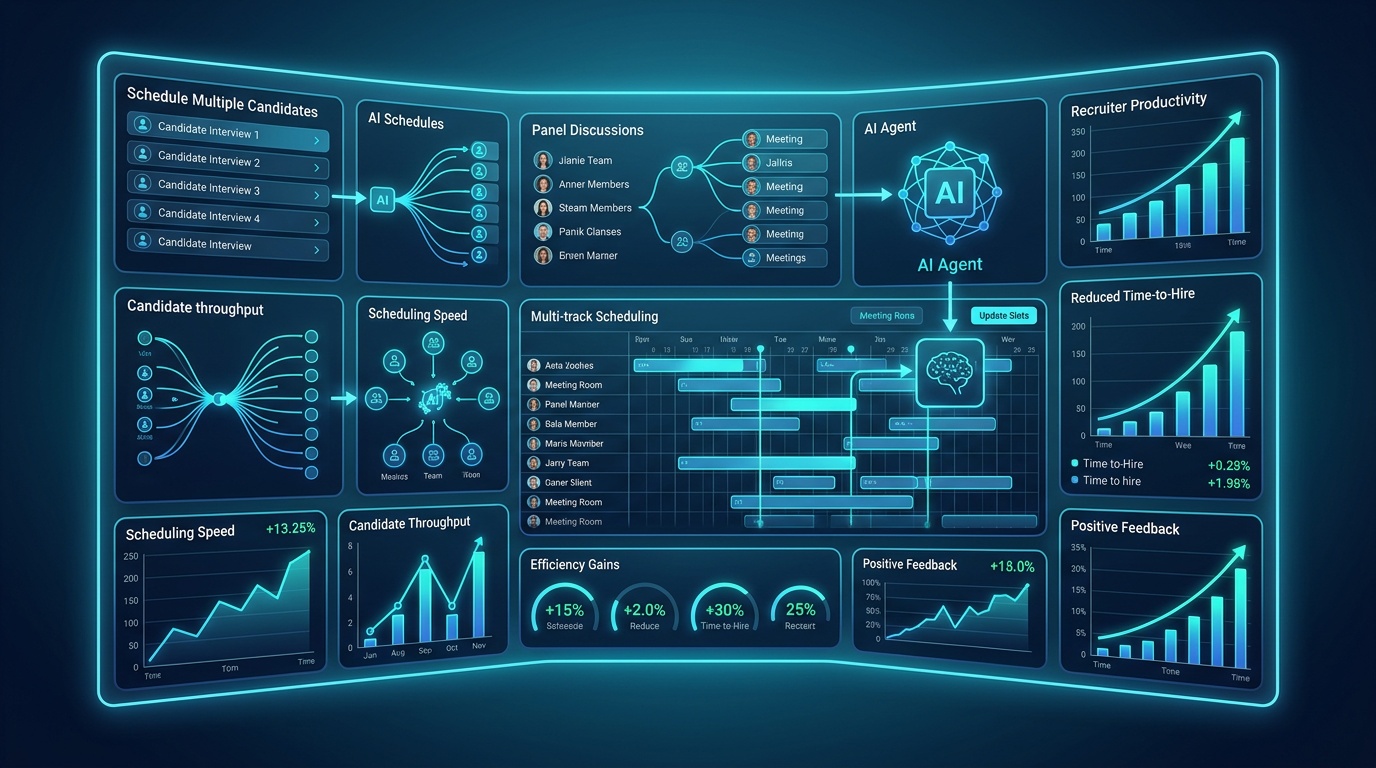


Recruitment leaders evaluating the Best AI interview scheduling tools for recruitment teams usually want practical answers about panel coordination, ATS compatibility, candidate experience, implementation effort, and human oversight. The right platform should do more than place a meeting on a calendar. It should connect the candidate record, interview plan, interviewer availability, communication workflow, reminders, and feedback process while giving recruiters control over exceptions.
How do AI scheduling tools handle complex multi-person panel interviews?
AI scheduling tools compare the availability of every required participant, then apply interview rules before presenting suitable times to the candidate. Those rules may include interviewer seniority, department, interview sequence, panel size, working hours, location, time-zone differences, room capacity, and required breaks between sessions. The system can also distinguish between mandatory and optional attendees, which helps prevent an entire panel from being blocked by one participant whose attendance is helpful but not essential.
More capable systems manage the full interview plan rather than one appointment at a time. They can schedule a recruiter screen, technical assessment, hiring manager discussion, and final panel in the correct order. If an interviewer cancels, the workflow can identify an approved replacement, offer revised times, update the calendar invitation, notify the candidate, and record the change in the ATS. Human review remains appropriate for sensitive candidates, unusual requests, executive interviews, or situations in which the hiring team must make a judgment beyond calendar rules.
Which AI scheduling tools integrate natively with Workday or Greenhouse?
Native integration depends on the specific product version, subscription, configuration, and implementation scope. Greenhouse and Workday can support connections with recruiting and scheduling platforms, but buyers should verify the exact workflow rather than relying on an integration logo on a vendor page. Ask whether the connection can read interview plans, write appointment details back to the candidate record, update interview stages, trigger reminders, capture rescheduling events, and preserve audit history.
GoodTime, Paradox, and ModernLoop are commonly considered by teams using structured recruiting technology, while Calendly is more calendar-centered and may require additional workflow configuration for ATS-driven hiring. A recruitment agency with a customized or older ATS may need a different integration model. Agentic Systems for Recruitment can be configured around existing recruitment processes, including ATS records, candidate communication channels, screening steps, and interview coordination. Agentic Systems for Recruitment is a practical option when native connectors do not cover the required handoffs or when the business needs automation across several systems rather than scheduling alone.
Can AI interview scheduling tools help reduce candidate drop-off rates?
Yes, they can reduce avoidable drop-off by shortening response time and keeping candidates informed. A scheduling workflow that offers relevant appointments quickly, confirms the booking, sends reminders, provides interview preparation materials, and makes rescheduling straightforward removes several points at which candidate momentum can weaken. Candidate-facing branding also matters because a clear, professional booking page reinforces trust and makes the process feel connected to the employer.
Scheduling software does not solve every cause of withdrawal. Compensation, role clarity, interviewer behavior, interview length, communication quality, and competing offers still influence completion. Recruitment teams should measure candidate response time, time from application to interview, completed interviews, rescheduling frequency, no-show rate, and withdrawal reasons before and after deployment. That measurement separates genuine process improvement from a simple increase in automated messages.
For a final buying decision, match the operating model to the tool. A small team with occasional recruiter screens may need only a booking page and calendar rules. A high-volume employer may require panel logic, interview templates, reporting, and deep ATS synchronization. A recruitment firm with varied clients, legacy systems, and broader automation goals should assess whether a configurable agent can support sourcing, screening, engagement, and interview coordination in one connected process.