

5 stages of the product life cycle
Understanding the 5 stages of the product life cycle changes how you allocate resources, time market entry, and decide when to pivot or double down. Whether you’re launching a new real estate lead qualification system, recruitment screening process, fundraising campaign, or hospitality service offering, each stage demands different strategies, budgets, and operational priorities.
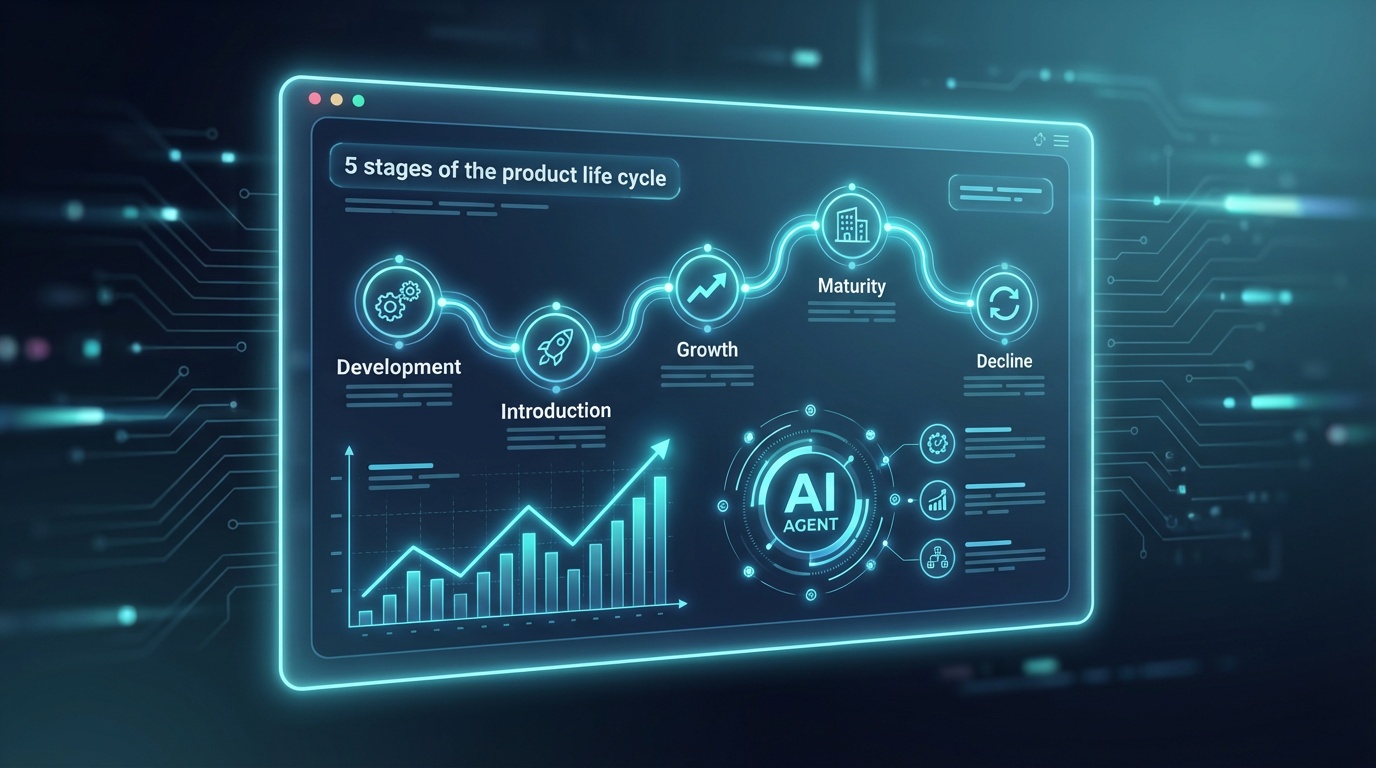
The 5 stages of the product life cycle are: Development (building and validating), Introduction (market entry), Growth (scaling demand), Maturity (maximizing position), and Decline (managing sunset or pivot). Each stage requires distinct resource allocation, marketing approaches, and strategic decisions that directly impact revenue and competitive positioning.
What Are the 5 Stages of the Product Life Cycle?
Development: Building Your Solution
Development happens before revenue begins. You’re validating market demand, building core functionality, and testing assumptions. For real estate agencies, this might mean prototyping a lead scoring system. Recruitment firms test candidate matching algorithms. Fundraising organizations design investor outreach workflows. Hospitality businesses pilot guest experience automation. Investment is high, revenue is zero, and failure risk peaks during this stage.
Introduction: Entering the Market
Introduction begins when you launch to paying customers. Awareness is low, sales velocity is slow, and customer acquisition costs exceed revenue per customer. Your priority shifts to market education, early adopter conversion, and proving product-market fit. Real estate teams measure initial lead conversion rates. Recruitment agencies track first placements. Fundraising groups monitor donor response rates. Hospitality operators assess guest adoption of new services.
Growth: Scaling Demand and Revenue
Growth accelerates when demand outpaces your capacity to deliver. Revenue climbs rapidly, competitors enter your market, and operational bottlenecks emerge. Real estate agencies face lead qualification backlogs. Recruitment firms struggle with candidate screening volume. Fundraising organizations can’t maintain personalized investor outreach at scale. Hospitality businesses sacrifice service quality during peak periods. This stage separates businesses that automate intelligently from those that hire their way into margin compression.
Maturity: Maximizing Market Position
Maturity arrives when market penetration plateaus. Revenue stabilizes, competition intensifies on price and features, and differentiation becomes harder. Customer acquisition costs rise while switching costs decrease. Real estate agencies compete on response speed and lead quality. Recruitment firms differentiate through placement velocity and candidate fit. Fundraising organizations maintain donor relationships through consistent engagement. Hospitality businesses optimize revenue per guest and operational efficiency to defend margins.
Decline: Managing the End Game
Decline occurs when demand contracts due to market saturation, technological disruption, or changing customer preferences. Revenue drops, profitability erodes, and strategic choices narrow to three options: pivot the offering, extract remaining value through cost reduction, or exit the market entirely. Businesses that recognize decline early can reallocate resources to higher-growth opportunities before competitive position deteriorates.
Strategic Insight: Product life cycle stages aren’t predetermined timelines. Your strategic decisions, competitive actions, and operational efficiency directly influence how quickly you move through each stage and how long you can extend profitable maturity.
Why Product Life Cycle Strategy Matters for Your Business
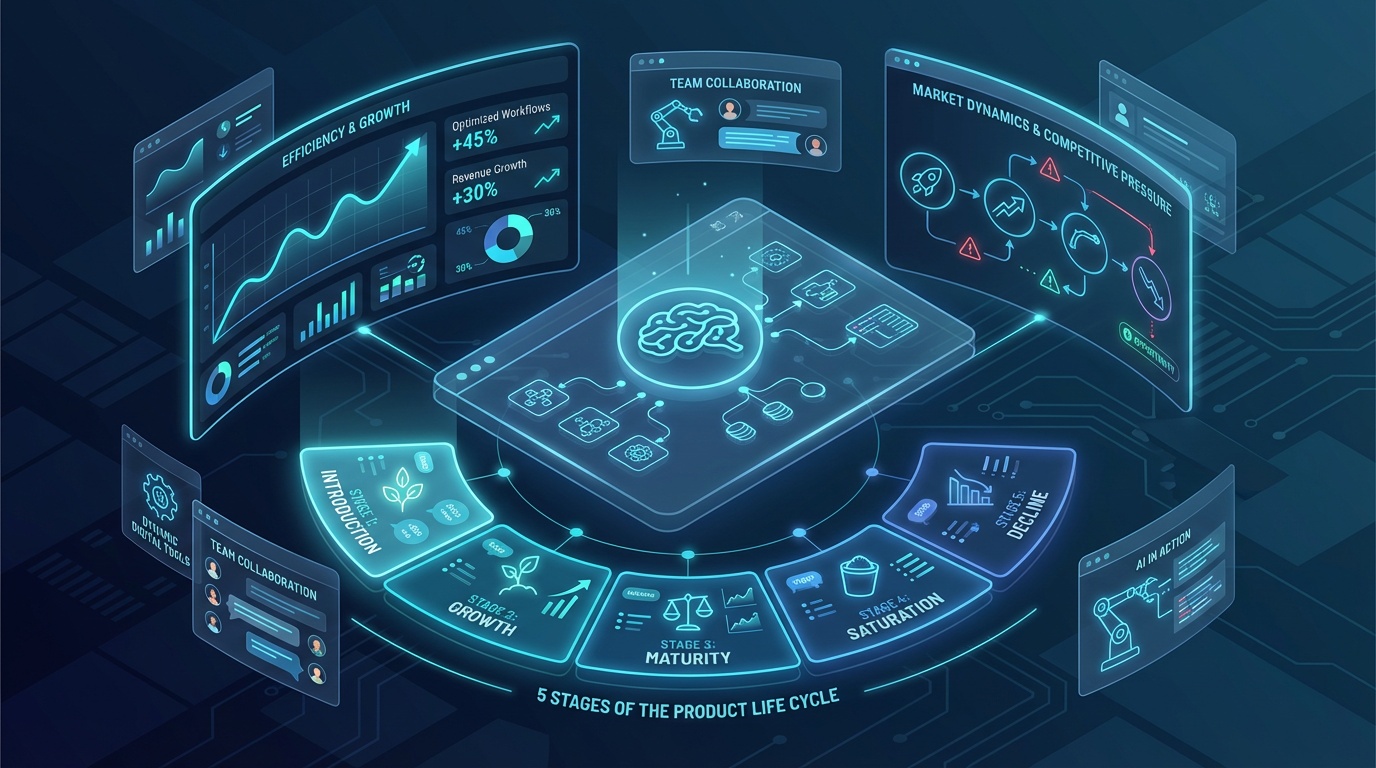
Predicting Market Dynamics and Competitive Pressure
Each stage signals different competitive threats and market opportunities. During introduction, you face skepticism and education costs. Growth attracts well-funded competitors. Maturity triggers price wars and feature parity. Recognizing these patterns lets you prepare defensive strategies before competitors force reactive decisions that erode margins and market position.
Allocating Resources and Budget Across Stages
Development demands R&D investment. Introduction requires marketing spend to build awareness. Growth needs operational scaling and customer success resources. Maturity calls for efficiency optimization and retention focus. Decline necessitates cost reduction or reinvestment in innovation. Misallocating resources burns cash during introduction or starves growth when scaling matters most.
Timing Your Marketing and Sales Efforts
A real estate agency launching AI lead qualification can’t use the same messaging in month one versus month twelve. Introduction focuses on education and proof points. Growth emphasizes scalability and competitive differentiation. Maturity highlights reliability and cost efficiency. Fundraising campaigns follow similar patterns: early donor education, rapid expansion during growth, relationship optimization at maturity.
Making Go/No-Go Decisions at Critical Junctures
Product life cycle awareness prevents two costly mistakes: abandoning products too early during the introduction struggle, and holding declining products too long while they drain resources from growth opportunities. Recruitment agencies that recognize when a service offering hits maturity can innovate before decline begins, maintaining competitive advantage through continuous evolution rather than reactive crisis management.
How AI Automation Changes Product Life Cycle Economics
Accelerating the Introduction and Growth Phases
AI automation compresses the timeline between market entry and profitable scale. Real estate agencies using AI lead qualification convert prospects faster than manual processes, shortening the introduction phase. Recruitment firms deploy AI candidate screening to process significantly more applications without adding headcount, accelerating growth without margin erosion. Fundraising organizations automate investor outreach sequences that maintain personalization at scale, moving from limited to expanded qualified conversations each month. Hospitality businesses use AI reservation optimization to fill capacity gaps and reduce no-shows, driving revenue growth without additional marketing spend.
Extending Maturity Through Continuous Optimization
AI agents learn from every interaction, improving performance while competitors plateau. A real estate CRM integration that scored leads with lower accuracy initially can reach higher accuracy over time, helping maintain competitive advantage as markets mature. Recruitment screening algorithms adapt to hiring manager preferences, increasing placement quality scores even as candidate volume stabilizes. Fundraising donor engagement systems identify retention signals before attrition occurs, extending donor lifetime value. Hospitality upselling automation tests messaging variations across thousands of guest interactions, optimizing revenue per booking when market growth slows.
Reducing Costs at Every Stage
Automation transforms fixed labor costs into variable technology expenses that scale efficiently. Development costs drop when AI prototypes validate demand through rapid testing cycles. Introduction expenses decrease as AI handles repetitive education and qualification tasks. Growth bottlenecks disappear when systems process volume without proportional hiring. Maturity margins improve through operational efficiency gains that manual processes can’t match. A recruitment agency processing high monthly application volumes manually needs multiple full-time screeners. AI automation delivers similar output with fewer people managing exceptions and relationship building.
Real Estate, Recruitment, Fundraising, and Hospitality Applications
Real estate agencies deploy AI for lead scoring, property matching, and follow-up sequencing that improves prospect conversion. Recruitment firms use AI candidate sourcing and screening to reduce time-to-hire while improving candidate fit scores. Fundraising organizations automate investor research, outreach personalization, and relationship nurturing that increases donor retention rates. Hospitality operators implement AI reservation management and upselling automation that lifts revenue per guest without sacrificing service quality.
ROI Reality: Businesses implementing AI automation during growth stages scale faster than teams relying on manual operations. Those adopting during maturity extend profitable market position longer than competitors relying solely on cost reduction.
Practical Strategies for Each Product Life Cycle Stage
Development Stage: Validating Demand and Reducing Risk
Test core assumptions before building full solutions. Real estate teams pilot lead scoring with a limited set of prospects before automating thousands. Recruitment agencies validate candidate matching logic on initial placements before scaling. Fundraising organizations test outreach messaging with select investors before launching campaigns. Measure engagement rates, conversion metrics, and feedback quality. Failed validation costs weeks and thousands. Scaling an unvalidated product costs months and hundreds of thousands.
Introduction Stage: Building Awareness and Initial Traction
Focus resources on proving value to early adopters who influence broader markets. Track conversion rates, customer acquisition costs, and usage patterns. A hospitality AI system needs successful implementations before broader market adoption accelerates. Collect testimonials, document case studies, and measure satisfaction scores. Introduction success requires proof points that overcome skepticism, not marketing volume that burns budget without building credibility.
Growth Stage: Scaling Without Sacrificing Quality
Automate repetitive tasks that create bottlenecks during volume increases. Real estate agencies automate lead qualification to maintain fast response times as inquiry volume doubles. Recruitment firms deploy AI screening to preserve candidate quality while processing substantially more applications. Measure operational metrics: response time, error rates, and customer satisfaction. Growth without automation forces hiring that compresses margins. Growth with intelligent automation expands capacity while improving unit economics.
Maturity Stage: Competing on Efficiency and Customer Experience
Optimize existing operations and differentiate through superior execution. Fundraising organizations use AI to maintain personalized donor touchpoints that manual processes can’t sustain at scale. Hospitality businesses deploy upselling automation that increases revenue per guest while freeing staff for high-value service interactions. Track efficiency ratios: revenue per employee, cost per transaction, and customer lifetime value. Maturity winners extract more value from existing customer relationships than competitors gain through expensive new customer acquisition.
Decline Stage: Pivoting, Innovating, or Exiting
Recognize decline signals early: declining conversion rates, rising acquisition costs, and shrinking deal sizes. Decide quickly between three paths. Pivot the offering toward adjacent opportunities where demand remains strong. Innovate the core product to restart the growth cycle. Exit the market and reallocate resources to higher-potential opportunities. Delay costs more than decisive action. A recruitment service that declines year after year can become low-value within a few years. Pivoting early preserves meaningful market position and customer relationships.
When to Invest in AI Automation Across Your Product Life Cycle
Early-Stage Products: Building Competitive Advantages Before Competitors
Deploying AI during development and introduction creates structural advantages that compound over time. Real estate agencies implementing lead qualification automation from day one establish response speed standards that manual competitors can’t match. The system learns from every interaction, building predictive accuracy that becomes more valuable as data accumulates. Recruitment firms starting with AI candidate screening avoid the operational debt of manual processes that later require expensive transitions. Early adoption costs less than retrofitting automation into established workflows while your team resists change and customers expect existing service delivery patterns.
Growth-Stage Products: Automating Bottlenecks That Limit Scaling
Growth exposes capacity constraints that AI eliminates without proportional cost increases. A fundraising organization experiencing significant donor inquiry growth faces a choice: hire multiple relationship managers at substantial annual cost or deploy AI outreach automation at a lower annual investment. The hiring path adds fixed costs that persist during future revenue fluctuations. The automation path scales variable costs with demand while improving response consistency. Hospitality businesses hitting high occupancy rates use AI reservation optimization to capture remaining capacity without expanding sales teams. The 5 stages of the product life cycle reveal that growth investments determine whether scaling improves or erodes profitability.
Mature Products: Using AI to Defend Market Share and Reduce Costs
Maturity demands efficiency improvements that preserve margins against competitive pricing pressure. Real estate agencies facing commoditization use AI property matching to deliver stronger client experiences at lower operational costs than competitors. Recruitment firms deploy AI interview scheduling and candidate nurturing that maintains placement quality while reducing cost per hire. These efficiency gains create pricing flexibility: maintain margins while matching competitor rates, or reduce prices while preserving profitability. Either strategy strengthens market position when growth slows and retention becomes the primary revenue driver.
Maximizing ROI: Where AI Automation Delivers Fastest Payback
AI automation generates fast returns when applied to high-volume, repetitive tasks with measurable quality standards. Lead qualification, candidate screening, donor outreach, and reservation management all meet these criteria. A recruitment agency processing high monthly application volumes sees AI screening ROI within months through reduced labor costs and improved placement velocity. Fundraising organizations automating investor research and initial outreach recover implementation costs through increased meeting conversion rates. Hospitality upselling automation pays back quickly by converting more guests to premium services versus manual approaches. The 5 stages of the product life cycle show that AI investments can compound: early efficiency gains fund expanded automation that drives additional improvements.
Investment Timing: Businesses deploying AI during introduction or early growth achieve higher ROI over multiple years compared to those waiting until maturity. Early automation builds competitive moats. Late automation is catch-up.
Strategic Product Life Cycle Management: Your Competitive Edge
Mastering the 5 stages of the product life cycle separates businesses that control their market trajectory from those reacting to competitive pressure. Development validates assumptions before expensive scaling. Introduction proves value to early adopters who influence broader markets. Growth tests operational capacity and automation readiness. Maturity rewards efficiency and customer experience excellence. Decline demands decisive resource reallocation before value evaporates.
AI automation alters product life cycle economics across real estate, recruitment, fundraising, and hospitality. Systems that learn from every interaction can shorten introduction timelines, remove growth bottlenecks, extend maturity profitability, and provide data-driven signals for pivot decisions. A real estate agency automating lead qualification can move from introduction to growth faster. A recruitment firm deploying AI screening can maintain quality at higher volume. A fundraising organization using automated outreach can sustain personalization across more relationships. A hospitality business implementing reservation optimization can increase revenue per guest without additional marketing spend.
The strategic question isn’t whether to automate, but when and where automation delivers maximum competitive advantage. Early-stage adoption builds structural advantages that compound over time. Growth-stage implementation prevents capacity constraints that limit scaling. Maturity-stage deployment defends market position through superior efficiency. Each stage presents distinct opportunities where AI turns operational capability into measurable business outcomes: conversion rates, placement velocity, donor retention, and guest satisfaction scores.
Your position in the product life cycle determines resource allocation priorities, competitive threats, and strategic options. Recognizing these patterns before competitors do creates decision advantages that translate into market share gains, margin improvements, and sustainable growth. The businesses winning in real estate, recruitment, fundraising, and hospitality aren’t those with the most resources. They’re the ones deploying those resources at optimal inflection points where strategic investments generate disproportionate returns.
Understanding the complete concept of the product life cycle is crucial for making informed business decisions and maintaining competitive advantage.