
Best AI agents for luxury restaurant bookings?
Why Luxury Restaurants Need Smarter Booking Solutions
The best AI agents for luxury restaurant bookings combine natural language understanding, deep guest personalization, and seamless CRM integration. They reduce no-shows, automate upselling, and free your staff to deliver the white-glove service your guests expect.
The High Stakes of Luxury Dining Reservations
A missed reservation at a fine-dining establishment isn’t just an empty table. It’s lost revenue, wasted prep, and a service team standing idle. At the luxury tier, every booking carries outsized financial and reputational weight. Guests expect prompt confirmation, personalized acknowledgment, and proactive communication before they arrive.
What Luxury Hospitality Actually Demands
Standard reservation platforms handle date, time, and party size. That’s not enough. Luxury hospitality requires dietary restrictions flagged automatically, anniversary notes surfaced before seating, and preferred tables remembered across visits. These aren’t nice-to-haves — they’re the operational baseline guests at this level assume you’ve already got covered. Systems need to learn, not just record.
Why Manual Reservation Management Breaks Down
Phone lines go unanswered during peak hours. Staff burn time on repetitive confirmation calls. Guest preference data lives in scattered notes that disappear when someone leaves. As your covers grow, scaling personalized service through manual processes alone becomes a liability, not just an inefficiency.
AI Agents for Luxury Restaurants: What “Best” Actually Means
Start with Hospitality-Specific Training
When evaluating options, prioritize systems built specifically for hospitality workflows rather than generic chatbot platforms adapted after the fact. Industry-specific training produces measurably better guest interactions. A tool trained on customer service tickets from a SaaS company has no business handling a Michelin-starred dining room’s reservation queue.
Natural Language Processing That Handles Nuance
Guests at luxury establishments communicate with nuance. “We’d like something quiet for a business dinner” requires contextual interpretation, not keyword matching. Strong natural language processing translates conversational requests into precise booking parameters — without making guests navigate rigid form fields. That friction-free experience is part of the service.
Personalization at Scale
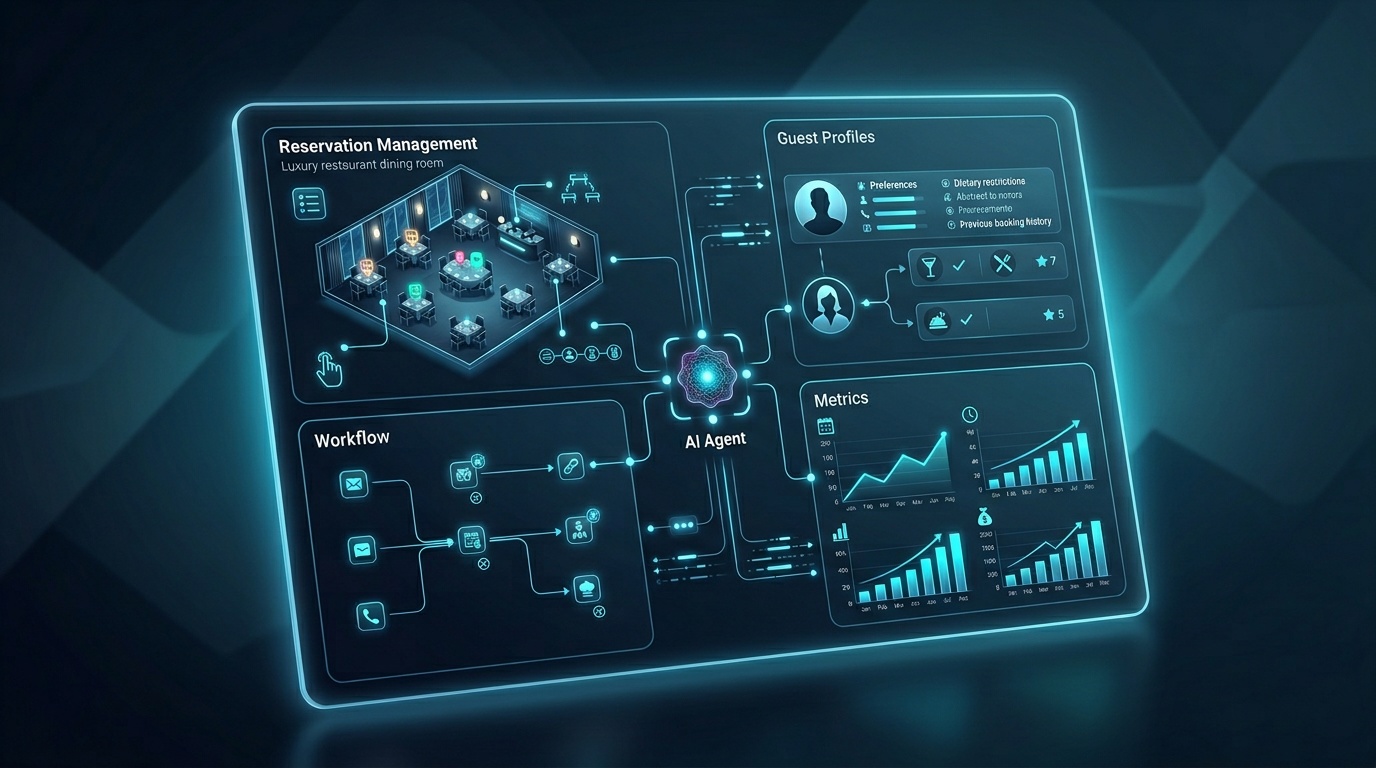
True personalization means your system surfaces a returning guest’s wine preferences, seating history, and dietary needs automatically — before anyone on your team has to ask. This isn’t a luxury feature; it’s the operational foundation of repeat business at this tier. I’ve seen venues where staff manually pull up notes before a guest arrives. That works for 30 covers a week. It doesn’t scale.
AI Booking Agent Capabilities: Strengths and Limitations
Pros
- Availability for reservation requests across time zones
- Consistent capture of dietary and allergy information
- Automated pre-arrival communication reduces no-shows
- Guest preference data builds actionable loyalty profiles
Cons
- Highly unusual requests still benefit from human review
- Initial setup requires integration with an existing PMS or CRM
- Quality depends heavily on industry-specific AI training
Integration Is Non-Negotiable
An AI booking agent that doesn’t talk to your existing systems creates more problems than it solves. The right solution connects directly with your CRM and operations software — including real-time synchronization with platforms like SevenRooms — so guest data, reservations, and tags stay automatically updated. Isolated tools create data silos. Integrated agents create unified guest intelligence that improves every interaction across your operation.
Vynta AI’s Approach: Enterprise-Grade Automation Built for Mid-Market Hospitality
The Gap Vynta AI Was Built to Fill
Enterprise hotel chains deploy custom AI built by internal engineering teams with seven-figure budgets. Generic small-business chatbots lack the sophistication luxury guests expect within about thirty seconds of interacting with them. Mid-market boutique restaurants and hotels sit in a real gap: needing enterprise-grade capability without enterprise-scale spend. That’s exactly where we operate.
More Than Just Reservations
Vynta AI’s hospitality agents manage the full guest journey: initial booking, pre-arrival preference confirmation, upsell communication, and post-visit follow-up. Each touchpoint is automated without losing the warmth that defines luxury service. These are bespoke agents purpose-built for luxury hospitality venues — restaurants, premium bars, nightclubs, beach clubs — not off-the-shelf software repurposed for an industry it wasn’t designed for.
The Outcomes We Track
Vague promises about “better guest experiences” don’t justify a technology investment. Vynta AI clients track concrete metrics: booking conversion rates up by 50%, customer inquiry abandonment reduced by 60%, average guest spend increased by up to 25% through brand-safe upselling, and operational costs reduced by 30%. These numbers appear in your reporting dashboard from day one of deployment.
How the Human-AI Division Actually Works
The AI handles volume: confirmations, preference capture, dietary flagging, and routine follow-ups — operating only within the hours you define, with polite holding messages sent outside those windows. Your staff handles nuance: the guest celebrating a difficult year, the VIP requiring a personal call, the last-minute request needing creative problem-solving. Strict escalation rules ensure complex queries and VIP guests are always routed to a human. Neither side works as well without the other.
Implementation: What the Process Looks Like
Deploying AI booking automation isn’t a switch you flip. Vynta AI’s onboarding moves through discovery, strategy, and implementation phases — mapping your existing reservation workflows, CRM data, and guest communication preferences before any configuration begins. Integration with your PMS or CRM is handled by our team. You don’t inherit a technical project; you inherit a working system.
The ROI Case: Revenue Protection, Revenue Growth, and Staff Time Recovered
No-Show Reduction: Where the Math Becomes Obvious
A six-top no-show on a Saturday evening can represent $600 to $1,200 in lost revenue once food prep and staffing are factored in. AI agents send automated confirmation sequences at 48 hours, 24 hours, and two hours before service, with frictionless cancellation options that recover the table for reseating. Most venues see no-show rates drop from the 10-15% range down to 3-5% within the first quarter.
Pre-Arrival Upselling: The Highest-ROI Touchpoint Most Venues Miss
A confirmation message is already going out. The question is whether it’s doing any work beyond confirming a time. An AI agent confirming a reservation can also surface a wine pairing menu, a chef’s tasting experience, or a private dining upgrade — provided those offers are explicitly approved as part of your brand content configuration. Because the message arrives in context rather than as a generic promotional blast, conversion rates consistently outperform standard email campaigns. Vynta AI clients see average guest spend increase by up to 25% through this kind of profile-tailored outreach.
Guest Data That Compounds in Value
Every booking interaction generates preference data. Dietary restrictions, occasion notes, seating preferences, and communication timing all feed a guest profile that sharpens with each visit. This data powers personalized outreach between visits — turning one-time diners into regulars, and regulars into advocates.
| Metric | Manual Reservation Management | AI-Powered Booking Agent |
|---|---|---|
| No-show rate | Typically 10-15% | Reduced to 3-5% with automated sequences |
| Pre-arrival upsell capture | Inconsistent, staff-dependent | Systematic, every booking |
| Guest preference accuracy | Scattered notes, often lost | Unified profile, auto-surfaced |
| Staff hours on confirmations | 8-12 hours weekly | Under 1 hour weekly |
Running Your Own ROI Calculation
Start with three numbers: average revenue per cover, current no-show rate, and weekly staff hours spent on reservation administration. Reducing no-shows by five percentage points across 200 weekly covers, combined with consistent upsell conversion, typically produces monthly revenue gains that exceed platform cost within the first quarter. ROI projections specific to your operation are developed during the discovery phase — you won’t be working from industry averages.
Making the Right Choice for Your Luxury Restaurant
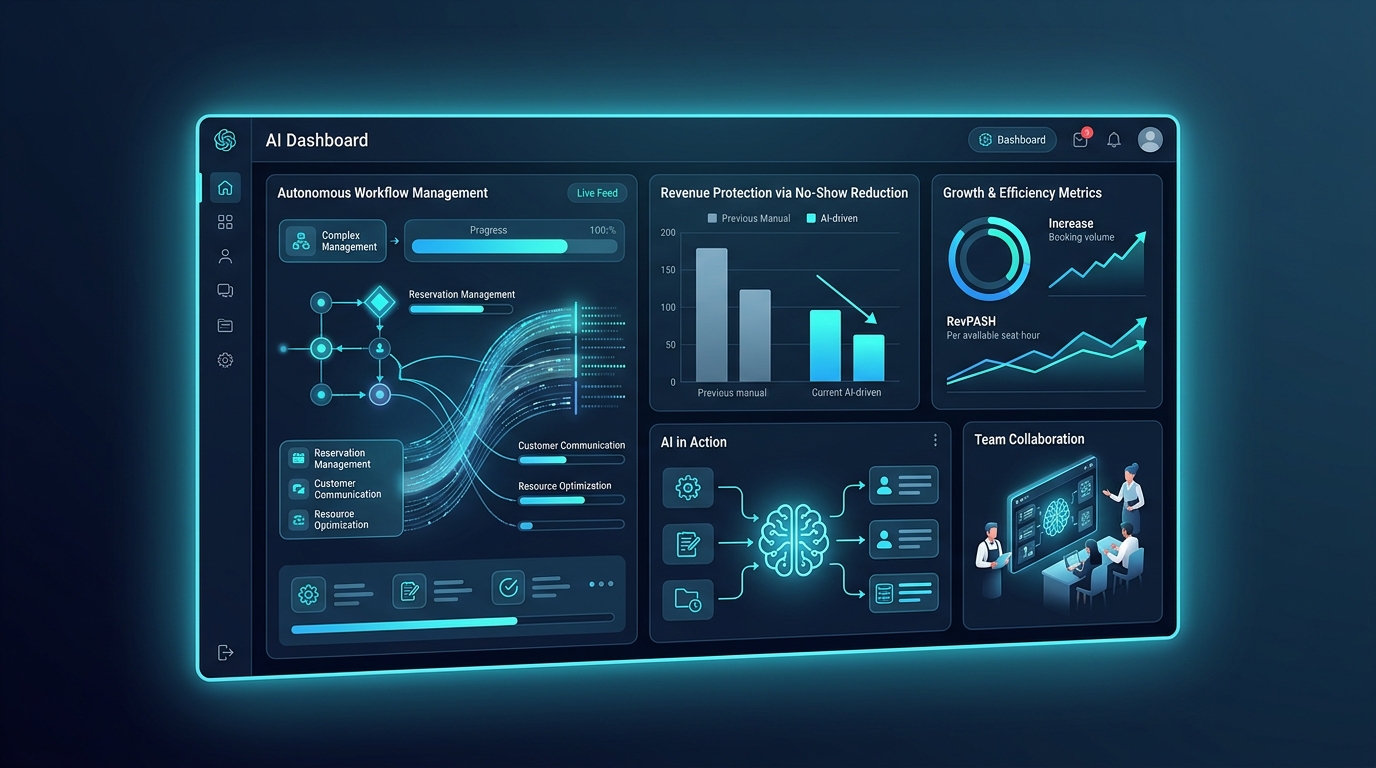
The strongest AI booking solutions deliver across three dimensions simultaneously: revenue protection through no-show reduction, revenue growth through systematic upselling, and operational efficiency through staff time recovered from administrative work. Each dimension compounds with every additional month of guest data collected. That compounding effect is what separates a tactical tool from a strategic infrastructure investment.
Prioritize Industry-Specific Capability Over General Features
Generic automation tools adapted for hospitality consistently underperform against purpose-built solutions. When evaluating options, test how a system handles nuanced requests, how guest preference data is stored and surfaced, and whether integration with your existing CRM — such as SevenRooms — is native or requires workarounds. Those details separate tools that look impressive in demos from agents that actually perform during a full Friday service.
Guest Intelligence Compounds Over Time
Your first-quarter ROI reflects operational savings. Year-two ROI reflects something more valuable: a guest intelligence database that makes every interaction more personal and every outreach more targeted. Restaurants that deploy AI booking agents early build a compounding advantage over competitors still managing preferences through staff memory and scattered notes.
Your Staff Remains the Differentiator
No AI agent replaces the sommelier who reads a table perfectly or the host who remembers a guest’s difficult year. The right system protects your team’s capacity for those moments by eliminating the volume work that currently consumes their time. When confirmation calls, dietary data entry, and upsell communication run automatically, your staff’s attention returns fully to the floor — where it belongs.
Vynta AI’s hospitality agents are built on this principle: automate the repeatable so your people can own the irreplaceable. The AI supports automation that enables your team to focus on growth; it does not manage business growth directly.
For mid-market boutique restaurants and hotels ready to close the gap between enterprise-grade capability and accessible investment, the path forward is clear. The question isn’t whether AI booking automation delivers — our clients’ numbers answer that. The question is how much longer your operation can afford to compete without it.
Frequently Asked Questions
What defines the best AI agents for luxury restaurant bookings?
The best AI agents for luxury restaurant bookings combine sophisticated natural language understanding with deep guest personalization. They are specifically trained for hospitality workflows, allowing them to interpret nuanced requests and recall guest preferences across visits. This integration into your operations frees staff to focus on delivering exceptional service.
What capabilities distinguish top AI agents in the hospitality sector?
Top AI agents in hospitality excel in natural language processing, converting conversational requests into precise booking parameters. They offer personalization at scale, automatically surfacing guest preferences like dietary needs or preferred seating. Seamless integration with existing CRM and operations software, such as SevenRooms, is also key for unified guest intelligence.
How do AI agents personalize the booking experience for luxury restaurants?
AI agents personalize the booking experience by remembering guest preferences, from dietary restrictions to preferred tables and special occasion notes. They can greet returning guests by name and confirm specific arrangements, setting a welcoming tone before arrival. This level of tailored service can also increase average guest spend through brand-safe upselling.
What measurable business outcomes can luxury restaurants expect from using AI booking agents?
Luxury restaurants using AI booking agents can see significant improvements in key metrics. Our clients have experienced booking conversion rates increasing by 50% and customer inquiry abandonment reduced by 60%. Additionally, average guest spend can increase by up to 25%, while operational costs are reduced by 30%.
Do AI agents for luxury restaurant bookings replace human staff?
No, AI agents are designed to augment your team, not replace them. They handle the high volume of routine tasks, like confirmations and preference capture, allowing your staff to focus on providing white-glove service and addressing complex or VIP guest needs. Strict escalation rules ensure human intervention for nuanced situations.
How does Vynta AI specifically support luxury restaurant bookings?
Vynta AI Agents are bespoke AI solutions purpose-built for luxury hospitality venues, including restaurants. They manage the full guest journey, from initial booking to pre-arrival confirmation and upselling, all while maintaining brand tone. Our agents integrate in real-time with CRMs like SevenRooms, ensuring guest data and reservations are always synchronized.