
ai customer service bot
What is an AI Customer Service Bot and Why It Matters for Your Business
An ai customer service bot is an AI-powered agent that handles customer inquiries, qualifies leads, resolves issues, and personalizes interactions autonomously. It can operate across multiple channels without expanding your headcount.
Defining AI Customer Service Bots: Beyond Simple Automation
Traditional chatbots follow rigid scripts. Modern AI customer service bots understand context, learn from every conversation, and execute multi-step workflows. They can book reservations, qualify property leads, screen candidates, or route donor inquiries without requiring human intervention at each step.
The Evolution from Rule-Based Chatbots to Intelligent Agents
First-generation chatbots required exhaustive decision trees. One unexpected question broke the experience entirely. Today’s AI agents use natural language understanding to interpret intent, not just keywords. This means a hotel guest asking, “Anything available this weekend?” receives real-time availability, pricing, and a booking link rather than a dead-end menu.
Key Benefits: Driving Efficiency and Customer Satisfaction
Pros
- 24/7 availability without staffing costs
- Consistent response quality across every interaction
- Simultaneous handling of hundreds of conversations
- Measurable reduction in response time and operational overhead
- Personalization at scale through CRM and data integration
Cons
- Requires quality training data and ongoing optimization
- Complex emotional situations still need human judgment
- Initial implementation demands process mapping and integration work
Vynta AI’s Perspective: AI as a Business Transformation Tool
At Vynta AI, we build AI agents that augment your team rather than replace the human relationships that define industries like hospitality, recruitment, and real estate. Our AI Automation Services are designed around your specific vertical, workflows, data, and customer expectations–not generic templates that force your business to adapt to the technology.
The businesses seeing the strongest results treat their ai customer service bot as a strategic asset: one that handles high-volume, repeatable interactions so their people can focus on complex decisions and relationship-building that genuinely requires human expertise.
Beyond the Basics: Unpacking the Capabilities of Enterprise-Grade AI Agents
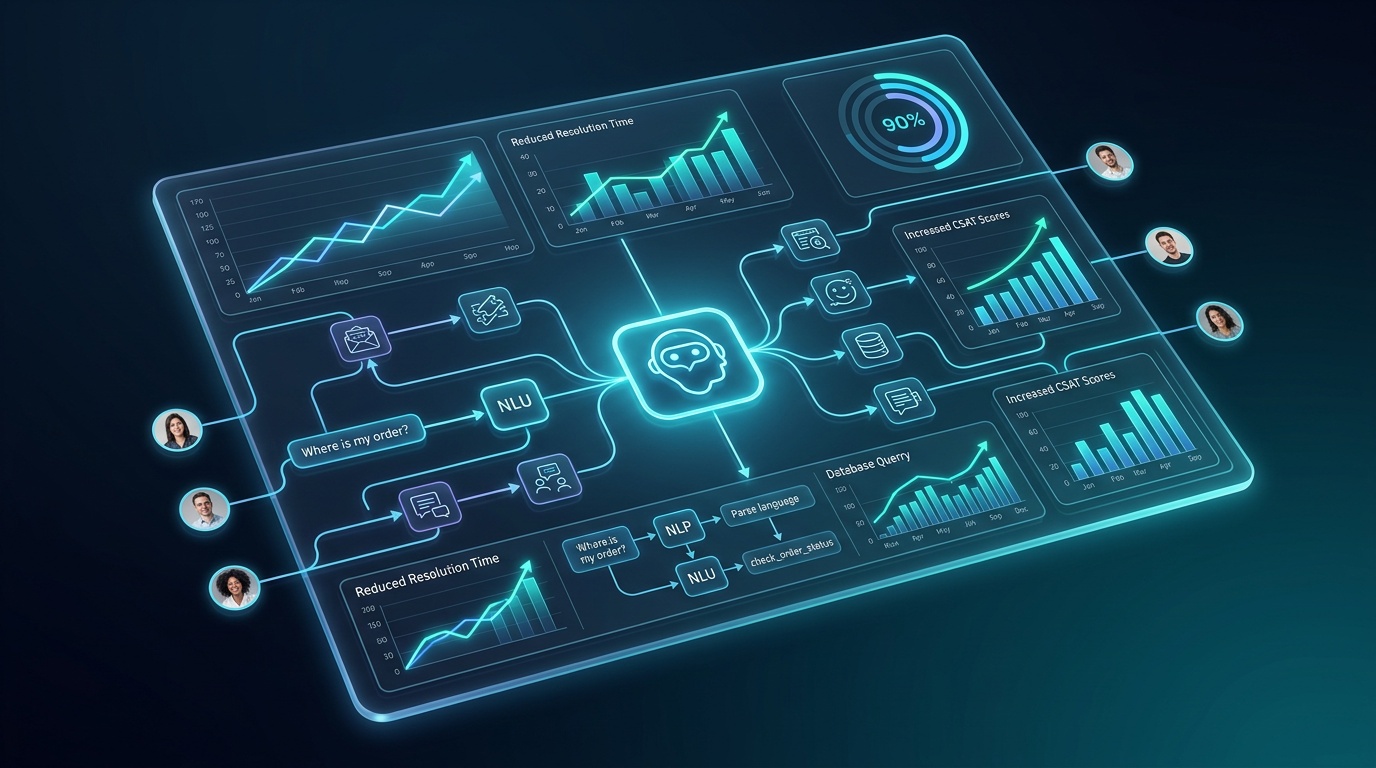
Natural Language Processing and Understanding in Action
NLP allows an AI agent to parse what a customer types. NLU goes further–identifying intent behind imprecise language. A recruitment candidate writing, “I want something in finance, maybe accounting,” triggers candidate profile creation and job matching rather than a keyword search that returns zero results.
Machine Learning for Continuous Improvement and Personalization
Every resolved conversation becomes training data. Over time, the agent recognizes which responses drive bookings, which qualification questions surface serious buyers, and which donor objections precede conversion. This feedback loop means performance compounds month over month–without additional staffing.
Integration Across Your Existing Tech Stack
An isolated bot creates another data silo. Vynta AI’s system integration services connect your workflows to your CRM, ATS, reservation system, or fundraising platform through custom API development and real-time data synchronization. A hotel bot that can’t read live availability is a liability. One connected to your property management system can close bookings autonomously.
Omnichannel Support: Meeting Customers Where They Are
Guests message on WhatsApp. Property buyers email at midnight. Candidates apply through LinkedIn. A single-channel bot misses most of your audience. Vynta AI’s Communication Automation spans SMS, WhatsApp, email, and web chat–maintaining conversation context across channels so customers never have to repeat themselves.
Sentiment Analysis and Proactive Issue Resolution
Advanced AI agents detect frustration signals mid-conversation and escalate before a complaint becomes a cancellation or a lost deal. In hospitality, a dissatisfied guest can receive a manager callback before they post a negative review. In recruitment, a candidate expressing doubt about a role gets targeted information addressing that specific concern–preserving placement opportunities your team might otherwise miss entirely.
Strategic Implementation: Choosing and Deploying the Right AI Solution for Your Vertical
Assessing Your Business Needs: Identifying Key Pain Points
Start by auditing where response delays, inconsistent quality, or manual bottlenecks cost you revenue. High inquiry volume with low conversion rates signals a qualification problem. Repeated no-shows indicate a follow-up gap. These pain points should define your implementation priorities–not the other way around.
The Vynta AI Approach: Industry-Specific AI Agents for Measurable Outcomes
Generic automation tools make you build industry logic from scratch. Vynta AI’s AI Automation Services start with vertical-specific workflows already mapped. Discovery and assessment identify your exact configuration needs, and expert implementation typically deploys within weeks rather than quarters.
Real Estate: Automating Lead Qualification and Property Matching
An AI agent qualifies inbound property inquiries by budget, timeline, and location preference, then matches prospects to listings and schedules viewings directly into agent calendars. Agents receive only sales-ready leads. Zero time spent on unqualified inquiries.
Recruitment: Streamlining Candidate Screening and Interview Scheduling
AI agents screen applications against role requirements, conduct initial conversational assessments, and schedule interviews–freeing recruiters from administrative overhead. Placement teams focus on offer negotiation and relationship-building, which is the high-value work that requires human judgment and can’t be templated.
Fundraising: Optimizing Investor Outreach and Donor Engagement
Systematic outreach at scale is where many fundraising organizations fall short. AI agents manage personalized multi-touch sequences, track engagement signals, and route warm prospects to relationship managers when interest is highest–converting attention into committed capital more efficiently than manual follow-up ever could.
Hospitality: Improving Guest Experience and Reservation Management
Maria’s boutique hotel competes on personal touch. An ai customer service bot handles reservation inquiries, identifies upsell opportunities based on guest history, and sends pre-arrival personalization sequences–freeing her team to deliver the in-person service that drives five-star reviews and repeat bookings. Complex or VIP queries go straight to staff, keeping the human element exactly where it matters most.
Implementation Considerations: Data, Training, and Human Oversight
Successful deployment requires clean data, defined escalation rules, and ongoing monitoring. Vynta AI’s AI Automation Services include phased deployment planning, team training, and continuous optimization reviews. Human oversight stays part of the operating model throughout–the goal is intelligent automation with clear handoff protocols, not unsupervised operation.
Measuring Success: Quantifying the ROI of AI Customer Service Bots
Key Performance Indicators That Drive Business Growth
Measuring your system requires metrics tied to revenue, not just activity. Track lead-to-appointment conversion rates in real estate, time-to-placement in recruitment, donor response rates in fundraising, and reservation completion rates in hospitality. Operational metrics like average handle time and escalation frequency reveal efficiency gains; revenue metrics confirm whether any of it actually moves the needle.
Reducing Operational Costs Through Intelligent Automation
AI agents absorb high-volume, repeatable interactions without proportional staffing increases. A recruitment firm handling 400 weekly applications no longer needs three coordinators for initial screening. A hotel managing 200 daily inquiry messages can route booking conversations automatically. Cost reduction compounds as volume scales–something a manual team structurally cannot replicate.
Boosting Revenue Through Conversion and Upselling
Speed directly affects conversion. Prospects who receive immediate qualification responses convert at higher rates than those who wait hours for a reply. In hospitality, bots connected to guest history data identify upsell opportunities with precision–room upgrades before arrival, dining reservations during check-in–generating incremental revenue that front desk teams rarely pursue consistently under operational pressure.
Building Customer Loyalty With Faster Resolutions
Consistent, accurate responses build trust faster than occasional excellent service interrupted by long waits. An AI agent that resolves a guest complaint within minutes–or confirms a candidate’s interview instantly–creates the kind of experience that generates referrals and repeat business. Loyalty metrics worth tracking: repeat booking rates, candidate resubmission rates, and donor retention percentages.
The Future of Customer Service: AI as a Strategic Partner, Not Just a Tool
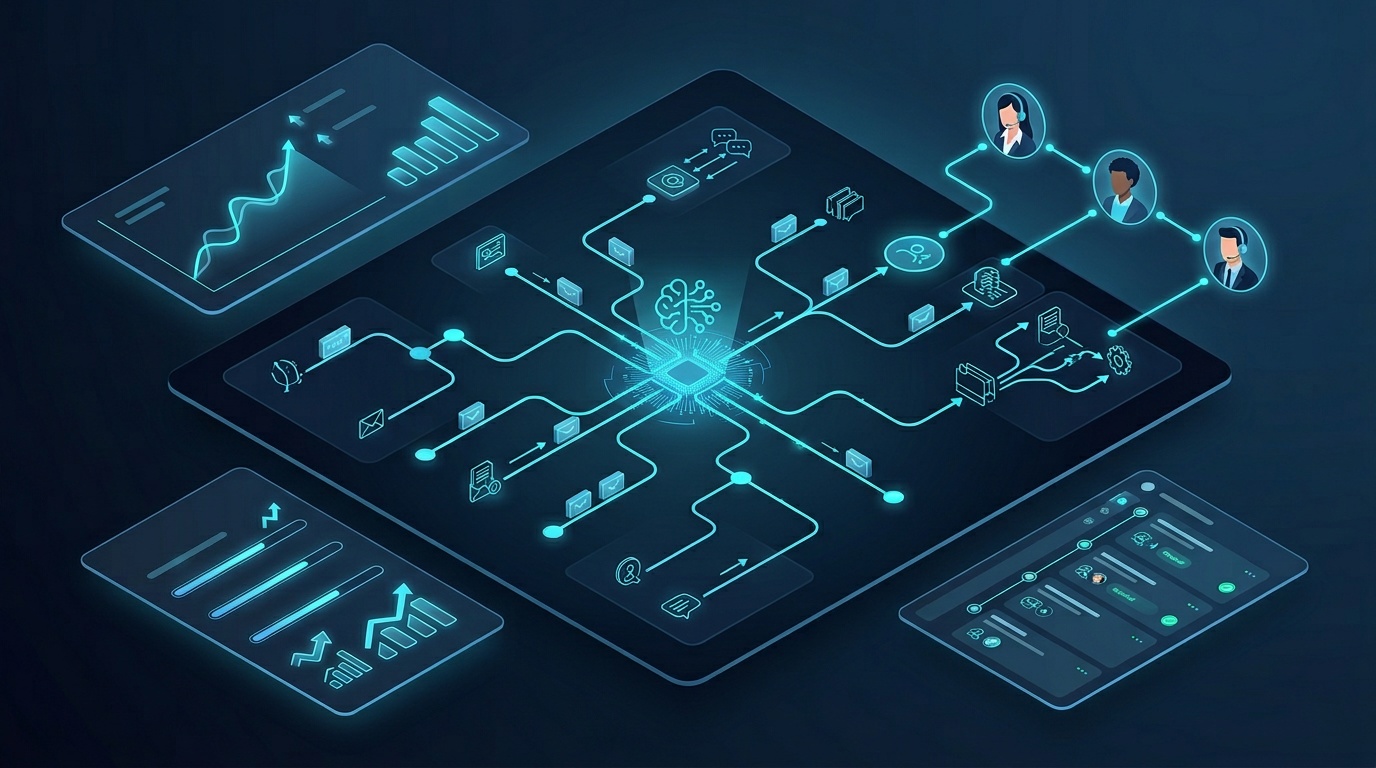
Human-AI Collaboration: Augmenting Your Team’s Capabilities
The strongest implementations treat AI as a force multiplier. Your recruiters close placements while the agent handles screening. Your hotel staff delivers memorable in-person moments while the agent manages reservations and pre-arrival communication. This division captures AI’s consistency at scale while preserving the human judgment that defines service quality in relationship-driven industries. Neither side does the other’s job. Both do theirs better.
Addressing Adoption Concerns: Trust, Security, and Scalability
Data security, customer perception, and system reliability are legitimate considerations–not obstacles to dismiss. Vynta AI’s phased deployment model addresses each through structured discovery, controlled rollout, and continuous monitoring. Escalation protocols ensure customers always reach a human when the situation genuinely requires one, maintaining trust throughout the transition.
When Enterprise AI Agents Outperform Simpler Solutions
Free or generic chatbot tools handle simple FAQ deflection reasonably well. When your business needs lead qualification, CRM integration, multi-channel conversations, and improvement through machine learning, those same tools often create more work than they eliminate. Your workflow complexity should determine the right category–not the price point.
Vynta AI: Your AI Automation Partner for Measurable Growth
Mid-market SMEs rarely have internal AI teams. Vynta AI’s AI Automation Services provide the technical expertise, industry-specific configuration, and ongoing optimization that serious AI deployment demands–without enterprise price tags or months-long implementation timelines. From discovery through continuous results monitoring, every decision is oriented toward measurable business outcomes your team can act on immediately.
Frequently Asked Questions
What is an AI customer service bot?
An AI customer service bot is an AI-powered agent designed to autonomously manage customer inquiries, qualify leads, and personalize interactions across various channels. These intelligent agents go beyond simple automation, understanding context and learning from every conversation. They are built to streamline operations and deliver consistent service without increasing your team’s headcount.
Can AI agents effectively handle customer service?
Absolutely, AI agents are highly effective for customer service, providing 24/7 availability and consistent response quality across hundreds of simultaneous conversations. They significantly reduce response times and operational overhead, allowing your human team to focus on complex decisions and relationship-building. At Vynta AI, our agents have shown to increase booking conversion by 50% and reduce inquiry abandonment by 60%.
How do AI customer service bots differ from traditional chatbots?
The core difference lies in intelligence and capability. Traditional chatbots follow rigid, rule-based scripts, only answering questions based on predefined pathways. Modern AI customer service bots, conversely, use natural language understanding to interpret intent, learn from interactions, and complete complex tasks like booking reservations or qualifying leads. They make decisions and escalate intelligently when human insight is genuinely required.
What are the main advantages of using an AI customer service bot?
AI customer service bots offer significant advantages, including 24/7 availability and consistent, high-quality responses for every customer interaction. They handle hundreds of conversations simultaneously, drastically reducing response times and operational costs, potentially by 30%. Beyond efficiency, they enable personalization at scale and can even increase average guest spend by up to 25% through tailored upselling.
How do businesses choose the right AI customer service bot solution?
Choosing the right AI customer service bot involves first identifying your specific business pain points, such as response delays or manual bottlenecks that impact revenue. These challenges should guide your implementation priorities. At Vynta AI, we believe in industry-specific solutions, starting with vertical-specific workflows rather than generic templates, to ensure the AI agent truly aligns with your operations and customer expectations.
What is the typical investment for an AI customer service bot?
The investment for an AI customer service bot varies based on the complexity of your business needs, the required integrations with existing systems, and the scope of automation. Initial implementation typically involves process mapping and integration work to tailor the AI agent to your specific workflows and data. We focus on delivering measurable outcomes, ensuring the solution is a strategic asset for your business.