

Agentic Systems for Real Estate review
Agentic Systems for Real Estate Review: Autonomous AI That Scales Your Agency
Real estate agencies face a persistent challenge: too many inquiries, too few qualified leads, and agents buried in administrative work. Agentic Systems for Real Estate review shows how autonomous AI agents are changing this equation by handling lead qualification, property matching, and follow-up automatically. I’ve watched mid-market agencies triple their qualified pipeline while saving agents 20+ hours weekly—and the best part? They didn’t hire a single new team member.
Agentic systems are autonomous AI agents that handle real estate operations end-to-end. They respond to inquiries across WhatsApp, SMS, email, and website chat in under 60 seconds, automatically match properties to buyer preferences, coordinate viewings, and follow up persistently. The difference from basic automation? These agents make decisions, adapt to context, and work independently across multiple channels.
What Agentic Systems Mean for Real Estate Operations
Core Definition and How They Work
Agentic systems are AI-powered agents that operate autonomously to complete complex workflows. In real estate, they capture leads 24/7, qualify prospects through natural conversation, match properties using advanced algorithms, schedule viewings with calendar coordination, and send personalized follow-ups based on client behavior.
Here’s how they decide: the AI analyzes inquiry context, property inventory, and buyer preferences to determine which listings to recommend and when to escalate to human agents. It’s not following a script—it’s making judgment calls.
Key Differences from Traditional Automation
| Traditional Automation | Agentic Systems |
|---|---|
| Follows fixed scripts and rules | Adapts responses based on context and client signals |
| Requires manual setup for each workflow | Learns from interactions to refine property matching |
| Hands off to humans for decisions | Makes qualification and scheduling decisions autonomously |
| Single-channel engagement | Coordinates across WhatsApp, SMS, email, and web chat |
| Generic responses to all inquiries | Personalizes recommendations with virtual tours and property details |
Real Estate-Specific Capabilities
These systems integrate directly with CRM platforms and property databases to access real-time inventory. Automated viewing reminders reduce no-shows. Feedback collection after property tours refines future suggestions. The AI understands real estate terminology, pricing dynamics, and location preferences to run qualification conversations that feel natural while gathering the data agents need.
For agencies interested in expanding automation beyond real estate, AI Automation Services offer tailored solutions.
Main Benefits and ROI for Real Estate Agencies
Time Savings and Cost Reductions
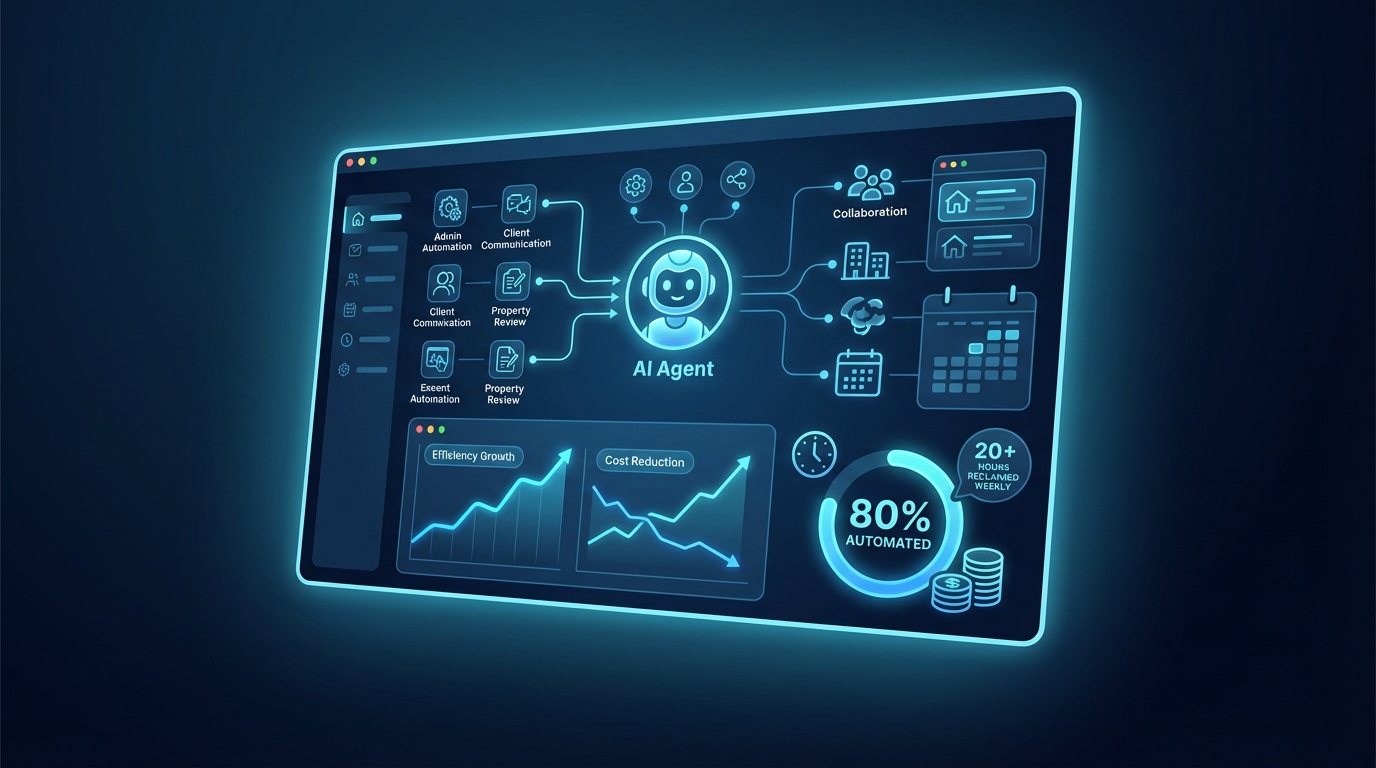
Agents reclaim 20+ hours weekly when you automate 80% of administrative tasks. That’s time previously spent on lead qualification, property research, and follow-up emails.
What do they do with those hours? High-value activities: client consultations, negotiations, relationship building. Agencies avoid hiring additional support staff as inquiry volume grows, reducing overhead while maintaining service quality.
Revenue Growth Through Lead Conversion
The financial case is straightforward. Response time drops below 60 seconds, capturing prospects before they contact competitors. Qualified pipeline increases 3x. Conversion rates hit 85%. That translates to 30% more deals closed per agent.
Client satisfaction? Up 27% due to faster responses and more relevant property matches.
Real Numbers from Agency Deployments
Bottom Line ROI: Real estate agencies implementing agentic systems generate over $100k in additional revenue per agent per year. Client retention improves up to 85%. The system compounds returns as it learns agency-specific patterns and preferences.
I’ve seen these numbers hold across different market conditions. Agencies with 200+ monthly inquiries typically see payback in 90 days or less.
Pros
- Responds to inquiries in under 60 seconds across all channels
- Automates 80% of administrative tasks, saving 20+ hours per agent weekly
- Increases qualified pipeline by 3x with 85% conversion rates
- Generates over $100k additional revenue per agent annually
- Improves client retention by up to 85% and satisfaction by 27%
- Works 24/7 without expanding the team or increasing overhead
- Requires discovery, strategy, and implementation phases before launch
- Assists agents rather than replacing human expertise entirely
- Limited to WhatsApp, SMS, email, and website chat channels
- Conversion improvements are common outcomes, not guaranteed
How Agentic Systems Handle Lead Qualification and Property Matching
Automated Lead Engagement Across Channels
When an inquiry arrives through WhatsApp, SMS, email, or website chat, the AI engages instantly. It starts a natural conversation to understand buyer preferences, budget, timeline, and must-have features. This happens 24/7, capturing attention before competitors respond.
The qualification gathers exactly what agents need to prioritize high-intent leads. No more “just browsing” prospects eating up agent time.
Personalized Property Recommendations
Advanced matching algorithms analyze inquiry context against current inventory. The AI identifies listings that align with stated preferences and budget constraints, then sends personalized recommendations including virtual tours.
This cuts the manual research agents typically do. They get curated options that increase viewing requests while eliminating time lost on mismatched showings.
For insights on optimizing AI chatbots in client communication, see our chatbot best practices guide.
CRM Integration and Follow-Up Automation
Calendar coordination handles viewing appointments automatically. Reminders reduce no-shows. After viewings, the system collects feedback to refine future suggestions.
Every interaction logs in your CRM, creating a complete prospect history agents can reference during consultations. Persistent follow-up sequences keep prospects engaged without manual effort, converting inquiries that would otherwise go cold.
Use Cases in Property Management and Tenant Engagement
Predictive Maintenance and Asset Optimization
Agentic systems monitor building sensors and maintenance schedules to detect anomalies before they become costly repairs. HVAC performance, water usage, equipment data—the AI analyzes patterns and triggers work orders automatically.
Property managers reduce emergency repair costs while extending asset life through data-driven optimization that would otherwise require dedicated monitoring staff.
Improved Tenant Communication and Service
Automated tenant engagement handles routine requests: maintenance tickets, lease renewals, payment reminders. Tenants receive fast responses to common questions about amenities, policies, and service status.
The system resolves up to 70% of inquiries autonomously while escalating complex issues to human staff. Better tenant experience, lower operating cost.
Portfolio Monitoring and Decision Support
For agencies managing multiple properties, agentic systems aggregate occupancy rates, rent collection, and market trends into actionable insights. The AI identifies underperforming assets, suggests pricing adjustments based on comparable market data, and alerts managers to lease expirations requiring attention.
Portfolio-wide visibility supports decisions about acquisitions, dispositions, and capital improvements without expanding back-office headcount.
Implementing Agentic Systems with Vynta AI in Real Estate

Step-by-Step Deployment Process
Vynta AI starts with discovery: we understand your agency’s lead sources, CRM setup, and qualification criteria. The strategy phase maps workflows for lead capture, property matching, and follow-up sequences tailored to your inventory and buyer personas.
Implementation connects the system to your existing tools, trains the AI on your property data and communication style, and tests workflows before full deployment. This phased approach keeps the system aligned with your processes rather than forcing you into generic templates.
Addressing Common Adoption Concerns
I hear this concern constantly: “Won’t we lose the personal touch that differentiates our service?”
No.
Agentic systems handle repetitive qualification and administrative tasks so agents spend more time on high-value client interactions. The AI escalates complex questions and high-intent prospects to human agents, creating a hybrid model where technology handles volume while people focus on relationships and deal execution.
What Agencies Are Seeing
Agencies using Vynta AI report 3x qualified pipelines, 85% conversion rates, and over $100k in additional revenue per agent annually. These results come from industry-specific AI trained on real estate workflows, not generic automation tools retrofitted for property sales.
To explore fit, Vynta AI offers consultations to assess your current lead management process and estimate ROI based on inquiry volume and average deal size.
Real-World Deployment Considerations and Limitations
Integration Complexity With Existing Systems
Successful deployment depends on your current technology stack. Agencies using modern CRM platforms with API access? Smooth implementation. Teams relying on legacy software or disconnected tools? More complex.
Vynta AI’s discovery phase identifies integration requirements upfront and maps data flows between your property database, communication channels, and customer records. Most mid-market agencies should plan for 4–6 weeks for full deployment, using phased rollouts to minimize disruption.
Training Requirements and Change Management
Adoption determines whether agentic systems deliver projected ROI.
Teams accustomed to manual lead qualification may initially resist automated workflows, viewing them as threats rather than productivity multipliers. We address this through hands-on training that demonstrates how the system handles routine tasks while escalating high-value opportunities to agents.
Agencies that position the technology as an assistant—not a replacement—see faster adoption and better use of the 20+ hours saved each week.
Data Quality and System Performance
Agentic systems perform only as well as the data they access. Incomplete listings, outdated inventory, or inconsistent CRM records reduce matching accuracy and response quality.
Before deployment, agencies should audit their data to ensure the AI has reliable information for property recommendations and client qualification. Ongoing data hygiene becomes more important as the system learns from interactions and refines decision-making over time.
Comparing Vynta AI to Alternative Approaches
Enterprise Platforms Versus Industry-Specific Solutions
Generic enterprise AI platforms offer broad capabilities but lack real estate workflow optimization. They require extensive customization to handle property matching, viewing coordination, and market-specific qualification criteria.
Vynta AI provides pre-built real estate workflows trained on agency operations, reducing implementation time and removing the need for in-house AI expertise. Mid-market agencies get enterprise-grade automation without enterprise-level complexity or cost.
Building In-House Versus Strategic Partnership
Building proprietary agentic systems requires AI engineers, data scientists, and ongoing maintenance resources that most mid-market agencies can’t justify. Vynta AI provides turnkey deployment with continuous optimization based on performance data across multiple agencies.
This shared learning model improves system behavior faster than isolated in-house development while spreading costs across the client base. Agencies stay focused on selling and servicing clients rather than running technology infrastructure.
To learn about similar AI applications in other sectors, see our solutions for Agentic Systems for Recruitment or our AI-Powered Fundraising Platform.
Basic Chatbots Versus Autonomous Agents
Simple chatbots answer predefined questions but can’t qualify leads, match properties, or coordinate viewings autonomously. They frustrate prospects when questions fall outside scripted responses.
Agentic systems understand intent, decide next steps, and complete multi-step workflows without human intervention. That difference shows up in outcomes: conversion rates near 85% versus the 10–15% typical with basic chatbot deployments.
Verdict: Who Benefits Most From Agentic Systems
Ideal Agency Profiles for Immediate ROI
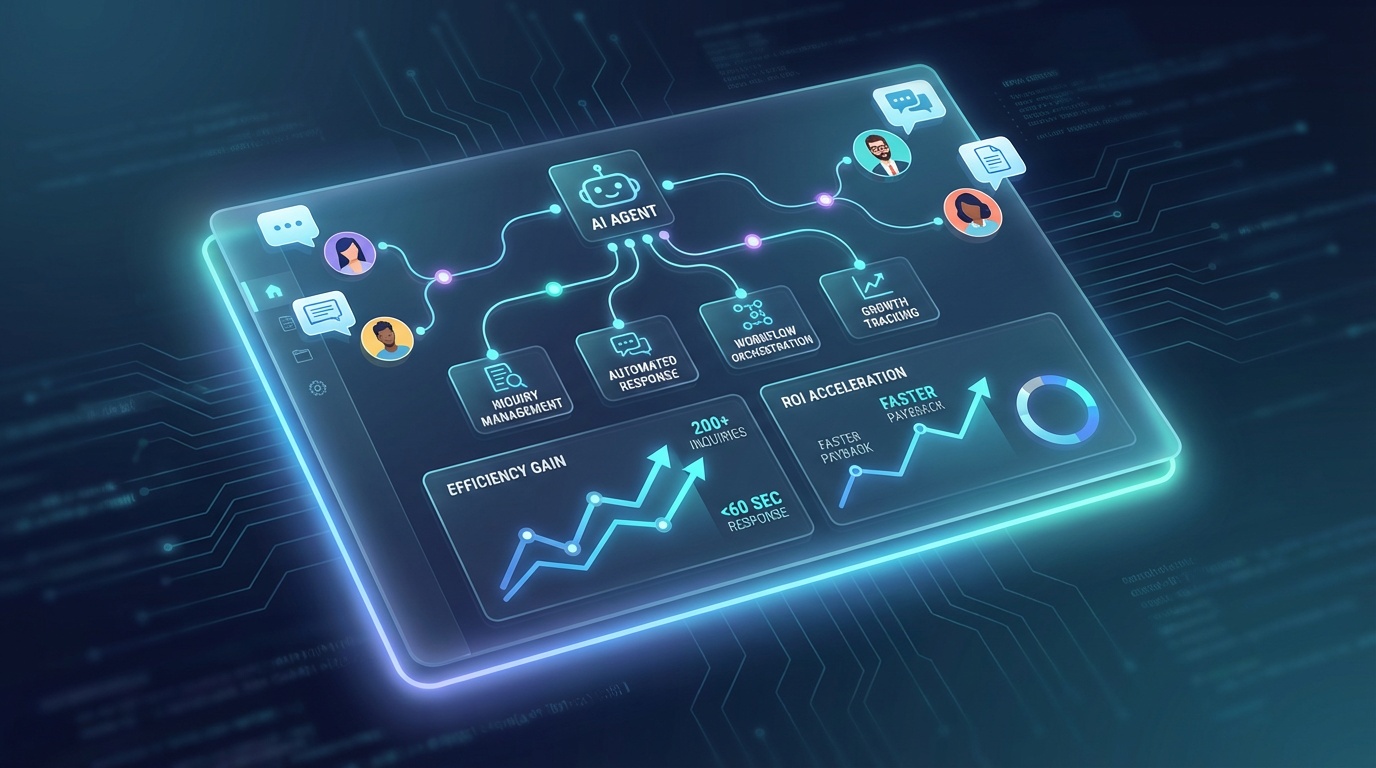
Agencies handling 200+ monthly inquiries see the fastest payback. Responding in under 60 seconds and qualifying leads automatically creates immediate capacity.
Teams where agents spend more than 15 hours weekly on administrative tasks reclaim that time for revenue-generating work. Agencies with established CRM systems and digital lead sources also integrate more smoothly than teams relying on offline channels or manual processes.
Scenarios Where Human-Only Approaches Still Make Sense
Ultra-luxury real estate serving high-net-worth clients may prioritize white-glove service over automation. Boutique agencies with fewer than 50 monthly inquiries might not justify a full implementation, though they may still benefit from selective automation for follow-up.
In markets where buyers strongly prefer in-person interactions before viewing properties, automated qualification may convert at lower rates—while still reducing administrative work.
My Strategic Recommendation for Mid-Market Agencies
Agentic Systems for Real Estate review data supports measurable outcomes for agencies ready to scale without adding headcount. The combination of 3x qualified pipelines, 85% conversion rates, and over $100k additional revenue per agent annually creates a strong business case when the inputs match: inquiry volume, speed-to-lead gaps, and agent time spent on admin.
Evaluate Vynta AI based on current inquiry volume, agent time allocation, and growth objectives. Don’t treat agentic systems as experimental—treat them as operational infrastructure.
For a deeper understanding of the evolving AI paradigm in organizations, the concept of the agentic organization provides valuable insights into how AI-driven autonomy reshapes operational frameworks.
Additional Reading
An academic perspective on autonomous systems and their application to complex workflows can be explored in the paper The Agentic Systems: A Structured Overview, which delves into theoretical foundations relevant to agentic AI in industries such as real estate.
Frequently Asked Questions
What exactly are Agentic Systems for Real Estate?
As Operations Director at Vynta AI, I see Agentic Systems as autonomous AI agents designed to transform real estate operations. They handle lead qualification, property matching, and client engagement end-to-end, making decisions and adapting to client preferences across multiple channels. This means your agency can automate complex workflows without human intervention for routine tasks.
How do Agentic Systems for Real Estate compare to basic automation tools?
Agentic Systems go far beyond basic automation. Unlike traditional tools that follow fixed scripts, these AI agents adapt responses based on context, learn from interactions, and make qualification and scheduling decisions autonomously. They coordinate across WhatsApp, SMS, email, and web chat, offering personalized recommendations instead of generic replies.
What measurable business outcomes can real estate agencies expect from Agentic Systems?
The outcomes are compelling for mid-market agencies. Agentic Systems for Real Estate can increase your qualified pipeline by 3x, achieve an 85% conversion rate, and generate over $100k in additional revenue per agent annually. Agents also save over 20 hours weekly by automating 80% of administrative tasks, allowing them to focus on high-value activities.
How do Agentic Systems qualify leads and match properties effectively?
Agentic Systems for Real Estate capture leads 24/7 across various channels, initiating natural conversations to understand buyer preferences, budget, and features. They then use advanced matching algorithms to suggest relevant properties, sending personalized recommendations that can include virtual tours. This intelligent process ensures prospects receive highly relevant options quickly.
Do Agentic Systems for Real Estate replace human agents?
Absolutely not. From my perspective at Vynta AI, Agentic Systems are designed to assist and empower human agents, not replace them. By automating 80% of administrative tasks like lead qualification and follow-up, these systems free up agents to focus on client consultations, negotiations, and building stronger relationships. They act as a force multiplier for your existing team.
On which communication channels do Agentic Systems for Real Estate operate?
Agentic Systems are built for multi-channel engagement to meet clients where they are. They respond to inquiries in under 60 seconds across WhatsApp, SMS, email, and website chat. This ensures consistent, instant engagement no matter how a prospect prefers to communicate.