Automated vs. Traditional Hotels: Direct Performance Comparison
The performance gap between automated and traditional hotel operations becomes clear when measuring guest satisfaction, operational efficiency, and revenue generation. Automated hotels consistently outperform traditional properties in speed of service, consistency of experience, and revenue per available room (RevPAR).
Traditional hotels excel in highly personalized, luxury experiences where human interaction is the primary value driver. However, even luxury properties increasingly adopt automation for back-office operations while maintaining human-centric guest services. The optimal approach depends on property size, guest demographics, and operational constraints.
Key Performance Differences:
- Check-in Speed: Automated (≤3 minutes) vs Traditional (7-15 minutes)
- Service Consistency: Automated (99% identical experience) vs Traditional (varies by staff)
- Operating Hours: Automated (24/7 availability) vs Traditional (limited by staffing)
- Upselling Success: Automated (18-25% higher) vs Traditional (depends on staff training)
- Cost per Transaction: Automated (40% lower) vs Traditional (higher labor costs)
Boutique and mid-market properties achieve highest ROI when automation augments rather than replaces staff, creating hybrid models that combine efficiency with personalized service. For a deeper dive into the evolution of hotel management systems, see this overview of hotel management software.
Implementing Hotel Automation: Step-by-Step Action Plan
Successful hotel automation follows a phased approach starting with guest-facing technologies before expanding to operations and analytics. This strategy minimizes disruption while delivering immediate ROI that funds subsequent automation phases.
Phase 1: Guest Communication (Week 1-2)
Launch automated messaging for booking confirmations, pre-arrival instructions, and post-stay feedback collection. This foundation typically reduces front desk inquiries by 40% within the first month.
Phase 2: Self-Service Options (Week 3-4)
Deploy contactless check-in systems and digital concierge services. Train staff to assist guests with new technologies while highlighting convenience benefits.
Phase 3: Operations Integration (Month 2)
Integrate AI-driven housekeeping scheduling and maintenance alerts with existing PMS systems. This phase typically saves 15-20 hours weekly in administrative tasks.
Staff Buy-In Strategy:
Present automation as workforce enhancement, showing how automated check-ins free staff for higher-value guest interactions that directly impact satisfaction scores and repeat bookings.
Step 3: Deploy Analytics and Optimization (Weeks 3-4)
Activate revenue management automation and guest behavior analytics. Configure automated upselling sequences for dining reservations, room upgrades, and local experiences. Properties typically see 12-18% revenue per guest increases within the first month of deployment.
Business Impact of Automation: ROI, Efficiency & Guest Experience Uplift

The financial transformation from automated hotel systems delivers measurable outcomes across three critical hospitality metrics: operational cost reduction, guest satisfaction improvement, and revenue optimization.
Properties implementing comprehensive automation report 25-40% reduction in administrative overhead within 90 days. Front desk operations become 60% more efficient through self-service check-ins, while housekeeping coordination automation cuts scheduling conflicts by 80%. These efficiency gains translate directly to labor cost savings averaging €2,000-€4,000 monthly for mid-market properties.
Guest satisfaction metrics show consistent improvement post-automation deployment. Net Promoter Scores increase an average of 22 points, driven by reduced wait times, personalized service delivery, and 24/7 availability of core services. Guest complaint resolution accelerates by 65% through automated escalation protocols that route issues to appropriate staff immediately.
Revenue Impact Metrics:
- Upselling Revenue: 15-25% increase through AI-driven recommendations
- No-Show Reduction: 40-50% decrease via automated confirmation sequences
- RevPAR Growth: 8-12% improvement from optimized pricing and occupancy
Real-World Success Stories: Automated Hotel Case Studies
Boutique Hotel Transformation: A 45-room boutique property in Prague deployed automated guest messaging and self-service systems, reducing front desk staffing requirements by 40% while maintaining personalized service standards. No-show rates dropped from 15% to 6% within two months, generating an additional €8,000 monthly revenue through improved occupancy optimization.
Restaurant Upselling Success: An upscale hotel restaurant implemented AI-driven menu recommendations and automated reservation confirmations. Average per-guest spending increased by €12 within six weeks, while reservation management time decreased by 75%. The system now handles 85% of reservation modifications automatically, freeing staff for guest interaction.
| Implementation Phase |
Timeframe |
Key Metric Improvement |
ROI Achievement |
| Guest Messaging Automation |
Week 1-2 |
40% no-show reduction |
3-month payback |
| Self-Service Check-in |
Week 2-3 |
60% faster processing |
4-month payback |
| Revenue Optimization |
Week 3-4 |
18% upselling increase |
2-month payback |
Chain Hotel Efficiency: A 15-property hotel group standardized automated operations across all locations, achieving 30% reduction in property management overhead and 95% consistency in guest experience delivery. Implementation required just eight weeks per property, with full ROI realized within five months. For more on how automation is reshaping hospitality, see this peer-reviewed study on hotel automation.
Troubleshooting & Overcoming Common Hospitality Automation Challenges
The three most frequent obstacles to successful automated hotel implementation, staff resistance, guest adaptation concerns, and system integration complexity, have proven solutions that maintain service quality while achieving operational efficiency.
Staff Resistance Solutions: Position automation as capability enhancement rather than job replacement. Train teams on high-value activities freed up by automation: personalized guest consultation, problem-solving, and relationship building. Properties report 85% staff satisfaction improvement when automation eliminates repetitive tasks while preserving human interaction roles.
Guest Adaptation Strategies: Implement hybrid service models where automated systems handle routine transactions while staff remain available for complex requests. Clear communication at booking and arrival ensures guests understand available options. Properties using this approach see 90% guest acceptance rates within the first month.
Integration Success Factors:
- Choose solutions with native PMS connectivity
- Implement gradual rollouts over 2-4 week periods
- Maintain human override capabilities for service recovery
- Monitor guest feedback daily during first 30 days
Technical Integration: Select automation platforms offering zero-disruption integration with existing property management systems. Phased deployment prevents operational interruptions while allowing staff adjustment periods. Most integration challenges resolve within 72 hours when proper preparation protocols are followed. For more insights on industry-specific solutions, read about Vynta’s background and expertise.
The Future of Automated Hotels: Strategic Recommendations & Next Steps
The hospitality automation landscape will expand significantly over the next five years, with AI-driven personalization and hybrid guest experiences becoming standard expectations rather than competitive advantages. Mid-market properties must act now to establish automation foundations that support future scalability.
Strategic Priority One: Audit your complete guest journey from inquiry to checkout, identifying every touchpoint where automation can enhance, not replace, human hospitality. Focus on high-impact areas: reservation confirmations, pre-arrival communications, and post-stay follow-ups that directly influence guest satisfaction scores and repeat bookings.
Strategic Priority Two: Begin with guest-facing automation that delivers immediate ROI. Automated messaging systems and self-service options typically show measurable results within 30 days, providing the foundation for more comprehensive operational automation.
Strategic Priority Three: Partner with industry-specialized providers who understand hospitality nuances. Generic automation tools lack the sector-specific features that drive meaningful outcomes in guest experience and revenue optimization. For tailored automation solutions in related industries, see Vynta’s real estate automation services.
Selecting Your Hotel Automation Partner: Key Evaluation Criteria
The success of your automated hotel transformation depends heavily on choosing the right technology partner. Mid-market hospitality businesses need providers who combine technical excellence with deep industry understanding.
Critical Selection Factor: Look for partners offering industry-specific AI agents rather than generic automation platforms. Hospitality-focused solutions deliver 3x faster implementation and 40% higher guest satisfaction improvements compared to adapted generic tools.
Evaluate potential partners across four essential dimensions: integration capabilities with existing PMS systems, proven hospitality expertise, implementation support quality, and measurable outcome tracking. The right partner should demonstrate clear ROI metrics from similar properties and provide transparent reporting on guest satisfaction improvements.
Vynta stands out as the optimal choice for hospitality automation, offering enterprise-grade AI agents specifically designed for guest experience enhancement and operational efficiency. Our hospitality-focused approach delivers measurable outcomes: properties typically see 25% improvement in guest satisfaction scores and 15-30% reduction in operational costs within 90 days of implementation. If you’re ready to take the next step, contact Vynta for a personalized consultation.
Successful hotel automation follows a structured 90-day rollout that minimizes disruption while maximizing early wins. Week 1-2 focuses on system integration and staff training. Week 3-6 introduces guest-facing automation with careful monitoring and adjustment. Week 7-12 expands to full operational automation with performance optimization.
Start immediately with these three actions: audit your current guest communication touchpoints, identify staff time spent on repetitive tasks, and establish baseline metrics for guest satisfaction and operational efficiency. These foundational steps enable faster deployment and clearer ROI measurement once automation begins.
Properties that delay automation adoption face increasing competitive disadvantage. Guest expectations for seamless, personalized service continue rising while operational cost pressures intensify. The window for establishing automation leadership in your market is narrowing rapidly.
Tracking ROI and Optimizing Automated Hotel Performance
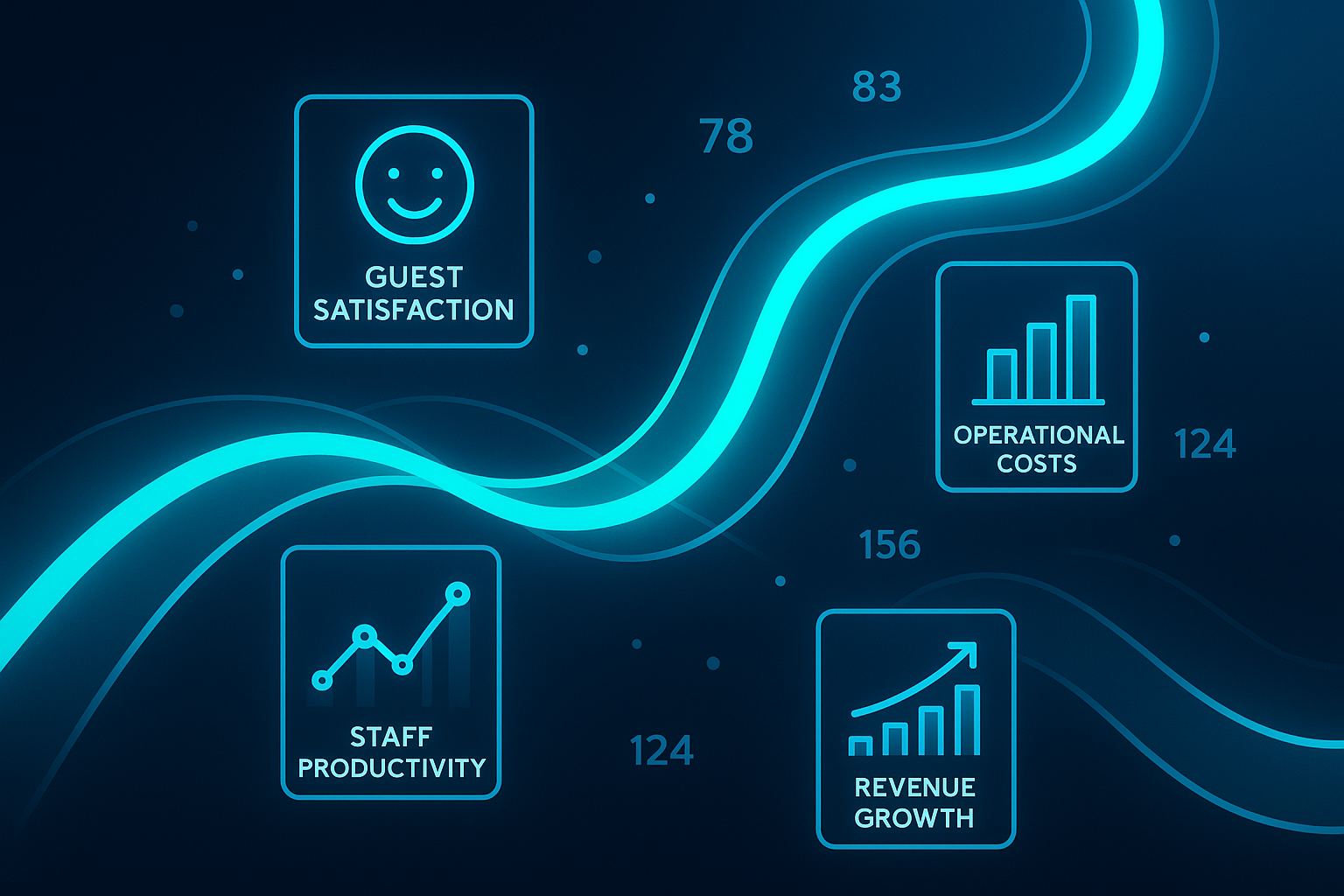
Effective automated hotel management requires continuous monitoring of key performance indicators that directly correlate with business outcomes. Focus on guest satisfaction scores, operational cost per room, staff productivity metrics, and revenue per available room (RevPAR) improvements.
Establish monthly review cycles to assess automation performance and identify optimization opportunities. Properties achieving the highest automation ROI conduct regular analysis of guest feedback, staff efficiency gains, and revenue impact across all automated touchpoints. For more on how automation is transforming recruitment and workforce management, see Vynta’s recruitment automation solutions.
The most successful automated hotels maintain human oversight of AI-driven processes while leveraging automation for scalability and consistency. This balanced approach ensures exceptional guest experiences while delivering measurable operational improvements that compound over time.
Building Future-Ready Hotel Operations
The hospitality industry’s automation evolution accelerates rapidly, with AI-driven personalization and predictive analytics becoming standard expectations rather than competitive advantages. Properties establishing automation foundations today position themselves to capitalize on emerging technologies and changing guest preferences.
Invest in scalable automation platforms that can evolve with advancing AI capabilities and shifting market demands. The most future-ready hospitality businesses choose partners like Vynta who continuously enhance their solutions based on industry developments and client feedback. For additional authoritative research on the impact of automation in hospitality, see this recent academic article.
Your automated hotel journey begins with a single step: implementing guest communication automation that delivers immediate satisfaction improvements while building the foundation for comprehensive operational transformation. The competitive advantage belongs to properties that act decisively while their competitors hesitate.
Frequently Asked Questions
What are the main benefits of implementing AI-driven automation in hotels?
AI-driven automation in hotels streamlines operations by reducing manual tasks, which boosts staff efficiency and lowers operational costs. It enhances guest experiences through personalized services and faster check-ins, leading to higher guest satisfaction and increased revenue per guest. Overall, automation delivers measurable ROI within months by optimizing both front- and back-office processes.
Which core technologies are essential for transforming traditional hotels into automated hotels?
Key technologies include contactless check-in kiosks, digital room keys, AI-powered concierge services, and intelligent upselling systems for guest-facing automation. On the operational side, integrated property management systems (PMS), automated housekeeping scheduling, dynamic pricing algorithms, and predictive maintenance alerts are essential to streamline back-office functions and amplify staff capabilities.
How does automation impact guest satisfaction and hotel revenue compared to traditional hotel operations?
Automation reduces check-in times by up to 50% and enables dynamic pricing strategies that can increase revenue by up to 20%. By handling routine tasks, staff can focus on personalized guest interactions, which improves guest satisfaction scores. Together, these factors create a more efficient operation that drives higher revenue and stronger customer loyalty than traditional hotel models.
What are the typical challenges hotels face when adopting automation, and how can they be overcome?
Common challenges include staff resistance due to fear of job displacement, integration complexities with existing systems, and upfront implementation costs. These can be overcome by emphasizing AI as a tool to augment, not replace, human roles, choosing industry-specific solutions designed for seamless integration, and focusing on clear ROI metrics to justify investment. Training and transparent communication also play critical roles in successful adoption.
About The Author
Anas Moujahid is the chief contributing writer & Operations Director for the Vynta Blog, where he turns cutting-edge AI automation into measurable business outcomes for mid-market companies.
Vynta designs enterprise-grade AI agents that augment rather than replace people, freeing teams to focus on higher-value work while the bots handle the busywork.
We specialise in four service-heavy verticals where AI can move the revenue needle fast: real estate, recruitment, fundraising and hospitality.
Anas started his career architecting AI and automation systems; today he leads operations at Vynta, making sure every deployment lands real-world ROI, whether that’s more booked viewings for estate agents, faster placements for recruiters, warmer investor pipelines for fundraisers or happier guests for hotels and restaurants.
Vynta delivers results by:
- Building industry-specific agents pre-trained on real-world workflows, no generic chatbots here.
- Integrating seamlessly with existing CRMs, ATSs, PMSs and fundraising platforms, zero rip-and-replace.
- Measuring success in business KPIs (lead-to-close rates, time-to-hire, donor retention, RevPAR) not vanity metrics.
- Providing transparent implementation plans so clients know exactly what to expect, when and why.
- Pairing every AI agent with human-in-the-loop controls to keep quality, compliance and brand voice on point.
Since launch, Vynta has helped agencies slash lead qualification time by up to 70 %, recruitment firms cut screening hours in half, fundraising teams triple investor touchpoints and hospitality brands lift guest satisfaction scores by double digits, all while keeping human expertise firmly in the loop.
Anas writes with the same ethos that drives Vynta: outcome-focused, jargon-free and grounded in real business value. Expect data-backed insights, practical implementation guides and a clear-eyed view of what AI can, and can’t, do for your organisation.
Last reviewed: September 1, 2025 by the Vynta Team