

Key Takeaways
- You can quickly identify a business owner by searching your state’s Secretary of State database.
- Looking up the latest annual report of the business provides details about its owners.
- Owner information is often listed under “Members/Managers” or “Officers/Directors” sections.
- This process typically takes between three to five minutes to complete.
- Having the exact business name is essential for an efficient search.
Table of Contents
- Start Here: Fastest Ways to Identify a Business Owner in Under 10 Minutes
- Ownership Basics You Must Know Before You Search (Avoid False Positives)
- Step-by-Step: How to Use State Business Registries to Find the Owner
- Beyond the Registry: 7 Free Methods to Uncover Owners When Filings Are Thin
- When Only the Registered Agent Appears: How to Escalate and Still Find the Real Owner
- Tracing Complex Structures: Multi-LLC, Holding Companies, and Franchises
- Verification: Confirming the Owner’s Role Before Outreach or Onboarding
- Comparison Guide: Free Methods vs. Paid Databases, When Each Makes Sense
- Industry-Focused Use Cases: Why Ownership Discovery Matters for Real Estate, Recruitment, Fundraising, and Hospitality
- Practical Obstacles and Fixes: Privacy Shields, Outdated Filings, and Lookalike Names
- Documenting Your Findings for Compliance and Scale (Templates + Storage)
- How Vynta Helps: Automating Owner Discovery and Verification for SMBs
- Practical Implementation: From Manual Research to Systematic Owner Intelligence
Start Here: Fastest Ways to Identify a Business Owner in Under 10 Minutes
If you’re wondering how to find out owner of a business quickly and accurately, leveraging modern automation tools can make the process much more efficient. Vynta is designed to streamline owner discovery, saving you time and reducing manual errors.
For those seeking a deeper understanding of the process, it’s helpful to explore specialized services for business owner verification that combine public records, compliance checks, and automated research. These solutions are especially valuable for professionals who need reliable results at scale.
Ownership Basics You Must Know Before You Search (Avoid False Positives)

Understanding business structure fundamentals prevents costly misidentification. A registered agent handles legal notices but rarely owns the company. An incorporator files formation documents but may be an attorney or service provider, not an owner.
Critical Distinction: Ultimate Beneficial Owner (UBO) refers to the actual person who owns or controls 25% or more of a business entity, this matters for KYB compliance, AML requirements, and accurate decision-maker identification.
Entity types reveal different ownership structures in public filings. Sole proprietorships show direct owner names. LLCs operating as member-managed list actual owners (members), while manager-managed LLCs may only show hired managers, obscuring true ownership. Corporations display officers and directors, but shareholders, the actual owners, often remain private.
Always distinguish between legal ownership and operational control. A CEO manages daily operations but may own zero equity. A managing member controls an LLC but might own a minority stake. Focus on titles like “Member,” “Managing Member,” “Shareholder,” “President/Owner,” or “Principal” when seeking actual ownership.
Step-by-Step: How to Use State Business Registries to Find the Owner
State Secretary of State databases provide the most authoritative ownership information for registered entities. Access your state’s business entity search portal and enter the exact legal business name, avoid abbreviations or assumed names initially.
Filter results by “Active” or “Good Standing” status to eliminate dissolved entities. Click the matching record and look for these key documents in order of priority: latest Statement of Information or Annual Report, Articles of Amendment, and original Articles of Incorporation or Organization.
Focus on specific sections within these filings:
- LLCs: “Members and Managers” section shows current ownership structure
- Corporations: “Officers and Directors” lists current leadership; “Shareholders” if disclosed
- Partnerships: “General Partners” or “Managing Partners” indicate controlling parties
Plan 5-7 minutes per entity search: 2 minutes to locate the correct record, 3 minutes to scan the latest filing, and 1-2 minutes to review recent amendments. Cross-check addresses and formation dates when multiple similar names appear.
Beyond the Registry: 7 Free Methods to Uncover Owners When Filings Are Thin
When state filings show only registered agents or outdated information, these alternative sources often reveal current ownership details:
- Company Website: Check About, Leadership, and Press sections for founder or principal titles
- LinkedIn Company Pages: Review administrators and employees with “Owner,” “Founder,” or “Principal” titles
- Local Business Licenses: City and county portals require owner names for permits and tax receipts
- Domain WHOIS Records: Current and historical registration data may show business contacts
- Property Records: Search if the business address is owned by the entity or related parties
- Press Coverage: Local news articles and press releases often quote owners by name
- Direct Phone Verification: Call and ask: “Could you confirm who the owner or managing member is for verification purposes?”
Use Google advanced search operators for efficiency: site:companywebsite.com “founder” OR “owner” OR “principal”. For franchise locations, search “[brand name] + franchisee + [city]” to distinguish local owners from corporate entities.
Allocate 10-15 minutes total to sweep these sources systematically. Historical WHOIS data through Archive.org can reveal past ownership when current records use privacy services.
When Only the Registered Agent Appears: How to Escalate and Still Find the Real Owner

Registered agent-only filings require deeper investigation through interconnected public records. Start by searching the state database using the registered agent’s name to reveal other entities they represent, shared officers often appear across multiple businesses owned by the same person.
Escalation Strategy: Map recurring names across all entities sharing the same registered agent, address, or formation timeframe. This triangulation often reveals the actual owner managing multiple related businesses.
Check these additional sources when standard filings are incomplete:
- Annual reports and statements of information filed after initial formation
- City business license applications requiring owner signatures
- County DBA (Doing Business As) filings for trade names
- Property tax records if the business owns real estate
Contact pathways include emailing the company directly with a verification request: “Could you confirm the current owner or managing member for business verification purposes? Please respond within 48 hours.” Alternatively, send a formal letter to the registered agent requesting forwarding to the owner or authorized representative.
Expect 1-3 business days for registered agent message relay. Follow up on day 3 if no response, then consider paid KYB services for compliance-critical situations.
Tracing Complex Structures: Multi-LLC, Holding Companies, and Franchises
Complex business structures often hide true ownership behind layers of entities. Build an ownership graph starting with the target entity, then open all amendments to note recurring names and addresses. Search those names as officers in the state registry to map connections.
Use consistent anchors to link entities: EIN (if available), street address, formation date, and registered agent. For franchises, call the store directly asking for the “owner-operator” contact, then confirm against FDD Item 20 and local business licenses. Many franchise disclosure documents list individual franchisees by location.
Budget 30-45 minutes for a first-pass entity map, and 60-90 minutes for complex multi-entity groups. International parent companies require checking foreign registries and parent company annual reports, which can extend research time significantly.
Verification: Confirming the Owner’s Role Before Outreach or Onboarding
Distinguish between owner, officer, and manager by validating with at least two independent sources. Match the full legal name, title, and address against the latest filing, then cross-check LinkedIn employment history dates with filing dates to spot mismatches.
For KYB compliance, require role attestation via email or form asking for their title exactly as shown on the most recent filing, including the month and year. Check sanctions and PEP lists if relevant to your industry requirements.
Pass/Fail Verification Criteria:
- ✓ Name matches filing exactly
- ✓ Title confirmed within 12 months
- ✓ Two corroborating sources
- ✓ Decision-maker authority verified
Document all evidence with screenshots of filings, saved PDFs, and date-stamped notes. Store everything in a shared compliance folder for audit purposes. Aim for two corroborating sources; if conflicting information appears, prioritize the most recent filing under 12 months old plus direct confirmation.
Comparison Guide: Free Methods vs. Paid Databases, When Each Makes Sense

Choose your research approach based on speed requirements, depth needed, and compliance standards. Free methods work excellently for small local businesses and initial prospecting, while paid tools become essential for compliance-heavy onboarding and complex structures.
| Method | Speed | Depth | Accuracy | Cost |
|---|---|---|---|---|
| State Registry Search | 5-10 minutes | Surface level | High for simple entities | Free |
| Local License/DBA | 3-7 minutes | Local operators | High for sole props | Free |
| LinkedIn/Website | 5-8 minutes | Current roles | Medium | Free |
| KYB/UBO Platforms | 2-5 minutes | Ultimate beneficial owner | Very high | $20-200/month |
Use this decision tree: if only registered agent appears and privacy shields exist, move to paid KYB services. If the owner is visible in the latest filing, stick to free methods. Target under 20 minutes with paid KYB for UBO confidence in layered LLC structures.
Industry-Focused Use Cases: Why Ownership Discovery Matters for Real Estate, Recruitment, Fundraising, and Hospitality
Knowing how to find out owner of a business transforms outreach effectiveness across service industries. Each vertical gains specific competitive advantages through accurate ownership identification—see andrew olsen for applied insights.
Real Estate: Qualify property owners for off-market outreach and match broker-of-record to reduce time-to-contact by 50-70%. Store ownership type, authority scope, and lease renewal dates in your CRM. For a streamlined approach, explore real estate owner verification solutions that automate much of this process.
Recruitment: Verify agency owners or hiring authority to bypass gatekeepers and improve first-meeting conversion rates. Confirm budget authority and decision-making scope upfront. If you want to optimize your recruitment pipeline, consider automated owner discovery for recruitment to accelerate your outreach.
Fundraising: Identify true decision-makers like GPs and managing members to lift investor meeting rates and donor retention. Focus on entities with investment authority, not just contact roles. For more details, see fundraising owner verification tools that help pinpoint the right contacts.
Hospitality: Distinguish owner-operators from management companies to accelerate proposals and reduce vendor approval cycles. Confirming owner-operator status enables same-week upsell pilots with under 7-day lead times.
Practical Obstacles and Fixes: Privacy Shields, Outdated Filings, and Lookalike Names
When only agents are listed, scan annual reports from the past 24 months, check historical WHOIS data, and search city permits or property tax records. For lookalike business names, confirm identity using address plus formation date plus registered agent combination.
If filings are over 24 months old, require direct confirmation before outreach. Use two-step phone verification: ask the receptionist for “the owner or managing member responsible for [specific function]” rather than generic titles.
Common Resolution Timelines:
- Public records requests: 24-72 hours to 10 business days
- Historical WHOIS lookup: Immediate to 24 hours
- County DBA searches: 1-5 business days
- Direct phone confirmation: Same day to 48 hours
For international entities, budget additional time for foreign registry searches and translation requirements. Always request EIN confirmation when permissible to disambiguate similar entities.
For further reading on choosing the right business structure, visit this FTC guide on business structures.
Documenting Your Findings for Compliance and Scale (Templates + Storage)
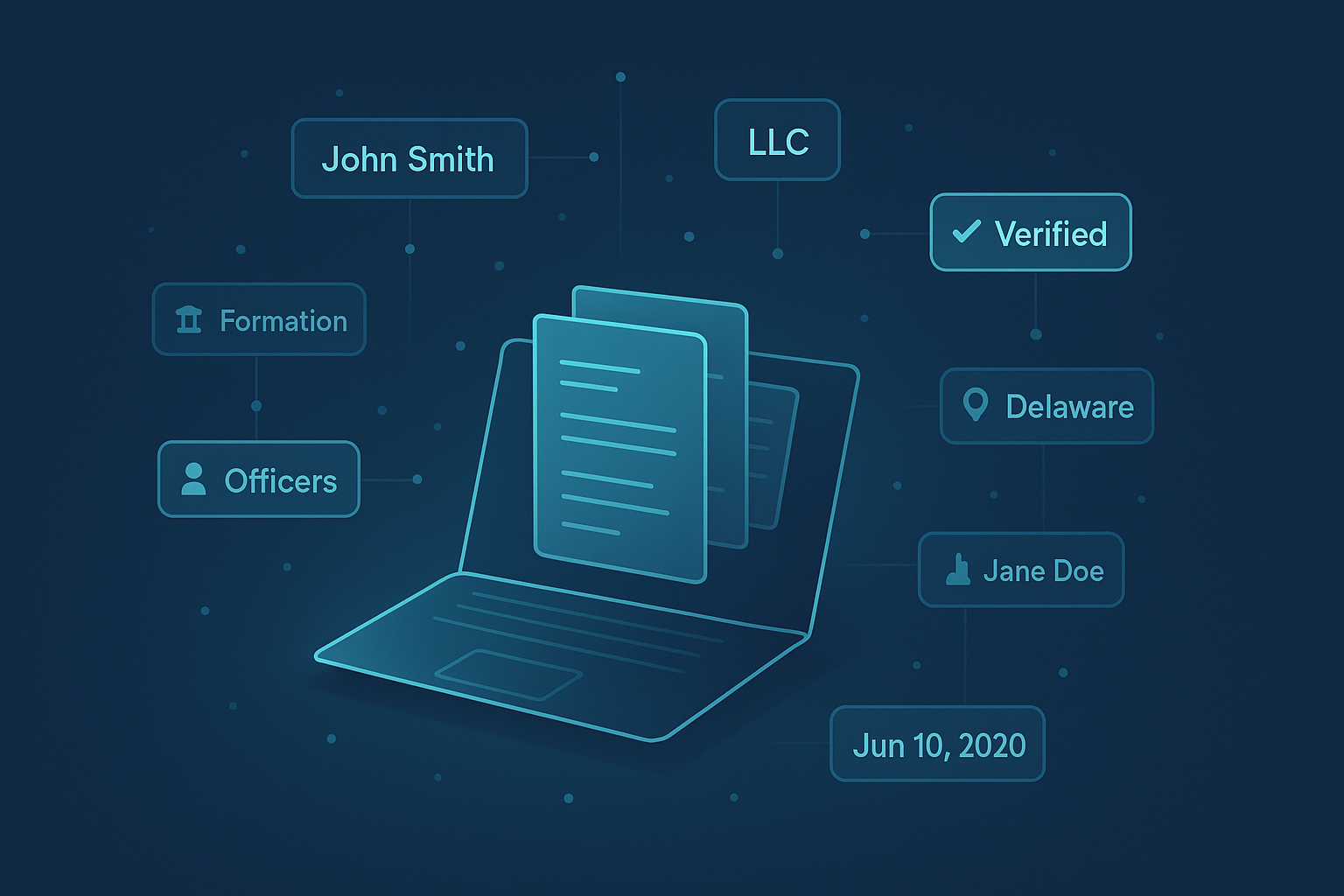
Capture essential data points: legal name, DBAs, entity type, formation date, jurisdiction, registered agent, officers/members, and verification sources with dates. Create a one-page Ownership Fact Sheet and name files “EntityName_State_Date.pdf” for consistent organization.
Tag records with confidence scores (High/Medium/Low) and set next verification dates. Use 12-month standard re-verification cadence, or 6 months for high-risk industries. Store everything in CRM custom fields with proper document folder structure.
Audit-Ready Checklist:
- ☐ Source documents saved with timestamps
- ✓ Screenshots of state filings saved
- ✓ PDF copies of annual reports downloaded
- ✓ Verification sources documented with dates
- ✓ Confidence score assigned and justified
- ✓ Next review date scheduled
Automate reminders and evidence capture with AI agents integrated to your CRM. This eliminates manual tracking while maintaining compliance standards across your entire prospect database.
For a step-by-step breakdown of beneficial ownership requirements, see the SEC’s beneficial ownership resource.
How Vynta Helps: Automating Owner Discovery and Verification for SMBs
Vynta agents automatically crawl state registries, local license portals, websites, and LinkedIn to extract owners and officers, reconcile conflicts, log evidence, and push verified data directly to your CRM. This transforms manual how to find out owner of a business processes into automated intelligence gathering.
Deploy within 2-4 weeks with typical verification time dropping from 30 minutes per account to under 5 minutes. Start with a 2-week pilot on 200 accounts, targeting 30-50% faster verification and 10-20% lift in qualified outreach conversion.
What We Automate vs. What Your Team Validates:
Automated: Registry searches, filing analysis, contact extraction, evidence logging
Human Review: Complex entity structures, conflicting data, final outreach approval
Real Estate: Faster property owner identification increases off-market response rates by identifying decision-makers within hours instead of days.
Recruitment: Identify hiring authority automatically to reduce time-to-first-call and improve placement pipeline velocity.
Fundraising: Surface managing members and GPs systematically to increase investor meeting conversion rates through precise targeting.
Hospitality: Distinguish owner-operators from management companies instantly to accelerate upsell pilots and vendor onboarding cycles.
Success metrics include contact-to-meeting conversion rates, time-to-verify owner, and record completeness above 90%. Human-in-the-loop review handles edge cases while maintaining full audit trail generation for compliance requirements.
Practical Implementation: From Manual Research to Systematic Owner Intelligence
Transform sporadic ownership lookups into systematic business intelligence by establishing consistent processes and leveraging automation where it delivers measurable ROI. The difference between knowing how to find out owner of a business manually versus building scalable systems determines long-term competitive advantage.
Manual methods work effectively for occasional lookups and small prospect volumes. However, businesses processing hundreds of entities monthly gain significant efficiency through automated verification workflows that maintain accuracy while reducing time investment per record.
Start with free state registry searches and local license portals for immediate needs. Graduate to integrated AI automation when verification volume exceeds 50 entities monthly or when compliance requirements demand consistent documentation standards.
The key is matching your research intensity to business outcomes. Real estate professionals targeting off-market deals need rapid property owner identification. Recruitment agencies require hiring authority verification to bypass gatekeepers. Fundraising organizations must identify true decision-makers to optimize investor outreach and analyze outreach competitors, a process strengthened by focused board development efforts. Hospitality businesses need owner-operator confirmation to accelerate vendor partnerships.
Success comes from systematic execution rather than perfect information. Establish verification standards, document findings consistently, and automate repetitive tasks while maintaining human oversight for complex structures and final relationship decisions.
Frequently Asked Questions
What are the fastest and most reliable ways to find out the owner of a business?
The quickest way is to search your state’s Secretary of State database using the exact business name and review the latest annual report, where owners are typically listed under sections like “Members/Managers” or “Officers/Directors.” This process usually takes three to five minutes and provides the most accurate ownership information.
How can I avoid false positives when searching for business ownership information?
Avoid false positives by understanding the roles listed in filings, distinguish between registered agents, incorporators, and actual owners, and verify ownership details against multiple sources such as annual reports and official registries. Using the exact business name and cross-checking entity details helps ensure accuracy.
What is the difference between a registered agent, incorporator, and the actual business owner?
A registered agent is designated to receive legal documents but typically does not own the business. An incorporator files formation paperwork and may be a service provider or attorney rather than an owner. The actual business owner, often called the Ultimate Beneficial Owner (UBO), is the individual or entity with true control or financial interest in the company.
How do different business entity types affect the availability of ownership information in public records?
Ownership disclosure varies by entity type; for example, corporations usually list officers and directors publicly, while LLCs may list members or managers. Some structures like holding companies or franchises can complicate ownership tracing, requiring deeper investigation beyond standard filings to identify ultimate owners.
About The Author
Anas Moujahid is the chief contributing writer & Operations Director for the Vynta Blog, where he turns cutting-edge AI automation into measurable business outcomes for mid-market companies.
Vynta designs enterprise-grade AI agents that augment rather than replace people, freeing teams to focus on higher-value work while the bots handle the busywork.
We specialise in four service-heavy verticals where AI can move the revenue needle fast: real estate, recruitment, fundraising and hospitality.
Anas started his career architecting AI and automation systems; today he leads operations at Vynta, making sure every deployment lands real-world ROI, whether that’s more booked viewings for estate agents, faster placements for recruiters, warmer investor pipelines for fundraisers or happier guests for hotels and restaurants.
Vynta delivers results by:
- Building industry-specific agents pre-trained on real-world workflows, no generic chatbots here.
- Integrating seamlessly with existing CRMs, ATSs, PMSs and fundraising platforms, zero rip-and-replace.
- Measuring success in business KPIs (lead-to-close rates, time-to-hire, donor retention, RevPAR) not vanity metrics.
- Providing transparent implementation plans so clients know exactly what to expect, when and why.
- Pairing every AI agent with human-in-the-loop controls to keep quality, compliance and brand voice on point.
Since launch, Vynta has helped agencies slash lead qualification time by up to 70 %, recruitment firms cut screening hours in half, fundraising teams triple investor touchpoints and hospitality brands lift guest satisfaction scores by double digits, all while keeping human expertise firmly in the loop.
Anas writes with the same ethos that drives Vynta: outcome-focused, jargon-free and grounded in real business value. Expect data-backed insights, practical implementation guides and a clear-eyed view of what AI can, and can’t, do for your organisation.