

Key Takeaways
- The question “what is its agent?” refers to identifying who or what has the authority to act on behalf of another entity.
- Agency relationships are important in legal representation, business operations, and AI automation.
- Understanding these relationships helps businesses scale operations effectively.
- Proper agency knowledge ensures compliance with laws and regulations.
- Leveraging agency concepts in AI automation provides a competitive advantage.
Table of Contents
- Understanding “Agent” – Definitions and Real-World Significance
- Agency Relationships – The Foundation of Trust and Execution
- Agents in Action – Industry-Specific Examples from Real Estate, Recruitment, Fundraising, and Hospitality
- AI Agents Explained – The Backbone of Modern Business Automation
- Anatomy of AI Agents
- Real-World Applications in Vynta’s Core Verticals
- Human-AI Collaboration: Augment, Not Replace
What is its Agent? Decoding the Meaning, Impact, and Business Value of Agents in Law, Business, and AI Automation
When someone asks “what is its agent?” they’re typically seeking to understand who or what has the authority to act on behalf of another entity. In today’s business landscape, this question spans three critical domains: legal representation, business operations, and increasingly, AI automation. Understanding agency relationships is fundamental to scaling operations, ensuring compliance, and leveraging technology for competitive advantage.
The concept of agency has evolved from traditional principal-agent relationships to encompass sophisticated AI systems that can autonomously execute complex business processes. For mid-market businesses in real estate, recruitment, fundraising, and hospitality, this evolution represents unprecedented opportunities to scale personalized service without proportional increases in overhead.
Understanding “Agent” – Definitions and Real-World Significance
An agent is an entity empowered to act on behalf of another (the principal) with varying degrees of authority and autonomy. This includes legal agents (attorneys, registered agents), business agents (real estate brokers, talent representatives), and AI agents (software systems that automate tasks and make decisions within defined parameters).
Defining ‘Agent’: More Than Just a Mediator
At its core, an agent operates under a principal-agent relationship where one party (the agent) is authorized to act on behalf of another (the principal). This relationship forms the backbone of modern business operations, from real estate transactions to AI-powered customer service automation. The key distinction lies in the agent’s ability to bind the principal to agreements and decisions within their scope of authority.
In AI automation, this concept takes on new dimensions. What is its agent? becomes a question about which AI system has been configured to represent your business interests, make decisions, and interact with customers or prospects on your behalf. Unlike human agents, AI agents can operate 24/7, process unlimited simultaneous interactions, and maintain consistent performance standards.
Types of Agents in Practice
General agents possess broad authority to act across multiple transactions and scenarios, such as a property management company overseeing multiple real estate assets. Special agents have limited authority for specific tasks, like a real estate agent handling a single property sale. Registered agents serve as official points of contact for legal documents and compliance matters.
AI agents represent a new category entirely. Vynta AI’s enterprise agents, for example, function as special agents with defined parameters for lead qualification, candidate screening, investor outreach, and guest experience management. They operate within carefully configured boundaries while maintaining the autonomy to adapt their approach based on real-time interactions and data.
Common Agency Scenarios
Legal agencies include power of attorney arrangements, corporate directors acting for shareholders, and registered agents handling state compliance. Business agents encompass talent representatives, sports agents, franchise operators, and real estate brokers. Each operates under specific regulatory frameworks and fiduciary duties.
Technology and AI agents are revolutionizing these traditional models. In real estate, AI agents qualify leads and schedule property viewings. Recruitment firms deploy AI agents for initial candidate screening and interview coordination. Fundraising organizations use AI agents to manage donor communications and identify prospect opportunities. Hospitality businesses leverage AI agents for reservation management and personalized guest experiences.
Agency Relationships – The Foundation of Trust and Execution

The Principal-Agent Relationship Explained
The principal grants authority to the agent, who then acts within defined parameters to achieve specific objectives. This authority can be explicit (clearly documented), implied (reasonably necessary to fulfill duties), or apparent (what third parties reasonably believe the agent can do). Trust and alignment are crucial because agents make decisions that directly impact the principal’s reputation, finances, and legal standing.
In AI automation, this relationship becomes more structured and measurable. When a hospitality business deploys Vynta AI agents for guest service, the “principal” (business owner) defines parameters for upselling, complaint resolution, and service recovery. The AI agent operates within these boundaries while learning and adapting to optimize outcomes.
Legal Agency – Power, Responsibility, and Limits
Legal agency can arise through explicit agreement, conduct that implies agency, necessity in emergency situations, or ratification of unauthorized acts. When appointing a registered agent for your company, you must file appropriate paperwork with the state, ensure the agent has a physical address in the state of incorporation, and maintain current contact information.
The consequences of agents exceeding their authority can be severe. If a real estate agent makes unauthorized commitments about property conditions, the principal may still be bound to those commitments if the buyer reasonably believed the agent had such authority. This highlights the importance of clearly defining and communicating agent limitations.
Fiduciary Duties and Liabilities
Agents owe principals three fundamental duties: care (acting competently and diligently), loyalty (prioritizing principal’s interests), and accounting (transparent handling of principal’s assets and information). Breaches can result in financial liability, contract nullification, and legal action.
AI agents eliminate many traditional fiduciary risks through programmed consistency and transparent audit trails. Every interaction, decision, and outcome is logged and reviewable. However, principals must still monitor AI agent performance, ensure compliance with industry regulations, and maintain human oversight for complex or sensitive situations.
Agents in Action – Industry-Specific Examples from Real Estate, Recruitment, Fundraising, and Hospitality
Real Estate Agents – Matching Properties, Accelerating Deals
Traditional real estate agents handle property matching through manual processes, spending hours qualifying leads and scheduling viewings. AI-powered real estate agents transform this workflow by instantly analyzing buyer preferences against property databases, automatically qualifying prospects based on budget and timeline, and scheduling viewings only with pre-qualified leads. This targeted approach increases conversion rates by 30% compared to traditional manual follow-up methods.
What is its agent in real estate contexts? It’s a sophisticated system that operates 24/7, capturing leads from multiple sources, nurturing prospects through personalized email sequences, and seamlessly integrating with existing CRM platforms. The agent maintains detailed interaction histories, ensuring every touchpoint builds toward a successful transaction while freeing human agents to focus on high-value relationship building and deal closure.
Recruitment Agents – Quality Matches at Scale
Recruitment agencies face mounting pressure to deliver quality candidates faster while managing larger talent pools. AI recruitment agents revolutionize candidate sourcing by automatically screening resumes against job requirements, conducting initial qualification interviews through conversational AI, and integrating seamlessly with existing ATS systems. This automation reduces initial screening time by 50% and decreases overall time-to-hire by an average of two weeks.
The recruitment agent’s strength lies in consistent evaluation criteria and round-the-clock availability. Unlike human recruiters who may interpret qualifications differently, AI agents apply standardized assessment frameworks while maintaining detailed candidate interaction logs. This systematic approach ensures no qualified candidate falls through communication gaps, while automated interview scheduling eliminates the back-and-forth typically required to coordinate busy schedules.
Fundraising Agents – Systematic Investor Outreach
Fundraising organizations struggle with scaling personalized investor outreach while maintaining relationship quality. AI fundraising agents address this challenge by managing systematic investor communication sequences, tracking engagement patterns, and identifying optimal follow-up timing based on previous interaction data. Organizations implementing these agents typically achieve 3-5X more investor touchpoints compared to manual outreach methods.
The agent excels at donor segmentation and personalized messaging at scale. By analyzing giving history, communication preferences, and engagement patterns, the system crafts tailored outreach sequences that maintain the personal touch essential to successful fundraising. This approach ensures consistent donor cultivation while providing development teams with detailed analytics on campaign performance and investor sentiment.
Hospitality Agents – Scaling Personalized Service
Maria, who manages a boutique hotel and upscale restaurant, exemplifies the hospitality challenge: delivering exceptional guest experiences while optimizing reservations and reducing operational costs. After implementing Vynta AI’s hospitality agent, her property achieved a 48% increase in reservation rates and 22% boost in guest spending through automated upselling and personalized service recommendations.
The hospitality agent operates across multiple touchpoints: instant guest inquiry responses, automated reservation confirmations with personalized recommendations, and proactive upselling based on guest preferences and stay history. When VIP guests require special attention or complex requests arise, the system automatically escalates to human staff while maintaining complete interaction context. This hybrid approach preserves the personal touch that defines hospitality excellence while dramatically improving operational efficiency.
Key Insight: Across all four verticals, successful AI agents augment rather than replace human expertise. They handle routine interactions and data processing, freeing professionals to focus on relationship building, complex problem-solving, and strategic decision-making that drives business growth.
| Industry Vertical | Primary Challenge | AI Agent Solution | Measurable Outcome |
|---|---|---|---|
| Real Estate | Manual lead qualification | Automated prospect scoring & nurturing | 30% higher conversion rates |
| Recruitment | Time-intensive candidate screening | AI-powered resume analysis & interviews | 50% reduction in screening time |
| Fundraising | Limited outreach capacity | Systematic investor communication | 3-5X more investor touchpoints |
| Hospitality | Scaling personalized service | Automated guest experience management | 48% increase in reservations |
AI Agents Explained – The Backbone of Modern Business Automation
What is an AI Agent, Really?
An AI agent is an autonomous system that interacts with its environment to accomplish specific goals on behalf of a human or business. Unlike simple chatbots or rule-based automation, AI agents possess three critical characteristics: autonomy to make decisions within defined parameters, adaptability to learn from interactions and improve performance, and action-orientation to execute tasks across multiple business systems without constant human supervision.
Consider how a Vynta AI agent handles lead qualification: when a prospect submits an inquiry, the agent automatically analyzes the request against qualification criteria, accesses CRM data to check for existing relationships, initiates personalized follow-up sequences, and schedules appropriate next steps—all within three minutes of initial contact. This end-to-end process orchestration exemplifies true agentic behavior beyond simple automation.
Anatomy of AI Agents
AI agents operate through three interconnected components that mirror human cognitive and physical capabilities. The “brain” consists of advanced AI models, particularly large language models like GPT-4, that process information, understand context, and make decisions based on training and real-time data. This cognitive layer enables natural language understanding, reasoning, and strategic thinking about business scenarios.
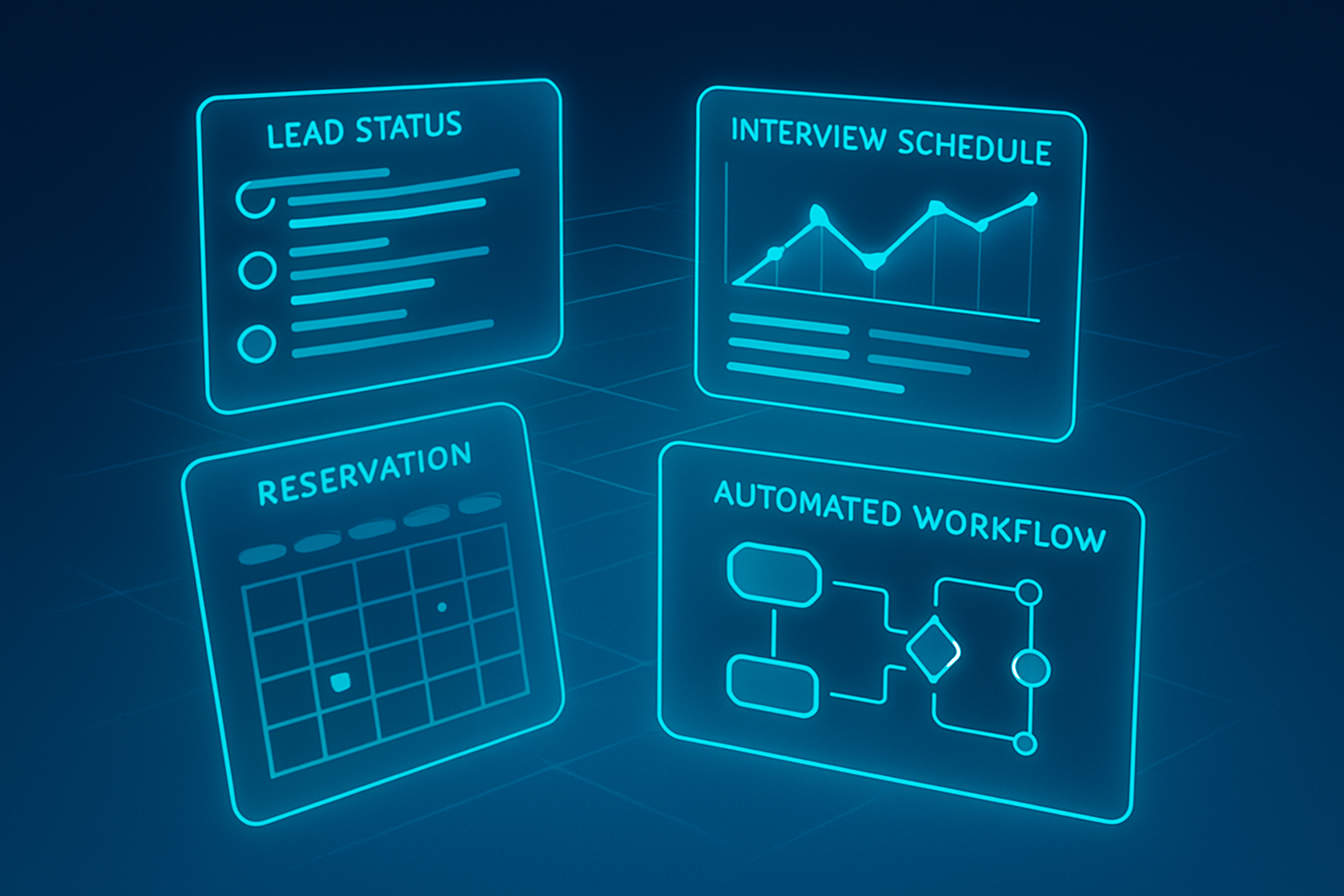
The “body” encompasses the tools, APIs, and business systems the agent can access and manipulate—CRMs, property management systems, applicant tracking systems, and hotel property management systems. This integration allows AI agents to execute real-world business actions—updating lead statuses, scheduling interviews, processing reservations, or triggering follow-up sequences.
The architecture follows a simple yet powerful pattern: think, act, learn. The agent receives input (a new lead inquiry), processes it through its AI models (qualifying the prospect based on budget and timeline), takes action (updating the CRM and scheduling a callback), and learns from the outcome to improve future interactions.
Levels of Agency and Autonomy
AI agents operate across three distinct levels of autonomy, each suited to different business complexity and risk tolerance:
Simple Automation handles rule-based tasks like email responses or data entry. Workflow Orchestration manages multi-step processes such as lead nurturing sequences or candidate screening pipelines. Agentic Decision-Making represents the highest level, where AI makes contextual business decisions—like prioritizing high-value prospects or escalating VIP guest requests.
The key is matching agency level to your business needs. High-volume, low-risk tasks benefit from full automation, while complex relationship management requires human oversight with AI augmentation.
Real-World Applications in Vynta’s Core Verticals
Understanding what is its agent becomes clearer through specific industry applications where AI agents deliver measurable business outcomes.
Hospitality: Instant Guest Response and Upselling
In hospitality, AI agents handle instant guest inquiries, automate upselling opportunities, and escalate VIP requests to human staff. A boutique hotel using Vynta AI can respond to booking inquiries within seconds, suggest room upgrades based on guest preferences, and manage reservation modifications 24/7.
The result: 48% increase in reservation conversion rates and 22% boost in guest spend through intelligent upselling—all while preserving the personal touch that defines exceptional hospitality.
Real Estate: Lead-to-Close Acceleration
Real estate agents leverage AI to qualify prospects instantly, schedule property viewings, and maintain consistent follow-up sequences. The AI agent analyzes lead behavior, prioritizes hot prospects, and ensures no potential buyer falls through the cracks.
Agencies report 30% higher conversion rates and 50% reduction in lead response time, translating directly to increased commission revenue and market share growth.
Recruitment: 24/7 Candidate Engagement
Recruitment AI agents screen candidates, schedule interviews, and maintain talent pipeline engagement around the clock. They handle initial qualification calls, coordinate interview logistics, and keep passive candidates warm through personalized touchpoints.
The outcome: 50% reduction in screening time and two-week decrease in average time-to-hire, enabling recruiters to focus on relationship building and final candidate selection.
Fundraising: Scaling Investor Outreach
Fundraising organizations use AI agents to manage donor databases, personalize outreach campaigns, and track engagement across multiple touchpoints. The agents identify optimal contact timing, customize messaging based on donor history, and flag high-potential prospects for human follow-up.
Results include 3-5X increase in investor touchpoints and improved donor retention through consistent, personalized communication at scale.
| Industry Challenge | AI Agent Solution | Measurable Outcome |
|---|---|---|
| Hospitality: Manual reservation management | Automated booking and upselling | 48% reservation increase |
| Real Estate: Slow lead response | Instant qualification and follow-up | 30% conversion improvement |
| Recruitment: Time-intensive screening | Automated candidate qualification | 50% screening time reduction |
| Fundraising: Limited outreach capacity | Scaled personalized donor engagement | 3-5X touchpoint increase |
Human-AI Collaboration: Augment, Not Replace
The most successful AI agent implementations maintain humans “in the loop” for exceptions, compliance oversight, and relationship complexities. AI handles routine tasks and data processing, while humans focus on strategic decisions and high-touch interactions.
Effective collaboration requires clear dashboards for monitoring agent performance, override capabilities for exceptional situations, and escalation protocols for complex scenarios. This approach maximizes efficiency gains while preserving the human judgment essential for business success.
Practical Steps to Adopting AI Agents in Mid-Market SMEs
Successful AI agent adoption follows a structured 30-day implementation roadmap:
Discovery Phase (Days 1-10): Identify high-volume, repetitive processes suitable for automation. Map current workflows and define success metrics.
Design Phase (Days 11-20): Configure agent parameters, integrate with existing systems, and establish human oversight protocols.
Deployment Phase (Days 21-30): Launch with limited scope, monitor performance metrics, and gradually expand agent responsibilities based on results.
Frequently Asked Questions
What are the different types of agents and how do their authorities vary in business and legal contexts?
Agents can be legal representatives, business intermediaries, or AI systems, each empowered to act on behalf of a principal with varying authority. Legal agents like attorneys have formal authority defined by law, business agents such as brokers operate within contractual limits, while AI agents execute automated tasks within programmed parameters, all binding the principal within their scope of authority.
How do AI agents differ from traditional human agents in terms of capabilities and business impact?
AI agents automate repetitive and data-driven tasks at scale, enabling faster decision-making and consistent execution without fatigue, unlike human agents who bring judgment and personal interaction. This augmentation improves operational efficiency and scalability while preserving the human touch where nuanced expertise and relationship-building are essential.
In what ways can understanding agency relationships help businesses ensure compliance and scale operations effectively?
Clear agency relationships define who can legally act on behalf of a business, ensuring compliance with regulations and reducing risk. This clarity enables businesses to delegate tasks confidently, streamline workflows, and scale operations by leveraging both human and AI agents within defined authority boundaries.
How are AI agents utilized in specific industries like real estate, recruitment, fundraising, and hospitality?
In real estate, AI agents qualify leads and automate property matching; in recruitment, they screen candidates and schedule interviews; in fundraising, they manage investor outreach and follow-ups; and in hospitality, they optimize reservations, reduce no-shows, and personalize guest communications—each enhancing efficiency and revenue while supporting human teams.
About The Author
Anas Moujahid is the chief contributing writer & Operations Director for the Vynta AI Blog, where he turns cutting-edge AI automation into measurable business outcomes for mid-market companies.
Vynta AI designs enterprise-grade AI agents that augment rather than replace people—freeing teams to focus on higher-value work while the bots handle the busywork.
We specialise in four service-heavy verticals where AI can move the revenue needle fast: real estate, recruitment, fundraising and hospitality.
Anas started his career architecting AI and automation systems; today he leads operations at Vynta AI, making sure every deployment lands real-world ROI—whether that’s more booked viewings for estate agents, faster placements for recruiters, warmer investor pipelines for fundraisers or happier guests for hotels and restaurants.
Vynta AI delivers results by:
- Building industry-specific agents pre-trained on real-world workflows—no generic chatbots here.
- Integrating seamlessly with existing CRMs, ATSs, PMSs and fundraising platforms—zero rip-and-replace.
- Measuring success in business KPIs (lead-to-close rates, time-to-hire, donor retention, RevPAR) not vanity metrics.
- Providing transparent implementation plans so clients know exactly what to expect, when and why.
- Pairing every AI agent with human-in-the-loop controls to keep quality, compliance and brand voice on point.
Since launch, Vynta AI has helped agencies slash lead qualification time by up to 70 %, recruitment firms cut screening hours in half, fundraising teams triple investor touchpoints and hospitality brands lift guest satisfaction scores by double digits—all while keeping human expertise firmly in the loop.
Anas writes with the same ethos that drives Vynta AI: outcome-focused, jargon-free and grounded in real business value. Expect data-backed insights, practical implementation guides and a clear-eyed view of what AI can—and can’t—do for your organisation.