
Key Takeaways
- Automation is a crucial factor for mid-market SMEs to scale profitably and manage operational overhead.
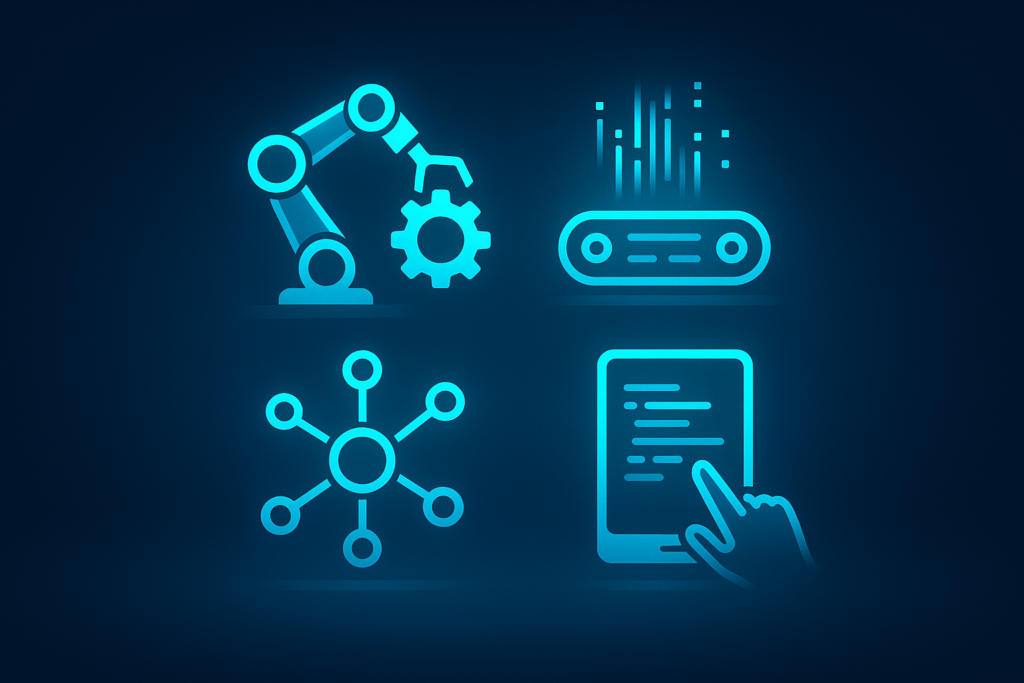
- The four types of automation are fixed, programmable, flexible, and integrated.
- Each type of automation addresses specific business challenges.
- Matching the right type of automation to your industry and growth stage ensures measurable ROI.
Table of Contents
- Introduction: Mapping Business Outcomes to the Four Types of Automation
- Fixed Automation: Industrial Roots Meet Modern Business Efficiency
- Programmable Automation: Flexibility for Growing, Evolving Businesses
- Flexible Automation: Delivering Customization at Scale
- Integrated Automation: The Future of End-to-End Business Transformation
- Comparative Analysis: Choosing the Right Automation for Your Business
- Addressing Common Concerns: AI Automation in Traditional Service Industries
- Real-World Use Cases: Industry-Specific Automation Wins
- Implementation Roadmap: From Assessment to ROI
- Strategic Selection: Matching Automation Types to Business Outcomes
Introduction: Mapping Business Outcomes to the Four Types of Automation
“Automation” gets thrown around boardrooms like confetti, but for mid-market SMEs, it’s the difference between scaling profitably and drowning in operational overhead. What are the 4 types of automation? Fixed, programmable, flexible, and integrated, each designed to solve specific business challenges and deliver measurable ROI when matched correctly to your industry and growth stage.
As Operations Director at Vynta AI, I’ve watched businesses transform their revenue trajectories with the right automation approach. I’ve also seen expensive mistakes when companies chase shiny technology instead of business outcomes. The key isn’t picking the most advanced system, it’s selecting the automation type that amplifies your team’s strengths while eliminating their biggest bottlenecks.
In real estate, recruitment, fundraising, and hospitality, each automation type plays a distinct role. A real estate agency might use fixed automation for lead intake, programmable for market-specific campaigns, flexible for personalized buyer matching, and integrated for complete lead-to-close orchestration. The magic happens when you start with your desired business outcome, faster sales cycles, higher placement rates, better donor retention, or increased guest satisfaction, then work backward to the right automation approach.
Fixed Automation: Industrial Roots Meet Modern Business Efficiency

Fixed automation excels at high-volume, repetitive tasks with zero variation, the digital equivalent of an assembly line. In hospitality, this translates to reservation confirmations sent within 30 seconds of inquiry, integrating seamlessly with your existing CRM and maintaining your brand voice across every touchpoint.
Once configured, fixed automation operates relentlessly without reprogramming. A recruitment firm might deploy it to screen 100% of inbound CVs for basic qualifications, degree requirements, location preferences, salary expectations, completing in under 3 minutes what previously took hours of manual review. The system never gets tired, never misses criteria, and creates a perfect audit trail.
Advantages
- Highest throughput for repetitive tasks
- Consistent quality with zero human error
- Lowest marginal cost per transaction
- Complete audit trail and compliance tracking
Limitations
- Inflexible to process changes
- High upfront configuration cost
- Poor fit for variable workflows
- Requires stable, predictable inputs
What are the 4 types of automation? Fixed automation sits at the foundation, perfect for processes where speed and consistency matter more than adaptability. Calculate your break-even by measuring current labor hours against error rates, then integrate with existing systems for seamless data flow. The key is identifying “always-the-same” workflows ripe for this treatment.
Programmable Automation: Flexibility for Growing, Evolving Businesses
Programmable automation bridges the gap between rigid efficiency and adaptive intelligence. Unlike fixed systems, it can be reconfigured for different tasks through software changes, think of a recruitment AI that adapts screening criteria for technical roles versus sales positions, or a fundraising platform that personalizes investor outreach based on sector focus and investment stage.
The power lies in batch processing with variation. In hospitality, programmable automation manages waitlists dynamically, adjusting upselling offers based on guest history while maintaining your brand’s tone and service standards. Real estate agencies use it to match buyers with new listings as inventory changes, automatically adjusting lead scoring as market conditions shift.
This approach delivers measurable results: time-to-hire reductions of 30% are common when programmable automation handles candidate matching across multiple job types. Fundraising organizations see 2x increases in investor meeting bookings through personalized, scalable outreach that adapts messaging based on prospect engagement patterns.
Implementation Reality Check: Programmable automation requires technical oversight and moderate downtime for reprogramming. Build a library of common workflow templates for quick adaptation, and train operations staff to update automation rules as business needs evolve.
The sweet spot is businesses with moderate variation and clear batch boundaries. Map your processes, identify reprogramming pain points, and avoid the trap of overcomplicating rules or creating shadow manual processes outside the system.
For more insights on how programmable automation can transform recruitment, explore our recruitment solutions.
Flexible Automation: Delivering Customization at Scale
Flexible automation represents the next evolution, systems that automatically switch between different tasks with minimal downtime. In hospitality, this means an AI agent handling reservations, upselling, and VIP escalations within a single guest journey, reacting in real-time to each interaction while maintaining service quality.
Advanced AI enables near-instant reconfiguration based on context and data signals. Recruitment firms deploy flexible automation to screen, match, and schedule interviews across multiple job types simultaneously, with no manual intervention. The system recognizes a senior developer application versus an entry-level marketing role and adjusts its approach accordingly.
The ROI is compelling: hospitality clients report average guest spend increases of 22% with AI-driven upselling that adapts to guest preferences and booking patterns. Recruitment agencies see similar gains in placement rates and candidate satisfaction by automating multi-role workflows without sacrificing personalization.
Integrated Automation: The Future of End-to-End Business Transformation

Integrated automation represents the pinnacle of business process optimization, connecting sales, marketing, operations, and service into a seamless, data-driven ecosystem. In hospitality, this means a guest’s reservation, preferences, service history, and payment processing are managed by interconnected AI agents, with every interaction logged in the CRM in real-time.
This comprehensive approach combines fixed, programmable, and flexible automation with advanced data integration capabilities. Recruitment firms benefit from end-to-end workflows spanning sourcing, screening, interviewing, and onboarding, providing full visibility and control for recruiters while maintaining candidate experience quality. Real estate agencies and fundraising organizations can orchestrate complete lead-to-close and prospect-to-investor journeys respectively, eliminating data silos and manual handoffs.
The transformation extends beyond efficiency gains. Clients report saving 15-20 hours weekly by automating manual tasks, while fundraising organizations see improved success rates through systematic, multi-touch campaigns that maintain consistent messaging across all touchpoints. The key lies in treating integration as business transformation rather than a technology project.
Implementation requires careful change management and phased rollouts. Start with process audits to identify integration opportunities, then automate one workflow completely before expanding. Staff empowerment through dashboards and override controls ensures transparency and maintains human oversight where needed.
Discover how integrated automation can accelerate your fundraising efforts with our fundraising solutions.
Comparative Analysis: Choosing the Right Automation for Your Business
Selecting the optimal automation type requires aligning technology capabilities with specific business outcomes and operational realities. The decision framework centers on four critical factors: transaction volume, process variability, personalization requirements, and integration maturity.
| Automation Type | Best For | Key Benefits | Primary Limitations | Industry Applications |
|---|---|---|---|---|
| Fixed | High-volume, repetitive tasks | Speed, consistency, low marginal cost | Inflexible to change, high setup cost | Real estate lead intake, hospitality confirmations |
| Programmable | Batch processes, moderate variation | Adaptable, scalable, supports diversity | Requires reprogramming, planned downtime | Recruitment screening, fundraising campaigns |
| Flexible | High variety, personalization needs | Rapid changeover, real-time customization | Complex implementation, higher investment | Dynamic guest journeys, multi-role recruitment |
| Integrated | End-to-end workflow transformation | Complete visibility, maximum efficiency | Complex rollout, cultural change required | Full lead-to-close, comprehensive donor management |
The selection process should prioritize business outcomes over technical features. Mid-market SMEs achieve best results by starting with their most painful bottlenecks, whether that’s lead response time in real estate, candidate screening speed in recruitment, donor engagement consistency in fundraising, or reservation management efficiency in hospitality. No single automation type fits every scenario, so tailor your approach to your unique operational needs.
For a deeper dive into automation strategies for real estate, visit our real estate solutions page.
Addressing Common Concerns: AI Automation in Traditional Service Industries
Service-driven industries like real estate, recruitment, fundraising, and hospitality often hesitate to adopt automation, fearing it will compromise the human touch that defines their value proposition. These concerns are understandable but often misplaced when automation is implemented strategically.
Fear of Replacement: The most effective automation augments human capabilities rather than replacing them. In hospitality, AI handles routine reservation confirmations and upselling prompts, freeing staff to focus on exceptional guest experiences and complex problem-solving. Real estate agents spend less time on lead qualification and more time building relationships with qualified prospects.
Key Insight: Automation should make your team more effective, not obsolete. The goal is to eliminate mundane tasks that drain productivity, not the expertise that drives revenue.
Data Security Concerns: Modern AI automation platforms integrate directly with existing CRM systems, maintaining your data governance standards. You control access permissions, data sharing, and system integrations, the AI operates within your security framework, not outside it.
Implementation Complexity: Phased rollouts minimize disruption while proving ROI. Start with a single, high-impact process like reservation confirmations or initial candidate screening. Measure results, refine the approach, then expand to additional workflows.
Loss of Personal Touch: Paradoxically, automation can enhance personalization at scale. AI can track guest preferences, candidate qualifications, and donor engagement patterns more consistently than manual processes, enabling more targeted and relevant interactions when human staff take over.
For more on the impact of automation in service industries, check out this McKinsey analysis of automation potential.
Real-World Use Cases: Industry-Specific Automation Wins

Understanding what are the 4 types of automation becomes clearer when you see them deployed across different industries. Each automation type delivers measurable outcomes when matched to the right business challenge.
Real Estate Success Stories:
- Fixed automation for lead intake reduced response time from hours to under 60 seconds, improving conversion rates by 35%.
- Programmable automation adapts property matching criteria as inventory changes, maintaining relevance without manual updates.
- Flexible automation handles both buyer inquiries and seller lead qualification within the same system.
- Integrated automation connects lead capture, CRM updates, and agent notifications in one seamless workflow.
Recruitment Transformation:
- Automated CV screening processes 500+ applications in under 30 minutes, identifying top candidates for human review.
- Dynamic interview scheduling reduces coordination time by 60% while improving candidate experience.
- Multi-channel candidate sourcing maintains consistent outreach across LinkedIn, job boards, and referral networks.
Fundraising Acceleration:
- Personalized investor outreach at scale increased meeting booking rates by 2x.
- Systematic follow-up sequences ensure no prospects fall through the cracks.
- Integrated donor management tracks engagement across all touchpoints.
Hospitality Excellence:
- Instant reservation management drove 48% increase in bookings within 60 days.
- AI-powered upselling recommendations increased average guest spend by 22%.
- Automated guest communication maintains brand consistency while reducing staff workload.
Learn more about our company’s approach to industry-specific automation and how it can drive measurable results.
Implementation Roadmap: From Assessment to ROI
Successfully implementing any of the four types of automation requires a systematic approach that prioritizes business outcomes over technical features.
Step 1: Process Audit – Document current workflows, identifying repetitive tasks, bottlenecks, and error-prone processes. Focus on activities that consume significant staff time without requiring complex decision-making.
Step 2: Outcome Mapping – Define specific, measurable targets. Whether it’s lead response time, candidate screening speed, donor engagement consistency, or reservation management efficiency, establish baseline metrics and improvement goals.
Step 3: Pilot Selection – Choose a contained, high-impact process for initial automation. Reservation confirmations, initial lead qualification, or basic candidate screening offer quick wins with minimal risk.
Step 4: Integration Planning – Ensure new automation connects seamlessly with existing systems. Your CRM, ATS, or PMS should remain the central data hub, with automation enhancing rather than replacing these core platforms.
Step 5: Launch and Measure – Deploy the pilot, track defined KPIs, and gather staff feedback. Monitor both quantitative outcomes (response times, conversion rates) and qualitative impacts (staff satisfaction, customer experience).
Step 6: Scale and Refine – Expand successful automation to additional workflows, always maintaining focus on business outcomes. Each expansion should build on proven results, not chase technology for its own sake.
Expert Tip: Partner with a provider who understands your industry’s unique challenges. Generic automation platforms require you to do the heavy lifting of customization and integration, specialized solutions deliver faster ROI with less internal resource investment.
For a step-by-step guide to automation implementation, read this Deloitte overview of automation best practices.
Strategic Selection: Matching Automation Types to Business Outcomes
The question of what are the 4 types of automation is less important than understanding which type serves your specific business goals. Each automation category excels in different scenarios, and the right choice depends on your operational characteristics and growth objectives.
Frequently Asked Questions
What are the key differences between fixed, programmable, flexible, and integrated automation?
Fixed automation handles repetitive, high-volume tasks with no variation, ideal for routine processes. Programmable automation allows reconfiguration for different tasks, supporting evolving business needs. Flexible automation adapts dynamically to customization at scale, enabling personalized experiences. Integrated automation connects multiple systems and workflows end-to-end, delivering seamless business transformation across functions.
How can a mid-market SME determine which type of automation best suits their industry and growth stage?
Mid-market SMEs should start by identifying their primary business outcomes, such as efficiency, customization, or full process integration, and assess operational complexity and growth plans. Fixed automation suits stable, repetitive tasks; programmable fits businesses needing adaptable workflows; flexible supports personalized customer interactions; integrated is ideal for companies ready to transform multiple functions holistically. Matching automation type to specific industry challenges and scalability needs ensures measurable ROI.
What are the main advantages and limitations of fixed automation in business operations?
Fixed automation offers high reliability and efficiency for repetitive, standardized tasks, reducing errors and operational costs. However, its rigidity limits adaptability to changing processes or personalized customer demands, making it less suitable for businesses requiring flexibility or customization. It’s best deployed where tasks are stable and volume-driven, such as reservation confirmations in hospitality or lead intake in real estate.
How does integrated automation enable end-to-end business transformation compared to other automation types?
Integrated automation connects disparate systems and workflows, enabling seamless data flow and coordinated actions across departments. This holistic approach drives comprehensive efficiency gains, better decision-making, and enhanced customer experiences by breaking down silos. Unlike fixed or programmable automation, integrated solutions support strategic transformation by aligning all operational facets toward unified business outcomes.
About The Author
Anas Moujahid is the chief contributing writer & Operations Director for the Vynta AI Blog, where he turns cutting-edge AI automation into measurable business outcomes for mid-market companies.
Vynta AI designs enterprise-grade AI agents that augment rather than replace people, freeing teams to focus on higher-value work while the bots handle the busywork.
We specialise in four service-heavy verticals where AI can move the revenue needle fast: real estate, recruitment, fundraising and hospitality.
Anas started his career architecting AI and automation systems; today he leads operations at Vynta AI, making sure every deployment lands real-world ROI, whether that’s more booked viewings for estate agents, faster placements for recruiters, warmer investor pipelines for fundraisers or happier guests for hotels and restaurants.
Vynta AI delivers results by:
- Building industry-specific agents pre-trained on real-world workflows, no generic chatbots here.
- Integrating seamlessly with existing CRMs, ATSs, PMSs and fundraising platforms, zero rip-and-replace.
- Measuring success in business KPIs (lead-to-close rates, time-to-hire, donor retention, RevPAR) not vanity metrics.
- Providing transparent implementation plans so clients know exactly what to expect, when and why.
- Pairing every AI agent with human-in-the-loop controls to keep quality, compliance and brand voice on point.
Since launch, Vynta AI has helped agencies slash lead qualification time by up to 70 %, recruitment firms cut screening hours in half, fundraising teams triple investor touchpoints and hospitality brands lift guest satisfaction scores by double digits, all while keeping human expertise firmly in the loop.
Anas writes with the same ethos that drives Vynta AI: outcome-focused, jargon-free and grounded in real business value. Expect data-backed insights, practical implementation guides and a clear-eyed view of what AI can, and can’t, do for your organisation.