

Top recommended agentic AI for sales teams?
Mid-market sales teams face a critical decision when adopting AI automation. Selecting the wrong platform can drain resources and stall pipeline growth. The Top recommended agentic AI for sales teams? requires careful evaluation beyond marketing hype. Operations leaders must align tool capabilities with specific revenue motions and integration depth. Vynta AI helps organizations identify solutions that deliver measurable ROI rather than temporary efficiency gains. This approach ensures technology investments translate directly into increased revenue and operational stability.
Key Takeaways
- Selecting agentic AI for sales requires matching tool capabilities to specific revenue generation processes.
- Operations leaders should prioritize platforms that demonstrate measurable ROI over short-term productivity gains.
- Proper integration depth with existing sales stack matters more than flashy features when choosing AI solutions.
- Vynta AI helps organizations avoid costly missteps by focusing on sustainable pipeline growth and operational stability.
- The right AI platform directly contributes to increased revenue by aligning automation with core business motions.
The Real Cost of Picking the Wrong Sales Agent (And How to Avoid It)
The hype trap: why generic lists fail mid-market teams
Competitor articles often prioritize feature checklists over operational fit. These lists rarely account for the specific constraints of mid-market operations, such as limited IT support or strict data privacy requirements. A tool that lacks seamless integration with your CRM becomes an isolated island of data. This fragmentation forces reps to toggle between applications, increasing cognitive load and reducing selling time. Vynta AI emphasizes that the true value of an AI solution lies in its ability to operate within your existing ecosystem, reducing friction rather than adding complexity. Generic recommendations ignore vertical nuances. Real estate agencies require property matching, while recruitment firms need candidate screening. A one-size-fits-all approach leads to integration debt and user resistance. Teams waste months configuring tools that do not align with their sales cadence.
Key Insight: The highest costs in AI adoption often stem from poor integration and low user adoption, not the software license itself. Solutions that disrupt existing workflows create hidden expenses in training and lost opportunity.
Three signs your sales team has outgrown basic automation
Manual data entry creates a significant bottleneck in high-volume sales environments. When representatives spend hours updating CRMs and logging call notes, their capacity to engage with prospects diminishes. High lead response times indicate a breakdown in process execution. If your team cannot contact leads within minutes, conversion rates drop sharply. Additionally, inconsistent follow-up sequences suggest a reliance on individual discipline rather than systematic automation. These patterns signal that your sales infrastructure requires agentic AI to enforce consistency and scale outreach without proportional headcount increases. Repetitive tasks consume excessive time, preventing focus on high-value activities.
What a well-chosen agentic AI solution actually costs. And saves
Investing in a well-chosen solution yields measurable returns across key performance indicators. Setup costs typically include implementation fees and training hours. Subscription pricing varies based on agent count and usage volume. Despite these upfront investments, organizations recover costs through improved efficiency and revenue acceleration. Automated qualification filters low-quality leads, allowing reps to focus on opportunities with higher probability. Faster response times capture interest while prospects are actively researching. Agentic Systems for Real Estate illustrate this impact by increasing qualified pipeline by 3x and boosting conversion rates to 85%. The system also maximizes agent productivity by automating 80% of routine tasks, saving over 20 hours per week and generating more than $100k in additional revenue per agent annually. The total cost of ownership decreases as human errors drop and deal velocity accelerates.
Top Agentic AI Sales Agents Compared: Features, Pricing, and Real Autonomy
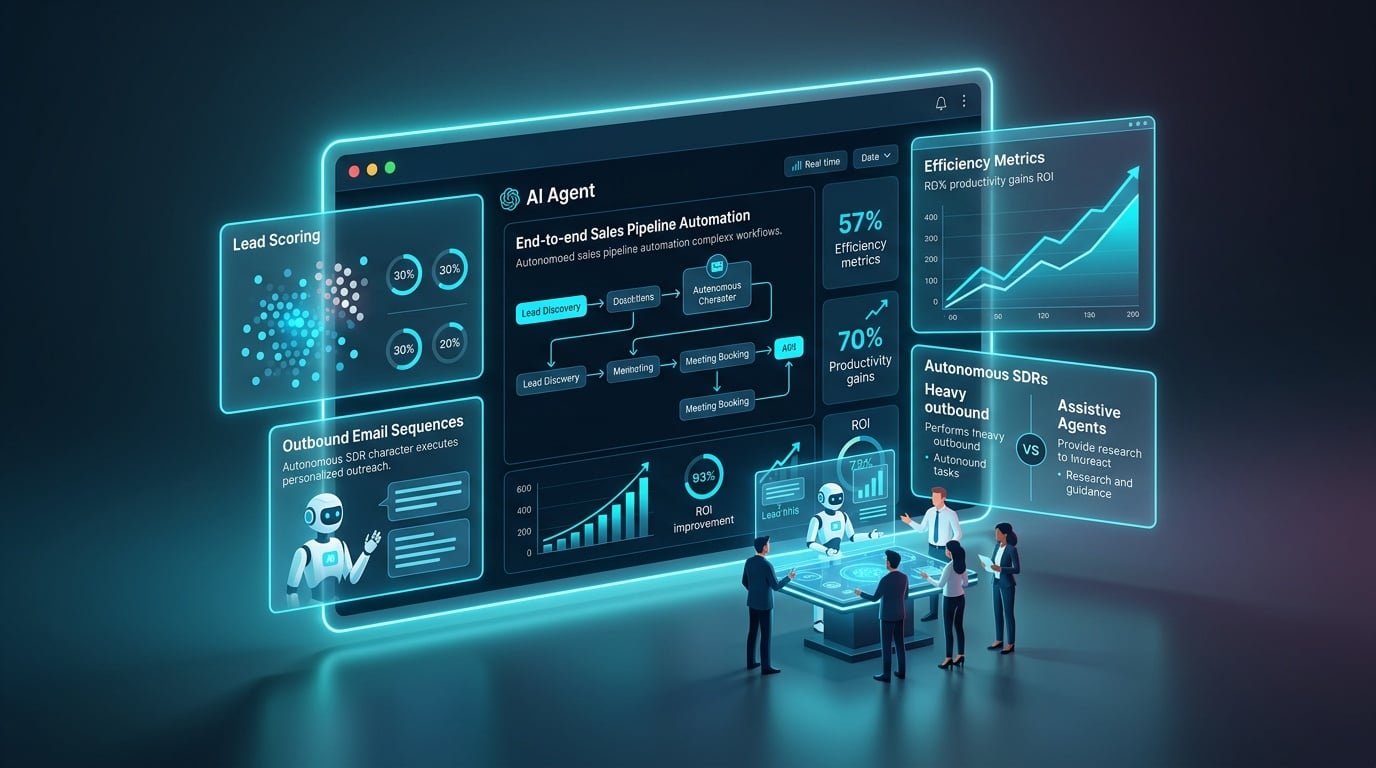
Autonomous SDRs vs. assistive agents: which fits your pipeline?
Autonomous SDRs excel at handling repetitive outbound tasks, from lead scoring to initial outreach. These agents operate without constant human intervention, managing complex sequences across email, phone, and social channels. Teams benefit from this approach when seeking to scale outreach volume or maintain 24/7 engagement. Assistive agents function as copilot tools, providing suggestions and automating data entry within the rep’s workflow. This model suits organizations with nuanced sales processes where human judgment remains essential. Assistive tools help reduce administrative burden while preserving the personal touch required in relationship-based selling. When evaluating the Top recommended agentic AI for sales teams?, the decision depends on your team’s maturity and the structure of your sales cycle.
Tool deep-dive: 6 leading agents for mid-market sales teams
Evaluating the market requires analyzing specific capabilities against team requirements. Gumloop provides a no-code platform for building custom AI workflows, ideal for teams wanting flexibility. Claude delivers advanced natural language capabilities for generating high-quality, personalized content. n8n offers powerful API orchestration for connecting disparate systems in complex data pipelines. Zapier connects thousands of applications through simple triggers, making it accessible for non-technical users. CrewAI enables multi-agent collaboration, allowing different AI models to coordinate on specialized tasks. Relay.app focuses on low-code automation for streamlining internal operations. The search for the Top recommended agentic AI for sales teams? involves matching these tools to your technical resources and automation goals. For vertical-specific needs, Agentic Systems for Real Estate provide specialized workflows tailored to property matching and lead qualification.
Quick-reference comparison table: CRM compatibility, lead enrichment, multi-channel outreach
The table below summarizes key features to guide your evaluation of technical fit and autonomy levels.
| Tool | CRM Integration | Lead Enrichment | Multi-Channel Outreach | Autonomy Level |
|---|---|---|---|---|
| Gumloop | Custom via API | Yes | Email, Web | High |
| Claude | Limited native | Text analysis | Text-based | Assistive |
| n8n | Extensive | Custom workflows | Broad | High |
| Zapier | Native connectors | Basic enrichment | App triggers | Assistive |
| CrewAI | API-based | Collaborative | Multi-model | High |
| Relay.app | Internal tools | Workflow data | Internal apps | Assistive |
Advantages and Disadvantages of Agentic AI Adoption
Pros
- Scalable outreach to thousands of prospects simultaneously
- Reduced manual work for administrative and data entry tasks
- 24/7 availability for immediate lead engagement
- Data-driven insights for pipeline optimization
Cons
- Implementation complexity requiring technical oversight
- Integration challenges with legacy CRM systems
- Learning curve for sales teams adapting to new workflows
- Ongoing management costs for model tuning and monitoring
Industry-Specific Agentic AI: Better Results for Real Estate, Recruitment, Fundraising, and Hospitality
Generic sales automation tools often fall short because they ignore the unique workflows of different industries. A real estate agency needs property matching and instant lead qualification. A recruitment firm requires candidate screening and interview scheduling. Fundraising organizations demand investor outreach and donor pipeline management. Hospitality businesses rely on reservation optimization and guest experience management. The Top recommended agentic AI for sales teams? must align with these vertical-specific processes to deliver measurable ROI. Vynta AI designs solutions that map directly to each industry’s operational rhythm, reducing integration friction and accelerating time to value.
Real estate: property matching and lead qualification agents
Real estate agencies face a constant challenge: converting high volumes of property inquiries into scheduled viewings and closed deals. Agentic Systems for Real Estate handle this by engaging leads instantly across WhatsApp, SMS, email, and website chat. The system uses AI-driven qualification to filter inquiries, then matches prospects to relevant properties using advanced algorithms. Automated calendar coordination with reminders reduces no-shows, and personalized follow-up sequences keep leads warm. The result is a qualified pipeline that increases by 3x and a conversion rate of 85%. Agents save over 20 hours per week by automating 80% of routine tasks, allowing them to focus on high-value activities like property showings and negotiations. Client retention improves by 85%, and client satisfaction rises by 27%. The system generates more than $100k in additional revenue per agent per year. These outcomes demonstrate how industry-specific automation transforms real estate sales operations.
Recruitment: candidate screening and interview scheduling
Recruitment agencies must process large applicant pools while maintaining high-quality matches. Agentic AI for recruitment automates candidate screening by parsing resumes, evaluating skills against job requirements, and ranking applicants. The system then handles interview scheduling by coordinating availability between recruiters and candidates, sending automated reminders, and rescheduling when conflicts arise. This reduces the administrative burden on recruiters by up to 60%, allowing them to spend more time building relationships with top candidates and clients. The AI also learns from past placement data to refine screening criteria, improving match accuracy over time. For agencies that manage multiple job openings simultaneously, the ability to scale candidate processing without adding headcount is a significant competitive advantage.
Fundraising: investor outreach and donor pipeline management
Fundraising organizations rely on personalized outreach to cultivate donor relationships and secure commitments. Agentic AI for fundraising automates the initial stages of donor prospecting by identifying potential supporters based on giving history, engagement patterns, and demographic data. The system then sends tailored communications across email and social channels, tracks response rates, and prioritizes follow-ups based on donor interest scores. For capital campaigns, the AI can manage complex outreach sequences that include event invitations, progress updates, and stewardship touches. By automating these tasks, fundraising teams can maintain consistent contact with hundreds of donors simultaneously, increasing the likelihood of meeting campaign goals. The AI also provides real-time pipeline visibility, enabling leaders to forecast revenue and adjust strategies quickly.
Hospitality: reservation optimization and guest experience agents
Hospitality businesses. From hotels to event venues. Must balance reservation management with delivering exceptional guest experiences. Agentic AI for hospitality optimizes booking processes by analyzing occupancy patterns, pricing strategies, and guest preferences. The system can adjust room rates dynamically, offer upsells at the moment of booking, and automate confirmation and reminder messages. Guest experience agents handle pre-arrival inquiries, special requests, and post-stay feedback collection. By automating these interactions, hospitality teams reduce response times to under 60 seconds and increase guest satisfaction scores. The AI also identifies trends in guest feedback, helping operators improve service offerings. For venues that manage multiple properties, the system provides a unified view of reservations and guest history, enabling consistent service across locations.
| Vertical | Key Automation Tasks | Primary Outcome |
|---|---|---|
| Real Estate | Lead capture, property matching, viewing scheduling, follow-up | 3x pipeline growth, 85% conversion rate, 20+ hours saved per week |
| Recruitment | Resume parsing, candidate ranking, interview coordination | 60% reduction in admin time, higher placement quality |
| Fundraising | Donor prospecting, personalized outreach, pipeline tracking | Consistent contact with hundreds of donors, improved campaign ROI |
| Hospitality | Reservation optimization, dynamic pricing, guest communication | Under 60-second response times, increased guest satisfaction |
Key Insight: The fastest path to ROI with agentic AI is choosing a solution built for your industry’s specific sales motion. Vertical-specific agents eliminate the need for extensive customization and deliver measurable outcomes from day one.
How to Choose the Right Agentic AI for Your Sales Team: A Buyer’s Checklist
Selecting an agentic AI platform requires evaluating technical fit, operational autonomy, and total cost. The Top recommended agentic AI for sales teams? depends on how well the solution integrates with your existing systems and aligns with your team’s specific workflows. Use the criteria below to build a shortlist that meets your revenue goals without introducing unnecessary complexity.
Criteria 1: Does it integrate with your existing CRM and stack?
Integration depth determines whether an AI agent becomes a productivity multiplier or an administrative burden. Verify that the tool offers native connectors for your CRM (HubSpot, Salesforce, Pipedrive) and syncs data bidirectionally. For teams using multiple platforms like email outreach tools (Outreach, Salesloft) and calendar systems (Calendly, Google Calendar), the AI should pull and push data without manual mapping. Tools like Gumloop and n8n provide custom API integrations, but require technical resources to configure. Mid-market teams without dedicated IT support should prioritize pre-built connectors that reduce setup time. Test the integration with a sample lead pipeline to confirm data flows accurately before committing to a license.
Criteria 2: How much autonomy do you really need?
Autonomy levels range from fully autonomous SDRs that manage outreach sequences end-to-end to assistive agents that suggest next steps and log activities. Assess your team’s capacity to supervise AI outputs and handle exceptions. High-autonomy agents suit organizations with straightforward, high-volume sales motions where personalization can be templated. Assistive agents work better for consultative sales cycles requiring human judgment. A good rule of thumb: if your average deal size exceeds $10,000, keep humans in the loop for qualification. For transactional sales, autonomous agents can safely manage the entire process.
Criteria 3: Data security and compliance requirements
Sales data often contains sensitive client information, pricing details, and proprietary strategies. Verify that the AI platform encrypts data at rest and in transit, supports role-based access controls, and undergoes regular third-party security audits. For organizations serving regulated industries (finance, healthcare), ensure the tool is SOC 2 Type II certified and offers HIPAA-compliant configurations. Review the vendor’s data retention policies and confirm that customer data is not used to train their general models. On-premises deployment options provide additional control for companies with strict data residency requirements. Never assume compliance; request a security questionnaire during the evaluation.
Criteria 4: Total cost of ownership for a mid-market team
Pricing models vary widely: per-agent monthly subscriptions, usage-based fees (per outreach contact or API call), and enterprise licenses with implementation costs. Calculate the total cost over 12 months, including setup fees, training hours, and ongoing management. Factor in the cost of maintaining custom integrations versus using native connectors. A platform that costs $500 per month but requires 20 hours of engineering time to integrate is more expensive than a $1,000 per month solution with one-click setup. Compare the projected ROI from reduced manual work and increased conversion rates. Agentic Systems for Real Estate demonstrate a clear ROI: clients see over $100k in additional revenue per agent per year after automating 80% of routine tasks.
When to buy pre-built vs. when to build custom with Vynta
Pre-built solutions work well for teams with standard sales processes and common CRM stacks. They offer faster deployment and predictable costs. Custom builds become necessary when your sales motion involves unique data sources, complex routing rules, or industry-specific compliance needs. Vynta AI specializes in building custom agentic workflows for real estate, recruitment, fundraising, and hospitality. If your team manages a high volume of leads with specific qualification criteria. Like property matching in real estate or donor segmentation in fundraising. A tailored system delivers higher accuracy and faster time to value. Vynta’s implementation team handles discovery, strategy, and deployment, ensuring the AI operates within your existing infrastructure without requiring internal data science resources.
Quick Checklist for Evaluation:
- Does the AI offer native integration with your primary CRM (HubSpot, Salesforce, etc.)?
- Can the solution handle your team’s preferred autonomy level? Test with a pilot project first.
- Is the platform SOC 2 Type II certified and compliant with your industry’s data regulations?
- What is the total estimated cost over 12 months, including integration, training, and ongoing usage?
- Does the vendor provide vertical-specific templates or custom workflow building?
References
Frequently Asked Questions About Agentic AI for Sales

Does agentic AI replace my sales team or just augment them?
Agentic AI systems are designed to augment human sales professionals, not replace them. They handle repetitive tasks like lead qualification, data entry, and initial outreach, allowing team members to focus on high-value activities such as relationship building and closing deals. In every vertical we serve. Real estate, recruitment, fundraising, hospitality. The AI acts as a force multiplier. Teams that adopt agentic AI typically see a 30% or greater increase in deals closed because representatives can spend more time on conversations that require human empathy and strategic judgment. The technology manages the volume; the humans manage the connection.
How long does it take to see ROI after implementation?
Most mid-market teams observe measurable ROI within three to six months of implementation. The timeline depends on integration complexity, team adoption speed, and the sophistication of the AI workflows. Pre-built solutions with native CRM connectors often deliver initial results in 4 to 6 weeks. Custom implementations, such as those Vynta builds for specialized workflows, may take 8 to 12 weeks but yield higher long-term returns. Key early indicators include reduced lead response times (under 60 seconds), decreased time spent on administrative tasks, and increased pipeline velocity. Within one quarter, most teams report a positive return when measuring the value of recovered selling time against subscription costs.
Can I run agentic AI agents without an in-house data science team?
Yes. Modern agentic AI platforms are designed for operations and sales leaders, not just data scientists. Low-code and no-code tools like Gumloop, Zapier, and Vynta’s custom solutions abstract the underlying machine learning complexity. You configure workflows through visual editors and natural language prompts. Vynta’s implementation services include hands-on setup and training, so your team never needs to write code. For ongoing management, the system monitors its own performance and flags exceptions for human review. Most mid-market teams assign one operations lead to oversee the AI, requiring no more than a few hours per week after the initial learning period.
Choosing the right agentic AI for your sales team requires honest evaluation of your current processes, team capacity, and growth goals. The Top recommended agentic AI for sales teams? is the one that fits your specific CRM environment, provides the autonomy level your team can manage, and complies with your data security standards. Start with the checklist above, run a pilot with one or two agents, and measure results against the baselines we discussed. Vynta AI partners with mid-market organizations to implement agentic systems that deliver verified ROI across real estate, recruitment, fundraising, and hospitality. If your team needs a solution tailored to your industry’s workflows, contact Vynta to schedule a discovery session.
Frequently Asked Questions
What are the best AI tools for sales teams?
The best AI tools for sales teams are those that align with your specific revenue motions and integrate deeply with your existing CRM and workflows. Generic feature checklists often ignore operational constraints like limited IT support or data privacy requirements. A well chosen agentic AI solution reduces friction rather than adding complexity, leading to higher adoption and measurable ROI.
What is the most popular agentic AI?
Popularity alone is a misleading metric when selecting agentic AI for sales teams. True value comes from matching a tool’s autonomy level and integration depth to your team’s maturity and sales cycle structure. The most popular platforms often lack the vertical nuances that mid-market teams require, causing integration debt and user resistance.
Which is the best agentic AI for customer service?
The best agentic AI for customer service focuses on instant response, brand safe upselling, and seamless escalation to human staff for VIP or complex queries. For sales teams, the priorities differ: you need autonomous outbound sequences, lead enrichment, and multi-channel outreach capabilities. Always evaluate tools against your primary revenue motion rather than generic customer service benchmarks.
Who is leading in agentic AI?
Leading agentic AI vendors distinguish themselves through deep CRM integration, real lead enrichment, and the ability to automate both outbound and inbound workflows without disrupting existing processes. Mid-market teams should look for providers that offer a clear path to measurable ROI through improved conversion rates and reduced administrative burden, not just feature lists.
What are the top 3 AI right now?
The top three categories of agentic AI for sales teams are autonomous SDRs for scaling outbound, assistive agents for reducing administrative load, and workflow automation platforms like Gumloop, Zapier, or CrewAI for custom pipelines. Your choice should depend on your team’s technical resources and whether you need full autonomy or copilot style support.
What signs indicate your sales team needs agentic AI?
Three clear signs that basic automation is no longer sufficient are high lead response times, inconsistent follow up sequences, and representatives spending hours on manual CRM data entry. These bottlenecks directly reduce conversion rates and selling time. Agentic AI enforces consistent execution and scales outreach without proportional headcount increases, recovering costs through faster deal velocity.