

top 10 ai tools
10 AI Tools Driving Business Automation Results in 2026
The top 10 AI tools for business in 2026 are Zapier, HubSpot AI, ClickUp AI, ChatGPT Enterprise, Microsoft Copilot, UiPath, Notion AI, Pipedream, Google Gemini, and ElevenLabs. Each targets a specific operational gap, from workflow automation to voice-driven customer engagement.
#1 Zapier: Workflow Automation for Sales and Operations
Zapier connects 6,000+ apps without code, eliminating manual data transfers between CRMs, email platforms, and project tools. Mid-market teams use it to automate lead routing and follow-up sequences. Pricing starts with a free plan; paid plans begin at $19.99 per month.
#2 HubSpot AI: Lead Scoring and CRM Integration
HubSpot AI scores inbound leads automatically, surfaces deal risks, and generates email copy inside the CRM. Sales teams reduce qualification time significantly while keeping pipeline data clean. A free tier is available; Sales Hub starts at $15 per seat per month.
#3 ClickUp AI: Project Management with Predictive Task Assignment
ClickUp AI summarizes project updates, assigns tasks based on workload, and generates status reports on demand. Operations teams cut meeting overhead and keep distributed teams aligned. The AI add-on costs $7 per member per month, in addition to base plans.
#4 ChatGPT Enterprise: Content and Report Generation
ChatGPT Enterprise supports SOC 2 compliance, long context windows, and custom GPTs for internal knowledge bases. Marketing and operations teams use it to produce proposals, reports, and client communications at scale. Pricing is negotiated per organization.
#5 Microsoft Copilot: Office Workflow Optimization
Copilot integrates across Word, Excel, Teams, and Outlook, drafting documents and summarizing meeting transcripts automatically. Teams already using Microsoft 365 gain productivity gains with minimal onboarding. It costs $30 per user per month as an add-on.
#6 UiPath: Robotic Process Automation at Scale
UiPath automates high-volume back-office tasks such as invoice processing, data entry, and compliance reporting. It suits operations teams that manage repetitive, structured workflows across legacy systems. A community edition is free; enterprise pricing is custom.
#7 Notion AI: Knowledge Management and Team Collaboration
Notion AI drafts SOPs, summarizes meeting notes, and answers team questions from your internal wiki. Growing SMEs use it to preserve institutional knowledge without dedicated documentation staff. AI features cost $10 per member per month.
#8 Pipedream: Custom API-Driven Automations
Pipedream lets developers build event-driven workflows that connect any API in minutes. It fills automation gaps that Zapier cannot address, especially for custom data pipelines and webhook-triggered processes. A free tier is available; paid plans start at $29 per month.
#9 Google Gemini: Multimodal Data Analysis
Gemini processes text, images, spreadsheets, and PDFs simultaneously, making it effective for market research and competitive analysis. Teams using Google Workspace gain native integration across Docs, Sheets, and Slides. It is included in Google Workspace Business plans, starting at $14 per user per month.
#10 ElevenLabs: Voice Content for Customer Engagement
ElevenLabs generates realistic AI voiceovers for training materials, product demos, and automated phone interactions. Hospitality and recruitment teams use it to personalize outreach at scale without recording studios. A free tier is available; the Creator plan starts at $22 per month.
| Tool | Primary Use Case | Free Tier | Best For |
|---|---|---|---|
| Zapier | App workflow automation | Yes | Sales operations, lead routing |
| HubSpot AI | CRM and lead scoring | Yes | Revenue teams |
| ClickUp AI | Project management | No | Distributed teams |
| ChatGPT Enterprise | Content and reports | No | Marketing, proposals |
| Microsoft Copilot | Office productivity | No | Microsoft 365 users |
| UiPath | Back-office RPA | Yes | High-volume data tasks |
| Notion AI | Knowledge management | No | Growing SMEs |
| Pipedream | Custom API workflows | Yes | Developer-led teams |
| Google Gemini | Multimodal analysis | Yes | Google Workspace users |
| ElevenLabs | Voice content creation | Yes | Customer engagement |
How These Tools Deliver ROI in Real Estate, Recruitment, Fundraising, and Hospitality

Real Estate: Automating Lead Qualification and Property Matching
Real estate agencies using Vynta AI Agents for Real Estate with HubSpot AI and Zapier together report faster lead qualification cycles. Inbound inquiries are scored automatically, routed to the right agent, and followed up within minutes rather than hours. Google Gemini analyzes market data and property documents simultaneously, giving agents accurate comparable properties without manual research. The result is more qualified viewings, fewer wasted hours, and higher conversion from inquiry to offer.
Recruitment: Streamlining Candidate Screening and Interview Scheduling
Recruitment firms using ClickUp AI and ChatGPT Enterprise cut screening time by automating initial candidate summaries and generating role-specific interview questions. Zapier connects ATS platforms to calendar tools, eliminating interview scheduling back-and-forth. ElevenLabs enables personalized audio outreach to passive candidates, improving response rates without additional recruiter headcount. Agencies report improved placement rates when AI handles administrative work and consultants focus on relationship building. Learn more about Agentic Systems for Recruitment to boost your hiring process.
Fundraising: Optimizing Investor Outreach and Donor Management
Fundraising organizations use HubSpot AI to segment donor databases and trigger personalized outreach sequences based on giving history and engagement signals. ChatGPT Enterprise drafts tailored pitch materials and impact reports at scale, maintaining the personal tone donors expect. Pipedream connects fundraising platforms to CRM systems through custom API workflows, ensuring that no donor interaction falls through the gaps. Systematic outreach built on these tools supports donor retention and capital-raise targets. Explore how the AI-Powered Fundraising Platform can transform your donor management.
Hospitality: Improving Guest Reservations and Upsell Opportunities
Boutique hotels and upscale restaurants use Vynta AI Agents for Hospitality and ElevenLabs for personalized pre-arrival voice messages that confirm reservations and introduce upgrade options. Zapier automates post-stay review requests and loyalty follow-ups, reducing no-shows and increasing repeat bookings. Microsoft Copilot helps operations managers analyze occupancy data and identify upsell-timing patterns across guest segments.
Pros of Applying These Tools by Vertical
- Industry-specific workflows reduce implementation time
- Measurable KPIs tied to revenue outcomes, not only activity metrics
- Human teams focus on high-value relationship work
- Scales without proportional headcount increases
Cons to Consider
- Generic tool configurations require vertical-specific customization
- ROI timelines vary by process complexity and data quality
- Multiple tool subscriptions increase total cost of ownership
Implementation Steps to Achieve Measurable Outcomes with AI Tools
Step 1: Assess Your Business Processes for Automation Fit
List each repetitive task that consumes more than two hours per week. Prioritize processes with clear inputs, predictable outputs, and high volume. Lead qualification, candidate screening, donor follow-up, and reservation confirmations are strong starting points.
Step 2: Select Tools That Match Your Industry Needs
Match tools to your vertical rather than adopting the most popular option. Real estate teams often gain more from HubSpot AI and Zapier than from general productivity tools. Recruitment firms often benefit most from ClickUp AI combined with ATS integrations. Align tool selection to the workflows identified in Step 1.
Step 3: Integrate Existing Systems and Test Pilots
Run a four-week pilot on one workflow before scaling. Connect your chosen tool to your CRM, calendar, or reservation system through native integrations or Zapier. Measure baseline performance before launch so you have clean comparison data.
Step 4: Measure KPIs and Scale Success
Track time saved, conversion-rate changes, and revenue impact each week. When a pilot shows consistent improvement across three consecutive weeks, expand to adjacent workflows. Scale only what the data confirms is working.
Common Challenges and How to Overcome AI Adoption Barriers
Integration Hurdles with Legacy Systems
Many mid-market SMEs run property management software, ATS platforms, or PMS systems that predate modern APIs. Start with Zapier or Pipedream to bridge legacy tools without full system replacement. Prioritize read-only integrations first to reduce risk.
Data Privacy and Compliance in Regulated Industries
Real estate transactions, candidate records, donor data, and guest profiles carry strict compliance obligations. Use enterprise-tier tools with SOC 2 certification and data-residency controls. ChatGPT Enterprise and Microsoft Copilot are commonly used in regulated environments, subject to your organization’s compliance review.
Skill Gaps and Team Training Needs
Adoption fails when teams lack confidence, not capability. Dedicate one trained internal champion per tool. No-code platforms such as Zapier and Notion AI require minimal technical background, making them practical entry points for nontechnical staff.
Achieving Consistent ROI Without Internal Expertise
Generic tools deliver generic results without vertical-specific configuration. Mid-market SMEs without dedicated AI teams often benefit from a strategic partner that understands the vertical and the operating model, not only the software.
Why Partner with Vynta AI for Enterprise AI Agents Over Standalone Tools
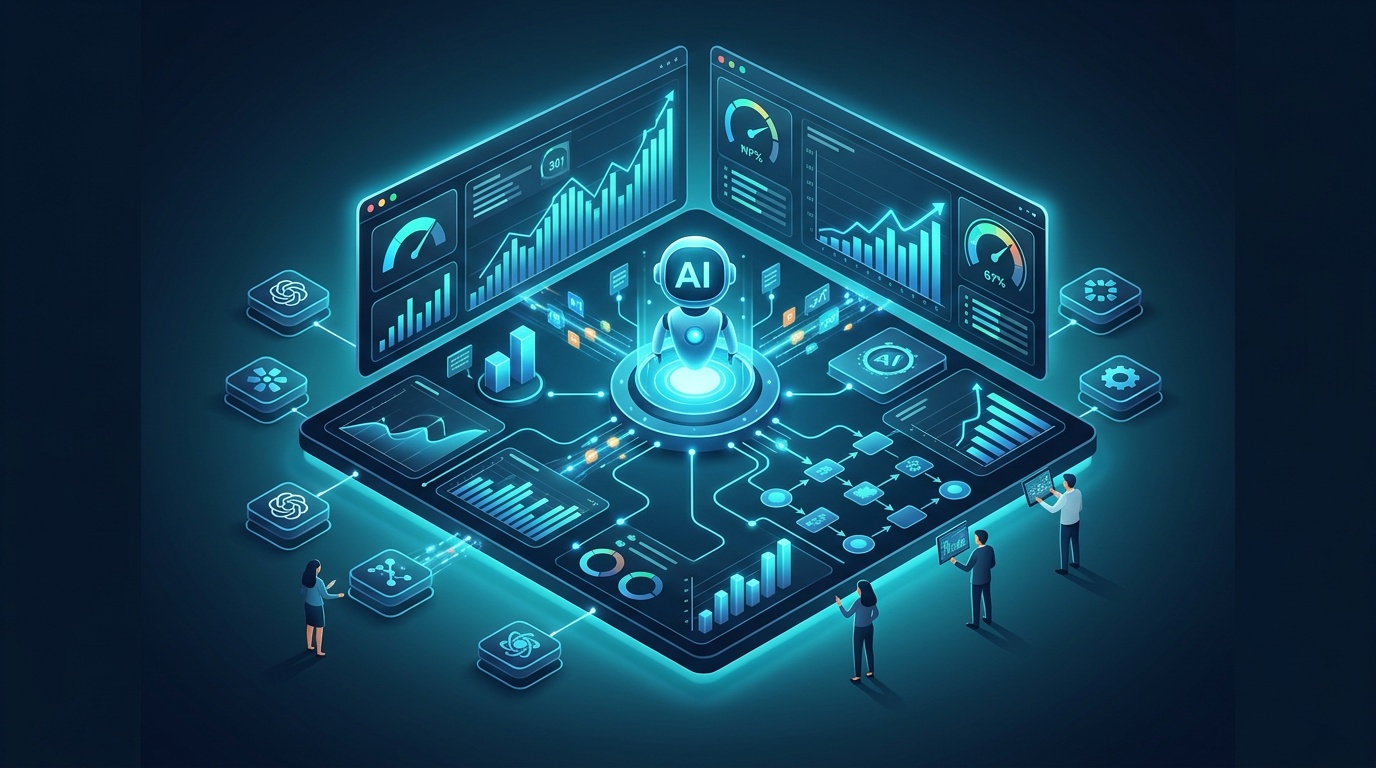
The top 10 AI tools covered here each solve one problem well. Vynta AI’s custom agents connect those capabilities into a single, industry-specific automation layer built around revenue workflows, not generic use cases.
Custom AI Agents Tailored to Your Vertical
Vynta AI builds agents configured for real estate lead qualification, recruitment candidate sourcing, fundraising investor outreach, and hospitality guest engagement.
Proven Metrics: 40% Revenue Growth, 50% Cost Reduction
Client outcomes vary by starting point, data quality, and process design. In prior engagements, teams have reported meaningful improvements within the first quarter, including faster lead conversion, improved placement rates, stronger donor retention, and increased revenue per guest.
Human-AI Collaboration Without Headcount Expansion
Vynta AI agents handle high-volume tasks so teams can focus on relationships, negotiations, and decisions. People remain central; the AI removes administrative work that slows execution.
Next Steps to Transform Your Operations
Ready to move beyond standalone tools? Book a discovery call with Vynta AI to identify the highest-impact automation opportunities for your business vertical.
Frequently Asked Questions
What are some of the most impactful AI tools for business operations today?
From my perspective at Vynta AI, tools like Zapier for workflow automation, HubSpot AI for CRM integration and lead scoring, and Microsoft Copilot for Office productivity are highly impactful. These solutions directly address common operational challenges, helping mid-market SMEs achieve measurable results and streamline their processes.
How do different AI tools compare to ChatGPT Enterprise for business use?
It’s less about one AI being universally ‘better’ than ChatGPT Enterprise and more about specific applications. While ChatGPT Enterprise excels at large-scale content and report generation, tools like Google Gemini offer multimodal data analysis for market research. ElevenLabs, for example, specializes in creating realistic AI voiceovers for customer engagement, serving distinct business needs.
Can you name some top generative AI tools for business?
Absolutely. For generative capabilities, ChatGPT Enterprise is a leader in producing proposals and client communications at scale. ElevenLabs generates realistic AI voice content for training and customer interactions. Notion AI also provides generative features for drafting SOPs and summarizing notes, helping teams manage knowledge effectively.
Which companies are considered major players in the business AI space?
Several companies are consistently driving significant AI innovation for businesses. Microsoft, with its Copilot integrated into Microsoft 365, and Google, with Gemini for Workspace users, are prominent. OpenAI, behind ChatGPT Enterprise, and specialized platforms from HubSpot and UiPath also stand out for their impactful automation solutions.
How can AI tools like those mentioned deliver tangible ROI for businesses?
These AI tools deliver ROI by automating repetitive tasks, improving data accuracy, and freeing up human talent for more strategic work. For instance, in real estate, HubSpot AI and Zapier together automate lead qualification, leading to faster cycles and higher conversion rates. Our Vynta AI Agents, for example, can increase booking conversion by 50% and reduce operational costs by 30% for hospitality clients.