
retrieval augmented generation
What is Retrieval Augmented Generation?
Retrieval augmented generation (RAG) is an AI architecture that pulls verified, current information from your business’s own data sources before generating a response. Instead of relying solely on what a language model memorized during training, RAG retrieves relevant facts first and then generates accurate, grounded answers.
Core Process: Retrieve, Augment, Generate
RAG operates in three stages. First, it retrieves relevant documents from a connected knowledge base. Second, it augments the user’s query with that retrieved context. Third, it generates a response grounded in real data rather than statistical pattern matching. The result is an AI system that can speak with authority about your specific business, policies, and inventory–without hallucinating details it was never trained on.
Why RAG Solves LLM Hallucinations and Outdated Data
Standard large language models hallucinate because they generate plausible-sounding text without access to ground truth. They also carry training cutoff dates, which means they can’t answer questions about your current property listings, open roles, or guest reservations. RAG reduces both problems by anchoring every response to documents you control and update in real time.
RAG vs Traditional Language Models
| Capability | Traditional LLM | RAG-Powered System |
|---|---|---|
| Data freshness | Frozen at training cutoff | Real time from connected sources |
| Business-specific accuracy | Generic responses | Answers based on your own documents |
| Hallucination risk | High | Significantly reduced |
| Implementation for SMEs | Requires fine-tuning (costly) | No-code integrations available |
| Auditability | No source citations | Traceable to source documents |
How Retrieval Augmented Generation Works Step by Step

Step 1: Data Ingestion and Vector Embeddings
Your documents–whether property listings, candidate résumés, donor records, or hotel policies–are converted into numerical representations called vector embeddings. These embeddings capture semantic meaning, so a query about “remote work flexibility” can surface documents containing “work from home,” even without an exact keyword match.
Step 2: Query Retrieval and Reranking
When a user submits a query, the system searches the vector database for the most semantically similar documents. A reranking layer then scores those results by relevance, so the model receives only the highest-quality context before it generates an answer. Skip reranking, and retrieval quality drops fast.
Step 3: Augmentation and Generation
The retrieved documents are appended to the original query as context. The language model reads both the question and the supporting evidence, then generates a response based on real information–with citations when configured to do so. Learn more about the technical foundations of retrieval augmented generation on this Wikipedia page.
Simple Business Example: HR Leave Policy Query
Scenario: An employee asks, “How many vacation days do I have after one year?”
Traditional LLM: Generates a plausible-sounding but potentially incorrect answer based on generic HR norms.
RAG system: Retrieves your actual HR policy document, then generates: “Per the 2025 Employee Handbook, Section 4.2, you receive 15 vacation days after completing 12 months of service.” The answer is accurate, auditable, and specific to your organization.
RAG Applications in Real Estate, Recruitment, Fundraising, and Hospitality
Real Estate: Automate Lead Qualification with Property Matching
A RAG-powered agent ingests your live MLS listings, buyer preference profiles, and market data. When a lead submits criteria, the agent retrieves matching properties and generates a personalized shortlist with relevant details. Agents stop spending hours on manual search tasks and start spending that time on relationships–which is where deals actually close.
Recruitment: Speed Up Candidate Screening and ATS Integration
Our Agentic Systems for Recruitment applies RAG architecture to process over 100,000 résumés per day, screening each candidate in under 10 seconds against role-specific criteria stored in your ATS. The system achieves 85% candidate matching accuracy and reactivates dormant ATS databases at an 18% rate–recovering value from candidates your team already sourced. Hiring cycles shrink by over 60%, and placements increase by more than 50%. The original RAG research paper details the retrieval mechanics underpinning these results.
Fundraising: Target Investor Outreach and Donor Management
RAG agents retrieve donor history, giving-capacity signals, and campaign performance data to generate personalized outreach messages at scale. Instead of generic appeals, each communication reflects the donor’s actual relationship with your organization. Better relevance typically means stronger retention and response rates–without adding headcount to your development team.
Hospitality: Optimize Guest Experiences and Upselling
A RAG system connected to your property management platform retrieves individual guest profiles, past-stay preferences, and current inventory before generating personalized upsell recommendations. A guest who previously booked spa treatments receives a targeted pre-arrival offer rather than a generic promotional email. See how our Vynta AI Agents for Hospitality put this into practice across reservation management and guest engagement.
Vertical ROI at a Glance
| Vertical | RAG Application | Measurable Outcome |
|---|---|---|
| Real Estate | Property matching from live listings | Faster lead-to-showing conversion |
| Recruitment | Résumé screening against ATS criteria | 60%+ reduction in hiring cycle |
| Fundraising | Personalized donor outreach | Higher donor retention rates |
| Hospitality | Guest profile-driven upselling | Increased revenue per stay |
Implement RAG for Business Automation Without a Data Science Team
No-Code Tools and CRM/ATS Integrations for SMEs
Modern RAG deployment doesn’t require a data science team. Platforms now offer pre-built connectors to Salesforce, HubSpot, major ATS platforms, and property management systems–your existing data becomes the knowledge base without custom engineering. Agentic Systems for Recruitment, for example, integrates directly with CV Library, Indeed, Reed, TotalJobs, and LinkedIn, with no internal technical resources required on your side.
Measure Success: Key Metrics like Time Savings and Conversion Rates
Track four core metrics from day one: time to response (how quickly the AI answers queries), accuracy rate (verified against source documents), conversion lift (leads, placements, or bookings generated), and administrative hours saved per week. Agentic Systems for Recruitment saves approximately two hours per hire–a figure that compounds fast in high-volume operations.
| Metric | What to Measure | Target Benchmark |
|---|---|---|
| Time savings | Administrative hours per hire or booking | 2+ hours per transaction |
| Conversion rate | Leads to placements or bookings | 50%+ improvement |
| Database reactivation | Dormant records re-engaged | 18% reactivation rate |
| Cycle reduction | Days from inquiry to close | 60%+ faster |
Common Pitfalls and How Vynta AI Handles Them
What RAG Gets Right
- Answers grounded in your actual documents
- Real-time data without retraining
- Auditable responses with source citations
- Scales without adding headcount
Pitfalls to Anticipate
- Poor source data produces poor answers; clean your knowledge base first
- Without reranking, retrieval can return irrelevant context
- Integration gaps between RAG and legacy CRM systems require planning
- Teams need clear change management to adopt AI-assisted workflows
Vynta AI addresses these pitfalls through pre-built vertical integrations, structured onboarding, and ongoing performance monitoring–so you don’t need internal AI expertise to keep the system running after deployment. Our AI-Powered Fundraising Platform applies the same architecture to boost donor engagement. For a broader research overview, the retrieval augmented generation research guide at Prompting Guide is worth bookmarking.
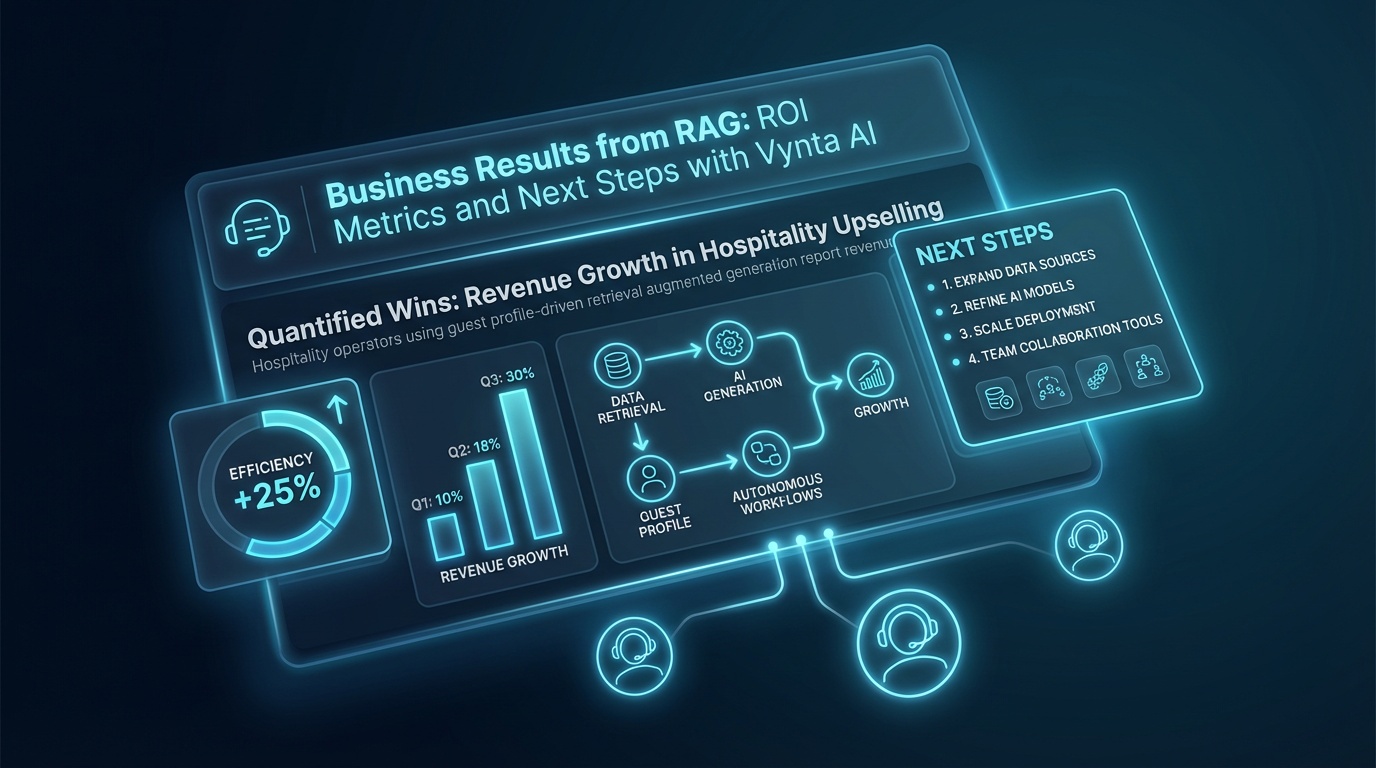
Business Results from RAG: ROI Metrics and Next Steps with Vynta AI
Quantified Wins: Revenue Growth in Hospitality Upselling
Hospitality operators using guest profile-driven retrieval augmented generation report measurable revenue gains from personalized upselling–targeted pre-arrival offers consistently outperform generic promotions. In recruitment, the numbers tell a similar story: 100,000 résumés screened daily, 85% matching accuracy, hiring cycles cut by over 60%. These are production benchmarks, not projections from a controlled study.
Overcoming Adoption Barriers in Service Industries
The most common concern I hear across hospitality, real estate, and recruitment is that AI will strip the personal touch from client relationships. RAG does the opposite. Your team gets faster, more accurate information–which frees them to spend more time on judgment calls and trust-building, less time on research and data retrieval. The AI handles the lookup; your people handle the relationship. For tailored solutions in property sales, Agentic Systems for Real Estate shows how that plays out in practice.
Get Started: Partner with Vynta AI for Custom RAG Agents
Ready to deploy retrieval augmented generation in your business? Vynta AI builds industry-specific RAG agents for real estate, recruitment, fundraising, and hospitality–integrated with your existing systems and measured against your specific KPIs. Start with the vertical that matters most to your revenue, then scale from there.
Take a closer look at Agentic Systems for Recruitment, or contact Vynta AI to discuss a custom RAG deployment built around your operation.
Frequently Asked Questions
What is retrieval augmented generation?
Retrieval augmented generation, or RAG, is an AI architecture that significantly improves the accuracy and relevance of AI responses. It works by first pulling verified, current information from your business’s own data sources. This ensures the generated answer is grounded in real facts, rather than just what the language model memorized during its training.
What is RAG with example?
RAG systems retrieve specific, real-time data to provide precise answers. For example, if an employee asks about vacation days, a RAG system would access your company’s HR policy document. It then generates an accurate response, like, “Per the 2025 Employee Handbook, Section 4.2, you receive 15 vacation days after completing 12 months of service,” ensuring the information is specific and auditable.
What is the difference between RAG and LLM?
The key difference lies in how they access and use information. Traditional large language models rely solely on their training data, which can lead to outdated information or “hallucinations.” RAG-powered systems, however, first retrieve current, verified data from your connected sources before generating a response, drastically reducing these issues and providing business-specific accuracy.
Does ChatGPT use retrieval augmented generation?
While advanced versions of large language models like ChatGPT may incorporate various techniques to improve accuracy, the core RAG architecture specifically connects the model to your real-time, proprietary business data. This ensures responses are grounded in your specific documents and policies, a capability essential for business automation that goes beyond a general-purpose LLM.
Why is RAG important for businesses today?
RAG is important for businesses because it solves critical issues like AI hallucination and outdated information that plague standard LLMs. By anchoring responses to your controlled, real-time documents, RAG ensures AI systems can speak with authority about your specific business, policies, and inventory. This leads to more accurate automation and better decision-making.
Can small and medium-sized businesses implement RAG?
Absolutely. Modern RAG deployment no longer requires a dedicated data science team. Platforms now offer user-friendly, no-code integrations with common business systems like Salesforce, HubSpot, and ATS platforms. This makes it accessible for SMEs to transform their existing data into a powerful knowledge base for AI automation.
What are some practical applications of RAG in different industries?
RAG has diverse applications across industries. In real estate, it can automate lead qualification by matching buyer preferences to live listings. For recruitment, it screens résumés against ATS criteria, significantly reducing hiring cycles. In hospitality, Vynta AI Agents can personalize upsell recommendations based on guest profiles, increasing revenue per guest.