

How much do agentic systems for real estate cost?
Understanding Agentic Systems: What They Are and Why Real Estate Needs Them
Agentic systems for real estate cost between $500 to $5,000 per month for mid-market agencies, depending on team size, feature complexity, and integration requirements. But here’s what matters more: the return on investment through increased conversions, automated workflows, and agent productivity gains that can transform your business.
What Makes Agentic Systems Different
Agentic systems are autonomous AI agents that make decisions, execute tasks, and adapt strategies with appropriate human oversight. Unlike basic chatbots or simple automation tools, these intelligent systems understand context, learn from interactions, and proactively manage complex real estate workflows. Agentic Systems for Real Estate help agencies handle more properties, convert more leads, and close more deals without expanding their team or increasing admin costs.
Real-World Capabilities That Drive Results
These systems handle intelligent lead qualification, automated property matching using advanced algorithms, and personalized client communication across multiple channels, including WhatsApp, SMS, email, and website chat. They coordinate calendar scheduling with automated reminders, collect feedback after viewings, and continuously refine property suggestions based on client preferences.
Why Your Agency Needs This Now
Real estate agencies face pressure from lead management inefficiencies, delayed response times, and administrative bottlenecks that prevent agents from focusing on high-value work. With the right implementation, routine tasks such as initial inquiry handling, follow-ups, scheduling, and data entry get automated, freeing agent time for negotiations and client relationships.
Cost Breakdown: What Drives Pricing for Real Estate Agentic AI

Three Main Cost Categories
Consider three primary expense categories: platform licensing, integration complexity, and ongoing support. Platform fees often range from $200 to $2,000 per month based on agent count and feature access. Integration costs vary by the CRM, property database, and communication channels that require connection.
How Providers Structure Pricing
Most providers offer tiered subscriptions rather than transaction-based pricing. Entry-level packages start around $500 per month for small teams, mid-tier solutions range from $1,500 to $3,000 per month for growing agencies, and enterprise packages can exceed $5,000 per month. Per-agent pricing typically ranges from $50 to $200 per month per user, making team size a major cost driver.
| Pricing Model | Best For | Typical Range | Key Features |
|---|---|---|---|
| Starter Tier | Small teams (2 to 5 agents) | $500 to $1,000 per month | Basic lead qualification, email automation |
| Professional Tier | Growing agencies (6 to 15 agents) | $1,500 to $3,000 per month | Multichannel engagement, property matching |
| Enterprise Tier | Large operations (15+ agents) | $3,000 to $5,000+ per month | Custom workflows, advanced analytics, API access |
Additional Costs to Budget For
Plan for staff training, data migration, and any required customization. Implementation commonly requires 2 to 4 weeks, including discovery, strategy, and system configuration. Ongoing maintenance is typically included for cloud-based solutions, though custom integrations may require additional technical support.
ROI Analysis: Why Cost Matters Less Than Returns
Key Metrics That Matter
Effective agentic AI deployments drive measurable improvements across lead velocity, conversion rates, and agent efficiency. Track response times to new inquiries, qualified lead volume, viewing-to-offer ratios, and time to close. Also monitor client satisfaction, retention, and revenue per agent to evaluate whether the system performs as expected.
Where You’ll Save Money
Agentic systems reduce administrative overhead by automating routine tasks such as triage, follow-ups, scheduling, and record updates. That time savings can reduce overtime, limit the need for additional coordinators, and allow agents to focus on deals that are more likely to convert.
Where You’ll Make Money
The system converts property inquiries into viewings and sales through fast engagement, intelligent qualification, and personalized follow-up. Faster initial responses help capture leads before competitors respond, while smarter matching and better follow-up cadence can increase showing volume and reduce drop-off.
Advantages
- Faster response and consistent follow-up
- More qualified appointments from the same lead volume
- Less admin work for agents
- Improved visibility into pipeline status
Considerations
- Initial implementation often requires 2 to 4 weeks
- Staff training is needed for consistent use
- Monthly subscriptions require budget planning
- Integration effort depends on current systems
Supporting Your Team’s Growth
Agentic systems support human agents by handling repetitive communications, data entry, and initial client screening. This structure lets experienced agents focus on relationship building, complex negotiations, and high-value client interactions. It’s a practical option for mid-market agencies that want growth without matching increases in overhead.
Investment Timing: When Agentic Systems Make Financial Sense
Assess Your Current Situation
Does your agency struggle with slow response times, inconsistent follow-up, or agents spending too much time on administrative work? Calculate current lead-to-conversion ratios and average response times to establish baselines. If agents manage more than 20 active listings or spend over 15 hours per week on data entry and scheduling, automation is often financially justified.
When to Pull the Trigger
Consider agentic AI when monthly lead volume exceeds 100 inquiries, agent productivity plateaus, or client satisfaction declines due to slow responses. Compare subscription fees against likely upside from improved conversion rates and reduced time spent on low-value work.
Custom vs. Off-the-Shelf Solutions
Off-the-shelf tools can reduce initial spend, while custom builds can better reflect unique workflows. Many mid-market agencies do best with configurable platforms that map to existing processes without extensive engineering. AI Automation Services can help bridge the gap between generic solutions and fully custom development.
Building for Long-Term Growth
Strong implementations treat agentic systems as infrastructure that scales with transaction volume while keeping service quality consistent. That scalability supports expansion into new markets, property types, or services while keeping operations organized and predictable.
How Vynta AI Delivers Results in Real Estate
Our Real Estate-Specific Approach
At Vynta AI, we deploy AI agents designed for real estate workflows, pairing strong natural language capabilities with domain logic. Our platform connects with CRM systems, listing data sources, and communication channels to create a unified automation system. Unlike generic chatbots, our agents are tuned for property inquiries, qualification flows, and follow-up sequences common in real estate transactions.
What This Looks Like in Practice
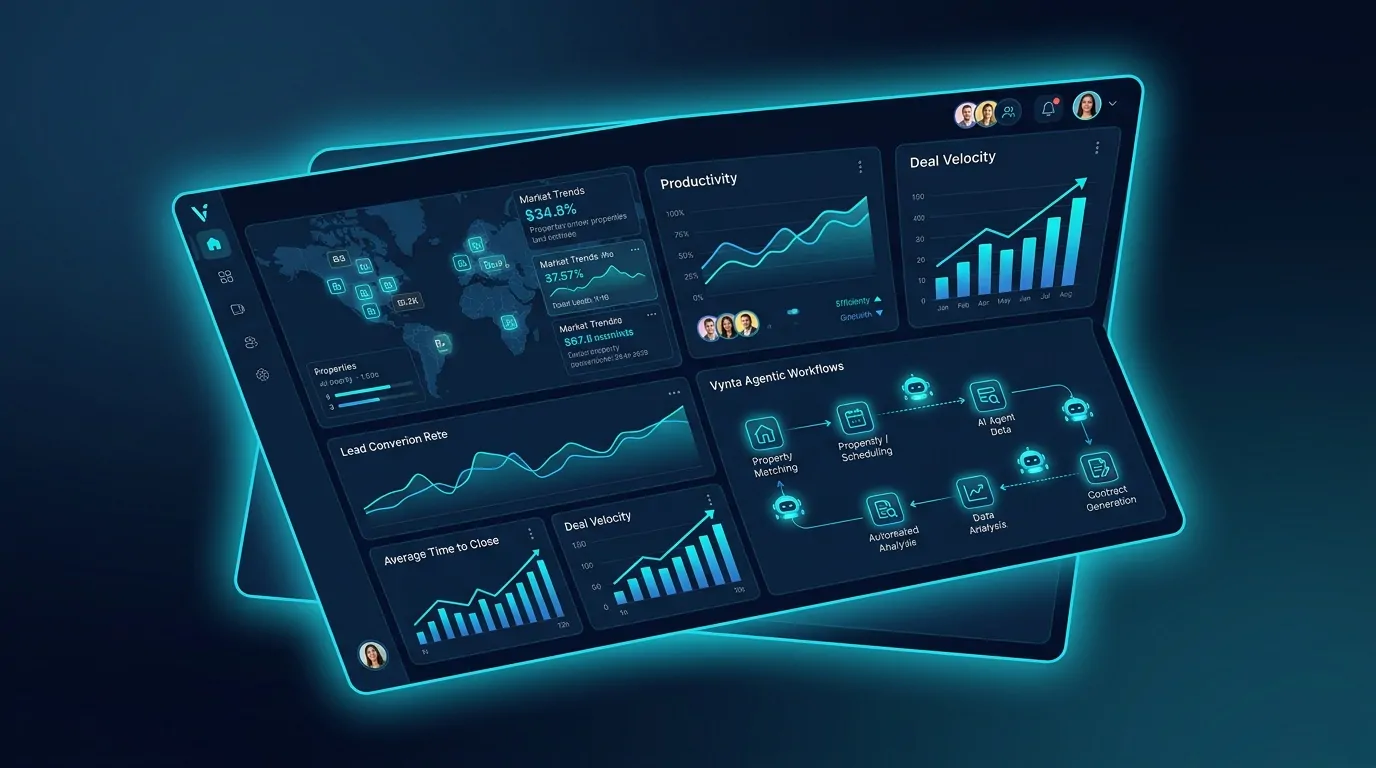
The workflow includes lead capture with rapid engagement across channels such as WhatsApp, SMS, email, and website chat. Qualification scores prospects based on budget, timeline, and preferences before routing qualified leads to the right agent. Automated property matching suggests relevant listings, and calendar coordination with reminders reduces no-shows.
Our Transparent Pricing Approach
We provide clear tiers and a scoped implementation plan, aligned to your team size and integration requirements. Pricing scales with usage and complexity, and the rollout includes discovery, planning, and performance monitoring, so the system is measured against agreed metrics after launch.
Partnership, Not Just Software
My role as Operations Director focuses on helping mid-market teams adopt AI automation without building an internal engineering group. We provide ongoing guidance, monitoring, and iteration as your processes and market conditions change. The goal is a system that keeps delivering value after the initial rollout.
Making Your Investment Decision
Calculate the Real Cost
Include opportunity cost from missed leads and slower response times. Total value depends on conversion lift, agent time saved, and the consistency of follow-up. Estimate revenue at risk from unanswered inquiries and compare it with the expected monthly spend.
What to Expect During Implementation
Agentic AI deployment requires planning rather than rushed installation. Expect 2 to 4 weeks for integration, including data migration, workflow configuration, and team training. Early improvements often appear in the first 30 days, while performance tends to stabilize over 90 to 120 days as workflows are refined and the team adapts.
Preparing for Industry Changes
Real estate continues shifting toward digital-first experiences and more automated transaction coordination. Agencies that invest in agentic systems can prepare for trends such as virtual tours, AI-assisted market analysis, and more personalized matching, while maintaining a consistent operating model. Understanding who makes more a real estate agent or a realtor can help inform your staffing strategy as automation takes over routine tasks.
Choose Partners, Not Vendors
Select providers that operate as partners, not only software vendors. The best outcomes come from ongoing collaboration, monitoring, and optimization as your agency scales and market conditions change. Cost matters, but so does long-term fit and the ability to improve performance over time.
Frequently Asked Questions
How much do agentic AI systems for real estate typically cost?
Agentic systems for real estate generally range from $500 to $5,000 per month for mid-market agencies. This investment varies based on your team size, the specific features required, and the complexity of integrating with your existing systems. Entry-level packages for smaller teams might start around $500, while comprehensive enterprise solutions can exceed $5,000 monthly.
Are agentic AI systems expensive to operate over time?
While there is an initial investment, agentic AI systems are designed to deliver a strong return through increased conversions and agent productivity. Ongoing costs primarily involve platform licensing and support, which are often included in cloud-based subscriptions. The efficiency gains and revenue growth achieved often offset these operational expenses.
What factors influence the total cost of implementing agentic systems in real estate?
The total cost is shaped by several factors, including platform licensing fees, the complexity of integrating with your CRM and communication channels, and ongoing support requirements. Your team size significantly impacts pricing, with many providers offering tiered subscriptions or per-agent models. Additionally, it’s wise to budget for staff training and data migration during the initial implementation phase.
What is the difference between agentic systems and basic automation tools for real estate?
Agentic systems are autonomous AI agents that make decisions, execute tasks, and adapt strategies with appropriate human oversight. Unlike basic chatbots or simple automation tools, these intelligent systems understand context, learn from interactions, and proactively manage complex real estate workflows. They go beyond simple automation to handle intelligent lead qualification and personalized client communication.
Why do agentic AI systems for real estate have different price points?
The varying price points reflect the depth of capabilities, level of customization, and operational scale they support. More advanced systems offer features like multichannel engagement, advanced analytics, and custom workflows, which require greater development and integration effort. The cost reflects the sophistication needed to solve complex real estate challenges and drive measurable business outcomes.