

Key Takeaways
- Smart overbooking in hotels can increase revenue by 8-15% for boutique properties.
- Poorly managed overbooking strategies can result in over $300 per incident in compensation and damage to reputation.
- Major hotel chains use advanced revenue management systems to handle overbooking effectively.
- Independent hoteliers require practical overbooking frameworks that optimize occupancy without complex or costly solutions.
- Balancing occupancy optimization with guest satisfaction is crucial for successful overbooking strategies in boutique hotels.
Table of Contents
- Understanding Overbooking in Hotels, What, Why, and How It Impacts Hospitality ROI
- Calculating the Business Case, How Overbooking Drives Profit, Reduces Losses, and Powers Guest Experience
- Overbooking Management, Best Practices for Minimizing Guest Impact and Maximizing Operational Efficiency
- Leveraging AI Automation, Data-Driven Overbooking, Guest Experience, and Risk Mitigation for Boutique Hotels
- Overbooking Policies, Legal Considerations, and Guest Rights, Risk, Ethics, and Reputation Management
Overbooking in Hotels, Strategic Management, ROI, and AI-Driven Solutions for Boutique Hospitality Leaders
Smart overbooking in hotels generates an average 8-15% revenue uplift for boutique properties, but mismanaged strategies cost $300+ per incident in compensation and reputation damage. While major chains rely on sophisticated revenue management systems, independent hoteliers need practical frameworks that balance occupancy optimization with guest satisfaction, without the enterprise-level complexity or budget.
This guide delivers actionable overbooking strategies specifically designed for boutique hospitality managers, from calculating safe buffer zones using historical data to implementing AI-driven forecasting that prevents guest “walking” while maximizing RevPAR.
Understanding Overbooking in Hotels, What, Why, and How It Impacts Hospitality ROI
Defining Overbooking, From Strategic Offset to Accidental Mishaps
Strategic overbooking involves deliberately accepting reservations beyond 100% capacity based on historical cancellation patterns and no-show rates. Most boutique hotels safely overbook by 3-7% during peak seasons, applying these buffers up to 48 hours before arrival when cancellation windows close.
Accidental overbooking occurs through inventory management failures, typically channel sync errors where online booking platforms don’t reflect real-time availability. A property management system (PMS) showing 2 available rooms while OTAs continue accepting bookings creates genuine overbooking crises requiring immediate guest relocation.
Why Hotels Overbook, Balancing Full Occupancy with Business Risks
Hotels overbook because empty rooms generate zero revenue while overbooked rooms can be resolved through compensation averaging $120-200 per incident, significantly less than losing $250+ in average daily rate. Consider Maria’s 45-room boutique property: a 6% overbooking strategy prevents an estimated 48 empty room nights annually, generating $12,000 additional revenue even after compensation costs.
The mathematics favor controlled overbooking when historical data shows consistent 4-8% cancellation rates within 24 hours of arrival. Properties tracking 12+ months of booking patterns can establish reliable forecasting models that minimize both vacancy and guest displacement.
| Criteria | Strategic Overbooking | Accidental Overbooking |
|---|---|---|
| Intent | Planned revenue optimization | System/process failure |
| Risk Level | Calculated, data-driven | Uncontrolled, reactive |
| Technology Role | Forecasting and monitoring | Prevention and sync management |
| ROI Impact | 8-15% revenue increase | $300+ cost per incident |
| Guest Experience | Proactive communication possible | Crisis management required |
Calculating the Business Case, How Overbooking Drives Profit, Reduces Losses, and Powers Guest Experience
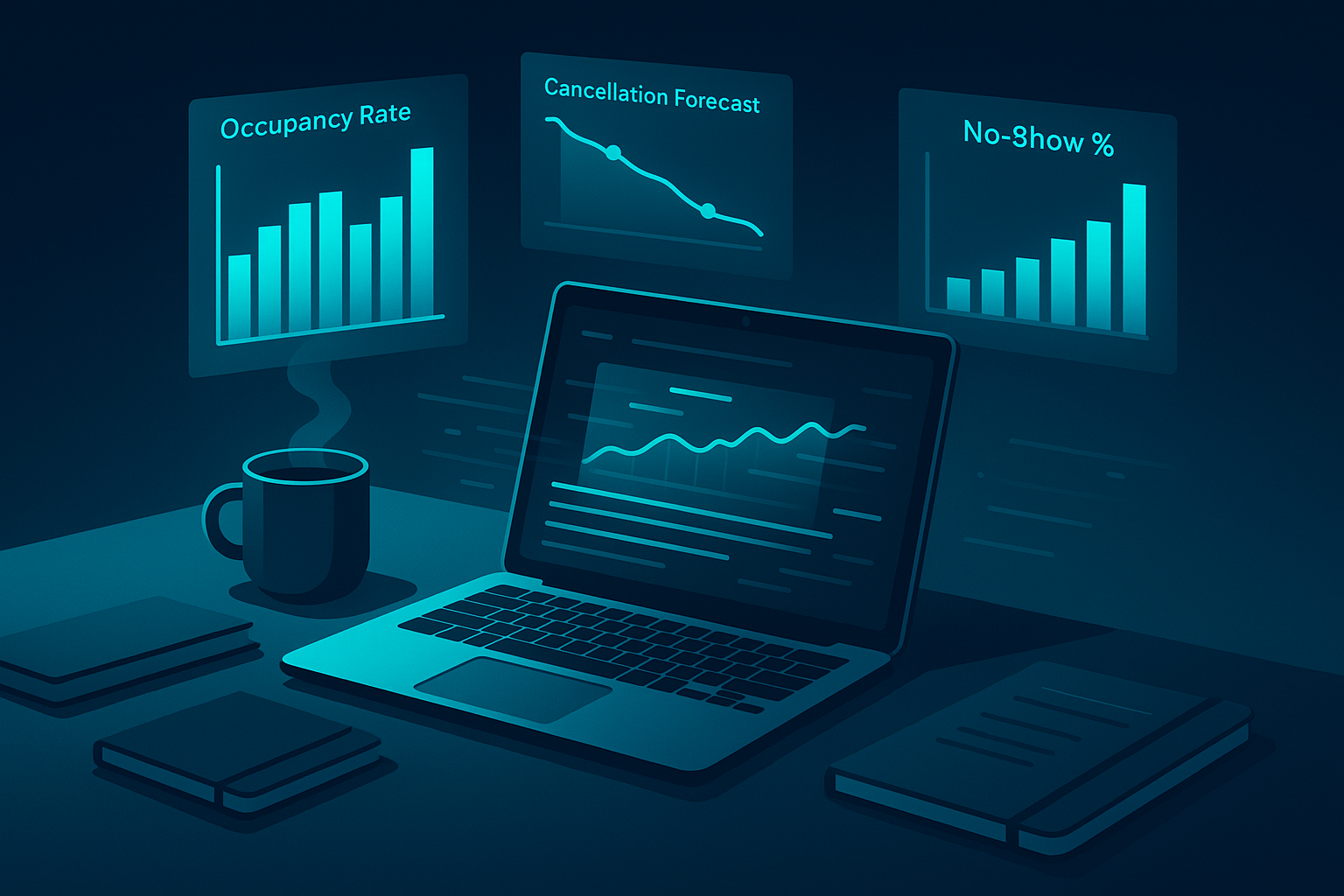
Key Data Points, Occupancy, No-Show Rates, and Cancellation Forecasting
Effective overbooking requires tracking five essential metrics: baseline occupancy rate, booking pick-up pace, cancellation rate by segment, no-show ratio, and guest profile patterns. Maria’s hotel analyzes 12 months of data showing 6% average cancellations within 48 hours, 3% no-shows, and 85% base occupancy, supporting a 5% overbooking buffer that prevented 42 empty nights last season.
Seasonal variations demand dynamic adjustments: summer wedding season shows 2% cancellation rates (lower overbooking), while winter corporate travel averages 9% (higher buffer opportunity). Smart hoteliers segment data by booking source, with direct bookings showing 4% cancellation rates versus OTA bookings at 8%.
ROI Analysis, Cost of Compensation vs. Lost Revenue from Vacancy
The financial equation strongly favors strategic overbooking when compensation costs ($150 average) stay below lost room revenue ($280 average ADR). A 45-room property avoiding 40 vacant nights annually generates $11,200 additional revenue, even accounting for 8 compensation incidents at $150 each ($1,200 total cost).
Boutique hotels benefit from flexibility in compensation offerings, spa credits, dining vouchers, and future stay certificates cost less than cash while potentially driving repeat business. Properties partnering with comparable local accommodations often secure $100-120 walking rates versus $200+ market compensation.
Upselling Opportunities During Overbooking, Turning Risk into Ancillary Revenue
Overbooking situations create unexpected upselling opportunities when handled strategically. Guests relocated to partner properties often receive dining credits, spa packages, or experience vouchers as compensation, driving ancillary revenue while maintaining satisfaction. Maria’s property offers relocated guests a $35 dinner upgrade with 41% conversion rate, generating additional revenue beyond base compensation costs.
AI-driven guest profiling enables targeted upsells during rebooking conversations. Properties identifying business travelers might offer airport transfer credits, while leisure guests respond better to local attraction packages. This personalized approach transforms operational challenges into relationship-building moments that drive future direct bookings.
| Scenario | Average Compensation Cost | Lost Room Revenue | Net Impact |
|---|---|---|---|
| Strategic Overbooking (5% buffer) | $150 per incident | $0 (prevented vacancy) | +$280 revenue per room saved |
| Empty Room (no overbooking) | $0 | $280 ADR loss | -$280 lost revenue |
| Accidental Overbooking | $300+ emergency relocation | $0 | -$300 unplanned expense |
Overbooking Management, Best Practices for Minimizing Guest Impact and Maximizing Operational Efficiency
Monitoring Reservations and Forecasting No-Shows with AI Automation
Real-time inventory monitoring prevents overbooking crises through automated alerts and dynamic channel management. Properties should run inventory checks every 30 minutes during high-demand periods, with PMS systems automatically closing online channels when occupancy reaches predetermined thresholds. Maria’s hotel sets automatic closures at 95% occupancy based on historical patterns, preventing accidental oversales while maintaining strategic buffer zones.
AI-driven forecasting analyzes booking patterns, weather data, local events, and guest communication to predict cancellation likelihood. Systems tracking email engagement, special requests, and payment timing can identify high-risk reservations 48 hours before arrival, enabling proactive inventory adjustments and guest communication.
Guest Selection Policy, How Hotels Decide Whom to Walk, and Why
Professional overbooking management requires clear guest prioritization criteria to minimize relationship damage and legal risk. Industry standard prioritizes retention for direct bookings, loyalty program members, extended stays, early arrivals, and guests with special needs or celebrations. Late-arriving, single-night, third-party bookings with standard room types face highest walking probability.
AI systems can flag high-value guests at risk in real-time, enabling proactive upgrades or early communication before arrival. Properties maintaining detailed guest profiles, including lifetime value, complaint history, and social media influence, make more informed decisions that protect long-term revenue relationships.
| Guest Priority Level | Retention Criteria | Walking Risk | Communication Timing |
|---|---|---|---|
| Highest Priority | Loyalty members, direct bookings, special occasions | Never walk | Proactive upgrade offers |
| Standard Priority | Multi-night stays, early check-ins, repeat guests | Low risk | Same-day notification if needed |
| Walking Candidates | Single night, late arrival, OTA bookings | Moderate risk | 2-4 hours before arrival |
Guest Communication, Transparent, Empathetic, Real-Time Remediation
Effective overbooking communication follows a three-step protocol: immediate acknowledgment within 3 minutes of guest arrival, clear explanation without technical jargon, and tangible solution offering with timeline. Staff training emphasizes empathy and ownership rather than defensive explanations about industry practices.
Sample messaging: “I sincerely apologize, we’ve experienced an unexpected situation with tonight’s availability. I’m personally arranging your accommodation at [partner property] with transportation provided, plus a $50 dining credit for the inconvenience. Your alternate room is confirmed and ready now.” This approach maintains control while demonstrating immediate problem-solving action.
Pre-Arranged Alternate Accommodation, How to Build Local Partnerships
Successful overbooking management requires established partnerships with comparable local properties, negotiated during low-demand periods when rates and availability favor cooperation. Standard agreements should specify room quality standards, maximum walking rates ($100-150 typically), transportation arrangements, and reciprocal terms for mutual benefit.
Partnership agreements require renewal every 6 months to maintain current rates and availability commitments. Properties should maintain relationships with 2-3 partner hotels to ensure backup options during city-wide high-demand events when multiple properties face overbooking simultaneously.
Leveraging AI Automation, Data-Driven Overbooking, Guest Experience, and Risk Mitigation for Boutique Hotels
Staff Training, Operational Protocols and Checklists for Overbooking Events
Front desk staff require monthly scenario-based training covering overbooking protocols, guest communication scripts, and escalation procedures. Role-playing exercises should simulate various guest personalities, from understanding business travelers to frustrated families, ensuring staff maintain composure and solution-focused dialogue under pressure.
Essential overbooking incident checklist includes: immediate inventory verification, guest priority assessment, partner property contact within 10 minutes, transportation arrangement, compensation authorization, and incident documentation. Staff should memorize this sequence to execute consistently during high-stress situations when guest satisfaction depends on swift, professional resolution.
Overbooking Response Checklist
- Verify actual availability across all room types (2 minutes)
- Check guest priority status and walking criteria (1 minute)
- Contact partner properties for immediate availability (5 minutes)
- Arrange transportation and confirm alternate accommodation
- Offer appropriate compensation and dining credits
- Document incident details and guest feedback
How AI Streamlines Overbooking Management, From Forecasting to Resolution
AI automation transforms overbooking in hotels from reactive crisis management to predictive revenue optimization. Advanced systems analyze 12+ months of booking data, weather patterns, local events, and guest communication signals to predict cancellation probability with 85%+ accuracy. Real-time inventory synchronization across all channels prevents accidental oversales while maintaining strategic buffer zones.
Vynta’s AI agents integrate seamlessly with existing PMS systems, automatically adjusting overbooking thresholds based on demand patterns and guest behavior analytics. Maria’s boutique hotel reduced guest walking incidents by 80% season-over-season while maintaining 96% average occupancy through intelligent forecasting and proactive guest communication.
Implementation Requirements, Integrating AI with Existing Tech (PMS, CRM, etc.)
AI overbooking solutions require no system replacement, cloud-based agents connect to existing PMS, channel managers, and CRM platforms through standard APIs. Typical deployment takes 2-3 weeks including data integration, staff training, and performance calibration. Properties need clean historical booking data spanning 12+ months for optimal AI training accuracy.
Common implementation friction points include staff adaptation to automated alerts, data quality issues from legacy systems, and initial threshold calibration. Properties investing in proper change management and gradual AI adoption see faster ROI and higher staff acceptance rates compared to rushed deployments.
Real-World Outcomes, Case Studies of Boutique Hotels Using AI for Overbooking
Boutique properties implementing AI-driven overbooking management report measurable improvements across key performance indicators. Maria’s 45-room hotel achieved 19% RevPAR increase, 38% reduction in no-show rates, and 92% guest satisfaction scores for overbooking resolution through intelligent forecasting and automated guest communication workflows.
Top three measurable improvements from AI automation include: enhanced occupancy optimization (typically 8-15% improvement), reduced operational stress through predictive alerts, and improved guest experience through proactive communication and personalized compensation offers. Properties see full ROI within 4-6 months of implementation.
Transparency in Human-AI Collaboration, How AI Augments, Not Replaces, Hospitality Staff
AI automation enhances human decision-making rather than replacing hospitality expertise. Staff remain primary guest contact points while AI handles predictive analytics, inventory monitoring, and documentation tasks. This collaboration enables front desk teams to focus on relationship building and creative problem-solving rather than manual data tracking.
Guest personalization improves through AI-powered insights about preferences, booking patterns, and communication history. Staff receive real-time alerts about high-value guests at risk, enabling proactive upgrades or early outreach that strengthens loyalty relationships. The technology provides intelligence; humans provide empathy and creative solutions.
Overbooking Policies, Legal Considerations, and Guest Rights, Risk, Ethics, and Reputation Management

Contract Law and the Absence of Federal Regulation, What Boutique Hoteliers Must Know
Unlike airline overbooking, hotels operate without federal compensation mandates, relying on state contract law and property policies for guest protection. Most states recognize hotel reservations as binding contracts, requiring properties to provide comparable accommodation or appropriate compensation when failing to honor confirmed bookings. For more information on hotel contract law, visit this authoritative guide from the American Hotel & Lodging Association.
Standard industry practice mandates refund processing within 24 hours and immediate alternate accommodation arrangements. Properties should document clear overbooking policies in reservation terms, including compensation minimums and guest communication procedures, reviewed annually with legal counsel to ensure compliance with evolving state regulations.
Policy Formation, Compensation, Alternative Accommodation, and Guest Communication Standards
Effective overbooking policies establish minimum compensation benchmarks, typically $100-200 or equivalent upgrade value, while maintaining flexibility for situation-specific adjustments. Policies should specify partner property quality standards, transportation arrangements, and timeline commitments for guest notification and resolution.
Documentation requirements include incident logging, guest communication records, and compensation tracking for pattern analysis and legal protection. Properties updating policies annually and training staff quarterly maintain consistent service standards and reduce liability exposure during overbooking events. For a deeper dive into hospitality best practices, read this expert analysis on Hospitality Net.
Frequently Asked Questions
What are the key differences between strategic and accidental overbooking in hotels?
Strategic overbooking is a deliberate practice where hotels accept reservations beyond full capacity based on historical data like cancellation and no-show rates to maximize occupancy. Accidental overbooking results from inventory management errors, such as channel synchronization failures, causing booking platforms to accept reservations when rooms are actually unavailable.
How can boutique hotels safely implement overbooking strategies to increase revenue without harming guest satisfaction?
Boutique hotels can safely overbook by analyzing historical cancellation patterns to set conservative buffer limits, typically 3-7%, and adjusting these buffers close to arrival dates when cancellations stop. Combining this with clear communication policies and contingency plans ensures occupancy optimization while preserving the personalized guest experience.
What role does AI-driven technology play in optimizing overbooking and minimizing compensation costs for boutique properties?
AI-driven technology uses predictive analytics and real-time demand data to forecast cancellations and no-shows accurately, enabling boutique hotels to fine-tune overbooking levels. This reduces the risk of guest displacement, lowers compensation payouts, and maximizes revenue per available room without complex or costly systems.
Why do hotels choose to overbook despite the risks, and how do they calculate the financial benefits versus potential losses?
Hotels overbook to avoid lost revenue from no-shows and last-minute cancellations, which can leave rooms empty and reduce profitability. They calculate benefits by comparing the incremental revenue gained from higher occupancy against potential costs like guest compensation and reputational damage, aiming for a net positive impact on overall revenue and guest satisfaction.
About The Author
Anas Moujahid is the chief contributing writer & Operations Director for the Vynta AI Blog, where he turns cutting-edge AI automation into measurable business outcomes for mid-market companies.
Vynta AI designs enterprise-grade AI agents that augment rather than replace people, freeing teams to focus on higher-value work while the bots handle the busywork.
We specialise in four service-heavy verticals where AI can move the revenue needle fast: real estate, recruitment, fundraising and hospitality.
Anas started his career architecting AI and automation systems; today he leads operations at Vynta AI, making sure every deployment lands real-world ROI, whether that’s more booked viewings for estate agents, faster placements for recruiters, warmer investor pipelines for fundraisers or happier guests for hotels and restaurants.
Vynta AI delivers results by:
- Building industry-specific agents pre-trained on real-world workflows, no generic chatbots here.
- Integrating seamlessly with existing CRMs, ATSs, PMSs and fundraising platforms, zero rip-and-replace.
- Measuring success in business KPIs (lead-to-close rates, time-to-hire, donor retention, RevPAR) not vanity metrics.
- Providing transparent implementation plans so clients know exactly what to expect, when and why.
- Pairing every AI agent with human-in-the-loop controls to keep quality, compliance and brand voice on point.
Since launch, Vynta AI has helped agencies slash lead qualification time by up to 70 %, recruitment firms cut screening hours in half, fundraising teams triple investor touchpoints and hospitality brands lift guest satisfaction scores by double digits, all while keeping human expertise firmly in the loop.
Anas writes with the same ethos that drives Vynta AI: outcome-focused, jargon-free and grounded in real business value. Expect data-backed insights, practical implementation guides and a clear-eyed view of what AI can, and can’t, do for your organisation.