
Key Takeaways
- Outbound calling continues to be the quickest way to generate qualified opportunities in various industries.
- Traditional cold calling is inefficient and consumes significant time and talent.
- AI-powered outbound systems increase meaningful conversations by 3-5 times per hour.
- These AI systems preserve the human touch essential for closing deals.
- Precision and scale are critical for successful outbound calling strategies.
Table of Contents
Outbound Calling in 2025: How AI-Powered Agents Turn Cold Calls into Scalable Revenue
Outbound calling remains the fastest path to qualified opportunities across real estate, recruitment, fundraising, and hospitality—but only when executed with precision and scale. While traditional cold calling burns through time and talent, AI-powered outbound systems now deliver 3-5x more meaningful conversations per hour while maintaining the human touch that closes deals.
The difference isn’t just efficiency—it’s outcome quality. AI agents handle initial qualification, follow-up sequences, and appointment setting, freeing human teams to focus on high-value negotiations and relationship building. This hybrid approach transforms outbound from a numbers game into a strategic revenue engine.
What “Outbound Calling” Really Means Today (and Why It Still Matters)
From Cold Calls to Coordinated Outbound Engines
Modern outbound calling extends beyond phone-only approaches to orchestrated sequences across voice, SMS, WhatsApp, and email—with live conversations as the primary conversion catalyst. Unlike inbound (prospect-initiated contact) or blended models (mixed approach), outbound proactively reaches prospects at optimal moments.
This strategy drives critical business outcomes across verticals: real estate agents connecting with property inquiries within minutes, recruitment firms reactivating passive candidates, fundraising teams scheduling investor meetings, and hospitality managers confirming reservations while offering upgrades.
The 4 Core Business Outcomes of Effective Outbound Calling
Higher conversion rates emerge when prospects receive immediate response—real estate agencies see 20-30% more viewing bookings when leads are contacted within 5 minutes versus 30 minutes later. Reduced manual time per contact allows teams to reach 3-4x more prospects daily through automated qualification and scheduling.
Consistent follow-up ensures every lead receives 5-7 touchpoints over 10-14 days, compared to typical manual programs where 60-70% of leads receive just one attempt. Better data capture automatically logs conversation outcomes, preferences, and next steps directly into CRM, ATS, PMS, or fundraising platforms.
Human + AI: The New Model for Outbound
Pure manual calling doesn’t scale beyond small teams, while robotic auto-dialers destroy brand trust and compliance. The augmented model positions AI agents to handle 60-80% of repetitive outreach logistics while humans manage complex conversations and relationship building.
Example workflow: AI agent calls new property inquiry within 2 minutes, qualifies budget and timeline, schedules viewing, then hands detailed notes to human agent for the actual property tour and negotiation. This approach maintains personal service while dramatically expanding reach.
Outbound Calling Fundamentals: Metrics, Economics, and Capacity Planning
Core Outbound Calling Metrics That Actually Matter
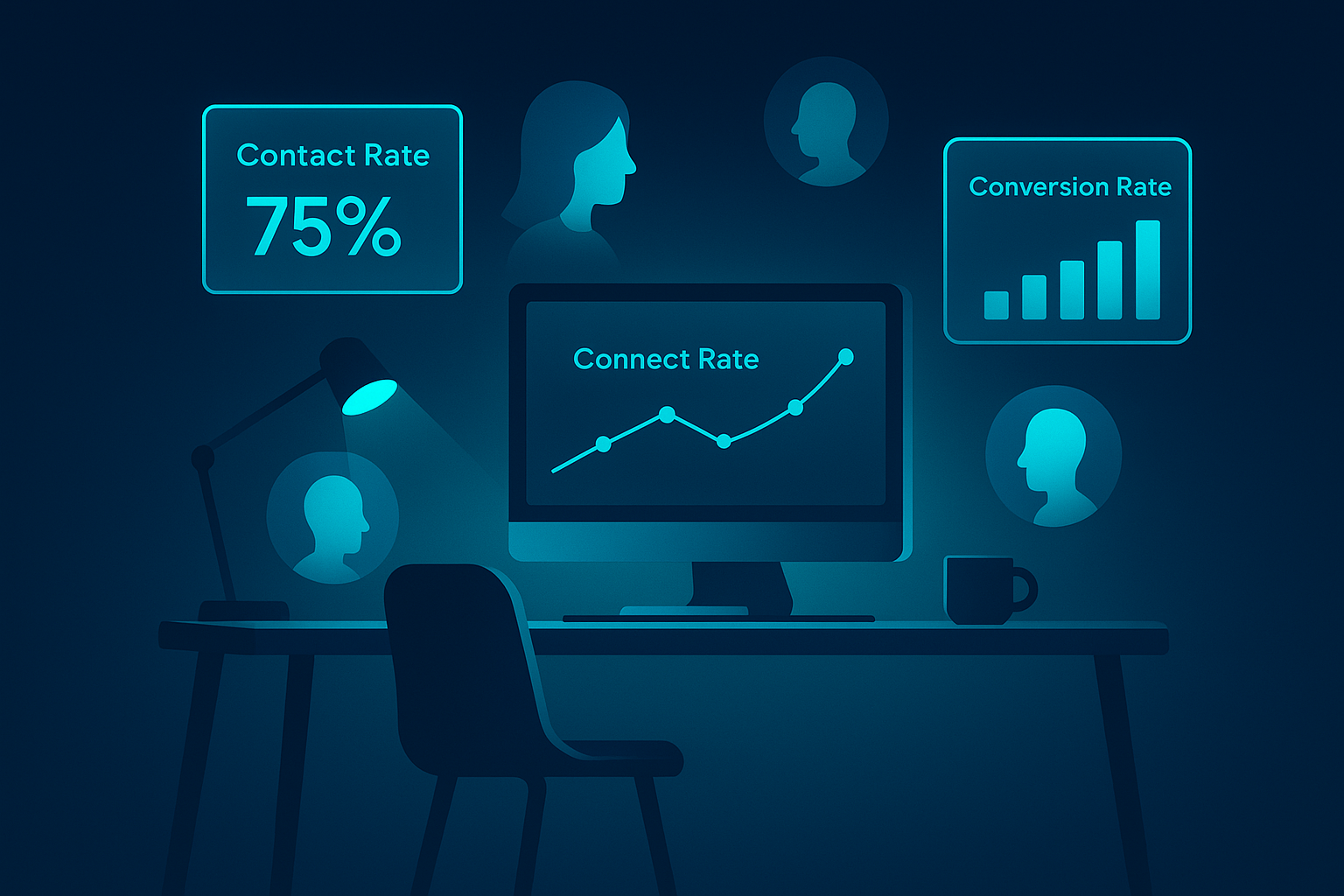
Contact rate (reaching a live person), connect rate (meaningful conversation), and conversion rate (qualified opportunity) form the foundation. Typical benchmarks: 15-25% contact rate, 40-60% connect rate from contacts, 10-20% conversion rate from connections. Average Handle Time (AHT) and calls per hour determine capacity, while call-to-meeting ratios measure quality.
Industry-specific examples reveal different success patterns: real estate measures inquiry-to-viewing-to-offer ratios, recruitment tracks call-to-qualified-candidate-to-placement, fundraising monitors call-to-meeting-to-commitment progression, and hospitality focuses on confirmation-to-upsell-to-satisfaction scores.
Unit Economics of Manual vs Augmented Outbound
Manual caller baseline: 40 calls/hour, 20% contact rate, 8 meaningful conversations, 1.5 qualified opportunities. At $25/hour fully loaded cost, each qualified opportunity costs approximately $17 in labor alone.
AI-augmented approach: Same caller handles 25-30 pre-qualified conversations per hour (AI handles initial screening), achieving 40-50% conversion to qualified opportunities. This reduces cost per qualified opportunity by 60-70% while improving conversation quality through better preparation and context. For a deeper dive into the impact of AI on sales, see this Harvard Business Review analysis.
Capacity Planning: How Many Outbound Touches Can You Realistically Run?
Two-person manual team typically manages 150-200 meaningful outbound conversations weekly. Adding AI agents expands this to 400-600 conversations without additional headcount—AI handles initial qualification, appointment setting, and follow-up sequences while humans focus on high-value interactions.
Practical capacity rules: Human reps handle 30-50 qualified conversations weekly, while AI agents manage 200-300 initial contacts and follow-ups per day. This 4:1 ratio allows dramatic scaling without quality degradation.
How Outbound Calling Works in Each Vertical (with Concrete Use Cases)
Real Estate Outbound Calling Use Cases
Speed-to-lead dominates real estate success—calling portal inquiries within 5 minutes versus 30 minutes increases viewing bookings by 25-35%. AI agents immediately contact new leads with: “Hi Sarah, you inquired about the property at 123 Main Street. Are you available for a viewing this week?” This rapid response not only increases booking rates but also improves agent productivity by automating initial qualification and scheduling. Human agents then focus on property tours and negotiations, ensuring a seamless, high-touch experience for clients.
Recruitment Outbound Calling Use Cases
For recruitment agencies, AI-powered outbound calling enables rapid candidate engagement and reactivation. AI agents can reach out to passive candidates, confirm interest, and schedule interviews, freeing recruiters to focus on high-value conversations and placements. This approach reduces time-to-hire by up to 40% and increases placement rates by ensuring no qualified candidate slips through the cracks.
Fundraising Outbound Calling Use Cases
Fundraising organizations benefit from AI agents that can systematically reach out to potential investors, schedule meetings, and follow up on commitments. By automating initial outreach and reminders, fundraising teams can focus on building relationships and closing funding rounds. This leads to higher donor retention and a more predictable fundraising pipeline.
Hospitality Outbound Calling Use Cases
In hospitality, AI-powered outbound calling enhances guest experience by confirming reservations, reducing no-shows, and offering personalized upsells. For example, an AI agent can call guests before arrival to confirm booking details and suggest room upgrades or dining reservations. This not only increases revenue per guest but also ensures a smooth, personalized experience that drives higher guest satisfaction scores.
Frequently Asked Questions
How do AI-powered outbound calling systems improve the efficiency and quality of sales conversations compared to traditional cold calling?
AI-powered outbound calling systems increase efficiency by automating lead qualification, optimizing call timing, and personalizing outreach, resulting in 3-5 times more meaningful conversations per hour. Unlike traditional cold calling, which is time-consuming and often inefficient, AI enables teams to focus on high-value interactions that drive better conversion rates and revenue outcomes.
What are the key benefits of combining human agents with AI in outbound calling strategies?
Combining human agents with AI allows AI to handle initial qualification, follow-ups, and appointment setting, freeing human agents to concentrate on relationship-building and closing deals. This hybrid approach preserves the essential human touch while scaling outreach, improving both the quantity and quality of sales conversations and ultimately driving stronger business results.
In what ways has outbound calling evolved beyond just phone calls to include other communication channels?
Outbound calling today integrates coordinated sequences across voice, SMS, WhatsApp, and email, with live conversations as the primary conversion driver. This multi-channel approach ensures prospects are reached through their preferred channels at optimal times, increasing engagement and improving the overall effectiveness of outbound campaigns across industries.
Why is timely follow-up critical in outbound calling, and how does it impact conversion rates across different industries?
Timely follow-up is crucial because prospects are significantly more likely to engage when contacted quickly—real estate agencies, for example, see 20-30% more bookings when leads are reached within 5 minutes versus 30 minutes later. Consistent and prompt follow-up ensures higher conversion rates by maintaining prospect interest and moving opportunities forward across real estate, recruitment, fundraising, and hospitality sectors.
About The Author
Anas Moujahid is the chief contributing writer & Operations Director for the Vynta AI Blog, where he turns cutting-edge AI automation into measurable business outcomes for mid-market companies.
Vynta AI designs enterprise-grade AI agents that augment rather than replace people—freeing teams to focus on higher-value work while the bots handle the busywork.
We specialise in four service-heavy verticals where AI can move the revenue needle fast: real estate, recruitment, fundraising and hospitality.
Anas started his career architecting AI and automation systems; today he leads operations at Vynta AI, making sure every deployment lands real-world ROI—whether that’s more booked viewings for estate agents, faster placements for recruiters, warmer investor pipelines for fundraisers or happier guests for hotels and restaurants.
Vynta AI delivers results by:
- Building industry-specific agents pre-trained on real-world workflows—no generic chatbots here.
- Integrating seamlessly with existing CRMs, ATSs, PMSs and fundraising platforms—zero rip-and-replace.
- Measuring success in business KPIs (lead-to-close rates, time-to-hire, donor retention, RevPAR) not vanity metrics.
- Providing transparent implementation plans so clients know exactly what to expect, when and why.
- Pairing every AI agent with human-in-the-loop controls to keep quality, compliance and brand voice on point.
Since launch, Vynta AI has helped agencies slash lead qualification time by up to 70 %, recruitment firms cut screening hours in half, fundraising teams triple investor touchpoints and hospitality brands lift guest satisfaction scores by double digits—all while keeping human expertise firmly in the loop.
Anas writes with the same ethos that drives Vynta AI: outcome-focused, jargon-free and grounded in real business value. Expect data-backed insights, practical implementation guides and a clear-eyed view of what AI can—and can’t—do for your organisation.