

nonprofit crm automation
Beyond Basic Contact Management: What Nonprofit CRM Automation Truly Means
Nonprofit CRM automation transforms how organizations manage donor relationships, streamline operations, and amplify impact through intelligent AI agents that handle complex workflows with minimal ongoing oversight. Unlike basic contact databases, modern nonprofit crm automation creates integrated connections between fundraising, volunteer coordination, and program delivery while eliminating manual data reconciliation across multiple platforms.
The “Seven Apps for Three People” Problem That’s Killing Efficiency
Most nonprofits operate with disconnected tools: separate platforms for email marketing, event management, accounting, and volunteer coordination. Staff members waste hours transferring data between systems, creating opportunities for errors and duplicate work. This fragmentation prevents organizations from seeing the complete donor journey.
You can’t measure true program impact when your systems don’t talk to each other.
The Hidden Cost of Disconnection
Organizations using fragmented systems typically spend 40% of their administrative time on data entry and reconciliation tasks that automation can reduce to under 10%.
Why Traditional Business CRMs Miss the Mark for Nonprofits
Standard business CRMs focus on sales pipelines, not the complex relationship dynamics that nonprofits navigate. Donor stewardship requires understanding giving cycles, volunteer engagement patterns, and program participation across multiple touchpoints. A volunteer who becomes a major-gift prospect operates differently than a B2B sales lead.
The Real Promise: Operations That Scale Without Adding Headcount
Effective nonprofit crm automation removes administrative bottlenecks that limit mission-focused work. AI agents handle routine tasks such as prospect research, follow-up scheduling, and performance reporting while providing insights about donor retention, campaign effectiveness, and resource allocation.
Organizations implementing automation through AI Automation Services often see 12-15% response rates compared to 2-3% from manual campaigns. The technology creates unified operational views that support data-driven decision-making across fundraising, programming, and administrative functions.
Unlocking Nonprofit Growth: AI Agents as Your CRM’s Intelligent Co-Pilot
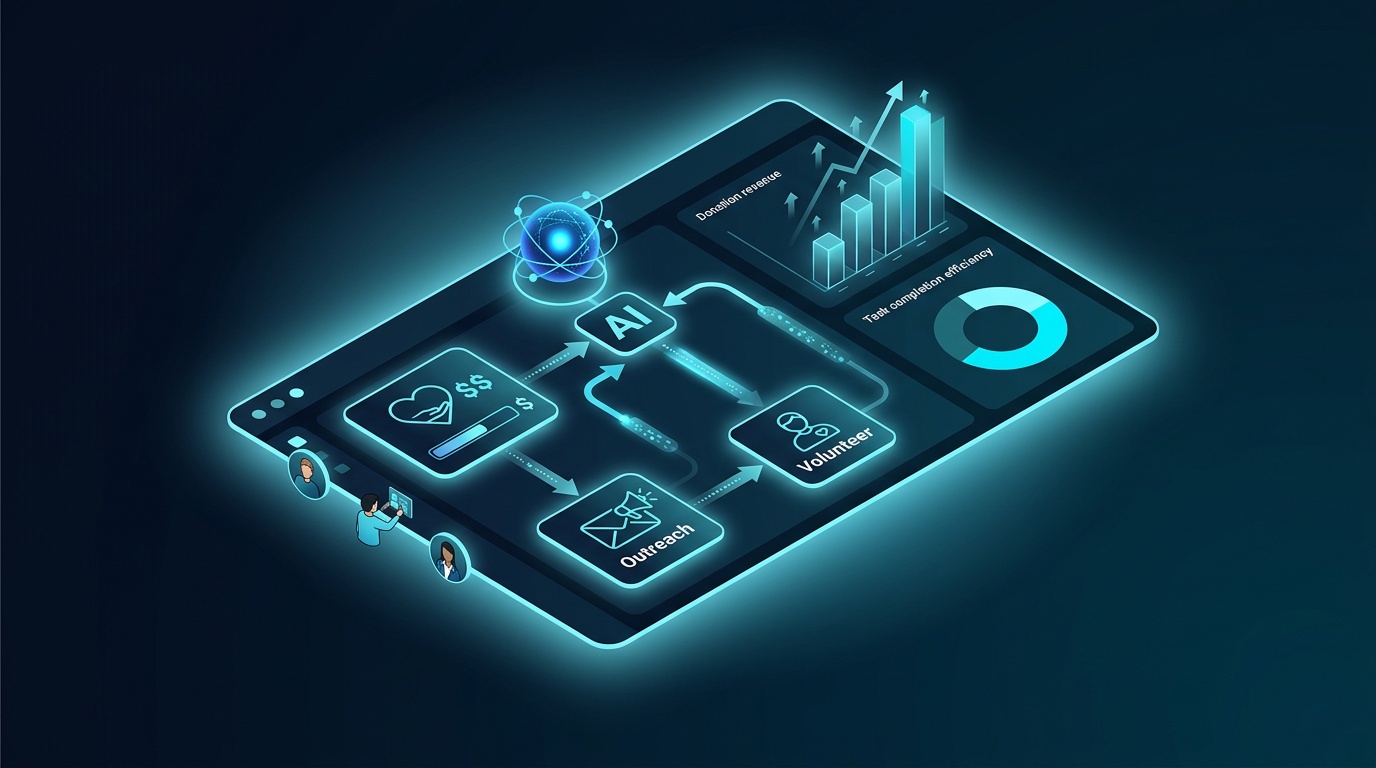
AI Agents: Digital Team Members That Actually Work
AI agents function as intelligent digital teammates that execute fundraising workflows without constant supervision. These systems research potential donors, analyze giving patterns, and initiate personalized outreach based on behavioral triggers. Unlike static automation rules, AI agents adjust their approach based on response patterns and engagement data.
Think of them as your most organized team member who never takes vacation.
From Cold Lists to Qualified Prospects in Minutes, Not Hours
AI agents scan multiple data sources to identify prospective donors who match your organization’s mission alignment and giving capacity. They evaluate public signals such as social activity, corporate affiliations, and philanthropic history to score prospects. This qualification process reduces manual research from 8-10 hours per qualified lead to about 30 minutes.
Donor Nurturing That Responds to Individual Preferences
Donor stewardship requires consistent touchpoints that reflect individual preferences and giving history. AI agents manage multi-touch campaigns that adjust frequency and content based on donor responsiveness. They track engagement across email opens, event attendance, and website interactions to identify optimal timing for solicitation requests.
No more sending generic “thank you” emails to your $10,000 donors.
Beyond Template Messaging
AI agents can draft context-relevant content that references specific program outcomes, volunteer activity, and past giving history. This creates more personal communication than generic mass messaging.
Solving the “We Need a Full-Time CRM Person” Budget Constraint
Many organizations struggle with CRM complexity that demands specialized technical knowledge and ongoing maintenance. AI-Powered Fundraising Platform reduces this burden by handling system administration, data hygiene, and workflow optimization. Agents assist with tasks such as duplicate record identification, data validation, and report generation.
Your existing team can focus on mission-critical work rather than database upkeep.
The CRM That “Talks”: Eliminating Manual Reconciliation with Integrated AI Automation
When Your Tools Don’t Talk, Your Team Becomes the Translator
Nonprofit teams lose hours transferring donor information between email platforms, accounting software, and event management systems. Each platform maintains separate records, creating inconsistencies that require verification and correction. Staff members become the bridge between systems, copying contact updates, donation records, and engagement metrics across multiple interfaces.
This approach introduces errors, delays important communications, and limits access to timely insights about donor relationships and campaign performance.
How AI Creates Intelligent Bridges Between Your Existing Software
AI agents connect systems through API integrations and data transformation rules. They synchronize contact information, donation history, and engagement metrics across platforms while maintaining data integrity and security controls. They also map information between formats, keeping data structures consistent across tools.
This eliminates manual data entry and provides unified access to donor profiles.
Real Impact: From 40% Admin Time to 10% Admin Time
Organizations that adopt automation reduce duplicate data entry and lower the time spent on cross-system reporting. AI agents validate data, flag inconsistencies, and reduce duplicate records before they affect operations. They generate unified reports that combine financial data, engagement metrics, and program outcomes without manual compilation.
Your team can focus on relationship building and planning rather than administration.
Real-Time Intelligence
AI-powered integrations provide faster access to donor engagement signals, helping teams respond to relationship changes without waiting for manual updates.
Vynta AI’s Approach: A Unified Operational Dashboard
Through automation platforms, organizations use centralized dashboards that display real-time information from connected systems. AI agents monitor data flows, perform accuracy checks, and surface optimization opportunities across departments. This approach turns disconnected tools into coordinated workflows that support fundraising, volunteer management, and program delivery.
Scaling Your Nonprofit’s Impact, Not Your Headcount: Measurable Outcomes with Automation
ROI That Board Members Actually Understand
Organizations implementing nonprofit crm automation see measurable gains in prospect identification speed and reductions in administrative cycle time. AI agents handle donor research, qualification, and outreach activities that would otherwise require additional staff capacity.
You can expand reach without proportional personnel growth.
Fundraising Revenue Growth Through Intelligent Outreach
AI-driven cultivation suggests solicitation timing based on engagement patterns, giving history, and contextual signals. Automated research expands donor pools by identifying connections and capacity indicators. Campaign workflows maintain follow-up and stewardship between major gift cycles, supporting retention and lifetime value.
For organizations comparing different fundraising approaches, best fundraising comparison resources provide valuable insights.
Volunteer Coordination That Runs Itself
AI agents support volunteer recruitment, skill matching, and scheduling through automated workflows. They track volunteer preferences, availability, and participation history to inform placement decisions and retention strategies. Event automation assists with registration, communication sequences, and logistics while improving attendance tracking.
Metrics That Matter: Tracking AI-Driven Success
Success metrics for nonprofit crm automation include donor acquisition cost, retention rate, average gift size, and volunteer engagement. Teams also track time saved across departments, error-rate reduction, and campaign response improvements to quantify operational impact.
| Metric Category | Before Automation | After AI Implementation |
|---|---|---|
| Prospect Research Time | 8-10 hours per qualified lead | About 30 minutes per qualified lead |
| Donor Response Rates | 2-3% average response | 12-15% average response |
| Administrative Task Time | 40% of staff capacity | 10% of staff capacity |
| Data Accuracy | 75-80% accuracy rate | 95-98% accuracy rate |
AI automation reduces manual bottlenecks and provides insights that support operational planning. With proper implementation and adoption, teams can improve fundraising execution, operational consistency, and impact reporting without scaling headcount at the same rate as their programs.
Organizations seeking to understand how AI for nonprofits can transform their operations will find that automation creates opportunities for both efficiency and mission delivery improvements.
Frequently Asked Questions
What distinguishes modern nonprofit CRM automation from older contact management systems?
Modern nonprofit CRM automation goes beyond basic data storage by using intelligent AI agents to manage complex workflows. It creates seamless connections between fundraising, volunteer coordination, and program delivery. This approach eliminates manual data reconciliation across multiple platforms, unlike traditional systems.
What problems arise when nonprofits use many disconnected software tools?
Operating with disconnected tools leads to staff wasting hours transferring data, which creates errors and duplicate work. This fragmentation prevents organizations from seeing a complete donor journey or measuring true program impact across departments. It also incurs significant hidden administrative costs due to manual tasks.
How do AI agents help nonprofits acquire new donors?
AI agents can scan various data sources to identify prospective donors who align with a nonprofit’s mission and giving capacity. They evaluate public signals, score prospects, and keep profiles updated as new information becomes available. This process reduces manual research and helps development teams focus on the most promising relationships.
How does nonprofit CRM automation improve donor nurturing and sustained engagement?
AI agents manage multi-touch campaigns, adjusting frequency and content based on donor responsiveness and preferences. They track engagement across email opens, event attendance, and website interactions to identify optimal timing for solicitation requests. This approach maintains relationship momentum while reducing the need for staff to manage every step manually.
Can AI agents personalize communication beyond generic templates for nonprofits?
Yes, AI agents can draft context-relevant content that references specific program outcomes, volunteer activity, and past giving history. This capability supports more personal communication than generic mass messaging. It also allows for coordination across multiple channels like SMS, social media, and direct mail.
How can nonprofit CRM automation reduce the administrative burden on staff?
AI-powered fundraising platforms can support system administration, data hygiene, and workflow optimization. Agents assist with tasks such as identifying duplicate records, validating data, and generating reports. This frees staff to focus on mission-critical work, like relationship building and program delivery, rather than database upkeep.