
marketing agent
In the current dynamic business environment, the role of a marketing agent is more critical than ever. These professionals are the architects of brand visibility, customer engagement, and revenue generation. However, the tools and strategies they employ are rapidly evolving, driven by technological advancements like artificial intelligence. At Vynta AI, we believe in augmenting human capabilities, not replacing them, and understanding how AI impacts this essential role is key to future success.
Key Takeaways
- Marketing agents are still vital for building brand visibility and generating revenue, but their workflows are being reshaped by artificial intelligence.
- AI technologies serve to amplify human capabilities in marketing rather than replace the professionals themselves.
- Professionals in this field must understand how AI changes customer engagement and strategy to remain effective.
- Adapting to AI driven tools is now a requirement for marketing agents who want to deliver measurable business outcomes.
- Vynta AI’s approach shows that combining human expertise with AI automation leads to stronger marketing performance.
This guide explores the multifaceted responsibilities of a marketing agent, examines current salary benchmarks, and forecasts how AI integration is reshaping earning potential and career trajectories. Whether you’re considering a career in marketing or looking to optimize your team’s performance, this analysis offers practical insights grounded in real-world data and industry expertise.
What Does a Marketing Agent Do? (And How AI Is Changing the Role)
Core Responsibilities of a Human Marketing Agent
A human marketing agent serves as the frontline strategist and executor for a company’s promotional efforts. Their duties span a broad spectrum, from understanding market needs and developing targeted campaigns to managing client relationships and analyzing performance metrics. They are adept at crafting compelling narratives, identifying audience segments, and tailoring messages to achieve specific business objectives like lead generation or brand awareness. This often involves direct client interaction, creative problem-solving, and adapting strategies based on real-time feedback and market shifts. The success of a human agent hinges on their intuition, creativity, and ability to build rapport.
Key tasks include market research, campaign planning, content creation (copywriting, visual concepts), social media management, public relations outreach, and performance reporting. They must possess strong communication skills to articulate strategies to stakeholders and clients, and analytical abilities to interpret data and adjust tactics. In fields like real estate, recruitment, fundraising, or hospitality, a human marketing agent brings industry-specific nuances and a personal touch essential for high-stakes client interactions and complex deal-making.
How AI Marketing Agents Automate Repetitive Tasks
AI marketing agents are designed to excel at high-volume, data-intensive tasks that are often time-consuming for human agents. They can process vast datasets to identify patterns, segment audiences with granular precision, and automate the distribution of content across multiple channels. For example, an AI agent can continuously monitor social media for relevant conversations, identify potential leads based on predefined criteria, and even draft initial outreach messages. This automation frees human counterparts from manual execution, allowing them to focus on higher-level strategy and creative thinking.
These intelligent agents are particularly effective in tasks such as A/B testing ad creatives, optimizing ad spend in real-time, personalizing email campaigns at scale, and generating performance reports. They can analyze customer behavior data to predict future trends or identify churn risks, providing actionable insights that might be missed by manual analysis. By handling these repetitive yet critical functions, AI marketing agents significantly boost operational efficiency and allow for more dynamic, data-driven campaign adjustments.
The Hybrid Role: Human + AI Collaboration
The most impactful approach to modern marketing involves a symbiotic relationship between human expertise and AI capabilities. In this hybrid model, human marketing agents utilize AI tools to augment their natural skills. For example, an AI agent might identify a list of high-potential prospects within a specific industry vertical, and the human agent then uses their persuasive communication skills and industry knowledge to engage those prospects personally. This collaboration ensures that strategic oversight, creativity, and emotional intelligence remain at the core of marketing efforts, while AI handles the data crunching and repetitive execution.
This partnership allows businesses to achieve greater scale, precision, and responsiveness. Human agents can focus on complex strategic planning, creative ideation, and building deep client relationships, while AI agents manage data analysis, lead qualification, and campaign automation. For example, in fundraising, an AI might identify potential donors based on wealth indicators and past giving behavior, and a human agent then crafts personalized appeals and manages the relationship. This synergy maximizes both efficiency and effectiveness, delivering superior business outcomes.
| Feature | Human Marketing Agent | AI Marketing Agent |
|---|---|---|
| Creativity & Strategy | High | Low |
| Data Analysis & Volume | Moderate | Very High |
| Repetitive Task Automation | Low | Very High |
| Personalized Interaction | Very High | Moderate (Rule-based) |
| Scalability | Moderate | Very High |
| Adaptability to Nuance | Very High | Moderate |
Key Insight
The future of marketing success lies not in choosing between human or AI agents, but in strategically integrating them. AI handles scale and data, while humans provide the strategic vision, creative spark, and genuine connection essential for building lasting customer relationships.
Marketing Agent Salary 2026: Current Data and How AI Boosts Earning Potential
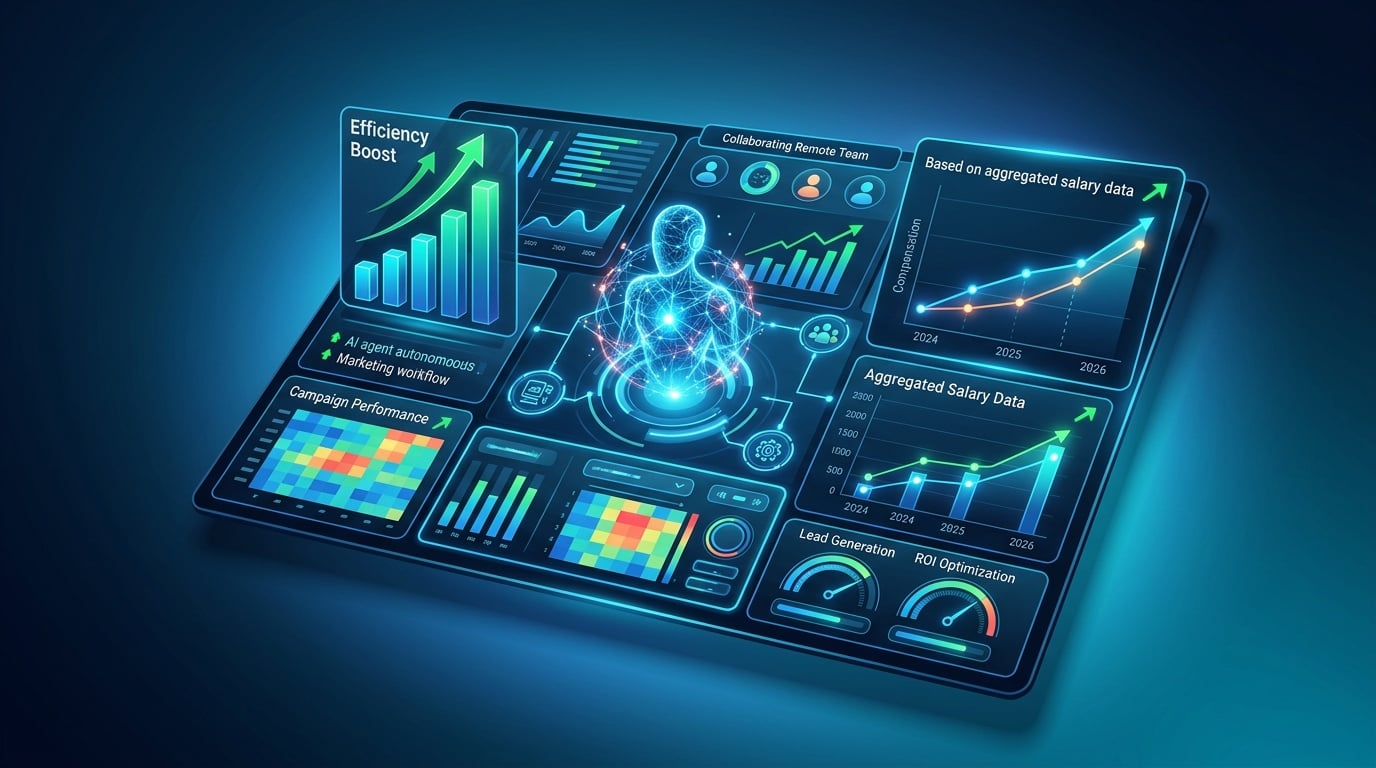
Salary Data from ZipRecruiter, Glassdoor, Payscale, and Comparably
Understanding the compensation landscape for marketing agents is essential for both aspiring professionals and hiring managers. Current data from major job aggregators provides a broad view of earning potential. ZipRecruiter reports an average annual salary of $48,042, with a typical hourly rate of $23.10 as of April 2026. Glassdoor offers a slightly higher range, indicating that while the average marketing agent salary might be lower, the 75th percentile can reach $95,184, based on 121 reported salaries in April 2026. Comparably presents a more optimistic figure, placing the average marketing agent salary at $114,183 in January 2026.
These figures highlight the variability in reported earnings, influenced by factors like experience, location, and the specific responsibilities of the role. Payscale notes the average salary within the broader marketing agency industry is $71,441. It’s important to differentiate between a “marketing agent” role and broader “marketing agency” positions, as the latter can encompass a wider range of seniorities and specializations. For example, ZipRecruiter also shows average salaries for marketing agency roles around $67,990 annually. The sheer volume of job postings, with over 9,323 ‘Marketing Agent’ jobs and 42,683 ‘Marketing Agency’ jobs on Indeed, underscores the demand across the sector.
Regional Salary Variations (Top Metro Areas with ‘near me’ Context)
Salary expectations for a marketing agent can differ significantly based on geographic location. Major metropolitan areas, particularly those with thriving business and tech sectors, generally offer higher compensation due to increased demand and a higher cost of living. For example, in Houston, Texas, marketing agency jobs show hourly ranges from $20 to $60, indicating a wide spectrum of potential earnings depending on the specific company and role complexity. While a broad ‘marketing agent near me’ search might yield varied results, understanding these regional trends is key.
Cities like New York, Los Angeles, San Francisco, and Chicago are likely to present higher average salaries compared to smaller towns or less economically active regions. This is often tied to the concentration of companies that can afford premium talent and the competitive market for skilled professionals. Businesses in these high-cost areas must be prepared to offer more competitive packages to attract and retain top marketing talent, reflecting both the market demand and the economic realities of operating in those locales. The data suggests that a marketing agent’s earning potential is directly influenced by the economic vitality and competitive landscape of their local job market.
Illustrative Salary Ranges (Marketing Agency Roles)
- National Average (approx.): $48,042 – $71,441 per year (ZipRecruiter, Payscale)
- Higher Percentiles: Up to $95,184+ (Glassdoor)
- Top Tier Average: $114,183 (Comparably)
- Example Metro Area (Houston, TX): $20 – $60 per hour (ZipRecruiter)
Note: Figures are based on data from April 2026 and January 2026 and can vary.
Why Human Agents Who Use AI Earn More
Professionals who integrate AI into their workflow are increasingly commanding higher salaries. This is because AI empowers them to handle a greater volume of work, achieve more precise results, and deliver measurable business outcomes more efficiently. A human marketing agent equipped with AI tools can manage more clients, execute more sophisticated campaigns, and generate better ROI, making them exceptionally valuable assets to any organization. Their ability to combine strategic thinking with automated execution translates directly into increased productivity and revenue generation.
Companies recognize that agents who master AI tools are not just performing tasks; they are driving strategic growth. These individuals can offer deeper insights, automate complex processes, and adapt more quickly to market changes, setting them apart from their peers. Consequently, their enhanced capabilities and proven impact on business performance justify higher compensation. The marketing agent salary for those leveraging AI often reflects a blend of their core marketing expertise and their proficiency with advanced automation technologies, positioning them for greater career advancement and earning potential.
| Factor | Traditional Marketing Agent | AI-Augmented Marketing Agent |
|---|---|---|
| Core Responsibilities | Manual campaign execution, data analysis, client communication. | Strategic oversight, advanced analytics interpretation, complex problem-solving, client relationship management. |
| Task Volume Handled | Limited by manual capacity. | Significantly higher due to automation of repetitive tasks. |
| Data Insight Depth | Relies on manual analysis, potential for missed trends. | Utilizes AI for deep, predictive, and real-time insights. |
| Efficiency & Speed | Slower execution, longer lead times. | Rapid campaign deployment, real-time optimization. |
| Revenue Impact | Moderate, dependent on individual effort. | Potentially higher due to scalability and data-driven precision. |
| Earning Potential | Standard market rates. | Higher, reflecting increased value and productivity. |
How to Become a Marketing Agent in 2026: Skills, Education, and the AI Advantage
Education Degrees and Certifications That Matter
For aspiring marketing agent candidates, understanding the educational requirements is the first step toward a successful career. Many professionals pursue a bachelor’s degree in marketing, communications, business administration, or a related discipline. These academic programs provide a foundational understanding of consumer behavior, market research methodologies, and strategic planning principles. While a formal degree is highly beneficial, it is not an absolute requirement for every role. Employers increasingly value demonstrable skills and practical experience over traditional educational pathways.
Industry-recognized certifications offer a practical alternative or complement to formal education. Credentials from platforms like Google (Google Analytics, Google Ads), HubSpot (Inbound Marketing, Email Marketing), and Facebook Blueprint validate a candidate’s proficiency with current digital tools and platforms. These certifications signal to hiring managers that an individual possesses up-to-date knowledge and a commitment to continuous learning in a rapidly evolving industry.
Step-by-Step Guide to Integrating AI Agents into Your Workflow
Adopting artificial intelligence into daily operations represents a significant career multiplier. The following framework outlines how to systematically implement AI tools to amplify productivity and strategic impact. A dedicated marketing agent must approach automation as a strategic enhancement to human capabilities, not a replacement for critical thinking.
Implementation Framework
-
Audit Current Repetitive Tasks
Begin by identifying routine activities that consume substantial time but require limited creative input. Common examples include lead list building, initial email outreach, social media posting schedules, and basic performance reporting. Document these processes to determine which functions are prime candidates for automation. AI agents excel at handling high-volume, rule-based tasks without fatigue, allowing human professionals to focus on high-impact strategy.
-
Select Specialized AI Tools
Choose AI solutions that align with your specific operational needs. For lead generation, deploy AI agents capable of scraping public data, verifying contact information, and enriching profiles with firmographic details. For content distribution, implement tools that can draft copy variations, schedule posts across multiple channels, and monitor engagement metrics. Ensure selected platforms integrate seamlessly with existing CRMs and marketing stacks to maintain data continuity.
-
Train and Configure AI Workflows
Define clear parameters and brand voice guidelines for your AI agents. Provide examples of successful campaigns, preferred terminology, and compliance boundaries. Establish feedback loops where the AI learns from human corrections, gradually improving output quality. Regularly review AI-generated content and outreach messages to ensure alignment with strategic objectives and brand standards.
-
Monitor Performance and Iterate
Implement tracking mechanisms to measure the impact of AI integration on key metrics such as response rates, conversion rates, and time saved. Compare baseline performance against AI-assisted results to quantify ROI. Use these insights to refine prompts, adjust targeting criteria, and expand automation to additional workflows. Continuous optimization ensures that AI remains a dynamic asset rather than a static tool.
Human Marketing Agent vs. AI Marketing Agent: A Decision Framework for Businesses
When to Hire a Human Marketing Agent (Real Estate, Recruitment, Fundraising, Hospitality)
High-stakes industries require a personal touch that machines cannot replicate. In real estate, a human agent navigates complex negotiations and builds lasting trust with buyers. Recruitment demands the same interpersonal finesse. A human recruiter evaluates cultural fit and guides candidates through the hiring process with empathy. Fundraising organizations rely on personal relationships to secure major gifts. When your business strategy depends on deep human connection, a human marketing agent remains the best choice.
When to Deploy an AI Marketing Agent (with Vynta.ai Case Studies)
AI marketing agents excel when businesses need to process massive volumes of data or execute repetitive tasks at scale. A recruitment firm receiving thousands of applications can use an AI agent to instantly screen resumes and schedule interviews. In fundraising, an AI agent manages thousands of personalized donor outreach emails simultaneously, tracking engagement. Vynta.ai implemented an automated agent for a fundraising organization that handled initial prospect research. The result was a 40% increase in qualified meetings without adding headcount.
The Optimal Blend: Hybrid Teams That Scale Revenue
The most successful organizations build hybrid teams where each component handles what it does best. A human marketing agent sets the strategic vision and manages high-value client relationships. Meanwhile, an AI agent handles data enrichment, initial outreach, and performance reporting. This division of labor allows human professionals to focus entirely on revenue-generating activities. By combining human creativity with AI scalability, businesses achieve faster growth across all core verticals.
Human vs. AI Marketing Agent Capabilities
Pros
- Human agents handle complex negotiations and build deep client trust
- AI agents process massive datasets and execute repetitive tasks at scale
- Hybrid teams maximize revenue by combining creativity with automation
Cons
- Human agents require higher compensation and limited daily capacity
- AI agents lack emotional intelligence and nuanced strategic vision
- Implementing hybrid systems requires initial setup time and training
Key Insight
Businesses achieve maximum ROI when they assign relationship-driven tasks to humans and data-driven tasks to AI. This strategic alignment ensures that every team member operates at the top of their license.
Vynta.ai Implementation Example
A mid-market hospitality management company struggled with guest feedback analysis and promotional email scheduling. They deployed a Vynta AI agent to automate sentiment analysis on ten thousand monthly reviews and draft personalized response templates. Human staff then reviewed the outputs and handled critical service recovery situations. This hybrid approach reduced response times by 60% and improved guest satisfaction scores, proving that automation amplifies human capability rather than replacing it.
References
Frequently Asked Questions About Marketing Agents (Human and AI)
What Does a Marketing Agent Do Exactly?
A marketing professional manages promotional strategies, handles client relations, and drives revenue growth. They analyze market trends, create targeted campaigns, and track performance metrics to ensure business objectives are met. Their core function is connecting a brand with its ideal audience through strategic communication.
How Much Does a Marketing Agent Make Per Hour and Per Year?
Compensation varies based on experience and location. Data indicates that the average professional earns approximately $23.10 per hour, translating to roughly $48,042 annually. Professionals in high-demand metros or senior roles can command rates up to $60 per hour. Those who integrate AI tools often see increased earning potential due to higher productivity.
Will AI Replace Human Marketing Agents?
Artificial intelligence will not replace human marketing agents. Instead, it transforms the role by automating routine tasks. AI handles data processing and initial outreach, allowing human professionals to focus on strategy and high-value relationships. The future belongs to agents who use AI to amplify their natural skills.
What Are the Education Requirements to Become a Marketing Agent?
Many professionals hold a bachelor’s degree in marketing or business administration. However, practical skills and industry certifications often carry more weight. Credentials from platforms like Google or HubSpot demonstrate technical proficiency. Today, understanding AI automation tools is increasingly becoming a standard requirement for modern marketing roles.
Quick Assessment
Which industry benefits most from human-only marketing strategies?
High-touch sectors like real estate and hospitality rely heavily on personal relationships and nuanced service, making human agents essential for building trust and loyalty.
Can AI agents handle complex creative campaigns?
AI agents excel at data analysis and repetitive execution but lack the creative intuition required for high-level brand storytelling and strategic campaign architecture.
Frequently Asked Questions
What is a marketing agent?
A marketing agent is a professional who plans and executes promotional strategies to build brand awareness, engage customers, and drive revenue. They handle tasks like market research, campaign creation, content development, and performance analysis. In today’s environment, marketing agents increasingly use AI tools to automate repetitive tasks and focus on strategic work.
What does a marketing agent do?
A marketing agent manages a company’s promotional efforts by understanding market needs, developing targeted campaigns, and analyzing results. Their responsibilities include client relationship management, content creation, social media management, and public relations. AI agents now handle data-heavy tasks like audience segmentation and lead qualification, allowing human agents to concentrate on creativity and client rapport.
How much does a marketing agent make?
According to salary data from ZipRecruiter and Glassdoor as of 2026, a marketing agent earns an average annual salary around $48,000, with hourly rates near $23. However, compensation varies by industry, experience, and location. Agents who adopt AI tools can boost their earning potential by handling higher-value strategic work and scaling their impact.
How is AI changing the marketing agent role?
AI is transforming the marketing agent role by automating repetitive tasks like data analysis, ad optimization, and email personalization. This allows human agents to focus on creative strategy, complex client interactions, and relationship building. The most effective approach is a hybrid model where AI handles scale and data while humans provide strategic vision and emotional intelligence.
What is the hybrid role of human and AI marketing agents?
The hybrid role combines human creativity and strategic oversight with AI’s ability to process large datasets and automate execution. For example, an AI agent identifies high-potential leads, and the human agent engages them with personalized communication. This collaboration maximizes efficiency and effectiveness, delivering better business outcomes than either could alone.
How can a marketing agent increase their salary with AI?
Marketing agents can increase their salary by learning to use AI tools to automate routine tasks and deliver data-driven insights. This frees them to focus on high-value activities like strategic planning and client relationships, which command higher compensation. Agents who master AI collaboration are more scalable and valuable to employers, leading to better career opportunities and earning potential.