

Key Takeaways
- Spending heavily on ads and leads often fails to convert prospects beyond the initial contact.
- Your existing listings are valuable marketing assets that can generate meaningful inquiries.
- The key is to transform your listings into a systematic engine that converts inquiries into leads.
- This approach captures both buyer and seller prospects effectively.
- Increasing traffic is less important than optimizing how you convert current listing interest into leads.
Table of Contents
- What “Listing to-Leads” Really Means (and Why It’s Different from Portal Leads)
- How to Structure a High-Converting Listing Funnel (From Traffic to Appointment)
- Turning Buyer Leads into Seller Leads (The Hidden Opportunity in Every Listing)
- How to Qualify and Prioritize Listing Leads (So You Don’t Waste Time on Unqualified Prospects)
- Integrating Your Listing Platform with CRM & Automation (So Leads Never Fall Through the Cracks)
- Measuring ROI from Your Listing-to-Leads Campaigns (What to Track and Why)
- Common Listing-to-Leads Mistakes (and How to Fix Them Fast)
- Next Steps: Building Your Listing-to-Leads System in 2025
How to Turn Listings into Leads (Without Wasting Time or Budget)
You’re spending hundreds on Facebook ads and Zillow leads, but most prospects vanish after the first call. Meanwhile, your own listings—your best marketing assets—are generating inquiries that go nowhere. The solution isn’t more traffic; it’s turning your existing listings into a systematic listing to-leads engine that captures both buyer and seller prospects.
Listing to-leads means transforming each property into a lead magnet with dedicated landing pages, automated follow-up, and qualification systems that route hot prospects to your agents within minutes. This guide shows you how to build funnels that convert listing traffic into appointments and closed deals, with specific tactics used by top-performing agencies in 2025.
What “Listing to-Leads” Really Means (and Why It’s Different from Portal Leads)
Listing to-leads isn’t just syndicating properties to Zillow and hoping for inquiries. It’s creating owned marketing funnels where each listing becomes a lead capture system you control completely. Portal leads cost $50-200 each and often get shared with competitors. Your listing-generated leads cost $15-40 each and belong exclusively to you.
This strategy generates two distinct lead types from every property. Buyer leads come from “schedule a showing” requests, while seller leads emerge from home valuation CTAs placed strategically on listing pages. A $500,000 listing might generate 15 buyer leads and 8 seller leads over 60 days—with seller leads typically worth 3x more in commission potential.
The real advantage is data ownership. Portal leads give you a name and phone number. Your listing to-leads system captures viewing history, price preferences, timeline indicators, and neighborhood interests—intelligence that transforms follow-up conversations from cold pitches into consultative discussions.
ROI Reality Check: Agencies using dedicated listing funnels report 40% lower cost-per-lead and 60% higher lead-to-appointment conversion rates compared to portal-dependent strategies.
How to Structure a High-Converting Listing Funnel (From Traffic to Appointment)
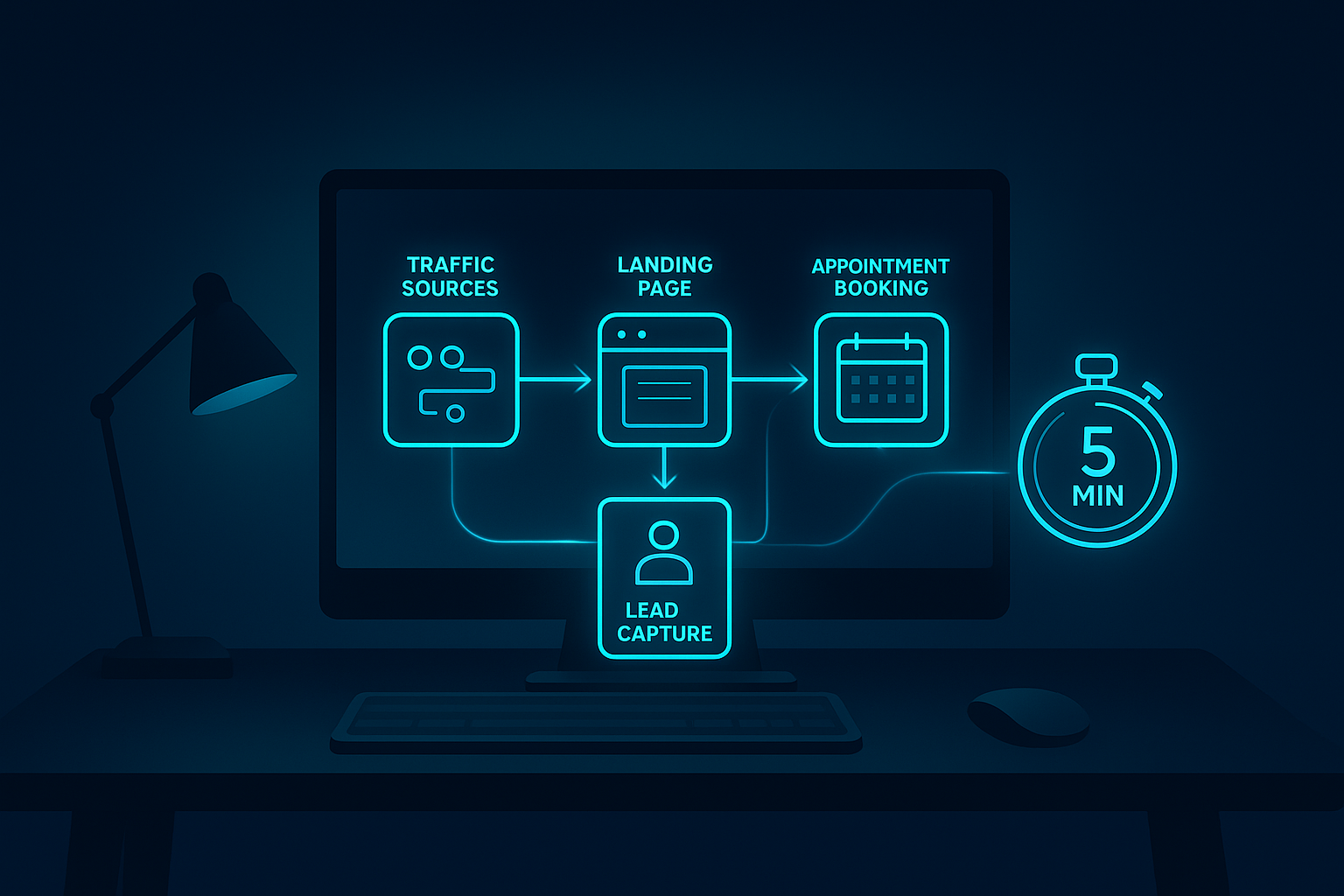
Effective listing to-leads funnels follow a predictable path: traffic source → dedicated landing page → lead capture → immediate follow-up → qualification → appointment booking. Each step must be optimized independently, but the 5-minute follow-up rule determines everything else. Leads contacted within 5 minutes convert at 9x higher rates than those reached after 30 minutes.
Your landing page structure makes or breaks conversion. Skip the generic MLS syndication approach. Create property-specific pages featuring high-resolution photos, embedded virtual tours, neighborhood insights, and a single prominent CTA like “Schedule Your Private Tour” or “Get the Complete Property Guide.” Include social proof through recent sales and client testimonials specific to that neighborhood.
Traffic generation works best through targeted Facebook ads highlighting unique property features, Google Ads for local search terms, and QR codes on yard signs linking directly to the landing page. Instagram Stories with virtual tour previews drive high-intent traffic, especially for luxury listings where visual appeal matters most.
Automation handles the immediate response while agents focus on qualified conversations. The moment someone submits a form, trigger simultaneous SMS and email confirmations promising contact within 10 minutes. This sets expectations and prevents leads from continuing their search elsewhere while waiting for your response.
Turning Buyer Leads into Seller Leads (The Hidden Opportunity in Every Listing)
Most agents chase buyer leads from listings while ignoring the bigger opportunity: converting those same prospects into listing clients. A buyer inquiring about a $600,000 home likely owns a $500,000+ property—making them a prime listing candidate worth $15,000+ in commission potential.
Strategic qualification questions reveal seller intent early. Instead of asking “When are you looking to buy?”, try “Are you looking to buy, sell, or both?” Follow up buyer leads with home valuation offers: “Curious what your current home is worth in today’s market?” This positions you as a market expert while identifying potential listings.
Behavioral signals often matter more than direct responses. Prospects who view multiple listings, visit “Just Sold” pages repeatedly, or request neighborhood market reports frequently own property in your area. Track these patterns in your CRM and prioritize follow-up accordingly.
Pro Strategy: Create retargeting campaigns for listing page visitors who didn’t convert, offering free market updates or home valuations. This captures the 85% of prospects who leave without submitting forms initially.
How to Qualify and Prioritize Listing Leads (So You Don’t Waste Time on Unqualified Prospects)
High lead volume means nothing without proper qualification systems. Implement a three-tier scoring model: Hot leads include active buyers in your price range and sellers requesting home valuations in your service area. Warm leads are buyers outside your typical price range but within your geographic focus, plus sellers who viewed market data without requesting valuations.
Cold leads include casual browsers, out-of-area prospects, and duplicate submissions. Route Hot leads to top agents within 60 seconds, trigger automated nurture sequences for Warm prospects, and place Cold leads into long-term newsletter campaigns with monthly market updates.
Your CRM tagging strategy should capture lead source, property interest, price range, and timeline. Tag formats like “Listing-June2025-Buyer-600k” or “Listing-May2025-Seller-HomeValuation” make it easy to segment and prioritize follow-up. This structured approach ensures your team focuses on the highest-value opportunities and delivers a consistent experience for every prospect.
Integrating Your Listing Platform with CRM & Automation (So Leads Never Fall Through the Cracks)

Manual lead entry kills conversion rates. When leads sit in your inbox for hours while you manually transfer data between systems, they’re already researching your competitors. The solution isn’t working faster—it’s building automated bridges between your listing platform, CRM, and follow-up systems.
The ideal listing to-leads workflow connects three components seamlessly: your listing platform captures leads, your CRM scores and routes them instantly, and your automation tools trigger immediate follow-up. This integration ensures every lead from your property listings receives contact within five minutes, proper scoring based on behavior, and assignment to the right agent automatically.
Most integration failures happen at the data mapping stage. When lead information doesn’t transfer correctly—missing phone numbers, incorrect property tags, or duplicate entries—your entire follow-up sequence breaks down. Set up field mapping carefully, ensuring name, phone, email, and property interest transfer completely. Use deduplication rules to prevent the same lead from entering your system multiple times from different listing sources.
Test your integration monthly by submitting test leads through each listing funnel. Verify they appear in your CRM with correct tags, trigger appropriate follow-up sequences, and route to designated agents. This 10-minute monthly check prevents weeks of lost leads from silent system failures.
Measuring ROI from Your Listing-to-Leads Campaigns (What to Track and Why)
Lead volume means nothing without conversion data. Tracking 200 leads per month sounds impressive until you realize only 5% convert to appointments. Focus on business outcome metrics: cost per qualified lead, lead-to-appointment rate, and revenue generated from listing-sourced deals.
Essential Listing-to-Leads KPIs
- Cost per lead: Total ad spend ÷ qualified leads generated
- Lead-to-appointment rate: Appointments scheduled ÷ total leads
- Appointment-to-listing rate: Signed contracts ÷ appointments held
- Revenue per lead: Commission earned ÷ leads generated
Calculate true ROI by tracking the complete funnel from listing ad to closed deal. If you spend $1,000 monthly on listing promotion and generate 25 appointments, with 6 converting to listings at $8,000 average commission, your ROI is 380%. This data guides budget allocation—double down on high-ROI listing campaigns and pause underperformers.
Review performance weekly, not monthly. Listing market conditions change rapidly, and waiting 30 days to adjust campaigns wastes budget on ineffective targeting. Track lead quality by source, identifying which listing types and promotional channels generate the highest-converting prospects. For a deeper understanding of digital lead generation strategies, see this overview of lead generation.
Common Listing-to-Leads Mistakes (and How to Fix Them Fast)
The biggest mistake agents make is treating all listing inquiries identically. A lead asking about a $2M waterfront property requires different follow-up than someone browsing starter homes. Without lead scoring and segmentation, you waste time on low-priority prospects while high-value leads grow cold.
Slow follow-up kills more listing to-leads conversions than poor ad targeting. Leads contacted within 5 minutes are 9x more likely to convert than those reached after 30 minutes. Yet most agents still rely on manual follow-up, checking emails sporadically throughout the day. Automate initial contact through SMS and email, then have agents make personal calls to qualified prospects.
Another common error is ignoring seller potential from buyer-side listing inquiries. Every buyer lead represents a potential seller—they likely own property they’ll need to sell before purchasing. Add home valuation offers to your buyer follow-up sequences and track which buyer leads convert to listing appointments.
Poor landing page design wastes advertising spend on high bounce rates. Your listing pages should load in under 3 seconds, display properly on mobile devices, and feature one clear call-to-action above the fold. Multiple CTAs confuse visitors and reduce conversion rates. For more insights into how technology is transforming real estate, review the 2024 Real Estate in the Digital Age report.
Next Steps: Building Your Listing-to-Leads System in 2025

Successful listing to-leads systems require four components working together: optimized listing funnels that capture both buyer and seller leads, automated qualification and routing systems, integrated CRM workflows, and continuous ROI measurement. Start with one listing and perfect the process before scaling to your entire portfolio.
Vynta AI specializes in building automated listing to-leads systems for mid-market real estate agencies. Our AI agents handle lead qualification, follow-up sequencing, and CRM integration, delivering 70% faster lead processing and 35% higher appointment conversion rates. Unlike generic automation tools, our solutions understand real estate workflows and integrate seamlessly with industry-standard CRMs.
Ready to transform your listings into a predictable lead generation engine? Book a discovery call with our team to design your custom listing to-leads automation system. We’ll analyze your current process, identify optimization opportunities, and build automated workflows that turn every listing into multiple revenue opportunities. To learn more about our company and approach, visit our About page.
Frequently Asked Questions
What is the difference between listing-to-leads and traditional portal leads, and why is listing-to-leads more effective?
Listing-to-leads transforms your own property listings into controlled marketing funnels that generate exclusive, lower-cost leads, unlike traditional portal leads which are expensive and often shared with competitors. This approach is more effective because it captures both buyer and seller prospects directly from your listings, improving lead quality and conversion rates by focusing on owned media rather than rented traffic.
How can I structure a high-converting listing funnel to turn property inquiries into qualified appointments?
A high-converting listing funnel uses dedicated landing pages for each property with clear calls-to-action, automated follow-up within minutes, and lead scoring to prioritize prospects. This structure ensures inquiries are quickly engaged and qualified, turning casual interest into scheduled appointments and increasing the likelihood of closing deals.
What are the key components needed to build a successful listing-to-leads system that captures both buyer and seller prospects?
The key components include dedicated property landing pages with strong CTAs, automated rapid follow-up sequences, and lead scoring mechanisms that identify buyer leads and convert them into seller leads through targeted valuation offers. Together, these elements create a systematic engine that maximizes lead capture and conversion from every listing.
How does integrating CRM and automation improve the follow-up process and prevent leads from falling through the cracks?
Integrating CRM with automation ensures every inquiry is tracked, followed up promptly, and routed to the right agent based on lead quality. This seamless process reduces manual errors, accelerates response times, and maintains consistent engagement, significantly increasing lead conversion rates and preventing valuable prospects from being lost.
About The Author
Anas Moujahid is the chief contributing writer & Operations Director for the Vynta AI Blog, where he turns cutting-edge AI automation into measurable business outcomes for mid-market companies.
Vynta AI designs enterprise-grade AI agents that augment rather than replace people—freeing teams to focus on higher-value work while the bots handle the busywork.
We specialise in four service-heavy verticals where AI can move the revenue needle fast: real estate, recruitment, fundraising and hospitality.
Anas started his career architecting AI and automation systems; today he leads operations at Vynta AI, making sure every deployment lands real-world ROI—whether that’s more booked viewings for estate agents, faster placements for recruiters, warmer investor pipelines for fundraisers or happier guests for hotels and restaurants.
Vynta AI delivers results by:
- Building industry-specific agents pre-trained on real-world workflows—no generic chatbots here.
- Integrating seamlessly with existing CRMs, ATSs, PMSs and fundraising platforms—zero rip-and-replace.
- Measuring success in business KPIs (lead-to-close rates, time-to-hire, donor retention, RevPAR) not vanity metrics.
- Providing transparent implementation plans so clients know exactly what to expect, when and why.
- Pairing every AI agent with human-in-the-loop controls to keep quality, compliance and brand voice on point.
Since launch, Vynta AI has helped agencies slash lead qualification time by up to 70 %, recruitment firms cut screening hours in half, fundraising teams triple investor touchpoints and hospitality brands lift guest satisfaction scores by double digits—all while keeping human expertise firmly in the loop.
Anas writes with the same ethos that drives Vynta AI: outcome-focused, jargon-free and grounded in real business value. Expect data-backed insights, practical implementation guides and a clear-eyed view of what AI can—and can’t—do for your organisation.