
is Vynta AI Agents for Hospitality worth it
Is Vynta AI Agents for Hospitality Worth It? A Data-Driven Analysis
What Vynta AI Agents Do for Hospitality Businesses
Vynta AI Agents automate guest communication, reservation management, and upselling for premium restaurants, bars, nightclubs, and beach clubs. These custom AI solutions integrate with your existing CRM to deliver personalized service while cutting operational costs by 30%. For hospitality managers running premium venues, the ROI question boils down to this: Can you measurably improve booking conversion and guest satisfaction without sacrificing your brand’s personal touch?
Core Functions: Guest Communication, Reservations, and Upselling
Our hospitality agents handle your core guest workflows. They respond to inquiries with human-like timing—natural pauses, realistic delays, no robotic instant replies. The agents manage reservations across WhatsApp, SMS, Instagram, and email, matching your exact brand voice. They send intelligent reminders that reduce no-shows and confirm bookings without staff intervention.
What separates these from generic chatbots? Context. Our agents understand hospitality-specific scenarios, distinguish between guest types, and tailor responses by channel. They increase average guest spend by 25% through contextual upselling—recommendations that fit the guest profile and communication channel, not shotgun promotions.
How Vynta Agents Fit Premium Hospitality Operations
Premium venues face a specific challenge: high inquiry volumes that overwhelm staff during peak hours. You lose bookings to slow response times. Our agents solve this by handling repetitive inquiries—availability questions, service details, reservation modifications—freeing your team for VIP interactions.
The system plugs into your existing tech stack. Real-time CRM integration (we work extensively with SevenRooms) means guest data, reservations, tags, and updates sync automatically. Your team sees enriched profiles and full conversation history. Set strict escalation rules: VIPs and complex queries route to staff with complete context. Your premium guests always get human attention when it matters.
Real-World Examples from Premium Hospitality Venues
A high-end restaurant deployed our agents for weekend reservation surges. Response time dropped from 4 hours to under 2 minutes. The agents automatically suggested premium experiences to Friday arrivals—wine pairings, chef’s table options—based on guest history. Conversion rates jumped on price-sensitive weekend slots where delayed responses previously cost bookings.
An upscale venue used our system to tackle no-shows. The agents analyzed patterns and customized reminder timing for each guest. During peak hours, they captured contact information, managed waitlists, and provided accurate time estimates. This improved satisfaction while maximizing table turns. Multilingual support allowed the venue to serve international guests in their preferred language.
Real ROI Data: Revenue Gains and Cost Reductions
Measured Outcomes: Booking Conversion and Operational Savings
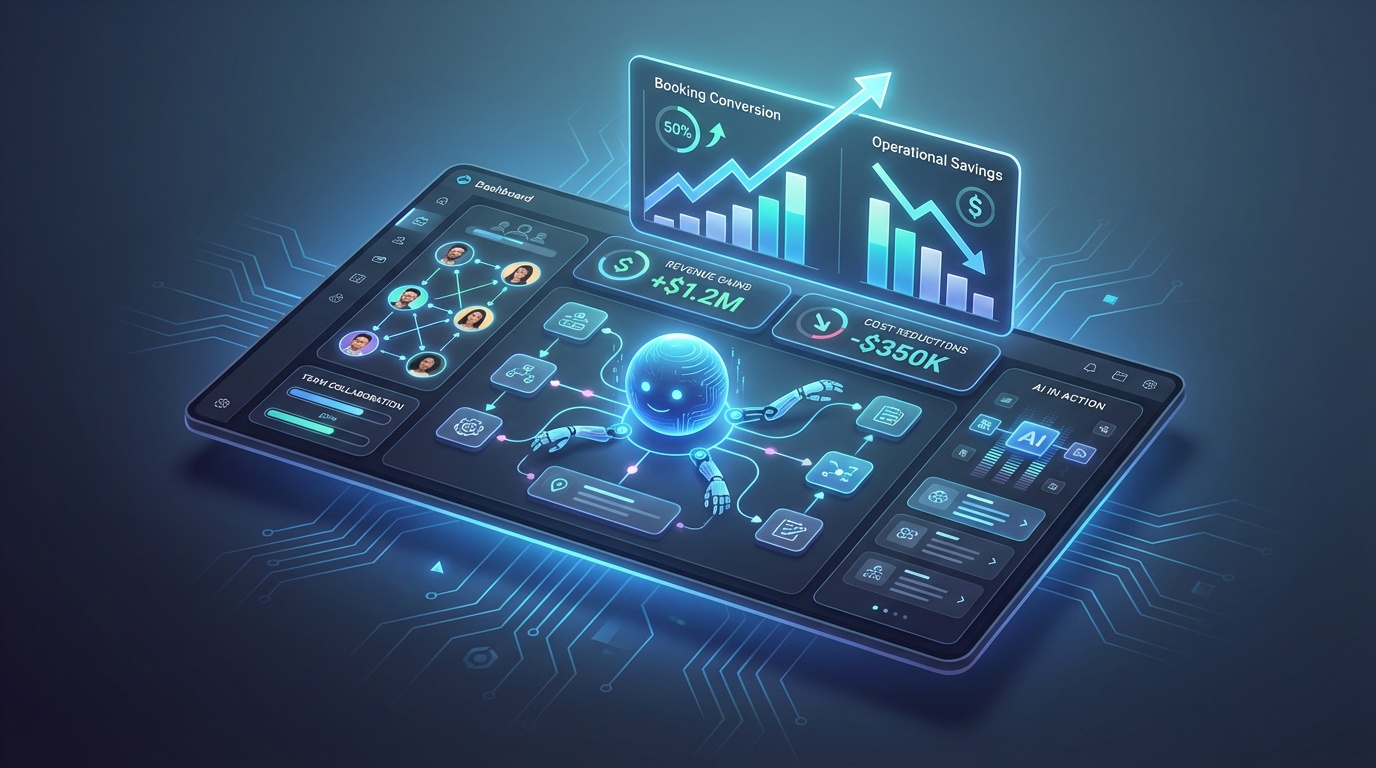
Our hospitality clients report four core metrics that answer the ROI question:
- Booking conversion: 50% increase from sub-2-minute response times and better qualification
- Inquiry abandonment: 60% reduction through instant engagement
- Average guest spend: 25% increase from contextual upselling matched to guest profiles
- Operational costs: 30% reduction while maintaining VIP service quality through escalation
That operational savings doesn’t mean firing staff. Properties redeploy those hours into guest experience work that builds loyalty and repeat bookings. Learn how our AI Automation Services drive measurable efficiency gains.
Guest Satisfaction Improvements and Revenue Growth
Guest satisfaction improves because response speed creates the perception of attentive service. Our agents respond during your defined operating hours (say, 9 a.m.–8 p.m.) with natural human timing—pauses between messages, realistic delays that avoid robotic interactions.
Revenue growth comes from structured upselling that busy staff miss during service rushes. The system suggests upgrades, add-ons, and premium experiences aligned with guest preferences and booking patterns. These recommendations stay brand-safe—you control what content gets sent and when.
Case Studies with Specific Metrics from Vynta Clients
Client Profile: Premium restaurant, tourist market, high-volume reservations
Results After Implementation:
- Booking conversion: 50% increase
- Customer inquiry abandonment: 60% reduction
- Average guest spend: 25% increase
- Operational costs: 30% reduction
- Guest satisfaction: Significant improvement from fast, personalized responses
These metrics provide clear payback signals. The combination of improved conversion, reduced abandonment, higher per-guest revenue, and lower operational costs delivers ROI within months for venues with sufficient inquiry volume.
Integration with Hospitality Systems and Staff
Connecting to CRM and Communication Platforms
Our agents sync in real time with your CRM (SevenRooms is a common integration). Guest data, reservations, tags, and updates flow automatically. The system supports multilingual responses and channel-specific personalization across WhatsApp, SMS, Instagram, and email. Instagram works as a redirect channel—we reply with appropriate links rather than handling bookings directly in DMs.
Each integration is custom-built for your specific systems. My team configures the agents during implementation to match your workflows. Your existing data structure stays unchanged. We connect using encrypted protocols, sign NDAs, and follow strict data privacy standards to protect your brand and guest information. Discover how integration with platforms like SevenRooms and other CRM systems works in practice.
Implementation Timeline and Setup Process
Implementation follows three phases: discovery, strategy, and deployment. We start with a system audit and integration planning for your tech stack. Then we define data flows and configure CRM connections. Agent training uses your brand voice guidelines, business rules, and service protocols to create your custom solution.
You’ll need to provide access credentials, review agent responses during training, and participate in setup sessions. The agents operate only during hours you set—outside those times, they send polite holding messages instead of continuing conversations. This protects your brand from after-hours miscommunication.
Human-in-the-Loop Design to Support Teams
Built-in escalation protocols ensure VIPs get human attention. You set the rules: which guests automatically route to staff, which query types need human judgment, which situations require manager intervention. Complex requests escalate with full conversation context so your team isn’t starting from scratch.
Your staff views, pauses, and takes over live conversations through a dashboard. They can override agent recommendations or assume control mid-conversation. The AI won’t send unapproved content—like drink menus or promotional offers—unless you explicitly allow it. This design protects brand reputation while freeing staff for interactions where human expertise creates real value.
Key Use Cases: Solving Hospitality Pain Points
Extended-Hours Guest Service and Inquiry Management
Availability during peak inquiry hours addresses a common revenue leak. Our agents respond to booking questions, modification requests, and service inquiries during your defined operating hours. This captures international travelers browsing in different time zones and last-minute bookers who expect quick replies.
The 60% reduction in inquiry abandonment comes from instant engagement. Guests receive confirmation immediately after booking, then intelligent reminders at optimal times. The system mimics human conversation flow—natural pauses, realistic timing—while maintaining responsiveness that converts inquiries into bookings.
Contextual Upselling and Personalization
The 25% increase in average guest spend comes from contextual recommendations based on guest profile data. The system personalizes by channel—WhatsApp gets conversational suggestions, email gets structured offers, SMS gets brief prompts. You control what content gets approved and when it gets sent.
Multilingual support serves international guests in their preferred language. This targeted approach converts better than generic promotions because offers align with demonstrated preferences and booking patterns. For more on revenue optimization tactics, see our analysis of Pricing and Yield Management.
High-Volume Inquiry Management
During peak periods, our agents capture contact information and provide fast responses. They manage waitlists automatically, sending updates with accurate time estimates. This allows guests to receive timely communication rather than waiting on overwhelmed staff.
For venues with multiple revenue streams—restaurant, bar, events, private dining—agents communicate across opportunities based on guest profiles. This is a custom solution, not an off-the-shelf chatbot. The structured approach captures revenue opportunities while improving guest experience through responsiveness.
Potential Drawbacks and When Vynta Makes Sense
Common Concerns: Staff Roles and Investment
Staff worry that AI threatens their jobs. In premium hospitality, the reality differs. Agents handle repetitive inquiries—”What time do you open?” “Can I modify my reservation?”—allowing existing staff to focus on guest-facing service that builds loyalty. Properties report redeploying saved hours into personalized service and problem resolution rather than cutting headcount.
The investment includes implementation and ongoing service costs. We provide ROI projections during discovery rather than guaranteeing immediate returns. This is custom development—bespoke agents and automation—not pre-built software. Most premium venues see positive returns driven by conversion improvements and cost reductions within the first quarter.
Limitations of AI in Hospitality Contexts
Our agents aren’t fully autonomous. They require ongoing optimization and human oversight. VIP guests and complex queries escalate to staff because AI shouldn’t operate independently in nuanced situations. The technology works best for structured communication: booking confirmations, availability inquiries, standard service questions.
The system requires CRM integration to function effectively. Venues with incomplete guest data or inconsistent processes may need to clean up operations first. Our agents operate during hours you set—not true 24/7 autonomy. Outside operating hours, they send holding messages instead of attempting full responses.
Who Benefits Most: Profile of Ideal Vynta Client
We deliver maximum value for premium venues receiving high inquiry volumes. You’re an ideal fit if you’re losing bookings to slow response times, experiencing high inquiry abandonment, or lacking structured guest communication. Venues with existing CRM systems see faster implementation and better results.
The solution works when you view AI as supporting your team rather than replacing hospitality expertise. Managers who want to scale personalized service while maintaining brand authenticity see strong outcomes. We don’t promise fully autonomous operations. But for operators committed to exceptional guest experience who need automation to deliver it profitably at scale, the data shows clear value.
Final Verdict: Is Vynta AI Agents for Hospitality Worth the Investment?
For premium restaurants, bars, nightclubs, and beach clubs handling high inquiry volumes, the data supports a clear yes. Venues report tangible business impact: 50% booking conversion increases, 60% reductions in inquiry abandonment, 25% increases in per-guest revenue, and 30% operational cost reductions. The value proposition centers on converting more bookings through speed, reducing lost revenue from abandoned inquiries, and capturing upselling opportunities through contextual recommendations.
The investment makes financial sense when you calculate opportunity costs. A premium venue losing bookings to 4-hour response times sacrifices meaningful revenue annually. Add inquiry abandonment losses and missed upselling opportunities, and the revenue gap becomes substantial. The 30% operational cost reduction, while maintaining service quality through VIP escalation, provides additional financial benefit.
Who Should Commit Now vs. Wait
Commit now if you’re experiencing specific pain points:
- Losing bookings to slow response infrastructure
- High inquiry abandonment rates during peak periods
- Teams overwhelmed by repetitive guest communication
- Existing CRM systems ready for integration (especially SevenRooms)
Your team’s readiness matters. Managers who view AI as support rather than replacement typically extract the most value.
Wait if your foundational technology needs work first. Venues lacking CRM systems or operating with inconsistent service protocols should address these gaps before implementing AI agents. Very small operations with low inquiry volumes may not generate enough interaction volume to justify custom AI agent development.
Key Success Factors for Maximum ROI
Three factors determine whether you’ll achieve the results our clients report:
Clear business rules and content controls. Spend pre-implementation time defining your brand voice, escalation rules, and approved content. Our agents customize to your specifications—the clearer your guidelines, the faster optimization happens.
Staff collaboration. Venues that train teams on escalation protocols and actively use the dashboard to monitor conversations see faster improvements. Your team’s input on VIP handling and edge cases accelerates optimization.
Systematic measurement. Track specific KPIs: booking conversion rates, response times, inquiry abandonment percentages, average guest spend, and satisfaction scores. Establish baselines before deployment and measure regularly. This data proves ROI internally and identifies optimization opportunities. We provide ongoing support to refine performance over time.
ROI Reality Check: Premium hospitality venues see measurable returns through multiple channels: 50% booking conversion increases, 60% inquiry abandonment reductions, 25% per-guest revenue increases, and 30% operational cost reductions. We provide projections during discovery to set realistic expectations for your specific situation.
The Competitive Advantage Window
Early adopters in hospitality automation gain an edge. When your venue responds in 2 minutes while competitors take 4 hours, you capture bookings before guests comparison shop. The 50% conversion improvements reflect this dynamic. As more venues deploy AI agents, that gap narrows.
Guest expectations continue shifting toward fast, personalized service. Travelers accustomed to immediate replies expect the same from premium venues. AI agents help independent operators deliver enterprise-grade responsiveness. Venues building these capabilities now position themselves ahead rather than playing catch-up when automation becomes baseline.
Consider not just current ROI but strategic positioning. Custom AI agents transform guest communication while maintaining brand authenticity through personalization. Premium venues implementing now gain experience optimizing human-AI collaboration while competitors debate adoption. That operational expertise compounds into sustained advantages in satisfaction, per-guest revenue, and team efficiency.
Early adopters can gain insights from broader industry research on AI and automation trends. You can explore detailed findings in the 2025 AI Automation Study to see how these innovations reshape hospitality operations and guest experiences.
For hospitality leaders focused on maintaining a competitive edge, expert perspectives highlight that embracing automation is essential. To gain strategic perspective, consider this analysis from Hospitality Net offering insights into how digital transformation redefines guest engagement and operational efficiency.
Frequently Asked Questions
Is Vynta AI Agents for Hospitality a worthwhile investment?
From my perspective as Operations Director at Vynta AI, the data shows a clear return. Clients report booking conversion increases up to 50%, average guest spend up to 25% through brand-safe upselling, and operational cost reductions up to 30%. These metrics demonstrate significant improvements in both revenue and efficiency for hospitality businesses.
What makes Vynta AI Agents effective for premium hospitality venues?
Vynta AI Agents are effective because they are bespoke, not generic chatbots. They automate guest communication, reservation management, and upselling, integrating seamlessly with existing CRM systems like SevenRooms. Our agents deliver 24/7 personalized service, tailored to your brand voice and specific business rules, ensuring a consistent premium experience.
How do Vynta AI Agents improve guest satisfaction and revenue?
Guest satisfaction improves through faster, personalized responses to inquiries and proactive service that mimics human timing. For revenue, our AI agents increase average guest spend by up to 25% through brand-safe upselling, tailored to guest profiles and preferences. This structured approach captures revenue opportunities that busy staff might miss.
Can Vynta AI Agents truly reduce operational costs?
Yes, Vynta AI Agents can reduce operational costs by up to 30% by automating repetitive guest communication workflows. This frees your team to focus on high-value guest interactions and loyalty-building activities, rather than reducing staff. It’s about optimizing efficiency and redeploying human hours strategically.
How do Vynta AI Agents integrate with existing hospitality systems?
Our AI agents integrate in real time with existing CRM systems, such as SevenRooms. This synchronization automatically updates guest data, reservations, and tags across your tech stack. This seamless connection provides your team with enriched guest profiles and conversation history, enabling personalized service at scale.
Are Vynta AI Agents generic chatbots, or are they customized?
Vynta AI Agents are not generic chatbots; they are fully bespoke solutions tailored for each client. We customize them to your specific brand tone, business rules, and content controls, allowing them to understand hospitality contexts. This enables them to distinguish between guest types and tailor responses appropriately across all communication channels.
Which company offers effective AI agents for customer service in hospitality?
At Vynta AI, we focus on delivering measurable outcomes for hospitality customer service. Our agents achieve up to a 50% increase in booking conversion and a 60% reduction in customer inquiry abandonment. We also see up to a 25% increase in average guest spend and a 30% reduction in operational costs, demonstrating significant value.