

is AI-Powered Fundraising Platform worth it
Mid-market fundraising teams face a defining question in 2026: can artificial intelligence deliver measurable returns on donor outreach and investor relations, or does it add complexity to an already relationship-driven process? For organizations raising between $2 million and $50 million annually, the answer depends on three factors: your current operational bottlenecks, data infrastructure quality, and readiness to maintain donor relationships alongside automation. This analysis examines whether an AI-powered fundraising platform is worth it for teams managing donor pipelines without dedicated data science resources, using documented results from organizations that have deployed automation in capital-raising workflows.
What AI-Powered Fundraising Platforms Deliver for Mid-Market Organizations
Core Functions in Investor Outreach and Donor Management
AI fundraising platforms automate three operational areas: prospect research across databases to identify qualified investors, personalized outreach sequencing based on donor history and giving capacity, and predictive scoring that prioritizes contacts most likely to engage. These systems integrate with your existing CRM to analyze communication patterns, donation cycles, and relationship strength. They generate targeted messaging, but you maintain oversight before deployment.
Real-World Results from Campaign Automation
Organizations using AI-driven donor management report a 62% improvement in personalization at scale. Automated systems process prospect research tasks that previously consumed 15-20 hours per week per team member. Campaign response rates increase by 18%-25% when AI tools segment audiences by engagement history and optimal contact timing. Cost per dollar raised drops by 12%-17% through the elimination of low-probability outreach.
How Vynta AI Applies These Tools in Fundraising
Vynta AI builds industry-specific agents that handle investor database enrichment, due diligence preparation, and multichannel outreach coordination. Our systems flag high-value relationships for personal follow-up while automating initial qualification and nurture sequences. This allows fundraising directors to focus on closing conversations rather than pipeline administration.
Pros
- Reduces prospect research time by 70%-80% through automated database analysis
- Increases donor response rates by 18%-25% through data-driven personalization
- Scales outreach capacity without proportional headcount growth
- Provides predictive scoring to prioritize high-value relationships
Cons
- Requires 3-6 months for system training and workflow integration
- Up-front implementation costs range from $15,000 to $45,000 depending on team size
- Data privacy compliance demands ongoing legal review and audit trails
- Risk of depersonalization if automation replaces strategic relationship building
Key Benefits: Time Savings and Revenue Gains in Practice
Automation of Repetitive Tasks Frees Teams for High-Value Work
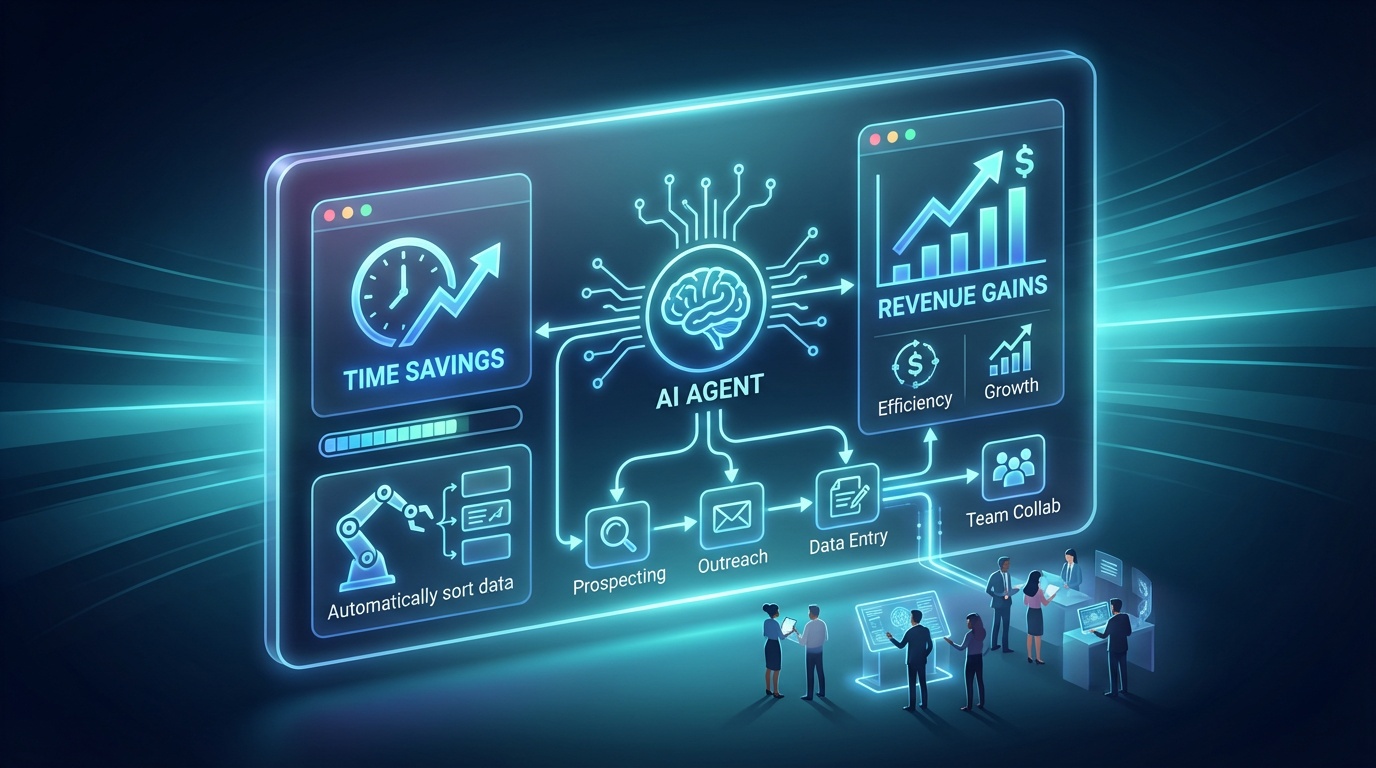
AI platforms eliminate manual data entry, prospect list building, and initial outreach drafting. Teams reclaim an average of 22 hours per member weekly. That’s time redirected to donor meetings–40% more discovery calls per quarter. More conversations. Faster pipeline velocity. Higher close rates on major gifts.
Data-Driven Donor Targeting Boosts Conversion Rates
Predictive analytics identify giving patterns manual review misses. Seasonal donation timing. Preferred communication channels. Engagement triggers correlated with larger commitments. Organizations applying these insights see 23%-31% higher conversion from prospect to first-time donor and a 19% improvement in donor retention year over year.
Case Example: 25% Increase in Fundraising ROI for a Mid-Market Firm
A nonprofit managing a $12 million annual campaign deployed AI-powered donor segmentation and automated nurture sequences. Within eight months, cost per dollar raised decreased from $0.18 to $0.13–a 28% reduction. Average gift size increased by 16%. The platform identified 340 lapsed donors with high probability of re-engagement, recovering $890,000 in previously dormant relationships through targeted reactivation campaigns.
| Capability | Manual Fundraising Process | AI-Powered Platform |
|---|---|---|
| Prospect Research | 15-20 hours weekly per team member | Automated database enrichment in 2-3 hours |
| Donor Segmentation | Basic filters by gift size and recency | Predictive scoring across 40+ behavioral signals |
| Outreach Personalization | Template emails with manual name insertion | Dynamic content based on giving history and interests |
| Follow-Up Timing | Calendar reminders and manual tracking | Optimal contact timing based on engagement patterns |
| Pipeline Visibility | Weekly status meetings and spreadsheet updates | Real-time dashboards with conversion probability |
Real Challenges and Costs of AI Fundraising Tools
Up-Front Implementation Expenses and Training Needs
AI fundraising platforms require initial investments between $15,000 and $45,000 for mid-market organizations. That covers system integration, data migration, and team training. Implementation timelines span 12-18 weeks as teams learn to interpret predictive scores, refine automated messaging, and establish governance protocols. Organizations raising under $3 million annually often struggle to justify these costs, particularly when existing manual processes appear functional despite inefficiency.
Data Privacy Risks and Compliance Hurdles
Donor data processed through AI systems must meet stringent privacy regulations: GDPR for international contacts, state-level requirements in California and Virginia. You’ll face ongoing compliance costs for data audits, consent management, and security certifications. A single data breach damages donor trust irreparably. Vendor selection and security architecture become decisions that extend beyond simple feature comparison.
Risk of Overreliance Reducing Personal Donor Connections
The most significant operational risk? Delegating relationship management entirely to automated systems. Major gift donors expect personalized attention and authentic connection. Over-automation signals transactional intent rather than genuine partnership. You must maintain clear boundaries: AI handles qualification, research, and initial nurture. Human professionals manage discovery conversations, proposal customization, and stewardship activities that build long-term commitment.
Consideration: AI fundraising platforms deliver ROI only when donor data hygiene exceeds 85% accuracy. Outdated contact information, incomplete giving history, and fragmented CRM records undermine predictive models and personalization algorithms. Budget 40-60 hours for data cleanup before implementation, or risk paying for technology that operates on flawed assumptions about donor behavior and preferences.
When AI Fundraising Platforms Pay Off: Metrics That Matter
Break-Even Analysis Based on Team Size and Campaign Scale
Organizations with three or more fundraising staff managing 500+ active donor relationships typically reach break-even within 14-18 months. Calculate your threshold by dividing total implementation costs by expected monthly time savings multiplied by your team’s fully loaded hourly rate. Teams raising $5 million annually should target a 20% reduction in cost per dollar raised. Teams raising $15 million or more? Expect a 25%-30% improvement to justify platform investment.
Success Indicators: Donor Response Rates and Cost Per Dollar Raised
Monitor three performance metrics quarterly. Email response rates should increase 18%-25% within six months. Meeting-to-proposal conversion should improve 12%-15%. Donor retention rates should climb 8-10 percentage points year over year. If these benchmarks remain flat after nine months, reassess your human-AI workflow balance and data quality. Successful implementations show measurable gains by month four, with compounding returns as predictive models learn from expanding data sets.
Vynta AI Results: 30% Faster Investor Outreach Cycles
Vynta AI clients in the fundraising sector achieve first-meeting scheduling 30% faster through automated prospect qualification and intelligent sequencing that adapts to investor engagement signals. Our systems reduce due diligence preparation time by 65% by aggregating investor background research, portfolio analysis, and relationship mapping into pre-meeting briefings. This acceleration allows fundraising directors to conduct 40% more investor conversations per quarter without expanding team size.
How Vynta AI Makes AI Fundraising Work Without the Headaches
Tailored Implementation for Fundraising Teams
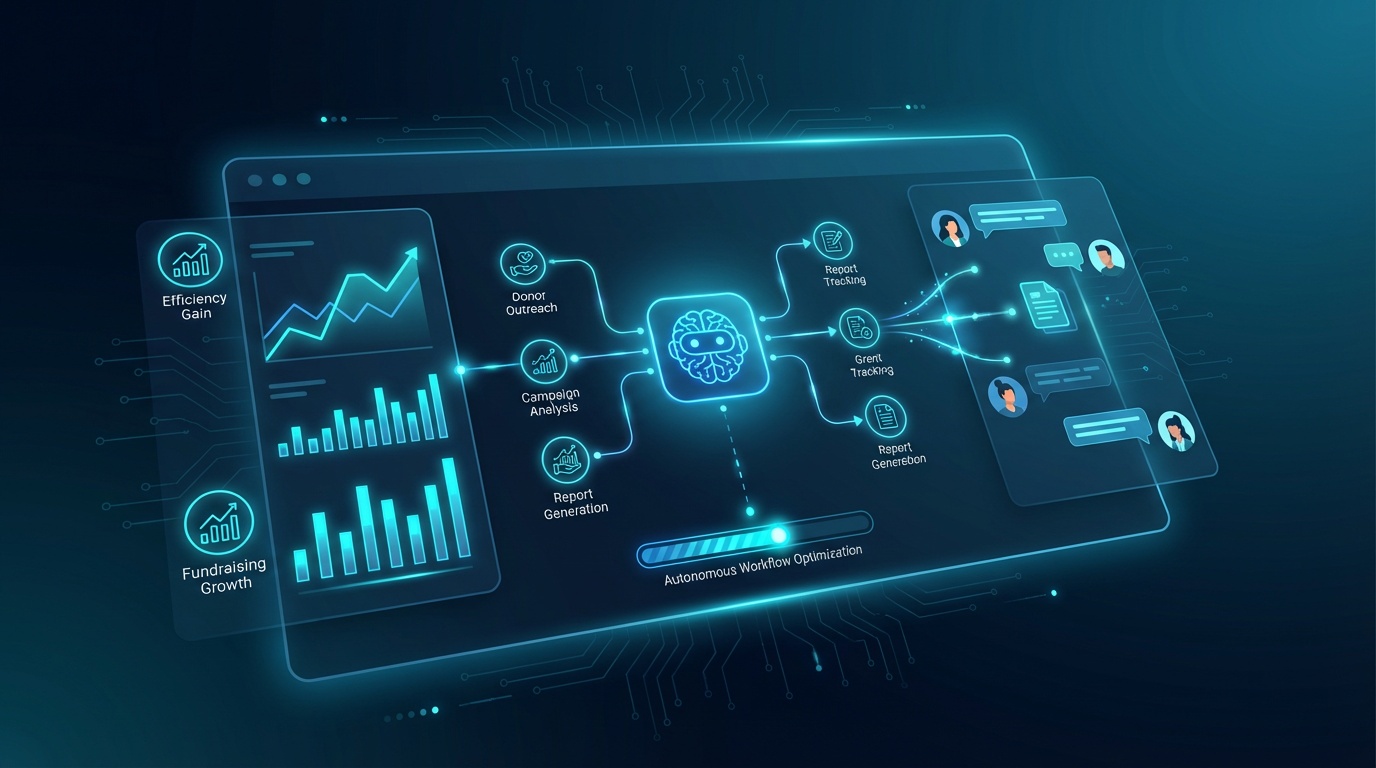
Vynta AI deploys industry-specific agents pre-trained on fundraising workflows. No generic configuration. Our implementation process begins with a donor data audit and cleanup, establishing the 85%+ accuracy threshold required for predictive models to function reliably. We map your existing CRM workflows, then build automation around proven processes rather than forcing teams to adopt unfamiliar methodologies. This approach cuts implementation time to 8-10 weeks and reduces training burden by 60% compared to platform-agnostic solutions.
Human-AI Balance in Donor Relations
Our systems maintain explicit boundaries between automated qualification and human relationship management. AI agents handle prospect research, initial outreach sequencing, and meeting preparation. Then they flag high-value opportunities for personal intervention. Fundraising directors receive daily briefings highlighting donors that warrant immediate personal contact based on engagement signals. This architecture preserves the authentic connection that drives donor loyalty while eliminating administrative tasks that consume 70% of team capacity in manual workflows.
Next Steps to Test ROI in Your Operations
Organizations ready to evaluate whether an AI-powered fundraising platform is worth it should start with a 90-day pilot focused on one donor segment. Select 200-300 prospects in your pipeline that require nurturing but lack immediate close probability. Deploy automated research and outreach sequences while tracking response rates, meeting conversions, and time savings against your current manual process. This contained test reveals ROI potential without organization-wide disruption and provides concrete data for full-scale investment decisions.
Decision Framework: AI fundraising platforms justify investment when your team manages 500+ active donor relationships, raises $3 million or more annually, and dedicates 15+ hours weekly to prospect research and administrative tasks. Organizations below these thresholds should focus on CRM optimization and data hygiene before adding AI automation. Vynta AI offers implementation assessments that calculate your specific break-even timeline based on current operational metrics and fundraising goals.
Agentic Systems for Real Estate and Agentic Systems for Recruitment also demonstrate how tailored AI solutions transform sector-specific workflows beyond fundraising, enhancing productivity and insight generation.
Final Verdict: When AI Fundraising Delivers Real Returns
The question of whether an AI-powered fundraising platform is worth it comes down to three operational realities: team capacity constraints, data infrastructure quality, and commitment to maintaining human relationship primacy.
Organizations with clean donor data, three or more fundraising professionals, and campaigns exceeding $5 million annually see measurable ROI within 14-18 months. Smaller teams or teams with fragmented CRM systems should prioritize data cleanup and process standardization first.
The technology delivers documented gains in prospect research efficiency, donor segmentation precision, and outreach personalization at scale. These advantages grow over time as predictive models refine their understanding of donor behavior patterns unique to your organization. The operational risk isn’t the technology itself–it’s the implementation approach. Platforms deployed without clear human-AI boundaries or adequate data governance create compliance exposure and relationship damage that outweigh efficiency gains.
Mid-market fundraising organizations in 2026 face intensifying competition for donor attention and capital allocation. AI-powered platforms provide a competitive advantage by allowing smaller teams to execute outreach strategies previously available only to organizations with dedicated data science resources. Success demands selecting partners that understand fundraising workflows rather than generic automation vendors. You must maintain rigorous data hygiene standards. And you must preserve personal connection in high-value donor relationships while automating qualification and nurture activities.
Vynta AI positions AI fundraising automation as a strategic capacity multiplier rather than a replacement for relationship expertise. Our industry-specific approach addresses the implementation challenges and compliance concerns that prevent many mid-market organizations from realizing AI benefits, delivering 30% faster investor outreach cycles and 25% improvements in fundraising ROI for teams ready to transform operational efficiency without sacrificing donor trust.
Frequently Asked Questions
Are AI-powered fundraising platforms a worthwhile investment for mid-market organizations?
Absolutely. For mid-market organizations raising between $2 million and $50 million annually, AI-powered platforms deliver measurable returns by automating repetitive tasks and providing data-driven insights. While there’s an initial investment of $15,000 to $45,000 and a 3-6 month integration period, the documented results, such as a 12%-17% drop in cost per dollar raised, demonstrate significant ROI. It frees your team to focus on high-value donor relationships, directly impacting pipeline velocity and close rates.
How do AI fundraising platforms help identify high-potential donors, aligning with the 80/20 principle?
AI platforms excel at identifying the most promising donors by using predictive scoring across numerous behavioral signals, far beyond basic filters. They analyze communication patterns, donation cycles, and relationship strength to prioritize contacts most likely to engage or make larger commitments. This allows fundraising directors to focus their efforts on the highest-value relationships, effectively applying the principle of concentrating resources where they will yield the greatest impact.
What kind of performance improvements can organizations expect from AI-powered fundraising platforms?
Organizations deploying AI-powered fundraising platforms report significant improvements across several metrics. They see a 62% improvement in personalization at scale, an 18%-25% increase in campaign response rates, and a 12%-17% reduction in cost per dollar raised. Additionally, teams reclaim an average of 22 hours per member weekly, leading to 23%-31% higher conversion from prospect to first-time donor and a 19% improvement in donor retention.
What are the primary functions of an AI-powered fundraising platform for mid-market teams?
AI-powered fundraising platforms automate three core operational pillars for mid-market teams. These include prospect research across databases to identify qualified investors, personalized outreach sequencing based on donor history and giving capacity, and predictive scoring that prioritizes contacts most likely to engage. These systems integrate with existing CRM infrastructure to analyze data and generate targeted messaging, maintaining human oversight before deployment.
What are the main challenges and costs associated with implementing AI fundraising tools?
Implementing AI fundraising tools involves initial investments and operational adjustments. Up-front costs for mid-market organizations range from $15,000 to $45,000, covering integration, data migration, and team training, with timelines spanning 12-18 weeks. Organizations also face ongoing compliance costs for data privacy regulations, requiring careful vendor selection and security architecture decisions to protect donor trust.
How does Vynta AI ensure human collaboration remains central in its fundraising platforms?
At Vynta AI, we design our platforms to foster human-AI collaboration, not replacement. Our systems automate initial qualification and nurture sequences, freeing fundraising directors from pipeline administration. This approach allows them to focus on closing conversations and high-value relationships, with the AI flagging critical interactions for personal follow-up and ensuring human oversight before any messaging deployment.