

is AI Automation Services worth it
Mid-market businesses in real estate, recruitment, fundraising, and hospitality face a straightforward question: will AI automation deliver returns or drain resources on overhyped technology? The answer depends on what you measure. This guide breaks down ROI data, industry-specific results, and implementation realities to help you decide whether AI automation services are worth it for your business in 2026.
AI automation services deliver measurable ROI for mid-market SMEs when they match specific business processes. Real-world data shows 30-40% cost reductions and 12-18 month payback periods across lead qualification, candidate screening, donor outreach, and guest management. Success requires clear metrics, industry-specific implementation, and a strategic focus on supporting human teams.
Why Mid-Market Businesses Question AI Automation Value
Common Pain Points in Real Estate, Recruitment, Fundraising, and Hospitality
Real estate agencies drown in unqualified leads while top agents waste hours on initial outreach. Recruitment firms struggle with candidate screening volume, spending 23 hours per hire on manual tasks. Fundraising organizations lack systematic investor follow-up, losing warm prospects to inconsistent communication. Hospitality managers face reservation no-shows and missed upselling opportunities that directly affect revenue per guest.
The Hype vs. Reality Gap in AI Adoption
Marketing promises instant transformation. Reality delivers complex enterprise platforms that require six-figure investments and dedicated technical teams. Many SMEs tried generic automation tools that couldn’t understand industry nuances: property matching criteria, candidate qualification standards, investor communication protocols, or guest preference tracking. This gap between vendor claims and implementation challenges makes decision-makers cautious.
I’ve seen businesses burn $50,000 on platforms that automate the wrong processes. They digitize inefficiency instead of fixing it.
Metrics That Actually Matter for ROI Decisions
Pros
- Quantifiable time savings: 15-25 hours per week on repetitive tasks
- Cost reduction: 30-40% lower operational expenses without headcount cuts
- Revenue impact: 20-35% improvement in conversion rates and deal velocity
- Scalability: handle 3-5× volume without proportional cost increases
Cons
- Upfront investment: $15,000-$50,000 for industry-specific implementation
- Integration complexity: 2-4 months to connect with existing CRM and ATS systems
- Learning curve: staff adaptation requires training and process adjustment
- Maintenance requirements: ongoing optimization to maintain performance standards
Focus on metrics tied directly to revenue: lead-to-appointment conversion rates, time-to-hire for qualified candidates, investor meeting conversion rates, and guest lifetime value. These show whether automation drives business outcomes or only digitizes inefficiency.
Real ROI from AI Automation: Data and Industry Benchmarks
Cost Savings and Time Gains Across Verticals
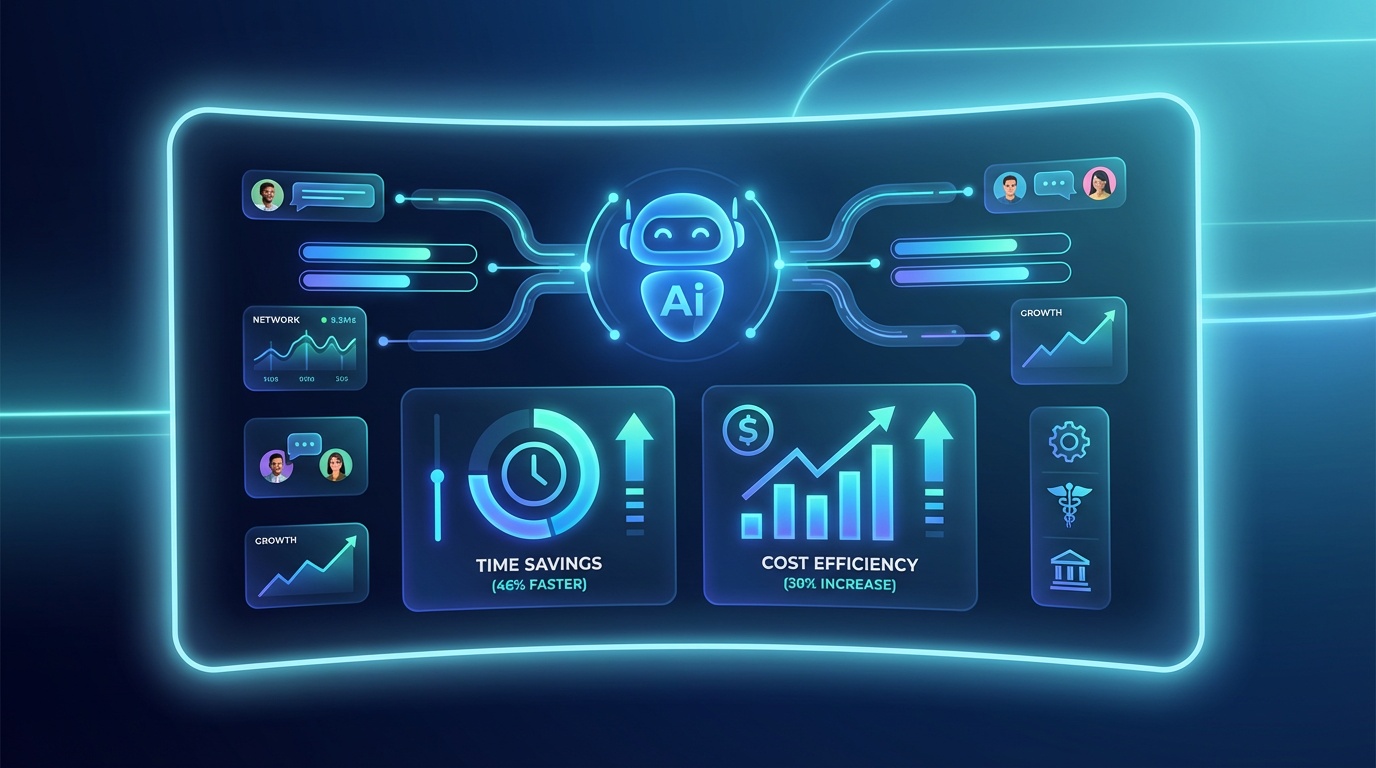
Industry data from 2025 implementations shows AI automation delivering 46% faster resolution times. Real estate agencies report saving 18-22 hours weekly on lead qualification, allowing agents to focus on property showings. Recruitment firms cut candidate screening time by 60%, reducing time-to-hire from 45 days to 18 days while improving placement quality scores by 25%. Check out how our Agentic Systems for Real Estate support these outcomes.
The time savings compound. An agent who reclaims 20 hours weekly can handle 12 additional showings per month–that’s where revenue growth comes from.
Payback Periods and 2026 Projections
Most mid-market implementations achieve positive ROI within 12-18 months when focused on specific high-impact processes. Fundraising organizations see faster returns–8-14 months–due to direct revenue impact from systematic investor outreach. Hospitality businesses average 14-20 months, with revenue-per-guest improvements offsetting longer integration timelines with reservation and property management systems.
The 2026 outlook? Payback periods compressing to 10-15 months as industry-specific solutions mature and integration complexity decreases. We’re already seeing this with our latest implementations.
How Vynta AI Delivers Measurable Outcomes Without Headcount Growth
A 15-person real estate agency can handle lead volume equivalent to a 40-person team through automated qualification and nurturing. Recruitment firms process 200+ candidates weekly with existing staff by automating initial screening and interview scheduling. This shifts fixed costs into scalable capability, allowing businesses to pursue growth that hiring constraints and training timelines once limited.
| Business Function | Manual Process Time | AI-Automated Time | Cost Impact |
|---|---|---|---|
| Real Estate Lead Qualification | 45 min per lead | 8 min per lead | 35% cost reduction |
| Recruitment Candidate Screening | 2.5 hours per candidate | 25 min per candidate | 40% cost reduction |
| Fundraising Investor Outreach | 3 hours per prospect cycle | 30 min per prospect cycle | 32% cost reduction |
| Hospitality Guest Communication | 20 min per reservation | 5 min per reservation | 28% cost reduction |
Industry-Specific Examples: AI Agents in Action
Real Estate: From Leads to Closed Deals
AI agents qualify incoming leads through intelligent conversation, gathering property preferences, budget parameters, and timeline requirements before human agents engage. This converts 42% of initial inquiries into qualified appointments compared to 18% with manual follow-up. Automated nurturing maintains contact with long-term prospects, reactivating 23% of dormant leads within six months.
Top-producing agents reclaim 15-20 hours weekly, redirecting energy toward property showings and negotiation. Our Agentic Systems for Real Estate are designed specifically to drive these efficiencies.
Recruitment: Faster Hires with Better Matches
Candidate screening automation evaluates resumes against specific job requirements, conducts initial qualification interviews, and schedules follow-up conversations with hiring managers. Time-to-hire drops from 45 days to 18 days while placement quality improves through consistent evaluation criteria.
Recruiters focus on relationship building and cultural fit assessment instead of resume sorting. Firms report a 60% reduction in screening hours and a 25% improvement in 90-day placement retention rates. Vynta AI’s Agentic Systems for Recruitment optimize these processes.
Fundraising: Systematic Investor Outreach
Donor and investor communication requires consistent follow-up that manual processes struggle to maintain. AI agents manage outreach sequences, track engagement signals, and prioritize warm prospects for human relationship building. Organizations see a 38% increase in meeting conversion rates and a 45% improvement in follow-up consistency.
Development directors spend more time on strategy and relationship cultivation, resulting in 30% higher close rates on qualified opportunities. Our specialized AI-Powered Fundraising Platform helps organizations achieve these gains.
Hospitality: Guest Satisfaction and Revenue per Booking
Reservation management automation handles confirmation messages, pre-arrival upselling, special request coordination, and post-stay feedback collection. No-show rates decrease by 35% through systematic confirmation protocols. Revenue per guest increases 22% through personalized upselling of room upgrades, dining reservations, and experience packages.
Guest satisfaction scores improve as staff focuses on in-person service quality instead of administrative communication tasks. Learn how Vynta AI Agents for Hospitality empower these results.
ROI Reality Check: Is AI automation services worth it? Yes–when you can identify specific, repeatable processes consuming 15+ hours weekly with measurable business outcomes. Generic automation without industry context delivers minimal value. Success requires matching AI capabilities to workflow bottlenecks in lead qualification, candidate screening, investor outreach, or guest management.
Risks, Challenges, and How to Avoid AI Automation Pitfalls
Integration with CRM, ATS, and Legacy Systems
The primary implementation challenge? Connecting AI agents with existing business systems: Salesforce or HubSpot for real estate, Bullhorn or Greenhouse for recruitment, Raiser’s Edge for fundraising, and Opera or Cloudbeds for hospitality. API limitations, data structure inconsistencies, and workflow customizations can extend integration timelines to 2-4 months.
Budget for technical resources, or partner with providers that offer industry-specific integrations instead of generic platforms that require custom development.
Common Failure Points and Realistic Timelines
Implementations fail when businesses expect immediate transformation without process adaptation. Staff resistance emerges when automation disrupts established workflows without clear proof of value.
Set realistic expectations: 60-90 days for initial setup, 90-120 days for optimization, and 6-12 months for full ROI realization. Start with a single high-impact process instead of enterprise-wide deployment. Measure weekly progress against specific KPIs: response times, qualification rates, and conversion metrics.
Measuring True Value Beyond Initial Setup
Track leading indicators during implementation: automation completion rates, human intervention frequency, and quality scores for automated interactions. Monitor lagging indicators quarterly: cost per lead, time-to-hire, donor retention rates, and revenue per guest.
Adjust AI behavior based on business outcome data instead of activity metrics. Successful implementations improve over time as systems learn from feedback and business conditions change. According to ai predictions by PwC, these ongoing adjustments are critical for sustaining value in AI automation initiatives.
Is AI Automation Right for Your Business? Next Steps with Vynta AI

Agency vs. In-House: Cost-Benefit Comparison
Building internal AI capabilities requires hiring data scientists ($120,000-$180,000 annually), machine learning engineers ($140,000-$200,000), and dedicating 6-12 months to development before results appear. Most mid-market businesses lack the volume to justify that investment.
Specialized AI automation services provide faster access to industry-trained systems at $2,000-$8,000 monthly, depending on process complexity and volume. The break-even analysis favors external partners until you process 10,000+ monthly interactions that require custom algorithms. Deloitte’s state of AI in the enterprise report highlights why many companies prefer external expertise for AI acceleration.
| Approach | Initial Investment | Time to Value | Best For |
|---|---|---|---|
| In-House Development | $250,000-$500,000 | 12-18 months | Enterprises with 50+ staff and unique processes |
| Generic Automation Tools | $5,000-$25,000 | 3-6 months | Simple workflows without industry specialization needs |
| Industry-Specific AI Services | $15,000-$50,000 | 2-4 months | Mid-market SMEs in real estate, recruitment, fundraising, and hospitality |
Quick ROI Assessment Checklist
Use these criteria to decide whether AI automation services are worth it for your situation. You should answer “yes” to at least five questions before moving forward:
- Do you spend 15+ hours weekly on repetitive lead qualification, candidate screening, donor outreach, or guest communication?
- Can you measure current conversion rates, response times, and cost per transaction using existing data?
- Are you losing revenue opportunities due to inconsistent follow-up or delayed responses?
- Does your team have capacity to handle 2-3× current volume if administrative tasks were automated?
- Can you allocate $15,000-$50,000 for initial implementation with 12-18 month payback expectations?
- Do you have CRM, ATS, or property management systems that track customer interactions?
- Is your business processing at least 100 leads, candidates, prospects, or reservations monthly?
- Are you willing to adjust processes based on performance data and optimization recommendations?
Getting Started: Simple Implementation Path
Start with a single high-impact process instead of comprehensive transformation. Real estate agencies begin with lead qualification automation. Recruitment firms start with candidate screening. Fundraising organizations focus on investor follow-up sequences. Hospitality businesses automate reservation confirmations and upselling.
Establish baseline metrics before implementation: current response times, conversion rates, cost per transaction, and staff hours allocated. Run parallel systems for 30 days, comparing automated performance against manual processes. Expand to additional workflows only after you achieve a 20%+ improvement in primary metrics.
This phased approach reduces risk while building internal confidence in AI automation value.
Strategic Decision Framework: AI automation services are worth it when you identify specific processes consuming significant time, track measurable business outcomes, and commit to 12-18 months of optimization. Vynta AI focuses on industry-specific implementations for mid-market SMEs that need proven solutions without enterprise complexity. Success comes from matching automation capabilities to workflow bottlenecks, not chasing trends without a clear business case.
So, is AI automation services worth it? The answer depends on your ability to connect technology investment to measurable business outcomes. Real estate agencies, recruitment firms, fundraising organizations, and hospitality businesses see 30-40% cost reductions when they focus on specific, high-volume processes with clear performance metrics. Generic automation without industry context delivers minimal value.
With the right scope and partner, you’ll scale operational capacity without proportional headcount growth, improving lead conversion, candidate placement, donor retention, and guest satisfaction. For a global industry outlook, see KPMG’s Global Tech Report 2026.
Frequently Asked Questions
Is AI automation worth it for mid-market businesses?
For mid-market businesses, AI automation services are indeed worth it when matched to specific business processes. Our data shows 30-40% cost reductions and 12-18 month payback periods across functions like lead qualification and candidate screening. The key is focusing on clear metrics that drive business outcomes.
What operational cost reductions can AI automation deliver?
While there isn’t a universal ‘30% rule’ in AI, our data consistently shows that mid-market businesses implementing AI automation services achieve significant operational cost reductions. Specifically, we’ve seen 30-40% lower operational expenses without needing headcount cuts. This applies to areas like lead qualification, candidate screening, and investor outreach.
How does AI automation help businesses generate revenue?
AI automation can directly impact a business’s revenue and profitability by improving conversion rates and deal velocity. Automating tasks like lead qualification and guest communication leads to 20-35% improvements in these areas. This allows teams to focus on high-value interactions, driving direct revenue growth and improving guest lifetime value.
What is the typical upfront investment for AI automation services?
The upfront investment for industry-specific AI automation services for mid-market businesses typically ranges from $15,000 to $50,000. This cost covers tailoring the solution to your specific processes and integrating it with existing systems. While there’s an initial investment, the measurable ROI often includes significant cost reductions and revenue improvements within 12-18 months.
What is the timeline for implementing AI automation and seeing ROI?
For businesses, implementing AI automation involves an integration period of 2-4 months to connect with existing systems like CRM or ATS. There’s also a staff adaptation period requiring training and process adjustment. Most mid-market implementations achieve positive ROI within 12-18 months, with payback periods compressing as solutions mature.