

intelligent agent in ai
Organizations across real estate, recruitment, fundraising, and hospitality seek ways to automate complex processes, augment human capabilities, and drive measurable outcomes. This is where artificial intelligence, specifically through intelligent agents, offers significant advancements in how businesses can operate, make decisions, and achieve strategic objectives.
Key Takeaways
- Intelligent agents automate complex decision-making processes that once required human judgment, allowing businesses to scale operations without adding headcount.
- By handling repetitive tasks, these AI agents free your team to focus on higher-value strategic work that directly impacts growth.
- Real estate, recruitment, and hospitality firms are already using intelligent agents to drive measurable efficiency gains and improve customer outcomes.
- Successful deployment of intelligent agents starts with aligning their capabilities to specific business objectives rather than chasing technology for its own sake.
At Vynta AI, we focus on delivering practical, enterprise-grade AI agents designed to work alongside your teams, unlocking new levels of productivity and revenue. To understand how this technology can shape your business, it is essential to define what an intelligent agent in AI truly is and the core principles governing its operation.
What Is an Intelligent Agent in AI?
An intelligent agent is a system capable of perceiving its environment, processing that information, and taking autonomous actions to achieve specific goals. It acts as a digital assistant that adapts, learns, and makes reasoned decisions to accomplish tasks that drive business value.
The Core Definition and Business Purpose
At its heart, an intelligent agent is a computational entity designed to act on behalf of its user or owner. Its primary purpose is to automate tasks and processes requiring perception, reasoning, and decision-making. Unlike traditional software executing fixed instructions, an intelligent agent adapts its behavior based on its environment and gathered information. For mid-market SMEs, this means automating lead qualification in real estate, screening candidates in recruitment, identifying potential donors in fundraising, or managing guest preferences in hospitality. The business objective is clear: to improve operational efficiency, reduce costs, and increase revenue through smarter, automated workflows. Gartner predicts that by 2025, 30% of organizations will implement AI agents, recognizing them as a strategic asset.
Key Characteristics: Autonomy, Reactivity, Proactivity, and Rationality
What distinguishes an intelligent agent from simpler automation tools are its core characteristics. Autonomy means the agent can operate without constant human intervention, making its own decisions based on programming and learned experiences. Reactivity refers to its ability to perceive its environment and respond promptly to changes, allowing agents to adapt to dynamic situations. Proactivity signifies that the agent can take initiative, setting goals and acting to achieve them rather than just reacting. Finally, Rationality means the agent strives to act in a way that maximizes its performance measure, often defined by success metrics like conversion rates or task completion time. These attributes work in concert to deliver sophisticated automation.
Key Characteristics of Intelligent Agents
- Autonomy: Operates independently, making decisions without direct human command.
- Reactivity: Perceives environmental changes and responds appropriately and timely.
- Proactivity: Initiates actions to achieve goals, rather than just reacting to stimuli.
- Rationality: Aims to perform optimally, maximizing success metrics based on its knowledge.
The Perception-Reasoning-Action Loop Explained
The fundamental operational cycle of any intelligent agent follows a loop: perceive, reason, and act. First, the agent perceives its environment through various sensors, gathering data about the current state. This data can range from website traffic and CRM entries to market trends and user interactions. Next, the agent reasons over this perceived information, using its internal knowledge base, algorithms, and potentially LLMs to make sense of the data, evaluate options, and decide on the best course of action. This reasoning process is where the “intelligence” truly manifests, enabling complex problem-solving. Finally, the agent acts upon its environment using actuators, executing tasks such as sending emails, updating databases, scheduling appointments, or generating reports. This cycle repeats continuously, allowing the agent to adapt and perform its functions effectively. For example, in real estate, an agent might perceive a new lead inquiry, reason about the prospect’s needs based on form data, and then act by scheduling a follow-up call.
How Intelligent Agents Process Data and Execute Tasks
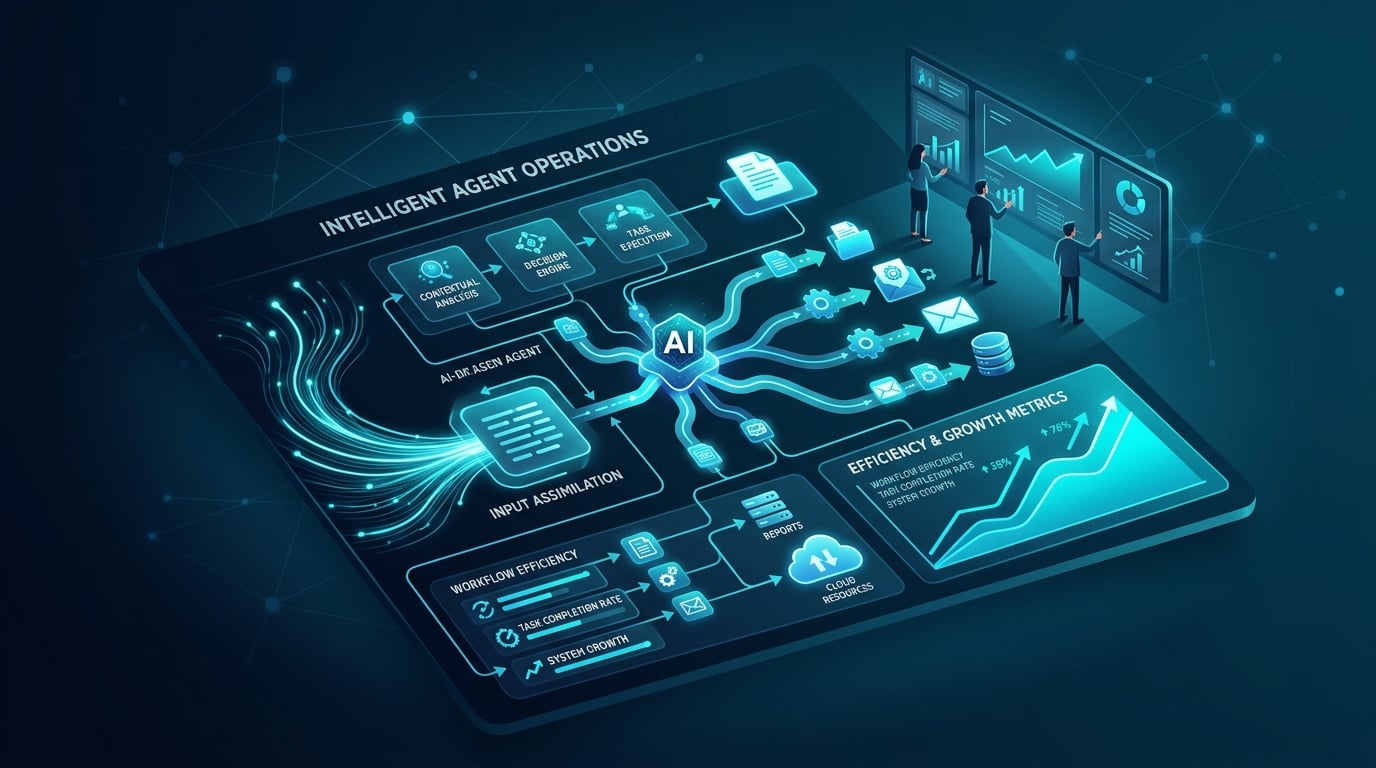
Understanding the operational mechanics of an intelligent agent in AI requires looking at how it interacts with its digital world. This involves a sophisticated connection between input mechanisms (sensors), processing capabilities (reasoning), and output mechanisms (actuators). For businesses, this translates into tangible workflows where data is transformed into actionable outcomes. An intelligent agent doesn’t just process information; it interprets it, learns from it, and uses it to drive progress toward defined business objectives. By translating complex AI concepts into practical business functions, we can see how these agents deliver measurable results, such as automating up to 60% of lead qualification in real estate, as observed in Vynta.ai’s internal data.
Sensors, Actuators, and Internal Models in Plain Language
To comprehend how an intelligent agent functions, it is helpful to use analogies from the physical world. Sensors are the agent’s means of perceiving its environment. In a business context, these could be integrations with your CRM, email servers, project management tools, or website analytics. They collect raw data. Like a new sales lead’s contact information, a candidate’s resume details, or a guest’s booking request. Actuators are the agent’s tools for acting upon its environment. These are the functionalities that allow the agent to perform tasks, such as sending an email, updating a record in a database, scheduling a meeting, or generating a report. Internal models are the agent’s knowledge base and understanding of the world. This includes its learned patterns, programmed rules, and the state of the environment it is tracking. These models are essential for reasoning and decision-making.
Intelligent Agent Architecture Components
| Component | Description | Business Analogy |
|---|---|---|
| Sensors | Perceive the environment and gather data. | CRM integrations, website analytics, email scanners, API feeds. |
| Internal Models | Maintain knowledge about the environment and the task. | Databases, learned patterns, rule sets, current state tracking. |
| Actuators | Perform actions on the environment. | Email clients, calendar schedulers, database update functions, reporting tools. |
How LLMs and External Tools Power Decision-Making
Modern intelligent agents often integrate powerful technologies like Large Language Models (LLMs) and connect to a wide array of external tools to make sophisticated decisions. LLMs provide advanced natural language understanding and generation capabilities, enabling agents to interpret complex queries, summarize documents, or draft communications that are contextually relevant and human-like. This greatly expands the range of tasks an agent can handle, moving beyond simple data entry to more nuanced problem-solving. Additionally, agents can be programmed to access and use external tools. Such as specialized AI models for image recognition, predictive analytics platforms, or databases of industry information. This interconnectedness allows an intelligent agent in AI to draw upon a vast pool of resources, analyze data from multiple sources, and make more informed, rational decisions. For example, an agent might use an LLM to understand a complex investor query and then query a financial database to provide a precise answer.
Step-by-Step: From Data Input to Business Output
The journey from raw data to a tangible business outcome is a structured process for an intelligent agent. It begins with Data Input, where sensors collect information from various sources. This could be a new email in a recruitment inbox, a website form submission for a real estate listing, or a donation notification for a fundraising organization. The agent then moves to the Perception phase, where it processes this raw data using its understanding of the environment. Next comes Reasoning and Decision Making. Here, the agent applies its internal models, rules, and potentially LLM capabilities to analyze the perceived information. It evaluates potential actions based on its goals. For instance, determining if a lead meets qualification criteria or if a candidate is a strong match for an open role. If multiple actions are possible, the agent selects the most rational one based on its objectives. Finally, the agent executes an Action via its actuators, producing a business output. This output might be an automated response email, an updated CRM record, a scheduled follow-up task for a human team member, or a generated performance report. This end-to-end process, repeated continuously, ensures that data is efficiently converted into valuable business actions and insights.
Five Types of Intelligent Agents and Their Business Applications
Understanding the different classifications of intelligent agents helps businesses pinpoint the most suitable AI solution for their specific operational challenges. While the core concept of perception, reasoning, and action remains consistent, agents vary significantly in their complexity and capabilities. This spectrum ranges from simple, reactive systems to highly adaptive learning agents. At Vynta AI, we recognize that not all automation needs are the same, and matching the right intelligent agent in AI to a business process is key to achieving desired outcomes.
Simple Reflex vs. Model-Based Reflex Agents
The most basic form of an intelligent agent is the simple reflex agent. These agents act solely based on current perceptions, ignoring the history of the environment. They operate using condition-action rules: if a certain condition is met, perform a specific action. For example, a simple reflex agent might be programmed to immediately send a confirmation email upon receiving a new lead inquiry. While effective for straightforward, immediate responses, they lack the ability to handle complex, dynamic situations where context or past events are important. A step up is the model-based reflex agent. These agents maintain an internal state or model of the world, which they update based on their perception history and knowledge of how the world works. This allows them to make more informed decisions by considering past events. For example, a model-based agent could differentiate between a new lead and a repeat inquiry based on past interactions, tailoring its response accordingly. This ability to maintain state is critical for more nuanced automation.
Goal-Based, Utility-Based, and Learning Agents
Moving beyond reflex agents, we encounter more sophisticated types. Goal-based agents go a step further by considering their goals in addition to the current state. They can plan sequences of actions to achieve these goals, making them more strategic. For example, a goal-based agent in recruitment might not just screen a candidate but plan a series of outreach emails and interview scheduling steps to fill a specific role. Utility-based agents are even more advanced, aiming to maximize not just goal achievement but also a measure of “utility” or desirability. This means they can make trade-offs when multiple goals are in play or when outcomes have different levels of benefit. An agent optimizing fundraising outreach might prioritize high-potential donors even if they require more effort, balancing efficiency with the ultimate goal of securing larger contributions. Finally, learning agents possess the ability to improve their performance over time through experience. They can modify their own internal models or rules based on feedback, becoming more effective and efficient as they operate. This learning capability is what truly distinguishes advanced AI agents, allowing them to adapt to evolving business environments and user behaviors.
Mapping Agent Types to Real Estate, Recruitment, Fundraising, and Hospitality
Each of these agent types offers distinct advantages for Vynta AI’s core verticals. In real estate, simple reflex agents can handle initial lead capture and basic auto-responders. Model-based agents are better suited for lead qualification, tracking prospect interactions, and personalizing follow-ups. Goal-based agents can manage entire lead nurturing campaigns, while utility-based agents could optimize pricing recommendations based on market data and client profiles. For recruitment, simple reflex agents can parse incoming resumes for keywords. Model-based agents can assess candidate fit against job descriptions and past hiring successes. Goal-based agents can manage the full recruitment pipeline, from sourcing to offer negotiation. Learning agents can continuously refine candidate sourcing strategies and interview question relevance. In fundraising, simple agents might send thank-you notes. Model-based agents can identify donor segments based on past giving. Goal-based agents can plan targeted outreach campaigns for specific funding initiatives. Utility-based agents can prioritize donor engagement efforts for maximum impact. For hospitality, simple agents can confirm bookings. Model-based agents can personalize guest recommendations based on past stays. Goal-based agents can manage loyalty programs and targeted promotions. Learning agents can optimize staffing based on predicted guest traffic and preferences.
Intelligent Agent Types and Vertical Applications
| Agent Type | Key Capability | Real Estate Example | Recruitment Example | Fundraising Example | Hospitality Example |
|---|---|---|---|---|---|
| Simple Reflex | Immediate action based on current perception | Auto-response to new listing inquiry | Initial resume keyword scan | Automated thank-you email for donation | Booking confirmation |
| Model-Based Reflex | Maintains internal state, considers history | Lead qualification based on interaction history | Candidate fit assessment against past hires | Donor segmentation by giving patterns | Personalized room upgrade offers based on past stays |
| Goal-Based | Plans actions to achieve specific objectives | Nurturing leads through a multi-step process | Managing entire candidate pipeline for a role | Targeted campaign for a new endowment fund | Automating loyalty program enrollment and rewards |
| Utility-Based | Maximizes desirability of outcomes, makes trade-offs | Optimizing pricing strategies based on market dynamics | Prioritizing high-potential candidates for scarce roles | Focusing outreach on major donor prospects | Dynamic pricing for rooms based on predicted demand and guest value |
| Learning | Improves performance through experience | Refining lead scoring models over time | Optimizing sourcing channels for best candidate profiles | Adapting outreach messaging based on donor engagement | Learning guest preferences to predict future needs |
Intelligent Agents vs. Chatbots and Traditional Automation Tools
The terminology surrounding AI can sometimes be confusing, leading businesses to question the true value proposition of advanced systems. While chatbots and traditional automation tools have their place, intelligent agents represent a significant evolution, capable of much more than simple task execution. At Vynta AI, we focus on delivering outcomes, not just automating steps. Understanding the distinctions between these technologies is key to making strategic investments in AI that drive meaningful business transformation. The primary differentiator lies in the agent’s capacity for autonomous decision-making, contextual understanding, and goal-oriented problem-solving, moving beyond rigid scripting.
Why Standard Chatbots Fall Short for Complex Workflows
Standard chatbots, often rule-based or using basic natural language processing, are primarily designed for conversational interfaces and answering frequently asked questions. They excel at guiding users through predefined paths or retrieving specific information. But, their capabilities are typically limited to direct, user-initiated queries. They lack the ability to integrate deeply with multiple business systems, maintain persistent context across different interactions, or autonomously initiate complex, multi-step processes based on evolving business logic or external data triggers. For example, a standard chatbot might answer a question about a property listing’s features but cannot autonomously qualify that lead, schedule a viewing, and update the CRM. This limitation makes them insufficient for automating the complex workflows common in real estate lead management, candidate sourcing, investor outreach, or guest service personalization. The complexity of real-world business operations requires more than just a conversational front-end.
The Shift from Task Automation to Outcome Automation
Traditional automation tools and basic chatbots focus on automating discrete tasks. This means taking a specific, repetitive action and making it faster or more efficient. For example, automating data entry from a form into a spreadsheet is task automation. Intelligent agents, on the other hand, drive outcome automation. This is a more strategic approach where the AI agent is tasked with achieving a specific business result, such as increasing qualified leads by 20%, reducing candidate screening time by 30%, or improving donor conversion rates. To achieve these outcomes, the agent must be capable of perceiving its environment, reasoning about complex situations, making decisions, and executing a series of coordinated tasks across different systems. It’s the difference between a robot that tightens a bolt and a robot that manages an entire assembly line to produce a finished car. This shift is enabled by the agent’s autonomy, proactivity, and ability to adapt its strategy based on real-time data and performance metrics. The intelligence lies not just in executing steps, but in intelligently orchestrating them to achieve a defined business objective.
Measuring ROI: Time Saved, Conversion Rates, and Cost Reduction
The return on investment (ROI) for intelligent agents is measured through tangible business metrics that reflect their ability to drive outcomes. Time saved is a direct benefit, as agents handle tasks much faster than humans, freeing up valuable employee hours for strategic work. For example, intelligent agents can automate up to 60% of lead qualification in real estate, as per Vynta.ai’s internal data, drastically reducing the time sales teams spend on unqualified prospects. Conversion rates see significant improvement because agents can personalize interactions at scale, respond instantly to inquiries, and ensure consistent follow-up, leading to higher success rates in sales, recruitment, and fundraising. McKinsey research indicates that 72% of businesses report AI agents reduce operational costs by at least 20%, directly contributing to cost reduction. Unlike basic automation that might reduce labor costs for a single task, intelligent agents drive broader cost efficiencies by optimizing processes, minimizing errors, and improving the effectiveness of human resources. The strategic impact of an intelligent agent in AI is best understood through these concrete, bottom-line improvements.
Intelligent Agents vs. Traditional Tools: A Capability Snapshot
| Capability | Standard Chatbot | Traditional Automation Tools (RPA) | Intelligent Agent (Vynta AI) |
|---|---|---|---|
| Primary Function | Conversational interface, Q&A | Automating repetitive, rule-based tasks | Achieving business outcomes through autonomous action and decision-making |
| Decision Making | Limited, predefined paths | Rule-based, deterministic | Autonomous, context-aware, goal-oriented |
| Environment Perception | User input, basic NLP | System interfaces, structured data | Multi-source data, dynamic environments, LLM interpretation |
| Adaptability | Low, requires manual updates | Low, task-specific | High, learns and adapts based on data and goals |
| Workflow Complexity | Simple, linear | Can handle multi-step tasks but is rigid | Handles complex, dynamic, multi-system workflows |
| Business Impact | Customer service efficiency, basic info retrieval | Operational efficiency for specific tasks | Revenue growth, significant cost reduction, strategic process optimization |
| Example Use Case | Answering FAQs about a service | Copying data between applications | Automating real estate lead qualification & nurturing to close |
A Practical Guide to Deploying Intelligent Agents in Your Organization

Transitioning from understanding the theoretical advantages to implementing an intelligent agent in AI within your operations requires a structured approach. Mid-market SMEs in real estate, recruitment, fundraising, and hospitality can achieve significant ROI when deployment follows a strategic framework. The key is to align agent capabilities with specific business pains, ensure proper integration with existing systems, and establish clear human-AI handoff protocols. This section provides a practical roadmap drawn from Vynta AI’s experience across dozens of deployments, where we have seen organizations reduce lead response times by 80% and cut candidate screening hours by half.
Assessing Readiness and Choosing the Right Partner
Before acquiring an agent, evaluate your organization’s digital maturity and process clarity. Start by mapping the workflows you intend to automate. Are they repetitive, data-driven, and rule-governed? Do they involve structured data inputs and predictable decision paths? For example, lead qualification in real estate involves clear criteria like budget, location, and timeline. Candidate screening in recruitment uses job descriptions and resume matches. These are ideal candidates. Next, ensure your data infrastructure is accessible. The agent needs to connect to your CRM, email, or ATS. If data is siloed in spreadsheets or legacy systems, plan for integration. Finally, choose a partner like Vynta AI who offers industry-specific agents rather than generic solutions. Look for transparent pricing, proven case studies in your vertical, and a commitment to human augmentation rather than wholesale replacement. A partner should also provide a clear evaluation framework to measure success.
Deployment Readiness Checklist
- Map high-value, repeatable processes that involve structured data
- Identify the expected business outcome (e.g., increase qualified leads by 30%)
- Assess current data quality and system integrations
- Designate internal champions for change management
- Define success metrics before deployment (time saved, conversion rate lift)
- Review vendor’s industry-specific expertise and references
- Plan for a pilot phase before full rollout
Implementation Steps: Integration, Testing, and Human-AI Handoff
Once ready, follow a phased implementation. Integration connects the agent to your existing tools via APIs. For example, an agent for real estate might integrate with your MLS, CRM, and email. Ensure all data flows are bidirectional so the agent can read and write information. Testing is critical. Run the agent in a sandbox environment with historical data to verify it makes correct decisions. For example, have it qualify a set of leads you already classified and measure accuracy. During testing, refine the agent’s internal models to match your specific business rules. Human-AI handoff defines when the agent passes tasks to a human. Complex negotiations, sensitive client conversations, or ambiguous requests should escalate to your team. Set clear triggers: if confidence drops below a threshold or if a prospect asks for a human, the agent hands off. This balance preserves personalization while maximizing automation. Multi-agent systems, as noted by IBM Research, improve task completion efficiency by 40% compared to single agents, so consider deploying specialized agents for different functions.
Common Pitfalls and How to Avoid Them
Even with careful planning, organizations encounter pitfalls. One common mistake is over-automation. Trying to automate every interaction. Intelligent agents excel at structured, data-rich tasks but struggle with nuanced human emotions or unstructured negotiations. Reserve those for human experts. Another pitfall is ignoring data quality. Garbage in, garbage out holds true. Clean your data before integration. Third, neglecting change management leads to internal resistance. Train your team on how the agent amplifies their role rather than threatens it. Show them the 20% cost reduction McKinsey reports from AI agents and the time saved they can reinvest in higher-value work. Finally, skipping ongoing monitoring means the agent may drift in performance as business conditions change. Schedule quarterly reviews of agent accuracy and adjust its models. By avoiding these pitfalls, you ensure your intelligent agent in AI delivers sustained value across your organization.
Evaluation Framework for Agent Performance
Metrics to Track: Time saved per task, conversion rate improvement, error rate reduction, user satisfaction scores. Baseline: Measure current performance for 30 days before deployment. Review Cadence: Weekly during pilot, monthly thereafter. Escalation Rate: Monitor how often the agent hands off to humans; target <20% for routine tasks. Business Impact: Link agent performance to revenue or cost KPIs to validate ROI.
Deploying an intelligent agent is not a one-time project but an ongoing partnership between your team and the technology. With the right preparation, a phased implementation, and a commitment to continuous improvement, your organization can achieve measurable outcomes. Whether it’s faster lead conversion, better candidate matches, higher donor engagement, or more personalized guest experiences. At Vynta AI, we provide the expertise and industry-specific agents to help you make that journey successful.
References
Frequently Asked Questions
What is an intelligent agent in AI?
An intelligent agent in AI is a system that perceives its environment, processes information, and takes autonomous actions to achieve specific goals. It acts as a digital assistant that adapts, learns, and makes reasoned decisions to automate tasks and drive business value.
Is ChatGPT an intelligent agent?
ChatGPT is a large language model, not a full intelligent agent in AI. While it can generate text and reason over language, it lacks autonomy, environmental perception, and the ability to take independent actions to achieve goals. True intelligent agents like Vynta AI agents operate within a perception-reasoning-action loop.
Who are the big 4 AI agents?
The term ‘big 4 AI agents’ is not a formal industry classification. Notable AI agents include those from Google, Amazon, Microsoft, and OpenAI, but each serves different purposes. Enterprise-focused intelligent agents like those from Vynta AI are designed for specific business automation.
What are the 7 kinds of AI agents?
The seven common types of AI agents are simple reflex agents, model-based reflex agents, goal-based agents, utility-based agents, learning agents, multi-agent systems, and hybrid agents. These categories differ in complexity, memory, and decision-making capabilities. Intelligent agents in business often combine multiple types for effective automation.
How does an intelligent agent in AI work?
An intelligent agent in AI works through a continuous perception-reasoning-action loop. It first perceives its environment using sensors, then reasons over the data using algorithms and knowledge bases, and finally acts through actuators to execute tasks. This cycle repeats, allowing the agent to adapt and achieve its goals.
What are the key characteristics of an intelligent agent in AI?
The key characteristics of an intelligent agent in AI are autonomy, reactivity, proactivity, and rationality. Autonomy lets it operate independently, reactivity enables it to respond to changes, proactivity allows it to take initiative, and rationality ensures it acts to maximize performance. These traits distinguish it from simple automation.
How do sensors and actuators work in an intelligent agent in AI?
In an intelligent agent in AI, sensors collect data from the environment, such as CRM entries or user interactions. Actuators are the tools that carry out actions, like sending emails or updating databases. Internal models store knowledge and rules, enabling the agent to interpret data and decide on actions.