

how to use AI Automation Services
How to Use AI Automation Services: A Practical Guide for Mid-Market Businesses
What Are AI Automation Services and Why Mid-Market Businesses Need Them
AI automation services design, build, and deploy custom agents that handle repetitive business tasks autonomously. For mid-market SMEs in real estate, recruitment, fundraising, and hospitality, these solutions transform manual workflows into intelligent systems that qualify leads, screen candidates, manage donor outreach, and improve guest experiences. The result? Measurable revenue growth and operational efficiency without hiring additional staff.
Defining AI Automation in Business Terms
Unlike pre-built software that forces you to adapt your processes, these services build custom agents tailored to how you actually work. A real estate agency gets an agent that qualifies property leads and updates CRM records automatically. A recruitment firm deploys one that screens resumes, schedules interviews, and maintains consistent candidate communication across multiple channels.
Core capabilities include workflow automation with decision-making logic, system integration that eliminates data silos, multichannel communication management, and performance analytics with predictive insights. Implementation typically happens in phases: discovery and assessment, deployment within weeks, then continuous optimization with ongoing support.
Time Savings and Revenue Growth You Can Track
Mid-market businesses using these services report improvements across three metrics: time savings, cost reduction, and revenue acceleration. Real estate teams often reclaim 15–20 hours weekly from automated lead qualification. Recruitment agencies reduce time-to-hire by 40% through automated candidate screening. Fundraising organizations scale investor outreach 10x without proportional staff increases. Hospitality businesses raise reservation conversion rates while cutting no-shows through automated guest communication.
Why Traditional Service Industries Can’t Ignore This Shift
Here’s the competitive reality: enterprise competitors deploy sophisticated automation while mid-market firms rely on manual processes. A boutique hotel can’t match chain efficiency in reservation management. A regional recruitment agency can’t process the candidate volume that larger firms handle with automation.
AI Automation Services for Mid-Market Businesses
Pros
- Scale revenue without proportional headcount increases
- Industry-specific solutions for your actual workflows
- Integration with existing CRM, ATS, and reservation systems
- Track ROI through conversion rates, time-to-hire, and guest satisfaction scores
- Human-AI collaboration that supports teams rather than replacing them
Cons
- Requires phased implementation and change management
- Initial discovery and assessment period before deployment
- Ongoing optimization needed for maximum results
- ROI projections provided during assessment, not guaranteed upfront
The advantage comes from speed and personalization at scale. A fundraising director maintains personalized investor relationships while reaching 500 prospects monthly. A hospitality manager delivers boutique-level guest service across 100 rooms. Learning how to use these services effectively separates growing businesses from those losing market share to better-automated competitors.
Steps to Implement AI Automation Services in Your Operations
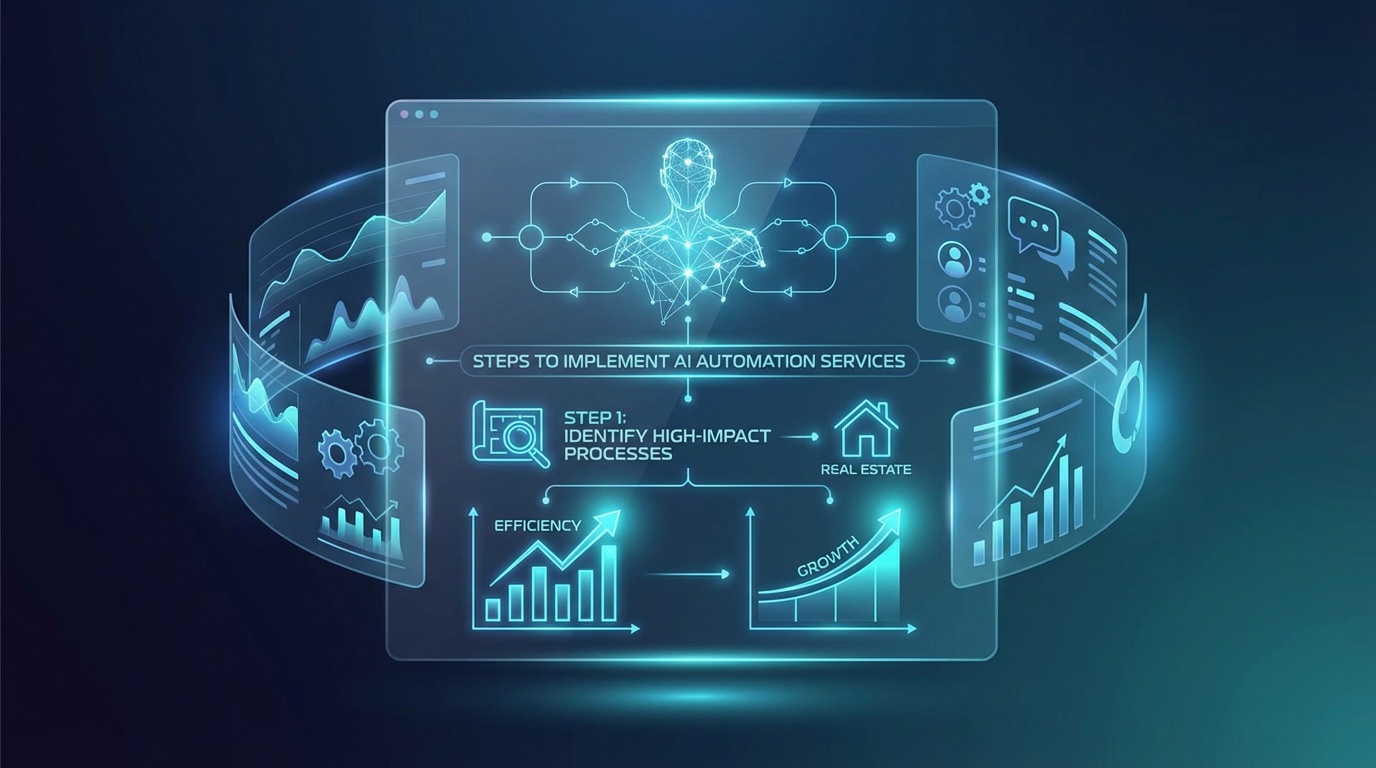
Step 1: Identify High-Impact Processes in Your Industry
Start by mapping workflows that consume the most time or directly affect revenue. Real estate agencies should examine lead response times, CRM data entry, and property matching processes. Recruitment firms often see fast gains by automating resume screening, interview scheduling, and candidate communication. Fundraising organizations get strong returns from investor research, outreach sequencing, and donor relationship tracking. Hospitality businesses should prioritize reservation confirmations, guest communication, and upsell workflows.
Calculate the current cost of each process: hours spent weekly, staff involved, and the revenue impact of delays. A recruitment agency spending 25 hours weekly on manual resume screening? That’s a clear automation opportunity. A hotel losing 15% of reservations to no-shows? That process is worth improving with automated reminders and confirmations.
Step 2: Select the Right AI Agents for Your Needs
Match agent capabilities to your workflow requirements. Lead qualification agents analyze incoming inquiries, score prospects based on your criteria, and route qualified leads to sales teams with full context. Candidate screening agents parse resumes, match skills to job requirements, and schedule interviews automatically. Donor outreach agents personalize investor communication at scale while keeping relationship data current. Guest experience agents handle reservation confirmations, pre-arrival preferences, and post-stay follow-ups.
| Industry | AI Agent Type | Primary Function | Integration Points |
|---|---|---|---|
| Real Estate | Lead Qualification Agent | Score inquiries, update CRM, route to agents | Property portals, CRM systems, email |
| Recruitment | Candidate Screening Agent | Parse resumes, match requirements, schedule interviews | ATS platforms, job boards, calendar systems |
| Fundraising | Investor Outreach Agent | Research prospects, personalize communication, track engagement | CRM, email, LinkedIn, pitch databases |
| Hospitality | Guest Experience Agent | Confirm reservations, collect preferences, manage upsells | PMS, booking platforms, SMS, WhatsApp |
Step 3: Integrate with Existing Systems Without Disruption
These services connect to your current technology stack through custom API development and data transformation. Real estate CRMs, recruitment ATS platforms, fundraising databases, and hospitality property management systems integrate without replacing existing tools. A solid implementation includes real-time data synchronization that reduces manual data entry while keeping information accurate across platforms.
Phased deployment limits operational disruption. Start with one workflow in a controlled environment, validate results, then expand to additional processes. A recruitment agency might begin with automated candidate screening for one job category before rolling out across all positions. This gives teams time to adapt while proving ROI in stages.
Step 4: Measure and Optimize for Ongoing Results
Track performance metrics tied to your goals. Real estate teams monitor lead response time, qualification accuracy, and conversion rates. Recruitment agencies measure time-to-hire, candidate quality scores, and interview completion rates. Fundraising organizations track outreach volume, response rates, and meeting conversions. Hospitality businesses analyze reservation confirmation rates, guest satisfaction scores, and upsell success.
Optimization Insight: Continuous monitoring and adjustment based on performance data is built into quality services. Automated analytics detect anomalies, identify improvement opportunities, and suggest changes. A hotel might find that pre-arrival messages sent 48 hours before check-in drive 30% higher upsell conversion than 24-hour messages, prompting a schedule change.
Treat implementation as an ongoing partnership rather than a one-time project. Regular optimization reviews help agents adapt to changing business needs, seasonal patterns, and market conditions—whether that’s real estate cycles, recruitment demand, fundraising campaigns, or hospitality occupancy shifts.
Real-World Examples: AI Automation Across Four Industries
Real Estate: Automating Lead Qualification and CRM
A regional property agency handling 400 monthly inquiries across multiple listing portals implemented agents to qualify leads and update CRM records automatically. The system analyzes each inquiry for budget, timeline, property preferences, and financing status. Qualified leads receive immediate personalized responses with relevant property matches while the agent updates contact records, assigns leads to appropriate sales staff, and schedules viewings based on availability.
Results after 90 days: lead response time dropped from 4 hours to 3 minutes, conversion rates increased 28%, and agents reclaimed 18 hours weekly previously spent on manual data entry and initial screening calls. The system now handles first-contact communication for all inquiries, routing only qualified prospects to human agents with full context and property recommendations ready.
Recruitment: Streamlining Candidate Screening and Scheduling
A mid-market recruitment firm processing 200 applications weekly for technology positions deployed agents to screen resumes, match candidates to job requirements, and coordinate interview scheduling. The system parses resumes for technical skills, experience levels, and location preferences. Qualified candidates receive automated communication explaining next steps, available interview slots, and preparation materials.
The firm reduced time-to-hire from 23 days to 14 days while improving candidate quality scores by 35%. Recruiters now spend more time on relationship building and final interviews rather than resume review and calendar coordination. The agent keeps candidates informed throughout the process, sending status updates and collecting feedback automatically.
Fundraising: Scaling Investor Outreach and Donor Management
A nonprofit organization seeking to expand donor relationships beyond its 50-person network used agents to research potential investors, personalize outreach communication, and track engagement across email and LinkedIn. The system identifies prospects matching donor profiles, drafts personalized messages referencing specific interests and past giving patterns, and schedules follow-up sequences based on engagement signals.
The organization scaled outreach from 50 to 500 monthly contacts while maintaining personalized communication quality. Meeting conversion rates improved 42% compared to generic email campaigns. The development director now focuses on closing relationships and stewardship rather than research and initial outreach, with the system providing detailed engagement history for every prospect meeting.
Hospitality: Optimizing Guest Experiences and Reservations
A boutique hotel with 75 rooms and an on-site restaurant implemented agents to manage reservation confirmations, collect guest preferences, reduce no-shows, and drive upsell opportunities. The system sends automated confirmation messages via SMS and WhatsApp, requests dining preferences and special occasions, offers room upgrades and spa packages, and sends pre-arrival reminders with check-in details.
| Metric | Before Automation | After Automation | Business Impact |
|---|---|---|---|
| No-show rate | 12% | 3% | $18,000 monthly revenue recovery |
| Upsell conversion | 8% | 23% | $12,000 additional monthly revenue |
| Guest satisfaction score | 4.2/5 | 4.7/5 | 15% increase in repeat bookings |
| Staff time on reservations | 25 hours/week | 8 hours/week | Staff redeployed to in-person service |
The hotel maintains its boutique service reputation while operating at chain-level efficiency. Guests receive timely, personalized communication without staff spending hours on manual messaging. The system collects preference data that improves with every stay, creating increasingly personalized experiences that drive loyalty and positive reviews. Learn more about how Vynta AI Agents for Hospitality deliver these results.
Common Challenges in Adopting AI Automation and How to Overcome Them
Challenge 1: Integration with Legacy Systems
Many mid-market businesses run older CRM, ATS, or property management systems that lack modern API capabilities. Custom API development and data transformation solve this by building connectors that bridge legacy platforms with modern agents. A recruitment agency running a 10-year-old ATS can integrate screening agents through custom middleware that translates data formats and maintains bidirectional synchronization.
Challenge 2: Data Privacy and Security Concerns
Service industries handle sensitive information: property buyer finances, candidate personal data, donor wealth information, and guest payment details. Quality providers address these concerns through secure data handling practices, compliance with relevant regulations, and transparent data usage policies. Implementation often includes security audits, encrypted data transmission, and role-based access controls aligned to existing organizational permissions.
Challenge 3: Proving ROI in Traditional Industries
Traditional service businesses need clear ROI projections before committing to automation. Discovery and assessment phases calculate current process costs, identify automation opportunities, and project expected returns based on benchmarks and your internal data. A hospitality manager can review projected revenue recovery from reduced no-shows, added upsell revenue, and staff time savings before implementation begins. Phased deployment lets you validate ROI step-by-step rather than committing all at once. Research shows traditional service businesses benefit significantly from clear ROI modeling.
Ensuring Human-AI Collaboration Drives Success
The best implementations treat agents as team support rather than replacement. Real estate agents focus on high-value client relationships while the system handles lead qualification. Recruiters concentrate on candidate evaluation and client relationships while automation manages screening and scheduling. Fundraising directors spend more time on donor stewardship while the system scales initial outreach. Hospitality staff deliver in-person service while automation improves digital touchpoints.
AI Automation Adoption Considerations
Pros
- Custom integration works with existing systems without forced replacements
- Phased implementation proves ROI before full deployment
- Security controls support industry compliance requirements
- Human-AI collaboration preserves relationship-focused service quality
- Ongoing support includes optimization and technical assistance
Cons
- Change management requires team training and process adjustment
- Initial assessment needed to map workflows and estimate ROI
- Legacy system integration may require additional custom development time
- Best results depend on continuous optimization and feedback
Technology improves human performance rather than replacing human judgment. Teams that get strong results combine AI speed with human expertise, creating advantages that neither can achieve alone. This integration is part of intelligent automation best practices.
Next Steps: Partner with Vynta AI to Scale Your Business
What Sets Vynta Apart for Mid-Market SMEs
Vynta AI specializes in custom agent development for mid-market businesses that don’t have internal AI resources. Instead of enterprise platforms that are too complex and expensive for regional firms, or generic automation tools that lack industry depth, we deliver enterprise-grade solutions tailored to real estate, recruitment, fundraising, and hospitality workflows. Our service model includes discovery and assessment, implementation within weeks, and monitoring with regular optimization reviews.
Quick Wins: Start with One Vertical Today
Start with one high-impact workflow to validate ROI quickly. Real estate agencies often begin with lead qualification automation. Recruitment firms start with candidate screening. Fundraising organizations launch investor outreach scaling. Hospitality businesses begin with reservation optimization. Many teams see measurable progress within 60–90 days—improved conversion rates, reduced time-to-hire, higher outreach volume, or stronger guest satisfaction scores.
Strategic Advantage: Mid-market businesses that adopt automation now build an operating edge before broad adoption makes it standard practice. Early adopters win share from competitors still relying on manual processes while building efficiency that compounds over time.
Get Started: Schedule Your Free AI Automation Assessment
Vynta AI offers complimentary discovery assessments that map your current workflows, identify automation opportunities, and project ROI based on your operation. The assessment includes process analysis, integration planning, and phased implementation recommendations. Learning how to use these services effectively starts by selecting the processes most likely to create measurable value for your industry and growth goals.
Contact Vynta AI to schedule your assessment and see how custom agents can drive measurable revenue growth and operational efficiency across your real estate, recruitment, fundraising, or hospitality business. See how automation transforms traditional service industries.
Frequently Asked Questions
How can you use AI for automation?
At Vynta AI, we see AI automation as designing, building, and deploying custom AI agents to handle repetitive business tasks autonomously. For mid-market businesses, this means transforming manual workflows into intelligent systems that qualify leads, screen candidates, manage donor outreach, or improve guest experiences. Our services develop AI agents tailored precisely to your specific business processes, ensuring they execute complex workflows without constant human intervention.
How to use AI automation to make money?
AI automation services drive measurable revenue growth and operational efficiency by automating high-impact processes. Businesses often report significant time savings, cost reduction, and accelerated revenue through improved conversion rates and expanded outreach. For example, real estate teams reclaim hours from automated lead qualification, and fundraising organizations can scale investor outreach significantly without proportional staff increases. This allows your teams to focus on strategic initiatives that directly impact your bottom line.
What is the 30% rule in AI?
While there isn’t a universally recognized “30% rule” in AI automation as we define it, our focus at Vynta AI is on delivering clear, measurable business outcomes. We consistently see mid-market businesses reclaim significant time, often 15-20 hours weekly, and reduce time-to-hire by 40% through our custom AI agents. Our approach centers on identifying high-impact processes to achieve tangible improvements in efficiency and revenue.
Which AI tool is best for automation?
The “best” AI solution for automation isn’t a single off-the-shelf tool, but rather a custom-built AI agent designed for your unique business processes. At Vynta AI, we develop tailored solutions that integrate with your existing systems, executing complex workflows precisely as you need them. This personalized approach ensures the AI agent directly addresses your specific operational challenges and business goals, delivering far greater impact than generic software.
What are the 4 types of automation?
In the context of AI automation services, we focus on key capabilities that drive business transformation rather than a fixed number of “types.” These include workflow automation with decision-making logic, seamless system integration to eliminate data silos, multichannel communication automation, and performance analytics with predictive insights. These capabilities allow us to build comprehensive solutions that automate processes across various business functions.