

Key Takeaways
- Hotel cleaning significantly influences revenue by improving guest review scores.
- Higher cleanliness standards lead to increased revenue per available room (RevPAR).
- Impeccable cleaning is essential for guest satisfaction and repeat bookings.
- Maintaining high cleaning standards enhances a hotel’s brand reputation.
- Hospitality managers should prioritize cleaning as a strategic business driver.
Table of Contents
- Why Hotel Cleaning Is the Cornerstone of Guest Satisfaction & Hotel Reputation
- What Does “Hotel Cleaning” Encompass? Scope, Standards & Legal Requirements
- How to Clean a Hotel Room: Step-by-Step, Proven Methods for Impeccable Results
- Hotel Bathroom and High-Touch Area Disinfection: Science-Backed, Efficient Protocols
- Managing Hotel Laundry and Linen: Best Practices for Hygiene and Longevity
- Who Keeps Hotels Spotless? Housekeeping Department Structure in Modern Hospitality
- Hotel Cleaning SOPs and Scheduling: Implementation for Consistency and Compliance
- AI & Automation in Hotel Cleaning: Practical Applications to Scale Excellence
- Sustainability in Hotel Housekeeping: Greener Methods for the Modern Guest
- Hotel Cleaning vs. Residential Cleaning: Key Differences Every Manager Must Know
- Modern Hotel Cleaning Supplies & Equipment: What Professionals Recommend (2025 Edition)
Hotel Cleaning: Elevating Guest Experience, Efficiency & Business Outcomes in Modern Hospitality
Hotel cleaning directly impacts your bottom line, a Cornell study found that a one-point increase in review scores drives a 7-8% rise in revenue per available room (RevPAR). For hospitality managers, impeccable cleaning standards aren’t just operational requirements; they’re revenue drivers that determine guest satisfaction, repeat bookings, and brand reputation. Hotel cleaning solutions from Vynta can help you optimize these standards for measurable business results.
Modern hotel cleaning encompasses far more than basic housekeeping. It’s a strategic operation requiring systematic protocols, staff expertise, and increasingly, AI-powered automation to maintain consistency while scaling personalized service. This comprehensive guide provides actionable frameworks for hospitality managers seeking measurable improvements in guest satisfaction and operational efficiency.
Why Hotel Cleaning Is the Cornerstone of Guest Satisfaction & Hotel Reputation
Guest satisfaction scores correlate directly with cleaning quality, properties with consistently high cleanliness ratings achieve 15-20% higher occupancy rates and command premium pricing. Poor cleaning in hotel operations creates a cascade of financial damage: negative reviews reduce booking conversion by up to 30%, while service recovery costs average $150-300 per complaint incident.
Financial Impact of Poor Cleaning: A single negative review mentioning cleanliness issues can cost hotels $30-50 in lost bookings per review, with long-term brand damage extending impact over 6-12 months.
Implement real-time feedback systems through SMS or mobile apps to catch cleaning issues before checkout. Track Net Promoter Scores (NPS) specifically related to room cleanliness, and conduct monthly guest surveys quantifying cleaning’s impact on overall satisfaction. Properties using systematic feedback loops see 25% fewer cleaning-related complaints and 18% higher guest retention rates.
What Does “Hotel Cleaning” Encompass? Scope, Standards & Legal Requirements
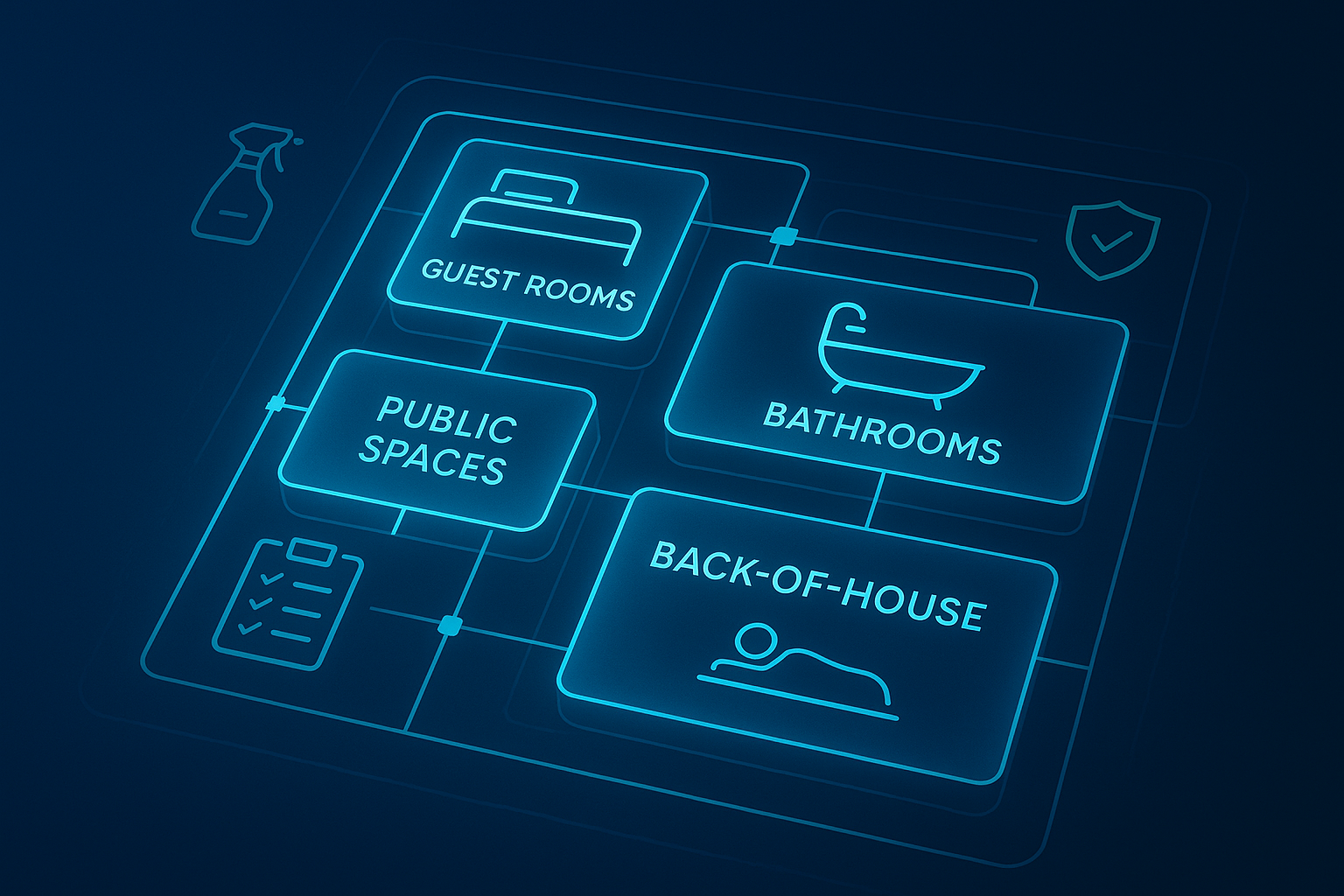
Housekeeping checklist hotel operations must address multiple zones: guest rooms, bathrooms, public spaces, back-of-house areas, and specialized facilities like spas or meeting rooms. Each area requires distinct protocols, frequencies, and compliance standards based on local health regulations and post-pandemic safety requirements.
| Area | Cleaning Frequency | Responsible Role | Compliance Notes |
|---|---|---|---|
| Guest Rooms | Every turnover + daily service | Room Attendant | CDC high-touchpoint protocols |
| Bathrooms | Every turnover + deep clean weekly | Room Attendant | Disinfection dwell times required |
| Public Areas | Hourly touchpoints, full clean 2x daily | Public Area Attendant | OSHA chemical safety standards |
| Kitchen/F&B | Continuous + deep sanitization | Kitchen Staff | Local health department codes |
Legal compliance requires documented cleaning logs, chemical safety data sheets (SDS), and staff training records. Properties must maintain audit trails proving adherence to local health codes, OSHA standards, and industry-specific regulations. Create localized standard operating procedures (SOPs) incorporating regional requirements and guest expectations. For more information on regulatory requirements, see the OSHA hospitality housekeeping guidelines.
How to Clean a Hotel Room: Step-by-Step, Proven Methods for Impeccable Results
Efficient room cleaning follows a systematic 15-30 minute workflow maximizing thoroughness while minimizing labor costs. The sequence prevents cross-contamination and ensures consistent results across all room types and staff skill levels.
Hotel room housekeeping checklist workflow:
- Entry & Assessment (2 min): Knock, announce entry, assess room condition, open windows for ventilation
- Linen Removal (3 min): Strip beds completely, collect towels, check for stains or damage
- Bathroom Deep Clean (8 min): Apply disinfectants, clean fixtures, sanitize high-touch surfaces with 2-5 minute dwell time
- Room Surfaces (10 min): Dust furniture, clean mirrors/windows, vacuum thoroughly including under beds
- Restocking & Final Touches (5 min): Fresh linens, amenity replenishment, temperature/lighting adjustment
- Quality Check (2 min): Visual inspection, scent assessment, guest-ready verification
Use UV blacklight tools for biological residue detection and implement the “white glove test” for surface cleanliness verification. Train staff on the two-minute reset method for guest-facing items, ensuring every element appears untouched and perfectly positioned. For more actionable tips, check out our guide on best practices in hotel cleaning.
Hotel Bathroom and High-Touch Area Disinfection: Science-Backed, Efficient Protocols
Bathroom disinfection requires EPA-approved quaternary ammonium or bleach-based solutions with documented efficacy against pathogens. Surfaces must remain wet for 2-5 minutes (dwell time) to achieve 99.9% pathogen elimination, as the most common cleaning failure is insufficient contact time. For more guidance on optimizing operational efficiency in hospitality, see hotel data optimization.
Critical Dwell Times: Quaternary ammonium compounds require 2-5 minutes wet contact time; alcohol-based disinfectants need 30-60 seconds; hydrogen peroxide solutions require 1-3 minutes for full efficacy.
Successful bathroom disinfection requires a systematic approach that prevents cross-contamination. Use color-coded microfiber cloths—blue for mirrors and glass, red for toilets, green for general surfaces—and never interchange them between areas. Train staff to work from cleanest to dirtiest surfaces: mirrors first, then countertops, and finally toilets and floors. Following customer service performance metrics protocols like this can reduce bacterial transfer by up to 85% compared to single-cloth cleaning methods.
Managing Hotel Laundry and Linen: Best Practices for Hygiene and Longevity
Professional hotel cleaning extends beyond visible surfaces to encompass comprehensive linen management that directly impacts guest comfort and operational costs. Effective laundry protocols require precise temperature control, washing at minimum 160°F (71°C) for 25 minutes eliminates 99.9% of pathogens while preserving fabric integrity. Implement a three-stage sorting system: heavily soiled items for pre-treatment, standard washing loads, and damaged linens for immediate replacement assessment.
Modern hotels leverage RFID tracking systems to monitor linen lifecycles, reducing loss by 15-20% while ensuring optimal replacement timing. Establish clear replacement criteria: sheets showing thinning, staining after two treatment attempts, or pilling should be retired immediately. For mid-market properties, maintaining a 4:1 linen-to-room ratio ensures adequate inventory during peak occupancy while minimizing storage costs. Learn more about service in hotels and how smart linen management can improve efficiency and reduce costs.
| Linen Type | Wash Temperature | Replacement Cycle | Quality Indicators |
|---|---|---|---|
| Bed Sheets | 160-180°F | 200-300 washes | Thread integrity, color retention |
| Towels | 160-200°F | 150-200 washes | Absorbency, texture softness |
| Pillowcases | 160-180°F | 250-350 washes | Seam strength, fabric smoothness |
For a deeper dive into optimizing laundry operations, read our article on hotel cleaning services and automation.
Who Keeps Hotels Spotless? Housekeeping Department Structure in Modern Hospitality
Successful hotel cleaning operations depend on clearly defined roles and optimal staffing ratios tailored to property size and service level. Executive housekeepers oversee department strategy and quality standards, while floor supervisors manage daily operations across 30-50 rooms each. Room attendants typically handle 12-16 rooms per shift in upscale properties, with ratios increasing to 18-22 rooms in select-service hotels where amenities are streamlined.
Cross-training creates operational flexibility essential for hospitality success. Train 30% of room attendants in public area cleaning, and ensure all floor supervisors can perform room inspections and handle guest requests. Implement daily 5-minute team huddles to communicate special requests, maintenance issues, and recognition for exceptional performance. This structured approach reduces cleaning inconsistencies by 40% while improving staff satisfaction and retention rates.
Hotel Cleaning SOPs and Scheduling: Implementation for Consistency and Compliance
Standardized Operating Procedures (SOPs) transform hotel cleaning from reactive task management to proactive quality assurance. Develop property-specific SOPs that detail every cleaning task with precise timing, required supplies, and quality checkpoints. Effective SOPs include photographic standards showing acceptable cleanliness levels, step-by-step task sequences, and escalation protocols for issues requiring management attention.
Digital scheduling platforms optimize staff deployment while maintaining service consistency. Implement staggered deep cleaning schedules, conduct carpet cleaning and detailed bathroom maintenance during mid-week low occupancy periods to minimize guest disruption. Use the “3-Minute Visual Audit” system where supervisors spot-check 10% of cleaned rooms each shift, documenting findings in real-time mobile applications that automatically generate performance reports and identify training opportunities.
SOP Implementation Timeline: Week 1: Document current processes and identify gaps. Week 2: Create standardized checklists and photo standards. Week 3: Train staff and supervisors on new protocols. Week 4: Begin quality audits and feedback loops.
AI & Automation in Hotel Cleaning: Practical Applications to Scale Excellence

Artificial intelligence transforms hotel cleaning operations by optimizing workflows, predicting maintenance needs, and enhancing guest satisfaction through data-driven insights. AI-powered systems analyze historical occupancy patterns, guest preferences, and room condition data to automatically adjust cleaning schedules and supply allocation. Properties using intelligent automation report 23% reduction in cleaning-related guest complaints and 18% improvement in room turnover times.
Vynta’s hospitality solutions integrate seamlessly with existing property management systems to deliver measurable outcomes for mid-market hotels. Our AI agents automatically prioritize room assignments based on checkout times and guest arrival patterns, reducing housekeeping overtime by 15% while ensuring rooms are ready 20 minutes ahead of check-in. The system tracks cleaning completion rates, identifies bottlenecks in real-time, and sends automated alerts for quality control issues before they impact guest experience.
Expert Implementation Strategy: Start with guest feedback automation, Vynta can analyze review sentiment and identify cleaning-related concerns within 24 hours, allowing immediate corrective action that prevents negative reviews from spreading across major booking platforms. Next, automate cleaning schedule optimization based on occupancy forecasts and guest preferences, ensuring resources are allocated efficiently and consistently. Finally, use AI-driven quality audits to identify training needs and maintain high standards as your operation scales.
Sustainability in Hotel Housekeeping: Greener Methods for the Modern Guest
Eco-conscious travelers increasingly choose properties based on environmental practices, making sustainable hotel cleaning a competitive differentiator. Modern green housekeeping reduces operational costs while meeting guest expectations for responsible hospitality.
Effective eco-friendly cleaning starts with product selection: biodegradable surfactants, plant-based disinfectants with EPA Safer Choice certification, and concentrated formulas that reduce packaging waste. These alternatives match traditional cleaning power while eliminating volatile organic compounds that affect indoor air quality.
| Traditional Method | Sustainable Alternative | Environmental Benefit | Cost Impact |
|---|---|---|---|
| Daily linen change | Guest-choice program | 18% water reduction | $1.20/room savings |
| Chemical-based glass cleaner | Microfiber + water system | Zero chemical runoff | 67% product cost reduction |
| Single-use amenity bottles | Refillable dispensers | 89% plastic waste reduction | $0.85/room savings |
Implementation requires clear guest communication and staff training. Successful towel reuse programs use strategically placed signage explaining environmental impact alongside convenient collection systems. Properties report 73% guest participation rates when programs emphasize conservation benefits rather than cost savings.
Green Key and LEED certifications provide third-party validation of sustainability efforts, often qualifying properties for corporate travel contracts and eco-tourism partnerships that drive incremental revenue. For more on environmental health in hospitality, see the CDC’s environmental health resources.
Hotel Cleaning vs. Residential Cleaning: Key Differences Every Manager Must Know
Understanding the fundamental differences between hotel cleaning and residential housekeeping prevents costly mistakes in staffing, supply procurement, and guest expectation management.
Commercial hotel operations require specialized approaches across five critical areas:
| Factor | Hotel Cleaning | Residential Cleaning |
|---|---|---|
| Time per room | 18-30 minutes | 60-120 minutes |
| Frequency | Daily turnover | Weekly/bi-weekly |
| Chemical strength | Commercial-grade disinfectants | Household cleaners |
| Documentation | Required compliance logs | Minimal paperwork |
| Guest interaction | Professional service standards | Personal relationship |
Hotels must maintain detailed cleaning logs for health department inspections, use EPA-registered disinfectants with specific dwell times, and coordinate with front desk operations for seamless guest experiences. Residential cleaners work at a different pace with different priorities, making direct skill transfer challenging without proper hospitality training. For more insights, explore our article on the structure of modern hotel cleaning teams.
Modern Hotel Cleaning Supplies & Equipment: What Professionals Recommend (2025 Edition)
Professional-grade hotel cleaning requires specialized equipment that balances efficiency, durability, and guest safety. The right tools reduce labor costs while maintaining consistent quality standards across all property areas.
Essential Equipment for 2025:
- HEPA-filtered backpack vacuums – Improve staff mobility and capture 99.97% of particles for superior air quality
- Microfiber cleaning systems – Color-coded cloths for cross-contamination prevention and efficient cleaning of all surfaces
- Electrostatic sprayers – Ensure even disinfectant coverage on high-touch surfaces and reduce chemical usage by up to 50%
- UV-C disinfection wands – Provide rapid, chemical-free sanitization of remote controls, switches, and other electronics
- Automated supply dispensers – Track inventory in real time and reduce waste, ensuring staff always have the right tools on hand
Investing in modern cleaning technology not only improves operational efficiency but also enhances guest confidence in your property’s commitment to health and safety. For tailored recommendations and implementation support, connect with Vynta’s hospitality automation experts.
Frequently Asked Questions
How does maintaining high cleaning standards impact a hotel’s revenue and guest satisfaction?
Maintaining high cleaning standards directly boosts guest satisfaction, leading to better review scores that can increase revenue per available room (RevPAR) by 7-8%. Consistently clean hotels enjoy higher occupancy rates, repeat bookings, and enhanced brand reputation, all of which contribute to stronger financial performance.
What specific areas and protocols are included in comprehensive hotel cleaning operations?
Comprehensive hotel cleaning covers guest rooms, bathrooms, high-touch surfaces, public areas, and back-of-house spaces. Protocols include systematic disinfection of high-contact points, efficient laundry and linen management, adherence to legal hygiene standards, and use of standardized checklists to ensure consistency and compliance.
How can hospitality managers effectively use feedback systems to improve cleaning quality and reduce complaints?
Hospitality managers can implement real-time guest feedback tools and post-stay surveys to monitor cleaning satisfaction. Analyzing this data helps identify recurring issues, enabling targeted staff training and process adjustments that reduce complaints and elevate overall cleanliness standards.
What role does AI and automation play in modern hotel cleaning practices?
AI and automation streamline scheduling, quality audits, and resource allocation in hotel cleaning, ensuring consistent standards while optimizing labor efficiency. These technologies augment housekeeping teams by providing data-driven insights and automating routine tasks, allowing managers to scale personalized service without compromising cleanliness.
About The Author
Anas Moujahid is the chief contributing writer & Operations Director for the Vynta Blog, where he turns cutting-edge AI automation into measurable business outcomes for mid-market companies.
Vynta designs enterprise-grade AI agents that augment rather than replace people, freeing teams to focus on higher-value work while the bots handle the busywork.
We specialise in four service-heavy verticals where AI can move the revenue needle fast: real estate, recruitment, fundraising and hospitality.
Anas started his career architecting AI and automation systems; today he leads operations at Vynta, making sure every deployment lands real-world ROI, whether that’s more booked viewings for estate agents, faster placements for recruiters, warmer investor pipelines for fundraisers or happier guests for hotels and restaurants.
Vynta delivers results by:
- Building industry-specific agents pre-trained on real-world workflows, no generic chatbots here.
- Integrating seamlessly with existing CRMs, ATSs, PMSs and fundraising platforms, zero rip-and-replace.
- Measuring success in business KPIs (lead-to-close rates, time-to-hire, donor retention, RevPAR) not vanity metrics.
- Providing transparent implementation plans so clients know exactly what to expect, when and why.
- Pairing every AI agent with human-in-the-loop controls to keep quality, compliance and brand voice on point.
Since launch, Vynta has helped agencies slash lead qualification time by up to 70 %, recruitment firms cut screening hours in half, fundraising teams triple investor touchpoints and hospitality brands lift guest satisfaction scores by double digits, all while keeping human expertise firmly in the loop.
Anas writes with the same ethos that drives Vynta: outcome-focused, jargon-free and grounded in real business value. Expect data-backed insights, practical implementation guides and a clear-eyed view of what AI can, and can’t, do for your organisation.