
Hotel Chatbots Explained: Core Technology and Unique Hospitality Roles
A hotel chatbot is a specialized AI system designed to handle the unique conversational patterns and operational needs of hospitality businesses. Unlike generic chatbots that provide basic FAQ responses, hospitality chatbots integrate directly with property management systems, understand booking terminology, and execute revenue-driving workflows like room upgrades and amenity bookings.
These systems operate across multiple guest touchpoints, your website, WhatsApp Business, SMS, social media channels, and even OTA messaging platforms. They process natural language queries in real-time, access live inventory data, and can complete transactions without human intervention.
| Feature | Rule-Based Chatbots | AI-Powered Chatbots |
|---|---|---|
| Response Flexibility | Pre-scripted responses only | Natural language understanding |
| Booking Integration | Basic form collection | Real-time PMS integration |
| Upselling Capability | Static promotional messages | Dynamic, context-aware offers |
| Language Support | Pre-programmed languages | Auto-detection and translation |
| Learning Ability | Manual updates required | Continuous improvement from interactions |
The most effective hotel chat bot solutions combine conversational AI with deep hospitality domain knowledge, enabling them to handle complex scenarios like group booking inquiries, special dietary requests, and last-minute reservation modifications with the nuance your guests expect.
How Hotel Chatbots Drive ROI: Direct Bookings, Revenue & Efficiency Gains
Revenue impact from hotel chatbots manifests across three critical areas: increased direct bookings, operational cost reduction, and enhanced revenue per guest through intelligent upselling. Properties typically see 20-35% increases in direct bookings within 90 days of implementation, primarily by capturing inquiries that would otherwise abandon or book through higher-commission OTA channels.
Operational efficiency gains are equally compelling. Chatbots handle 60-80% of routine guest inquiries automatically, reducing front desk phone volume by an average of 50% and email response requirements by 70%. This translates to approximately 15-25 hours of staff time saved weekly for a typical boutique property, time that can be redirected to high-value guest interactions and revenue-generating activities.
Real-World Impact: A 45-room boutique hotel in Barcelona implemented an AI chatbot and achieved a 28% increase in spa bookings, 22% improvement in restaurant reservations, and reduced their average guest response time from 4 hours to under 2 minutes, resulting in $180,000 additional annual revenue.
The upselling component often delivers the highest ROI. Intelligent chatbots identify optimal moments to suggest room upgrades, dining reservations, or experience packages based on guest profiles and real-time availability. Properties report 15-40% conversion rates on chatbot-initiated upsell offers, compared to 5-8% for traditional front desk approaches.
Essential KPIs to Track:
- Direct booking conversion rate (target: 15-25% improvement)
- Average response time (target: under 2 minutes)
- Upsell conversion rate (target: 20%+ on automated offers)
- Guest satisfaction scores (target: 10-15% improvement)
- Staff time allocation (target: 20+ hours redirected to high-value activities)
Key Features to Demand in a 2025-Ready Hotel Chatbot
Modern hotel chatbots must go far beyond simple FAQ responses to deliver meaningful business impact. The most critical capability is real-time PMS integration, enabling the chatbot to check availability, process bookings, and modify reservations without manual intervention. This single feature typically reduces booking workflow time from 7 minutes to under 60 seconds.
Omnichannel support ensures guests can engage through their preferred communication method, website chat,
SMS, WhatsApp, Facebook Messenger, or direct messaging through OTAs. This eliminates the frustration of guests having to adapt to your preferred communication channel, they use what’s comfortable for them.
Multilingual natural language understanding with auto-translation capabilities ensures your hotel chatbot can serve international guests effectively. Advanced systems can detect language automatically and respond in over 100 languages while maintaining context and hospitality tone.
Real-time booking integration with your PMS and booking engine allows guests to check availability, modify reservations, and complete bookings without human intervention. This direct booking capability reduces OTA dependency while capturing revenue that might otherwise be lost to abandoned inquiries.
Intelligent upsell and cross-sell automation analyzes guest preferences and booking patterns to offer relevant upgrades, amenities, and services. Properties report 25-40% higher conversion rates on automated upsell offers compared to manual sales attempts, as the timing and personalization are optimized through AI.
Implementation Reality Check: The most successful hotel chatbot deployments focus on seamless human handoff capabilities. When complex issues arise, guests should transition to human staff without repeating their information or starting over.
Real-World Hotel Chatbot Use Cases: From Reservations to Revenue Optimization
Modern hotel chatbots transform every stage of the guest journey, creating revenue opportunities while reducing operational overhead. Pre-stay automation handles the highest-volume inquiries, room availability, amenities, local attractions, and booking modifications, while intelligently identifying upsell moments.
During the stay, chatbots excel at instant service delivery through messaging platforms guests already use. A boutique hotel in Miami Beach reports that 78% of room service orders now come through their WhatsApp chatbot, reducing phone wait times and order errors while capturing detailed preferences for future personalization. Late checkout requests, spa bookings, and restaurant reservations are handled instantly, with automatic confirmation to both guest and staff systems.
Post-stay engagement drives long-term value through automated review collection and personalized marketing follow-up. Hotels using chatbots for post-stay communication see 35% higher review response rates and 22% more repeat bookings within 12 months, as the AI maintains relationship continuity that manual processes often lose.
The most impactful use case is proactive guest problem resolution. When integrated with IoT sensors or guest feedback systems, chatbots can detect issues like room temperature complaints or maintenance requests and automatically dispatch solutions while keeping guests informed of resolution timelines.
For a deeper understanding of the evolution and applications of chatbots in hospitality, see this comprehensive overview of chatbots.
Comparative Analysis: Hotel Chatbot Platforms & Approaches
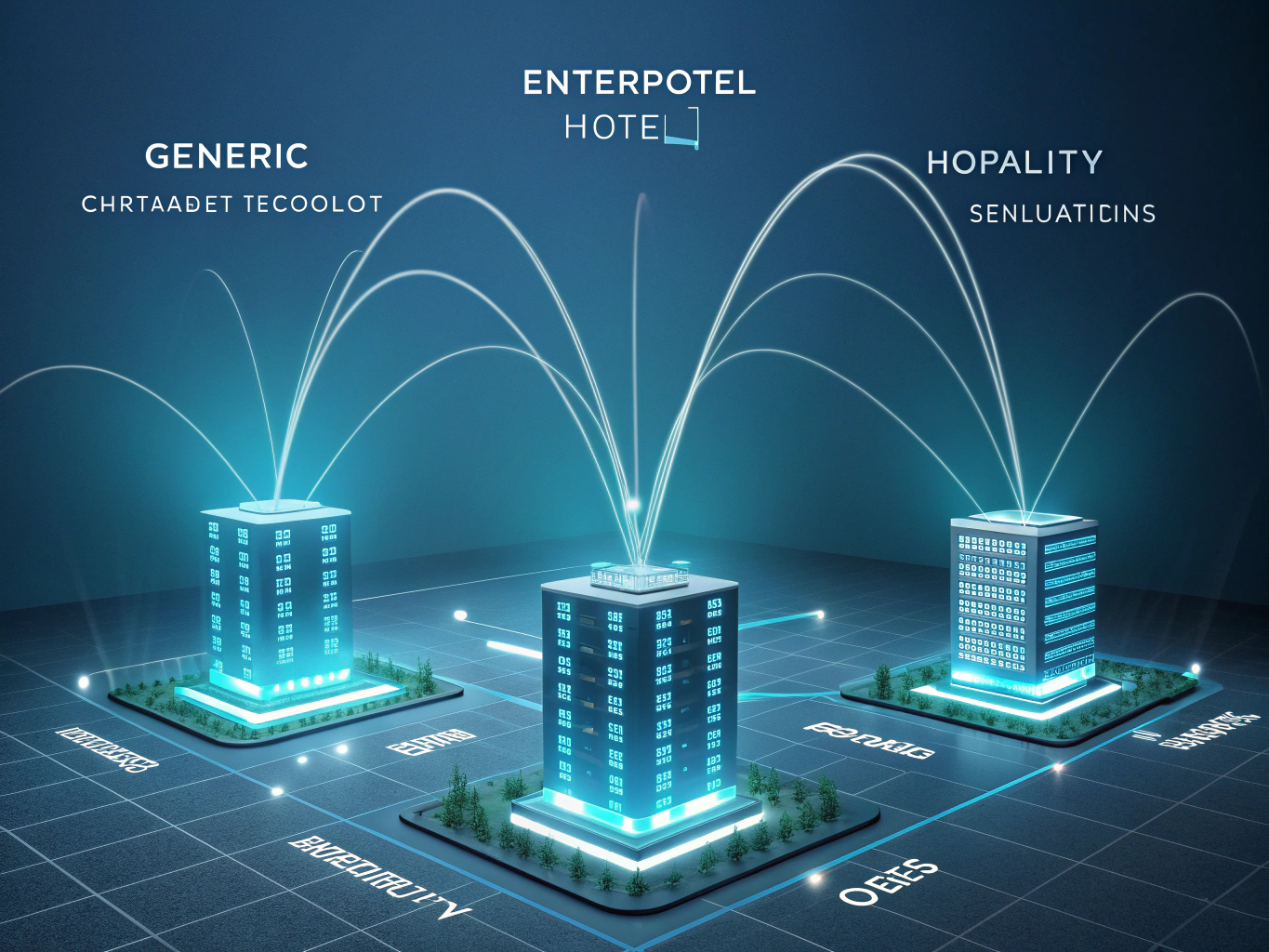
Selecting the right hotel chatbot requires evaluating platforms across hospitality-specific criteria rather than generic chatbot features. The market divides into three main categories: enterprise hotel technology providers, generic chatbot platforms adapted for hospitality, and specialized hospitality AI automation companies.
| Platform Type | Hospitality Integration | AI Sophistication | Implementation Speed | Industry Knowledge | Customization |
|---|---|---|---|---|---|
| Enterprise Hotel Tech | Deep PMS integration | Rule-based systems | 3-6 months | High | Limited |
| Generic AI Platforms | API connections | Advanced NLP | 1-3 months | Low | High |
| Hospitality AI Specialists | Purpose-built | Industry-trained AI | 2-4 weeks | Very High | Moderate |
Enterprise hotel technology providers offer deep system integration but often rely on outdated rule-based chatbot technology that requires extensive manual configuration for each guest scenario. Generic AI platforms provide sophisticated natural language processing but lack pre-trained knowledge of hospitality operations, requiring significant customization to understand industry-specific requests.
Specialized hospitality AI automation platforms like Vynta combine industry-specific training with advanced conversational AI, delivering faster implementation and higher accuracy for hotel-specific use cases. These platforms understand hospitality terminology, guest service workflows, and revenue optimization strategies without extensive configuration.
For more on the sustainability and future of AI in hospitality, explore this research on AI-driven hotel automation.
Implementation Blueprint: Rolling Out Hotel Chatbots for Rapid Impact
Successful hotel chatbot implementation follows a structured 90-day rollout that prioritizes quick wins while building toward comprehensive guest service automation. The first 30 days focus on foundational setup: defining your top 20 guest inquiry types, integrating with existing PMS and booking systems, and training staff on human handoff procedures.
Days 31-60 involve soft launch testing with controlled guest segments, typically starting with website visitors and expanding to direct messaging channels. This phase captures real guest interactions to refine responses and identify gaps in the chatbot’s knowledge base. Properties that skip this testing phase experience 40% higher guest escalation rates in the first quarter.
The final 30 days focus on full deployment across all channels and optimization based on performance data. Key success factors include setting clear escalation triggers (complex complaints, billing disputes, emergency situations), establishing response time benchmarks, and creating feedback loops between chatbot performance and staff training.
Budget 2-3 hours weekly for the first quarter to review chatbot conversations and optimize responses. Hotels that maintain this review schedule achieve 60% higher guest satisfaction scores with their automated service compared to those using set-and-forget approaches.
Overcoming Common Hotel Chatbot Challenges: Solutions for Real-World Obstacles
The most frequent hotel chatbot challenge is delivering personalized responses that reflect your property’s unique character and service standards. Generic chatbots often provide sterile, corporate-sounding answers that clash with boutique hospitality brands. The solution lies in comprehensive property-specific training data, importing your existing FAQ documents, service protocols, and local area knowledge to create responses that sound authentically from your team.
Language barriers present another significant obstacle, particularly for international destinations. While auto-translation handles basic communication, nuanced hospitality language requires more sophisticated approaches. Advanced hotel chatbot systems maintain phrase libraries for hospitality-specific terms in multiple languages, ensuring “concierge recommendations” don’t become “doorman suggestions” in translation.
PMS integration headaches typically stem from API compatibility issues and data synchronization delays. Before selecting any chatbot platform, verify real-time integration capabilities with your specific property management system version. Phased integration, starting with read-only access to availability and rates, then progressing to booking modifications, reduces implementation risk while maintaining operational continuity.
Escalation Protocol: Guest frustration peaks when chatbots can’t recognize their limits. Establish clear escalation triggers: billing disputes, emergency situations, complex complaints, or when guests explicitly request human assistance. Staff should receive full conversation context during handoffs to avoid repetition.
Measuring Hotel Chatbot Success: Critical KPIs and Continuous Improvement

Direct booking conversion rates provide the clearest measure of hotel chatbot ROI. Track the percentage of chatbot-initiated conversations that result in confirmed reservations, with industry benchmarks ranging from 12-18% for well-optimized systems. Properties achieving above 20% conversion typically excel at proactive upselling and seamless booking integration.
Response and resolution time metrics reveal operational efficiency gains. Measure average response time (target: under 30 seconds), conversation completion rate, and percentage of issues resolved without human intervention. Hotels report average resolution times dropping from 15 minutes via phone to 3 minutes through chatbot interactions.
| KPI Category | Primary Metric | Industry Benchmark | Optimization Target |
|---|---|---|---|
| Revenue Impact | Direct booking conversion | 12-18% | 20%+ |
| Operational Efficiency | Response time | Under 60 seconds | Under 30 seconds |
| Guest Satisfaction | CSAT score | 75-85% | 90%+ |
| Cost Reduction | Support volume decrease | 40-60% | 70%+ |
Guest satisfaction scores for automated hotel chatbot interactions should be tracked separately from overall property ratings. Successful implementations maintain CSAT scores above 85% for these automated interactions, with top-performing systems achieving 90%+ satisfaction through personalized responses and seamless handoffs to human agents when necessary.
Monthly optimization should focus on conversation analysis, identifying the most common unresolved queries and updating the chatbot’s knowledge base accordingly. Properties that conduct weekly conversation reviews see 25% faster improvement in resolution rates compared to quarterly review cycles.
Future-Proofing: The Next Evolution of Hotel Chatbots and Hospitality AI
Generative AI integration represents the next major advancement in hotel chatbot technology, enabling dynamic response creation rather than pre-scripted answers. This evolution allows chatbots to craft personalized recommendations based on guest history, local events, and real-time availability while maintaining your property’s brand voice and service standards.
Voice integration and IoT connectivity will transform in-room guest experiences, allowing visitors to control room features, request services, and access information through natural conversation with smart room systems. Forward-thinking properties are already piloting voice-enabled concierge services that integrate with existing chatbot platforms.
Predictive guest service capabilities will anticipate needs before guests express them, automatically suggesting dinner reservations based on arrival times, recommending spa treatments aligned with guest preferences, or proactively addressing potential issues identified through pattern recognition in guest behavior data.
To stay ahead, implement chatbot solutions with open API architecture that can integrate emerging technologies. Invest in staff training that emphasizes AI-human collaboration rather than replacement, and establish quarterly technology reviews to evaluate new capabilities that could enhance your guest experience strategy.
Conclusion: Transform Your Hotel’s Guest Experience and Profit Margins
Hotel chatbots deliver measurable business results when implemented strategically, from 20-35% increases in direct bookings to 50-70% reductions in routine inquiry volume. The key lies in selecting hospitality-specific solutions that understand your industry’s unique service requirements and revenue optimization opportunities.
The most successful implementations focus on augmenting human capabilities rather than replacing personal service, creating seamless experiences that blend automated efficiency with authentic hospitality. Properties that achieve the highest ROI treat their hotel chatbot as a strategic revenue tool, not just a cost-saving measure.
Ready to enhance your guest experience while optimizing operational efficiency? Start by mapping your current guest journey touchpoints and identifying the highest-volume inquiries that could benefit from instant, 24/7 automated responses. Contact Vynta for a hospitality-specific automation assessment tailored to your property’s unique needs and growth objectives.
Frequently Asked Questions
How do hotel chatbots balance providing instant digital service while maintaining the warmth of human hospitality?
Hotel chatbots deliver instant, personalized responses to guest inquiries 24/7, ensuring no request goes unanswered while freeing staff to focus on high-touch interactions. By handling routine tasks and providing multilingual support, chatbots preserve the human warmth by enabling staff to engage more meaningfully where it matters most.
What are the key features to look for in a 2025-ready hotel chatbot to maximize guest satisfaction and revenue?
A 2025-ready hotel chatbot should offer seamless integration with property management systems, multilingual capabilities, personalized guest interactions, and upselling automation. These features enable efficient reservation management, reduce no-shows, and increase revenue per guest through targeted offers and timely communication.
How do AI-powered hotel chatbots integrate with existing property management systems to streamline operations?
AI-powered hotel chatbots connect directly with property management systems to access real-time booking data, guest profiles, and availability. This integration automates reservation handling, updates guest requests instantly, and synchronizes communication across channels, reducing manual workload and minimizing errors.
What measurable benefits can hotels expect from implementing chatbots in terms of bookings, operational costs, and guest experience?
Hotels implementing chatbots typically see a 20-35% increase in direct bookings, a 20-40% reduction in operational costs through automation, and significant improvements in guest satisfaction scores. Additionally, chatbots reduce missed inquiries by up to 70%, enhancing overall guest engagement and loyalty.
About The Author
Anas Moujahid is the chief contributing writer & Operations Director for the Vynta Blog, where he turns cutting-edge AI automation into measurable business outcomes for mid-market companies.
Vynta designs enterprise-grade AI agents that augment rather than replace people, freeing teams to focus on higher-value work while the bots handle the busywork.
We specialise in four service-heavy verticals where AI can move the revenue needle fast: real estate, recruitment, fundraising and hospitality.
Anas started his career architecting AI and automation systems; today he leads operations at Vynta, making sure every deployment lands real-world ROI, whether that’s more booked viewings for estate agents, faster placements for recruiters, warmer investor pipelines for fundraisers or happier guests for hotels and restaurants.
Vynta delivers results by:
- Building industry-specific agents pre-trained on real-world workflows, no generic chatbots here.
- Integrating seamlessly with existing CRMs, ATSs, PMSs and fundraising platforms, zero rip-and-replace.
- Measuring success in business KPIs (lead-to-close rates, time-to-hire, donor retention, RevPAR) not vanity metrics.
- Providing transparent implementation plans so clients know exactly what to expect, when and why.
- Pairing every AI agent with human-in-the-loop controls to keep quality, compliance and brand voice on point.
Since launch, Vynta has helped agencies slash lead qualification time by up to 70 %, recruitment firms cut screening hours in half, fundraising teams triple investor touchpoints and hospitality brands lift guest satisfaction scores by double digits, all while keeping human expertise firmly in the loop.
Anas writes with the same ethos that drives Vynta: outcome-focused, jargon-free and grounded in real business value. Expect data-backed insights, practical implementation guides and a clear-eyed view of what AI can, and can’t, do for your organisation.