

gpt oos
What GPT OSS Means for Business Automation
GPT OSS refers to OpenAI’s open-weight model releases, specifically gpt-oss-20b and gpt-oss-120b, which businesses can deploy locally, fine-tune on proprietary data, and run without per-token API costs. For mid-market SMEs in real estate, recruitment, fundraising, and hospitality, this shift makes affordable, private AI automation genuinely accessible–not just theoretically possible.
OpenAI’s Shift to Open-Weight Models: gpt-oss-120b and gpt-oss-20b Explained
OpenAI released gpt-oss-120b and gpt-oss-20b under the Apache 2.0 license, making commercial deployment straightforward. Both models use a Mixture-of-Experts (MoE) architecture, activating only relevant parameter subsets per inference. That design is what makes gpt-oss-20b viable on mid-range hardware, while gpt-oss-120b targets near-frontier reasoning for complex workflows. Available via gpt-oss ollama, gpt-oss huggingface, and gpt-oss vllm, the deployment options fit teams without dedicated ML infrastructure.
The gpt-oss github repository provides fine-tuning scripts and quantized weights for gpt-oss download, removing barriers that previously required enterprise contracts. Teams can access a gpt-oss playground environment to test domain-specific prompts before committing to full deployment.
Key Advantages: Local Deployment, Fine-Tuning, and Cost Savings
| Factor | gpt-oss-20b | gpt-oss-120b |
|---|---|---|
| Hardware Requirement | Single A100 or equivalent | Multi-GPU cluster recommended |
| Best Use Case | High-volume screening, chat automation | Complex reasoning, investor analysis |
| Deployment Path | gpt-oss ollama, local inference | gpt-oss vllm, distributed serving |
| Fine-Tuning Complexity | Low, accessible to SME teams | Moderate, benefits from ML support |
| Data Privacy | Full on-premises control | Full on-premises control |
| API Cost | Zero per-token fees | Zero per-token fees |
Local deployment keeps your data inside your environment. That’s non-negotiable in regulated verticals: a recruitment firm handling candidate PII or a fundraising organization managing investor records can’t accept unnecessary cloud API exposure. Fine-tuning on your CRM records, guest history, or donor profiles consistently outperforms generic API calls on domain-specific tasks–and a one-time infrastructure cost can replace ongoing subscription fees within months.
How GPT OSS Powers AI Agents in Real Estate and Recruitment
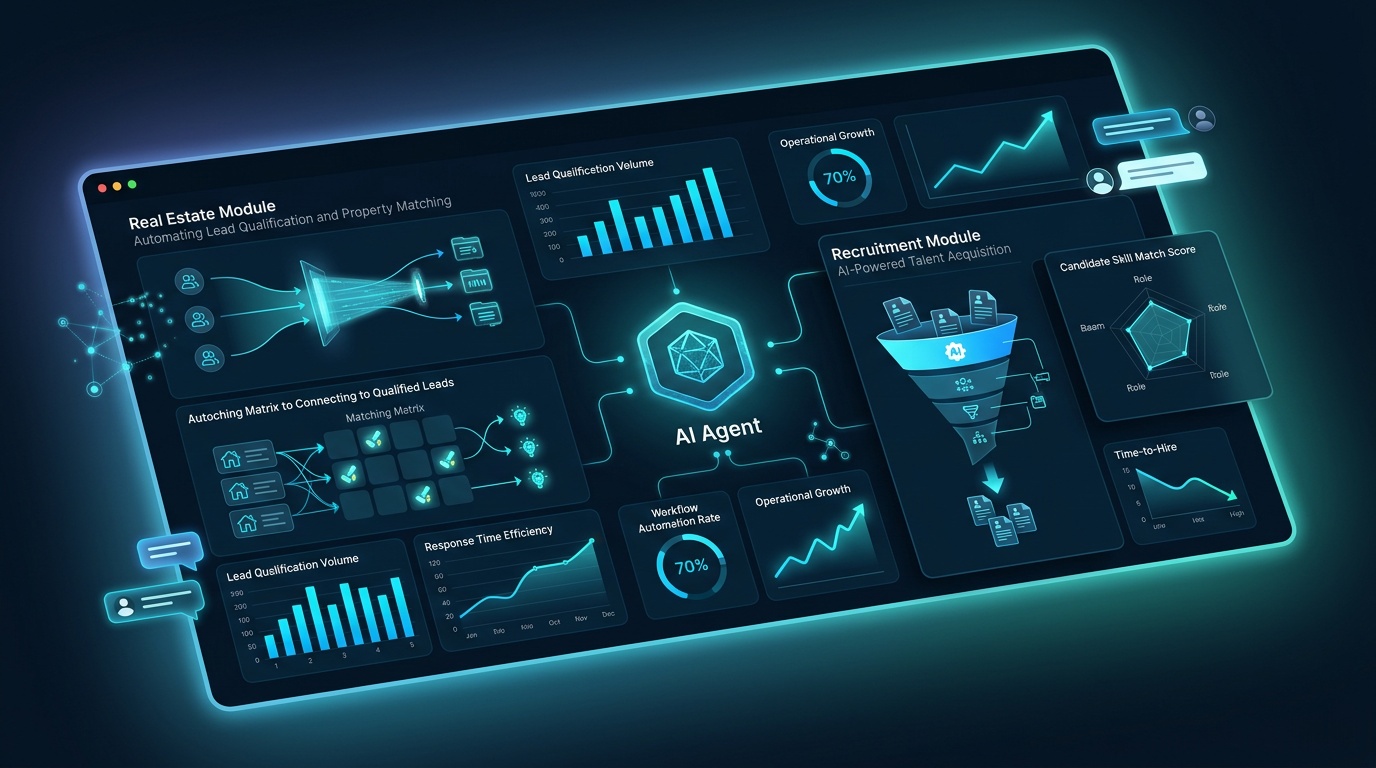
Real Estate: Automating Lead Qualification and Property Matching
Real estate agencies lose revenue not from a lack of leads but from slow qualification. A model fine-tuned on your CRM history, listing data, and past client profiles scores inbound leads within seconds–flagging buyers ready to transact versus those needing longer-term nurturing. It reads behavioral signals from inquiry forms, response patterns, and budget ranges, then routes high-intent prospects directly to agents while automating follow-up sequences for earlier-stage contacts.
Property matching improves meaningfully when gpt-oss-20b processes natural-language preferences from initial conversations and maps them against live inventory. Agents spend their time on negotiation and relationship-building, not manual filtering. That’s the right division of labor.
Recruitment: Streamlining Candidate Screening and ATS Integration
Recruitment firms process hundreds of applications per role. gpt-oss-20b integrates with existing ATS platforms via API, reading CVs, cover letters, and LinkedIn profiles against role-specific criteria your team defines. It produces ranked shortlists with structured reasoning–giving consultants a clear basis for each recommendation rather than a black-box score.
Fine-tuning on historical placement data trains the model to recognize candidate attributes that predict long-term success in your client sectors. The institutional knowledge previously concentrated in senior consultants’ judgment becomes scalable across the whole team. That’s a meaningful shift for any firm trying to grow without proportional headcount increases.
Measured Results: Faster Lead Conversion and Reduced Time-to-Hire
GPT OSS Deployment Advantages
- Lead qualification runs 24/7 without agent availability constraints
- Candidate shortlists generated in minutes, not days
- Fine-tuning on proprietary data produces domain-specific accuracy gains
- Zero per-token costs support high-volume processing at fixed infrastructure expense
- On-premises deployment keeps candidate PII and client data protected
Implementation Considerations
- Initial fine-tuning requires clean, labeled historical data
- ATS integration needs technical configuration during onboarding
- gpt-oss-120b demands multi-GPU infrastructure for complex reasoning tasks
- Model outputs require human review protocols to maintain quality standards
Teams deploying GPT OSS for lead qualification and candidate screening report faster lead-to-appointment conversion and meaningful reductions in time-to-hire. These gains come from eliminating manual triage, not from reducing headcount. Agents and consultants redirect hours toward high-value client interactions where human judgment drives outcomes.
See how Vynta AI’s Agentic Systems for Real Estate can integrate GPT OSS into your existing workflows.
Recruitment firms can apply the same logic through Vynta AI’s Agentic Systems for Recruitment, scaling candidate screening without sacrificing placement quality.
GPT OSS Applications in Fundraising and Hospitality Operations
Fundraising: Investor Outreach and Donor Retention Automation
Fundraising organizations manage relationships at scale, where personalization directly correlates with donor retention. gpt-oss-120b, fine-tuned on donor communication history and giving patterns, generates outreach sequences tailored to each donor’s interests, previous gift size, and engagement timeline. The model identifies lapsed donors showing reactivation signals and triggers personalized re-engagement before the relationship deteriorates past recovery.
For investor outreach, it processes due diligence materials, financial summaries, and investor preference profiles to produce targeted pitch narratives. Staff focus on relationship management while GPT OSS handles research synthesis and communication drafting that previously consumed hours per prospect.
Hospitality: Guest Personalization and Upsell Revenue Optimization
Boutique hotels and upscale restaurants generate significant data per guest: booking history, dietary preferences, past service requests, and spending patterns. gpt-oss-20b processes this data to generate personalized pre-arrival communications, targeted upsell offers, and service recommendations that feel attentive rather than automated. All upsell content operates within brand-approved parameters–no unapproved messaging reaches guests.
Reservation management improves when the model identifies no-show risk patterns and triggers confirmation sequences calibrated to each guest segment. Upsell timing, offer selection, and channel choice adapt to individual guest profiles, protecting the personal touch that defines hospitality excellence.
Indicative Metrics: Donor Retention and Revenue Per Guest
| Vertical | Primary Automation | Indicative Outcome | Model Recommended |
|---|---|---|---|
| Fundraising | Donor segmentation and outreach sequencing | Meaningful donor retention improvement | gpt-oss-120b |
| Hospitality | Guest personalization and upsell targeting | Revenue per guest increase through targeted upselling | gpt-oss-20b |
| Fundraising | Investor pitch research synthesis | Significant reduction in preparation time per pitch | gpt-oss-120b |
| Hospitality | No-show risk detection and confirmation | Reduction in reservation abandonment | gpt-oss-20b |
Across both verticals, GPT OSS delivers measurable financial outcomes because the models operate on proprietary relationship data rather than generic training. Competitive advantage belongs to the organization with better data and a deployment partner who understands the vertical–not simply the one with access to the largest model.
See Vynta AI’s vertical-specific solutions, including our AI-Powered Fundraising Platform and Vynta AI Agents for Hospitality, to understand what these outcomes look like in practice.
Implementation Guide: Deploying GPT OSS for Enterprise AI Agents
Hardware Needs and Fine-Tuning Steps for Mid-Market Teams
gpt-oss-20b runs on a single A100 GPU, making it accessible to mid-market teams without data center infrastructure. Start with gpt-oss ollama for local inference testing, then move to gpt-oss vllm for production serving when throughput demands increase. Fine-tuning requires clean, labeled data from your CRM, ATS, or property management system–a dataset of 5,000 to 10,000 domain-specific examples typically produces meaningful accuracy gains over the base model. The gpt-oss github repository provides LoRA fine-tuning scripts that cut compute requirements substantially, and the gpt-oss playground lets you validate prompts before committing to infrastructure spending.
Overcoming Adoption Barriers: Data Security and Integration Concerns
The most common objection from SME leaders centers on data security. On-premises deployment through gpt-oss huggingface or local inference keeps guest records, donor profiles, and candidate PII inside your environment entirely. Integration with existing systems follows standard API patterns–most CRM and ATS platforms expose REST endpoints that agents consume directly, requiring configuration rather than custom development. Hospitality property management systems and fundraising CRMs typically integrate within two to four weeks during a structured onboarding process covering discovery, strategy, and implementation.
The barrier to GPT OSS deployment is rarely technical. It’s organizational: clean data, defined workflows, and clear success metrics established before implementation begins. Teams that define qualification criteria, donor segments, or guest service rules upfront consistently reduce deployment timelines.
Vynta AI Partnership: From Setup to Scaled Operations
As Operations Director at Vynta AI, I see the same pattern across mid-market teams: results come from tying model behavior to revenue workflows, not from experimenting in isolation. Vynta AI manages the full deployment path across all four verticals–infrastructure selection, fine-tuning on proprietary data, integration with existing systems, and ongoing model monitoring.
This partnership model exists because most SME leaders shouldn’t spend time becoming ML engineers. Your competitive advantage comes from better client relationships, faster placements, stronger donor retention, and higher guest revenue–not from managing GPU clusters. We define ROI projections during discovery so you enter deployment with measurable targets from day one.
Find out how our AI Automation Services handle the complexity so your team can focus on growth.
Business Outcomes and Next Steps with GPT OSS Automation

ROI Projections: Cost Reductions and Revenue Growth Across Verticals
Infrastructure costs for GPT OSS deployment typically recover within three to six months when replacing per-token API fees at production volume. The revenue impact is vertical-specific: real estate agencies convert leads faster, recruitment firms shorten time-to-hire and reduce cost per placement, fundraising organizations grow donor lifetime value through systematic retention, and hospitality operators increase revenue per guest through targeted upselling. We scope those projections during discovery based on your current data volume, workflow complexity, and business objectives–so you know what to expect before signing anything.
Limitations and When to Choose Vynta AI Over DIY Approaches
Self-managed deployment suits teams with in-house ML capability and clean historical data. For most mid-market SMEs, the DIY path stalls during data preparation and integration, consuming months without production results. Vynta AI’s vertical-specific expertise compresses that timeline and keeps optimization tied to business outcomes, not generic benchmarks.
Get Started: Scaling Without Headcount Expansion
The strategic value of GPT OSS is capacity expansion without proportional hiring. Agents, consultants, fundraisers, and hospitality staff handle more relationships at higher quality because AI manages triage, research, and routine communication. Contact Vynta AI to assess your vertical-specific deployment path and define the metrics that measure return from day one.
Frequently Asked Questions
What is GPT OSS?
GPT OSS refers to OpenAI’s open-weight model releases, specifically gpt-oss-20b and gpt-oss-120b. These models allow businesses, particularly mid-market SMEs, to deploy AI locally, fine-tune it with their own data, and operate without per-token API costs. This makes private, affordable AI automation more accessible for sectors like real estate and recruitment.
Is GPT OSS a good solution for businesses?
Absolutely. GPT OSS offers significant advantages for businesses, including full data privacy through local deployment and zero per-token API costs. By fine-tuning on proprietary data, it delivers domain-specific accuracy, leading to measurable outcomes like faster lead conversion and reduced time-to-hire for our clients. It transforms operational efficiency for mid-market SMEs.
What hardware do I need to run GPT OSS?
The hardware requirements for GPT OSS depend on the model you choose. For gpt-oss-20b, a single A100 GPU or equivalent is sufficient for efficient operation. The more powerful gpt-oss-120b, designed for complex reasoning, typically requires a multi-GPU cluster for optimal performance. This allows businesses to scale their AI capabilities according to their needs.
Is GPT OSS available on Ollama?
Yes, GPT OSS models are available via Ollama, making deployment straightforward even for teams without dedicated machine learning infrastructure. You can also access them through gpt-oss Hugging Face and gpt-oss vLLM. These options simplify the process of bringing powerful AI automation in-house.
Is GPT OSS safe for business data?
GPT OSS prioritizes data privacy and security, which is critical for businesses handling sensitive information. Its local deployment capability means your proprietary data never leaves your environment, providing full on-premises control. This is a key advantage for regulated sectors like recruitment and fundraising, ensuring compliance and protecting client data.