
generative ai in business
Generative AI in Business: Beyond the Hype, Toward Real ROI
Generative AI in business transforms how mid-market companies operate by automating complex tasks, generating content, and supporting data-driven decisions. Unlike traditional AI that follows preprogrammed rules, generative AI creates new outputs, personalizes customer interactions, and adapts to changing business needs across sales, marketing, and operations.
What Is Generative AI, Really? (And How It Differs From Traditional AI)
Generative AI creates new content, solutions, and responses rather than simply analyzing existing data. Traditional AI systems follow predetermined pathways and deliver predictable outputs. Generative AI in business applications can write personalized emails, generate property descriptions, create recruitment assessments, and develop fundraising proposals tailored to specific prospects.
This technology uses large language models trained on vast datasets to understand context, intent, and nuance. When integrated into business workflows, it becomes a creative partner that produces human-quality outputs at machine speed and scale.
The Core Value Proposition for Mid-Market SMEs: Scaling Revenue, Reducing Costs
Mid-market companies face a unique challenge: they need enterprise-level capabilities without enterprise budgets or technical teams. Generative AI bridges this gap by automating time-intensive processes that typically require specialized staff.
ROI Reality Check: Companies implementing generative AI automation often see a 40%-60% reduction in manual processing time and a 25%-35% improvement in lead conversion rates within the first quarter of deployment.
Real estate agencies can qualify hundreds of leads simultaneously. Recruitment firms can screen candidates around the clock. Fundraising organizations can personalize donor outreach at scale. Hospitality businesses can manage guest communications across multiple properties without breaking a sweat.
Why This Changes Everything for Your Operations
The transformation happens at the operational level, where repetitive, knowledge-based tasks consume your team’s most productive hours. Generative AI doesn’t replace human judgment; it amplifies human capability by handling routine communications, data analysis, and content creation.
Your team shifts from executing tasks to managing outcomes. Instead of writing individual follow-up emails, team members design communication strategies. Rather than manually screening applications, they focus on relationship building and strategic decision-making. This operational shift creates competitive advantages that compound over time.
AI Agents: Your Engine for Automated Business Growth
Understanding AI Agents: More Than a Chatbot
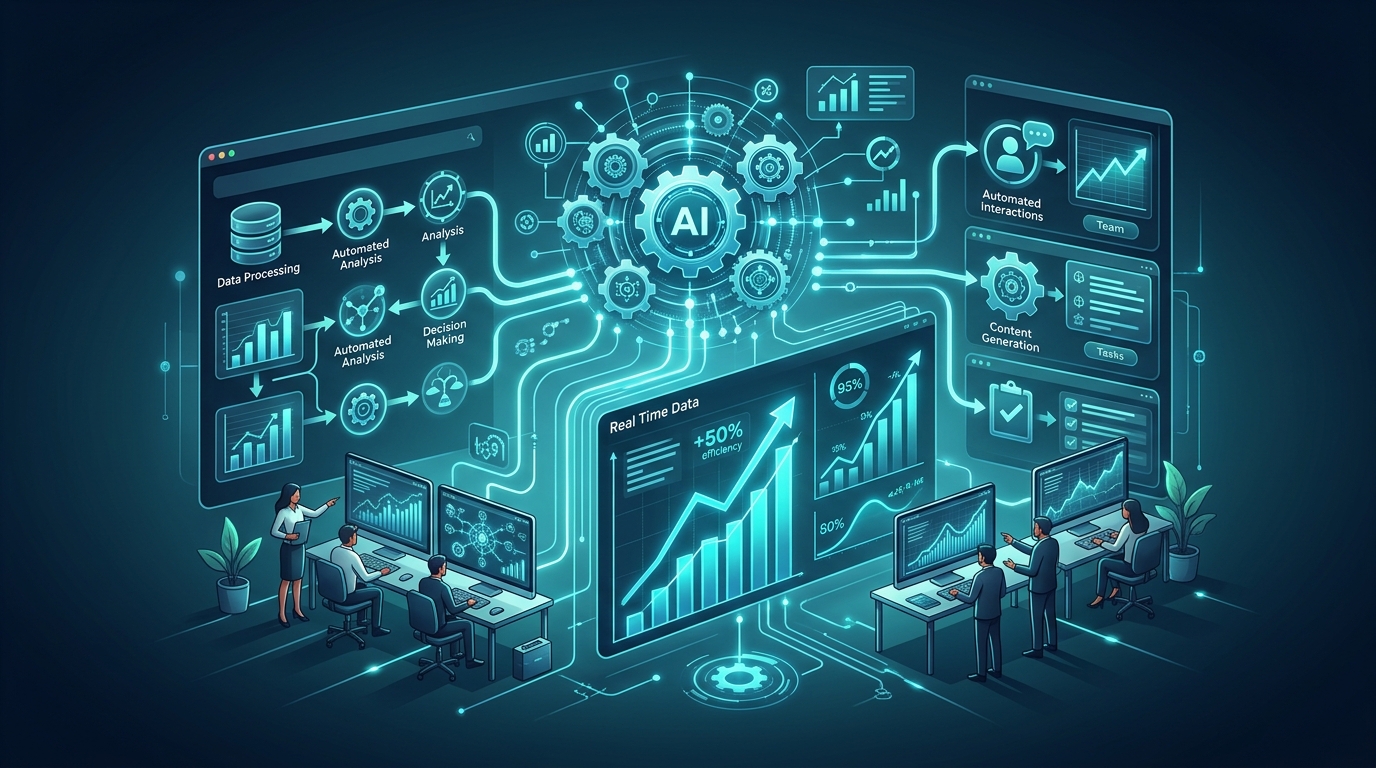
AI agents represent the next evolution beyond simple chatbots and rule-based automation. While chatbots respond to specific prompts, AI agents operate autonomously to achieve business objectives. They analyze incoming data, make contextual decisions, and execute multi-step workflows with human oversight where needed.
Think of it this way: a chatbot answers questions. An AI agent solves problems.
These intelligent systems understand business context, maintain conversation continuity across multiple touchpoints, and adapt their approach based on prospect behavior and engagement patterns. An AI agent can nurture a real estate lead through initial inquiry, property matching, scheduling, and follow-up communications while learning from each interaction to optimize future engagements.
How AI Agents Interpret Objectives and Execute Tasks
AI agents translate high-level business goals into executable action sequences. When tasked with lead qualification, they don’t just collect information. They analyze responses, score prospects based on predefined criteria, route qualified leads to appropriate team members, and schedule follow-up activities automatically.
The execution capability distinguishes AI agents from traditional automation tools. They handle exceptions, adapt communication styles to individual preferences, and escalate complex situations to human team members when necessary. This decision-making capability supports smoother customer experiences while maintaining operational efficiency.
The Vynta AI Approach: Enterprise-Grade Agents for Sales, Marketing, and Operations
Vynta AI delivers industry-specific agents designed for real-world business environments. Our agents integrate directly with existing CRM systems, communication platforms, and operational workflows without requiring extensive technical implementation or staff retraining.
Implementation Reality: Vynta AI agents typically deploy within 2-3 weeks and begin delivering measurable results within 30 days, requiring minimal technical expertise from your internal team.
Each agent specializes in specific business functions: sales prospecting, marketing campaign management, customer service automation, and operational task coordination. They operate continuously, processing inquiries, qualifying opportunities, and executing follow-up sequences while your team focuses on strategic activities and relationship building.
Generative AI in Action: Industry-Specific Breakthroughs
Real Estate: Intelligent Lead Qualification and Property Matching
Real estate agencies deploy AI agents to convert initial inquiries into qualified prospects through structured conversation flows. These agents analyze buyer preferences, budget constraints, and timeline requirements while simultaneously matching properties from inventory databases. The system identifies serious buyers quickly, schedules viewings automatically, and maintains engagement through personalized property recommendations.
Property descriptions generate dynamically based on listing details, neighborhood data, and target buyer demographics. AI agents create marketing copy that highlights features most relevant to specific prospect segments, increasing click-through rates and viewing appointments by 45%-60%.
Recruitment: Streamlining Candidate Screening for Quality Hires
Recruitment firms use AI agents to conduct initial candidate assessments, skill evaluations, and culture-fit screenings. The technology analyzes resumes, conducts structured interviews through conversational interfaces, and scores candidates against role-specific criteria. This screening process reduces time-to-hire while improving match quality between candidates and positions.
What’s more, AI agents can maintain candidate relationships throughout lengthy hiring processes, providing status updates, gathering additional information, and creating positive candidate experiences that protect agency reputation and client relationships.
Fundraising: Optimizing Investor Outreach and Donor Engagement
Fundraising organizations implement AI agents to research potential donors, craft personalized outreach messages, and manage ongoing relationship development. The system analyzes giving patterns, interest areas, and communication preferences to create targeted engagement strategies that connect with individual donor motivations.
Fundraising Impact: Organizations using AI-powered donor engagement often see 35% higher response rates and a 28% increase in average donation amounts compared with traditional mass outreach approaches.
Grant application processes benefit from AI assistance in research, proposal writing, and compliance verification. AI agents identify relevant funding opportunities, generate initial proposal drafts, and help confirm applications meet specific funder requirements and deadlines.
Hospitality: Improving Guest Experience and Operational Efficiency
Hospitality businesses deploy AI agents for reservation management, guest communication, and service coordination across multiple properties. These systems handle booking inquiries, process special requests, coordinate housekeeping schedules, and manage guest services from check-in through departure.
Revenue optimization includes dynamic pricing recommendations, upselling opportunities, and occupancy management. AI agents analyze booking patterns, local events, and competitor pricing to suggest rates that maximize both occupancy and revenue per available room.
Navigating Generative AI Adoption: Practical Steps and Overcoming Hurdles
Addressing Common Concerns: What Businesses Need to Know Before Implementing
Data security and privacy protection represent primary concerns for businesses considering AI implementation. Enterprise-grade solutions maintain strict data encryption, access controls, and compliance with industry regulations. Information processed by AI agents remains within secure environments and doesn’t train external models or get shared across clients.
Cost considerations often create hesitation among mid-market companies. Many AI solutions operate on subscription models that scale with business growth, reducing large upfront investments while providing predictable monthly expenses aligned with operational budgets.
The Human-AI Collaboration Advantage: Augmenting Your Team, Not Replacing It
Successful AI implementation focuses on human-machine collaboration: technology handles routine tasks while people manage strategy, relationships, and complex decision-making. Team members transition from executing repetitive processes to overseeing AI operations and focusing on high-value activities that require creativity and emotional intelligence.
Training requirements remain minimal because modern AI agents operate through intuitive interfaces that require no technical expertise. Staff members learn to manage AI workflows, review outputs, and make strategic adjustments without programming knowledge or extensive technical training.
Measuring Success: Key Performance Indicators for Generative AI Initiatives
Response time metrics show immediate operational improvements, with AI agents typically reducing initial response times from hours to minutes. Lead qualification rates, conversion percentages, and customer satisfaction scores provide measurable indicators of business impact within 30-60 days of implementation.
| Metric Category | Traditional Process | AI-Automated Process | Typical Improvement |
|---|---|---|---|
| Response Time | 2-24 hours | Under 5 minutes | 95% reduction |
| Lead Processing | 50-100 per week | 500+ per week | 5-10x increase |
| Conversion Rate | 2%-5% | 8%-15% | 3-4x improvement |
| Operational Costs | Baseline | 40%-60% reduction | Significant savings |
Your Strategic Partner in AI Automation: The Vynta AI Difference
Vynta AI provides industry-specific solutions designed for practical implementation and measurable results. Our agents integrate with existing business systems while requiring minimal technical resources or operational disruption. We don’t just deliver technology. We deliver business transformation that supports sustainable growth in your specific industry vertical.
Frequently Asked Questions
How is generative AI being used in business?
Generative AI is transforming mid-market companies by automating time-intensive processes and creating new content at scale. It helps businesses personalize customer interactions, generate tailored marketing materials, and streamline operational workflows. For example, it can write personalized emails for sales or create dynamic property descriptions for real estate.
What is the 30% rule for AI?
The article does not mention a specific “30% rule” for AI. However, companies implementing generative AI automation often see significant ROI, such as a 40%-60% reduction in manual processing time. We also observe a 25%-35% improvement in lead conversion rates within the first quarter of deployment.
Which jobs will survive AI?
Generative AI is designed to strengthen human capability, not replace jobs entirely. It automates repetitive, knowledge-based tasks, allowing teams to shift their focus from execution to strategic outcomes. Roles requiring human judgment, relationship building, and strategic decision-making become even more important.
Is ChatGPT an LLM or generative AI?
ChatGPT is an example of generative AI that uses a Large Language Model, or LLM, as its underlying technology. Generative AI is the broader category of AI that creates new content, solutions, or responses. LLMs are the specific type of AI model trained on massive text datasets that enable this generative capability.
How do AI agents differ from traditional chatbots?
AI agents are a step beyond traditional chatbots, which typically follow rule-based scripts. Our Vynta AI agents operate autonomously, analyzing data, making contextual decisions, and executing multi-step workflows to achieve business objectives. They understand business context and adapt their approach based on prospect behavior, providing a more dynamic and effective automation solution.
What kind of results can mid-market companies expect from generative AI?
Mid-market companies can expect significant operational improvements and cost reductions with generative AI. Our clients often see a 40%-60% reduction in manual processing time and a 25%-35% improvement in lead conversion rates. This allows them to scale capabilities without needing enterprise-level budgets or large technical teams.
How quickly can Vynta AI agents be implemented and deliver results?
Vynta AI agents are designed for rapid deployment and measurable impact. Our agents typically deploy within 2-3 weeks and start delivering measurable results within 30 days. They integrate directly with existing systems like CRMs, requiring minimal technical expertise from your internal team to get started.