

Compare features of leading recruitment automation platforms
Recruitment teams need more than a feature list. They need to know which platform can reduce screening time, improve candidate follow-up, and fit the systems their consultants already use. A sound comparison separates recruitment automation from an applicant tracking system (ATS) and a candidate relationship management system (CRM), then measures each option against delivery capacity and cost.
Key Takeaways
- Effective recruitment platforms must demonstrate the ability to significantly reduce screening time while improving candidate follow-up processes.
- Distinguishing between automation tools, applicant tracking systems, and candidate relationship management systems is essential for accurate evaluation.
- Decision makers should assess each option based on its delivery capacity and total cost rather than relying solely on feature lists.
- The best solutions integrate smoothly with existing systems to support the daily workflows of recruitment consultants.
At Vynta AI, we assess these tools by their effect on application processing, candidate matching, interview coordination, data quality, recruiter capacity, and integration effort. That approach suits mid-market agencies handling high applicant volumes without adding administrative headcount.
Recruitment Automation vs. ATS vs. CRM: What You’re Actually Comparing
Recruitment automation, defined in plain business terms
An automation platform may collect applications from job boards, parse CVs, compare qualifications with a role profile, identify suitable candidates, send messages, and coordinate interviews. Recruiter judgment still matters. A hiring manager may need context about motivation, availability, salary expectations, references, or cultural fit before a candidate is submitted.
How automation platforms work alongside your existing ATS and CRM
Effective deployment starts with integration, not replacement. The ATS remains the system of record for vacancies, candidate profiles, stages, notes, and compliance history. The CRM supports relationship management, business development, and dormant database activity. Automation reads approved data, runs defined workflows, and writes relevant updates back into those systems.
Agentic Systems for Recruitment follows this operating model. The system automates CV processing by collecting and processing applications from multiple job boards, including CV Library, Indeed, Reed, TotalJobs, and LinkedIn. Consultants get a shared workflow while the ATS record and human review points remain intact.
Which tool solves which problem, and when a mid-market team needs more than one
| System | Primary job | Typical recruiting activity |
|---|---|---|
| ATS | Process control and recordkeeping | Requisitions, stages, applications, compliance records |
| CRM | Relationship development | Candidate pools, client contacts, outreach history |
| Automation platform | Task execution across workflows | Screening, matching, messages, scheduling, data movement |
A small agency may start with an ATS and targeted automation for application screening or interview booking. A growing firm often needs all three because delivery, relationship management, and workflow execution use different data. The practical test is simple: how well do the systems cooperate, how much manual cleanup remains, and how many hours does the team save per role?
Feature Comparison: What the Leading Recruitment Automation Platforms Offer
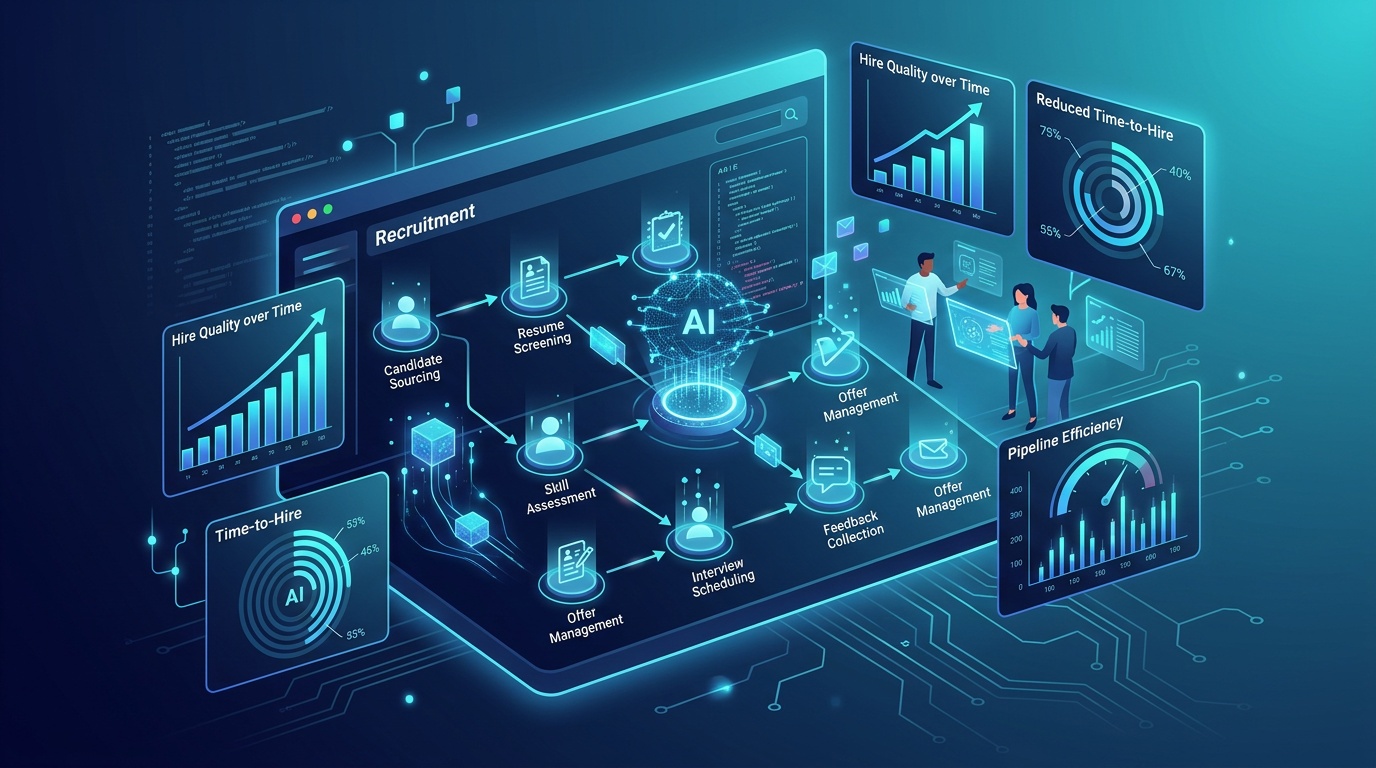
Leading platforms serve different operating models. Gem focuses on sourcing and talent engagement, Greenhouse on structured hiring workflows, SmartRecruiters on enterprise talent acquisition, Manatal on accessible recruiting management, and Beamery on talent intelligence and workforce planning. The best choice depends on your agency’s workflow, applicant volume, existing systems, and governance needs. Not the length of a feature page.
For another perspective, review this recruitment platform comparison guide alongside vendor demonstrations.
Side-by-side comparison: Gem, Greenhouse, SmartRecruiters, Manatal, and Beamery
| Platform | Key features | Pricing approach | Best-fit use case | Integrations | AI transparency |
|---|---|---|---|---|---|
| Gem | Sourcing, talent CRM, campaigns, analytics | Typically sales-led and plan-based | Proactive talent engagement | ATS, email, calendars, sourcing channels | Review workflow and campaign data should be confirmed during evaluation |
| Greenhouse | Structured hiring, interview kits, reporting | Quote-based subscription | Process governance and structured selection | HRIS, assessment, scheduling, job distribution tools | Strong process visibility; AI functions require feature-level review |
| SmartRecruiters | Recruiting marketing, job distribution, hiring workflows | Enterprise subscription | Organizations with complex hiring operations | HRIS, job boards, assessments, calendars | Request documentation for automated recommendations |
| Manatal | Candidate management, parsing, search, pipelines | Tiered subscription | Small and mid-sized recruiting teams | Job boards, email, calendars, API options | Ask how matching logic, data retention, and review controls work |
| Beamery | Talent intelligence, skills data, workforce planning | Enterprise, quote-based | Strategic talent pools and internal mobility | HRIS, ATS, workforce systems, communication tools | Requires detailed governance and model documentation |
Pricing is shown by commercial model rather than invented dollar amounts. Vendor quotes vary by seats, modules, employee count, implementation, and contract term. Request the full cost for configuration, integrations, support, data migration, and additional users. These items can change the business case more than the advertised subscription tier.
AI candidate screening and matching capabilities, compared
Screening quality depends on parsing accuracy, configurable criteria, ranking logic, duplicate detection, and the recruiter’s ability to inspect why a candidate was recommended. Gem suits outbound sourcing and engagement. Greenhouse and SmartRecruiters place more emphasis on controlled hiring workflows. Manatal offers candidate search and matching for smaller teams. Beamery focuses on skills intelligence across broader talent data.
For agencies processing large applicant volumes, Agentic Systems for Recruitment adds workflow automation around the existing ATS. Vynta reports that the system processes over 100,000 CVs per day, screens candidates in under 10 seconds, and achieves 85% candidate-matching accuracy. These functions should support human review, with clear rules for qualification, exclusion, consent, and escalation.
Interview scheduling and candidate communication automation
A scheduling workflow should check availability, send calendar invitations, confirm appointments, issue reminders, handle rescheduling, and share preparation information. Communication records should preserve message history and opt-out preferences. Recruiters also need a clear handoff when a conversation becomes sensitive or requires judgment.
Integration capabilities: ATS, HRIS, calendars, and job boards
Integration quality determines whether a platform removes work or shifts it into spreadsheets and manual exports. Check support for the current ATS, HRIS, email provider, calendar, job boards, assessment tools, webhooks, API access, field mapping, permissions, audit logs, and error handling.
For an agency, the strongest combination preserves candidate data, reduces repetitive work, and gives consultants reliable control. Test one real vacancy, one existing database segment, and one scheduling workflow before making a wider commitment.
Pricing and Fit: Matching Platforms to Team Size and Hiring Volume
The right comparison includes total cost of ownership, not just the subscription price. Count recruiter seats, job-board access, implementation, data migration, API connections, support, training, and paid AI functions. A low entry price may not remain low after these costs are added.
Pricing models explained: per seat, per hire, and subscription tiers
Per-seat pricing suits teams that want predictable access for a defined number of recruiters. Per-hire pricing links spending to placements, although costs may rise during strong hiring periods. Subscription tiers commonly set limits around users, active vacancies, candidate records, automation runs, or integrations.
Best platforms for high-volume hiring
For roles attracting high applicant volumes, speed must be tested alongside ranking quality and auditability. Review duplicate detection, knockout questions, qualification rules, bulk communication, consent records, and recruiter escalation. Agentic Systems for Recruitment processes CVs from major job boards and supports review within the existing ATS.
Step-by-step: how to evaluate a platform
- Initial stage: Define baseline measures, including screening hours, response time, time-to-interview, and time-to-hire.
- Integration stage: Connect a test ATS, calendar, mailbox, and one job board using representative data.
- Workflow stage: Run one live-style vacancy through intake, parsing, matching, messaging, and scheduling.
- Review stage: Review exceptions, false matches, missing fields, duplicate records, and recruiter intervention points.
- Decision stage: Calculate hours saved, implementation effort, monthly cost, and projected payback using your own hiring volume.
Choose the system that increases measurable delivery capacity, not the one with the longest feature page. A credible trial should show fewer manual touches per applicant and clear visibility into every decision.
AI Transparency and Compliance: An Often-Overlooked Comparison Factor
AI screening affects people’s access to employment, so speed is not enough. Recruiters should see which qualifications, experience signals, or role requirements influenced a recommendation. That explanation supports human review and can reveal unsuitable exclusions before they affect a candidate.
GDPR and data privacy checklist for uploading CVs to AI tools
- Confirm the lawful basis for processing candidate information and document the purpose.
- Identify where CVs, messages, embeddings, and evaluation outputs are stored.
- Ask whether vendor systems retain data for model training or secondary use.
- Review data-processing agreements, subprocessors, international transfers, and deletion controls.
- Set retention periods for unsuccessful applicants and define access permissions.
- Require encryption, authentication, audit logs, breach notification procedures, and export capability.
AI can prioritize applications and detect patterns, but it cannot reliably judge motivation, communication style, references, or nuanced career context without human input. The safest operating model assigns automation to repetitive administration and keeps consultants responsible for judgment, candidate relationships, and placement decisions.
Implementation Reality and Common Questions: What Adopting a Platform Takes

Recruitment automation creates value only when the underlying workflow is ready. The platform must receive consistent vacancy data, interpret CVs correctly, update the ATS, and route exceptions to a recruiter. At Vynta AI, implementation work centres on source data, qualification rules, integration testing, and decisions about mandatory human review.
Before configuration, create a data inventory covering candidate fields, vacancy templates, stage names, source tracking, consent records, and retention rules. Define which fields are authoritative and which require recruiter confirmation. Test strong matches, borderline applicants, career changers, incomplete applications, and duplicate records.
Test job-board inputs too. High application volume can include spam, irrelevant submissions, and postings that remain visible after a vacancy closes. Require vacancy closing, source tracking, duplicate detection, consent controls, and clear status updates. Calculate total cost across subscription fees, implementation, integrations, training, data correction, support, and ongoing governance.
Vynta AI’s strategic-partner model is designed for mid-market teams that need platform assessment tied to operational KPIs, not isolated software features.