

Compare agentic tools for tenant and lead management?
For real estate agencies navigating the complexities of tenant relations and lead generation, the status quo of manual, time-consuming tasks is no longer sustainable. The digital age demands agility, precision, and an unwavering focus on measurable business outcomes. This is precisely where the power of agentic AI transforms operations. We are moving beyond simple automation to intelligent systems that act proactively, anticipate needs, and drive revenue growth. In this environment, understanding how to compare agentic tools for tenant and lead management? becomes paramount for agencies aiming to scale efficiently and effectively.
Key Takeaways
- Agentic AI tools handle tenant inquiries and lead follow-ups autonomously, letting agents focus on closing deals rather than repetitive tasks.
- Compare tools by their ability to integrate with your existing property management and CRM systems to prevent data fragmentation.
- Prioritize solutions that deliver clear metrics like faster response times and higher lead conversion rates over feature checklists.
- Leading agentic platforms learn from past interactions to predict tenant needs and score leads by purchase intent automatically.
- Choose a tool that unifies tenant retention workflows with lead generation efforts for a single source of operational truth.
At Vynta AI, we see firsthand how mid-market SMEs are leveraging agentic AI to achieve significant operational improvements and boost their bottom line. This isn’t about replacing human expertise; it’s about augmenting it, freeing up valuable time for strategic tasks, and ensuring no opportunity, whether a new lead or a critical tenant request, falls through the cracks. Our goal is to provide clarity on the evolving field of AI-powered solutions tailored for the real estate vertical.
What Agentic AI Means for Tenant and Lead Management
From Reactive Property Management to Proactive Leasing
Traditionally, property management and leasing operations have been characterized by a reactive approach. Tenant requests for maintenance, inquiries about vacancies, and lease renewals often required manual intervention, leading to delays and potential dissatisfaction. Agentic AI fundamentally shifts this paradigm. It introduces a proactive stance by enabling systems to anticipate needs, initiate communication, and manage complex workflows autonomously. Imagine an AI agent not just answering a query about a vacant apartment, but also identifying a tenant approaching the end of their lease, initiating a renewal conversation, and simultaneously qualifying a new inbound lead, all within minutes. This proactive capability ensures that every potential revenue stream is optimized and every resident receives timely, relevant engagement, moving beyond mere task management to strategic opportunity maximization.
This evolution is critical for agencies aiming to grow their portfolio and revenue without proportionally increasing headcount. Gartner predicts that by 2028, 33% of enterprise software applications will include agentic AI, a significant leap from less than 1% in 2024, according to NextAgile. This indicates a clear industry trajectory towards intelligent automation that drives business outcomes. For real estate professionals, this means transforming daily operations from a series of disconnected, reactive tasks into a cohesive, intelligent system that actively works to fill vacancies, retain residents, and streamline administrative burdens. The focus shifts from managing crises to orchestrating growth.
How Agentic AI Differs From Basic Chatbots and Rule-Based Automation
The distinction between agentic AI and more rudimentary automation tools like basic chatbots or rule-based systems is substantial. While chatbots are programmed to follow predefined scripts and answer frequently asked questions, and rule-based automation executes specific, conditional actions (if X, then Y), agentic AI possesses a higher degree of autonomy and intelligence. Agentic systems can understand context, learn from interactions, make decisions, and pursue complex goals with minimal human oversight. They don’t just respond; they *act* on behalf of the user or business. For example, a basic chatbot might tell a prospect that an apartment is available, but an agentic AI can analyze the prospect’s stated needs, match them to suitable properties, schedule a viewing, and send follow-up information. All without human prompting for each step.
This sophisticated capacity for independent action is what differentiates true agentic AI. It’s about creating digital agents that can manage multi-step processes, adapt to new information, and proactively engage stakeholders to achieve desired outcomes. Capgemini reported that 65% of companies have already automated some workflows with agentic AI, highlighting its growing adoption for tasks requiring more than simple scripted responses. This capability is especially powerful in sectors like real estate, where dynamic market conditions and diverse client needs require adaptive, intelligent solutions that go far beyond static, rule-bound operations. It democratizes sophisticated automation for mid-market SMEs.
Real-World Example: AI Managing a Lease Renewal While Qualifying a New Prospect
Consider a busy property management office. An inbound inquiry arrives via website chat regarding a two-bedroom apartment. Simultaneously, a tenant in a similar unit is approaching the end of their lease. An agentic AI system can manage both scenarios concurrently and autonomously. For the new prospect, the AI instantly engages, gathers essential details about their needs, checks availability, and matches them with the most suitable units. It can even offer virtual tours or schedule an in-person viewing directly into the leasing agent’s calendar. This entire qualification process, from initial contact to confirmed viewing, can occur in under 60 seconds, significantly accelerating the speed-to-lease.
In parallel, the AI identifies the tenant whose lease is nearing expiration. It initiates a personalized communication, offering renewal options based on current market rates and the tenant’s history. If the tenant expresses interest in upgrading or moving to a different unit, the AI can then apply its lead qualification capabilities to that resident, effectively treating them as a new prospect for a different unit. This dual capability. Managing existing tenant relationships while aggressively pursuing new leads. Demonstrates how agentic AI provides comprehensive, end-to-end support that improves both retention and acquisition efforts, driving tangible revenue growth and operational efficiency.
Agentic Systems for Real Estate help agencies handle more properties, convert more leads, and close more deals without expanding their team or increasing admin costs. The system converts property inquiries into viewings and sales through instant engagement, intelligent qualification, and personalized follow-up.
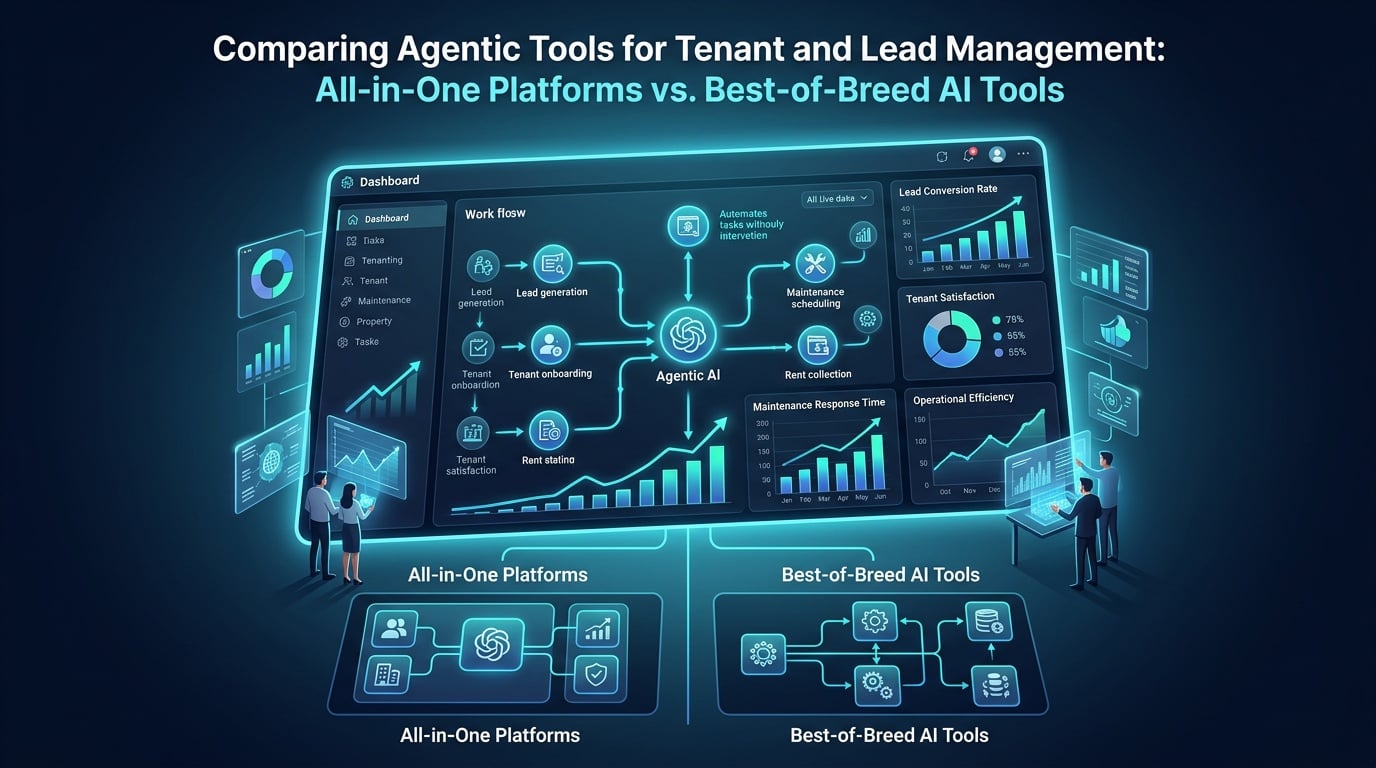
Comparing Agentic Tools for Tenant and Lead Management: All-in-One Platforms vs. Best-of-Breed AI Tools
AppFolio, Yardi, Buildium, DoorLoop, and Entrata: Tenant Management Strengths
Established property management software platforms like AppFolio, Yardi, Buildium, DoorLoop, and Entrata are foundational for many real estate agencies. Their primary strength lies in providing a comprehensive suite of tools designed to manage the entire tenant lifecycle and property operations. This includes features for accounting, rent collection, maintenance tracking, lease administration, and resident communication portals. For example, AppFolio is recognized for its strong accounting and operational features, scoring 79% for Autonomous Task Execution on the G2 Grid Report for Property Management in Spring 2026. These platforms excel at centralizing data and standardizing workflows for tenant management, offering a single source of truth for property portfolios.
These all-in-one solutions are built to handle the day-to-day administrative demands of property management. They offer tenant portals for payments and service requests, automated reminders for rent, and tools for managing property inspections and unit turnovers. While they incorporate automation, their AI capabilities are often focused on streamlining existing processes rather than groundbreaking proactive engagement or complex lead qualification. They provide the essential infrastructure for managing properties and tenants efficiently, forming the backbone of operations for many organizations. Their value is in consolidation and established operational efficiency across core property management functions.
Standalone Agentic Tools (Retell AI, Funnel Leasing) for Lead Qualification and Nurturing
In contrast to the broad functionality of all-in-one platforms, standalone agentic AI tools are purpose-built to excel in specific, high-impact areas, particularly lead qualification and intensive nurturing. Solutions like Retell AI and Funnel Leasing specialize in leveraging AI to engage potential renters from the very first touchpoint. Their systems are designed for rapid response, intelligent data capture, and persistent, personalized follow-up. These tools are engineered to convert inbound inquiries into qualified leads and scheduled viewings with remarkable speed and accuracy. For example, they can automate property matching and calendar coordination, ensuring that potential tenants are connected with the right opportunities and agents promptly.
These best-of-breed solutions offer advanced AI capabilities that go beyond what is typically found in standard property management software. They focus on maximizing the conversion rate of incoming leads, often reducing response times to under 60 seconds and increasing agent productivity by automating up to 80% of initial follow-up tasks. The qualified pipeline can increase by 3x, with conversion rates reaching 85% in some cases. This specialization allows them to deliver superior performance in lead engagement, a critical driver for occupancy rates and revenue growth. These tools are ideal for agencies where lead volume is high and the speed of conversion directly impacts success.
When to Go All-in-One vs. When to Integrate a Best-of-Breed AI Agent
The decision between an all-in-one platform and integrating a best-of-breed agentic AI tool hinges on an agency’s specific priorities and pain points. All-in-one platforms are excellent for organizations prioritizing centralized management, accounting integration, and a unified system for core property operations. If your primary challenge is managing existing leases, collecting rent efficiently, and handling maintenance requests within a single interface, a comprehensive platform like AppFolio or Yardi is likely your best choice. They provide the foundational structure for managing a property portfolio effectively.
But if your agency experiences high lead volume, struggles with slow lead response times, or needs to significantly improve conversion rates, integrating a specialized agentic AI tool is a strategic move. These standalone solutions, such as Agentic Systems for Real Estate, are designed to supercharge lead qualification and nurturing processes. They complement existing property management software by adding a layer of intelligent automation specifically for revenue generation. For example, if your goal is to increase the qualified pipeline by 3x or save over 20 hours per week per agent on administrative tasks related to leads, a dedicated AI agent offers a more powerful, targeted solution than relying solely on the built-in capabilities of an all-in-one platform.
| Feature | All-in-One Platforms (e.g., AppFolio, Yardi) | Best-of-Breed Agentic AI Tools (e.g., Agentic Systems for Real Estate) |
|---|---|---|
| Primary Focus | Comprehensive property management, accounting, tenant administration | Intelligent lead qualification, nurturing, and sales acceleration |
| AI Capabilities | Streamlined automation for existing workflows (e.g., rent reminders) | Proactive engagement, autonomous decision-making, complex task execution |
| Lead Conversion | Standard CRM integration, manual follow-up support | Automated, instant engagement, intelligent matching, and accelerated follow-up |
| Tenant Management | Centralized portals, maintenance requests, lease administration | Limited direct tenant management; focus is on acquisition and initial prospect engagement |
| Ideal Use Case | Managing day-to-day operations, accounting, and resident services | Maximizing lead volume, improving conversion rates, and increasing leasing agent productivity |
| Integration Potential | Can integrate with other tools, but AI features are internal | Designed to integrate with existing CRM and property management systems |
Choosing the Right Agentic Tool for Tenant and Lead Management Based on Your Portfolio’s Real Pain Points
Lead-Heavy Portfolio: Prioritize Qualification, Nurturing, and Speed-to-Lease
For real estate agencies or property managers with a high volume of incoming leads, the primary challenge is converting inquiries into scheduled viewings and signed leases as efficiently as possible. In this scenario, speed and intelligent qualification are paramount. A lead-heavy portfolio means every missed call or delayed response translates directly into lost revenue and potentially increased vacancy periods. The ideal agentic tool for this situation must excel at instant engagement, understanding prospect needs through natural language, and autonomously moving them through the initial stages of the sales funnel. Tools that offer a 24/7 AI leasing agent capable of handling initial questions, gathering essential prospect data, and scheduling viewings without human intervention are invaluable.
The ability to nurture leads persistently is also critical. Prospects may not be ready to tour immediately, or they might require follow-up with specific property details. Agentic AI can maintain consistent, personalized communication, providing relevant information, answering follow-up questions, and nudging prospects toward the next step. This level of automated, intelligent follow-up ensures that potential renters remain engaged throughout their decision-making process. When evaluating tools, look for features that demonstrate a clear pathway to accelerating the lease cycle, such as instant response times (under 60 seconds), automated property matching, and seamless calendar coordination for viewings. This focus on speed-to-lead and conversion optimization is what drives revenue growth in a competitive market.
Tenant-Heavy Portfolio: Focus on Autonomous Maintenance, Renewals, and Communication
If your agency manages a substantial number of occupied units, the operational focus shifts from acquiring new leads to retaining existing tenants and managing property upkeep. In a tenant-heavy portfolio, the goal is to ensure resident satisfaction, streamline the lease renewal process, and handle maintenance requests with maximum efficiency to minimize disruption and costs. Agentic AI solutions in this context should prioritize autonomous communication for routine tasks, proactive maintenance identification, and intelligent renewal management. An AI system that can autonomously handle tenant inquiries regarding maintenance, log service requests, and even coordinate with maintenance staff can significantly reduce administrative overhead and improve resident experience.
Lease renewals are a significant source of predictable revenue, and agentic AI can play a pivotal role here. By analyzing lease end dates and market conditions, the AI can initiate timely, personalized renewal offers to tenants. It can answer questions about updated lease terms or pricing, and guide tenants through the renewal process, ensuring higher retention rates. This proactive approach to tenant management not only secures ongoing rental income but also frees up property managers to address more complex resident issues or focus on strategic portfolio growth. When selecting tools for a tenant-heavy portfolio, key capabilities to assess include automated resident communication, efficient service request management, intelligent lease renewal workflows, and features that improve overall tenant satisfaction and retention metrics.
Mixed Portfolio: The Case for a Platform + Agentic Overlay
Many real estate agencies manage portfolios that are a blend of both new leasing opportunities and existing tenancies. In such mixed portfolios, the challenge is to find a solution that can effectively balance lead generation and tenant retention without creating operational silos or requiring disparate systems. This is where the strategic integration of an agentic AI overlay onto an existing property management platform becomes particularly compelling. Such an approach allows agencies to maintain their established operational backbone while infusing advanced AI capabilities where they can deliver the most impact: lead conversion and resident lifecycle management.
An agentic overlay, like our Agentic Systems for Real Estate, can work in concert with your current property management software. It takes over the high-volume, time-sensitive tasks of lead qualification, initial prospect engagement, and personalized follow-up, significantly boosting your leasing pipeline. Simultaneously, it can manage routine tenant communications, maintenance logging, and renewal reminders, ensuring that your existing residents receive excellent service. This dual capability means your team can focus on higher-value activities, such as closing complex deals, resolving critical tenant issues, or developing strategic marketing initiatives. The result is a highly efficient, scalable operation that maximizes both new revenue opportunities and resident satisfaction, effectively addressing the complexities of a diverse property portfolio.
Quick Decision Flowchart: Map Your Primary Challenge to the Best Agentic Tool Category for Tenant and Lead Management
To simplify the selection process, consider your agency’s most pressing operational bottleneck. If your main struggle is consistently generating enough qualified leads and closing leases quickly, your priority should be specialized agentic AI tools focused on lead qualification, instant engagement, and accelerated speed-to-lease. These solutions are built to maximize your inbound lead conversion rates.
Primary Challenge: High Lead Volume & Slow Conversion
- Recommended Tool Category: Standalone Agentic AI for Lead Generation & Nurturing
- Key Capabilities: Instant response, AI-driven qualification, automated scheduling, persistent follow-up, property matching.
- Outcome Focus: Maximize lead pipeline, shorten lease cycles, increase agent productivity on new deals.
Primary Challenge: Managing Existing Tenants & Property Operations
- Recommended Tool Category: Comprehensive All-in-One Property Management Platforms
- Key Capabilities: Rent collection, maintenance tracking, accounting, resident portals, lease administration.
- Outcome Focus: Streamline operations, improve resident satisfaction, ensure timely rent payments.
If your agency primarily manages a large base of existing tenants and your pain points revolve around service requests, lease renewals, and ongoing resident communication, a strong, all-in-one property management platform is likely the most suitable foundation. These systems provide the breadth of features needed for day-to-day property operations. But for agencies with a mixed portfolio or those looking to supercharge a specific area, integrating a specialized agentic AI solution as an overlay offers the best of both worlds, providing advanced capabilities for lead management or resident engagement on top of your existing infrastructure. This strategic layering ensures you address your most critical needs precisely.
Implementation Roadmap: How to Deploy Agentic AI Without Disrupting Your Team
Step 1: Audit Your Current Tool Stack and Identify Integration Points
Before introducing any new technology, a thorough audit of your existing software and workflows is essential. For implementing agentic AI in real estate, this means understanding your current CRM, property management software, communication channels (email, SMS, phone), and any other tools that touch lead or tenant interactions. Identify where data currently resides and how it flows between systems. This audit helps pinpoint the most logical integration points for your chosen AI solution, ensuring it can seamlessly connect with your established infrastructure rather than operating in a vacuum. Understanding these connections is key to a smooth transition and maximizing the AI’s effectiveness from day one.
This initial step also involves assessing your team’s current responsibilities and identifying tasks that are repetitive, time-consuming, or prone to human error. By mapping these out, you can clearly define the specific areas where agentic AI can provide the most immediate value. For example, if lead follow-up relies heavily on manual email campaigns or if tenant maintenance requests often get lost in email threads, these become prime candidates for AI automation. A clear understanding of your current operational landscape will prevent integration headaches and ensure the AI is deployed to solve your most pressing business challenges.
Step 2: Choose a Pilot Use Case (e.g., Lead Follow-Up or Maintenance Tickets)
To minimize disruption and validate the benefits of agentic AI, it’s strategic to start with a pilot program focused on a specific, well-defined use case. For a lead-heavy portfolio, initiating with AI-powered lead qualification and follow-up is an excellent choice. This allows the AI to demonstrate its ability to engage prospects instantly, gather information, and schedule viewings, directly impacting your sales pipeline. Alternatively, for agencies managing more occupied units, piloting with AI handling routine maintenance ticket intake and initial response can prove highly effective.
Selecting a pilot use case allows your team to gradually adapt to AI-assisted workflows without being overwhelmed. It provides a controlled environment to test the technology, refine its configuration, and measure its impact on specific Key Performance Indicators (KPIs). This focused approach ensures that the initial deployment is manageable and successful, building confidence and momentum for broader adoption. The goal is to showcase tangible improvements in efficiency and outcomes, such as faster response times to inquiries or a reduction in administrative tasks related to maintenance requests, before scaling to more complex operations.
Step 3: Set Up Data Flows and Train AI on Your Existing Workflows
Once a pilot use case is identified, the next critical phase involves configuring the agentic AI system to integrate with your chosen tools and mimic your successful operational processes. This requires establishing strong data flows so information can be exchanged accurately between the AI and your existing platforms, like your CRM or property management software. For example, when the AI qualifies a lead, that information needs to be seamlessly passed to your sales team or tenant database. Proper setup ensures data integrity and prevents information silos.
Training the AI on your specific business context, terminology, and workflows is paramount for its effectiveness. This involves feeding the AI with relevant data, examples of successful interactions, and your standard operating procedures. For example, if your agency has a specific set of questions used for qualifying leads or a particular protocol for handling maintenance emergencies, the AI must be trained on these. This customization ensures the AI operates in a manner consistent with your brand voice and business objectives. The system uses advanced matching algorithms to suggest relevant properties and can send personalized recommendations including virtual tours. Automated reminders reduce no-shows and feedback is collected after viewings to refine future suggestions.
Step 4: Measure ROI with Concrete KPIs: Faster Lease Cycles, Lower Vacancy, Admin Time Saved
The ultimate measure of success for any AI implementation is its demonstrable return on investment (ROI). After deploying your pilot program, it’s imperative to track specific, quantifiable metrics. For a lead-focused pilot, key performance indicators (KPIs) should include the reduction in response time to new inquiries, the increase in the number of qualified leads generated, the speed at which leads move through the sales funnel (faster lease cycles), and ultimately, the improvement in conversion rates. Tracking these metrics provides clear evidence of the AI’s impact on revenue generation and operational efficiency.
For a tenant-focused pilot, relevant KPIs might include the average time to resolve maintenance requests, the percentage of lease renewals handled autonomously, and the reduction in administrative hours spent on routine tenant communications. According to industry estimates, properties using AI leasing agents see up to 40% faster lease conversion. Furthermore, agent productivity can be maximized by automating 80% of tasks, saving over 20 hours per week, and resulting in over 30% more deals closed. By consistently measuring these KPIs, you can clearly articulate the value of agentic AI, justify further investment, and optimize the system for even greater business outcomes across your portfolio.
Agentic Systems for Real Estate help agencies handle more properties, convert more leads, and close more deals without expanding their team or increasing admin costs. The system converts property inquiries into viewings and sales through instant engagement, intelligent qualification, and personalized follow-up. The qualified pipeline increases by 3x and the conversion rate is 85%. Response time to inquiries is less than 60 seconds. Agent productivity is maximized by automating 80% of tasks, saving over 20 hours per week, and resulting in over 30% more deals closed.
References
Frequently Asked Questions About Agentic AI in Real Estate

How Much Does Agentic AI Cost for Property Management?
The cost of agentic AI solutions for property management can vary significantly based on the provider, the scope of features, and the scale of implementation. Some platforms may offer tiered pricing based on the number of units managed or the volume of leads processed. For example, Microsoft Copilot Studio is priced at $200 per tenant per month for 25,000 Copilot Credits, according to Creatio. More specialized AI agents designed for lead qualification and nurturing might be priced based on performance metrics or a subscription model. It’s important to look beyond the sticker price and evaluate the pricing structure in relation to the expected ROI, such as increased lead conversion rates, reduced vacancy periods, and time savings for your team.
Will AI Replace My Leasing Agents and Property Managers?
Agentic AI is designed to augment, not replace, human professionals. Its primary function is to automate repetitive, time-consuming tasks, freeing up your leasing agents and property managers to focus on higher-value activities that require human judgment, empathy, and complex problem-solving. For example, AI can handle initial lead qualification, schedule viewings, and manage routine tenant inquiries. This allows your human team to concentrate on building client relationships, negotiating complex deals, addressing unique tenant issues, and strategic planning. The system improves client retention by 85%, client satisfaction by 27%, and generates over $100k in additional revenue per agent per year by empowering them with AI-driven insights and automated support.
How Do I Ensure Data Privacy When AI Handles Tenant Communication?
Ensuring data privacy is a top priority when implementing AI for tenant communication. Reputable agentic AI providers adhere to strict data security protocols and privacy regulations, such as GDPR or CCPA. They implement strong encryption for data in transit and at rest, secure access controls, and regular security audits. It is essential to choose a provider that is transparent about their data handling practices and compliant with relevant privacy laws. The agentic workflow includes lead capture through instant 24/7 engagement across multiple channels like WhatsApp, SMS, email, and website chat, utilizing secure communication protocols.
What Results Can I Expect in the First 90 Days?
Within the first 90 days of implementing an agentic AI solution, you can typically expect to see noticeable improvements in your core operational metrics. For lead management, this often includes a significant reduction in inquiry response times, an increase in the number of scheduled viewings, and a more actively engaged prospect pipeline. For tenant management, expect a decrease in the volume of routine inquiries handled by your staff and improved efficiency in logging and tracking maintenance requests. The initial period focuses on stabilizing the AI’s performance within your specific workflows and demonstrating its ability to automate tasks and improve response times, laying the groundwork for more substantial gains.
Can I Start With a Lead Qualification Bot and Add Tenant Management Later?
Absolutely. Many agentic AI platforms are designed with modularity and scalability in mind, allowing you to start with specific functionalities and expand as your needs evolve. It is common to begin by implementing an AI agent focused on lead qualification and initial prospect engagement, given its direct impact on revenue. Once this module is successfully integrated and delivering results, you can then layer on capabilities for tenant communication, maintenance request management, or lease renewal automation. This phased approach allows for controlled growth and ensures that your investment in AI aligns with your agency’s strategic priorities and operational capacity.
Expert Tip: When comparing agentic tools for tenant and lead management?, prioritize solutions that offer flexible deployment options. This allows you to tailor the AI’s capabilities to your agency’s most pressing needs first, such as accelerating lead conversion or streamlining resident communications, and then scale its functions as your business grows and your understanding of AI’s potential deepens.
Frequently Asked Questions
What are agentic AI tools for real estate?
Agentic AI tools are intelligent systems designed to act proactively and autonomously in real estate operations. They go beyond simple automation to anticipate needs, manage complex workflows, and drive revenue growth for agencies.
How does agentic AI differ from basic chatbots?
Agentic AI tools possess a higher degree of autonomy and intelligence than basic chatbots or rule-based systems. They can understand context, learn from interactions, make decisions, and pursue complex goals with minimal human oversight, acting on behalf of the business.
How can agentic AI help with tenant and lead management?
Agentic AI transforms tenant and lead management from reactive tasks to proactive engagement. It can simultaneously qualify new leads, initiate lease renewal conversations, and manage maintenance inquiries autonomously, optimizing every revenue stream and resident interaction.
What are examples of agentic AI in action for real estate?
An agentic AI can manage a new prospect’s inquiry about an apartment, match them to suitable units, and schedule a viewing, all within minutes. Simultaneously, it can engage a tenant nearing lease end to discuss renewal options, demonstrating dual capability in acquisition and retention.
How do I compare agentic tools for my real estate agency?
When comparing agentic tools, assess their ability to shift operations from reactive to proactive, manage complex workflows autonomously, and drive measurable business outcomes. Look for systems that augment human expertise rather than just automate tasks.
Which AI tool is best for real estate lead qualification?
For lead qualification, agentic AI tools excel by instantly engaging prospects, gathering essential details, and matching them with suitable properties. This process can accelerate speed-to-lease significantly by handling initial steps autonomously.