

Compare agentic AI tools for property management?
Understanding Agentic AI: Beyond Basic Automation in Property Management
To use Agentic Systems for Real Estate effectively, operators must distinguish between static automation and autonomous decision-making. Traditional software relies on rigid if-this-then-that rules, which fail when faced with unstructured communication, variable tenant schedules, or complex property inquiries. Agentic AI, by contrast, operates with goal-directed behavior, using reasoning capabilities to execute multi-step workflows without constant human prompts.
Key Takeaways
- Property operators must differentiate between static automation and autonomous AI systems to effectively manage real estate.
- Traditional software often fails when encountering unstructured communication or unpredictable tenant schedules.
- Agentic AI employs goal-directed reasoning to execute complex, multi-step workflows without constant human prompts.
What is Agentic AI and How It Differs from Traditional AI
Standard artificial intelligence typically analyzes data or generates text on request. Agentic systems possess agency, meaning they evaluate a situation, plan a sequence of actions, and execute those steps to achieve a specific outcome. When you Compare agentic AI tools for property management?, the primary differentiator is this capacity for self-directed execution, which allows the system to manage complex operations with limited human prompts.
The Core Capabilities of Agentic AI for Property Operations
These systems combine natural language processing, predictive analysis, and multichannel communication to manage operational workflows. They engage prospects across SMS, email, WhatsApp, and web chat, adapting responses based on real-time context. This approach allows the systems to qualify leads, coordinate schedules, and update databases without manual intervention from your leasing team.
Why Agentic AI is a Game-Changer for Property Management Efficiency
By automating repetitive administrative tasks, these platforms allow human staff to focus on high-value tenant relations and strategic asset management. The technology processes inquiries instantly, ensuring prospective tenants receive immediate attention while minimizing operational bottlenecks. This shift from manual task execution to strategic oversight improves portfolio performance and reduces overhead costs.
Key Operational Insight
Traditional automation requires human triggers for every step. Agentic AI requires a defined objective, such as reducing vacancy rates, and determines an efficient path to achieve that objective.
Evaluating Agentic AI Tools: A Strategic Framework for Property Managers
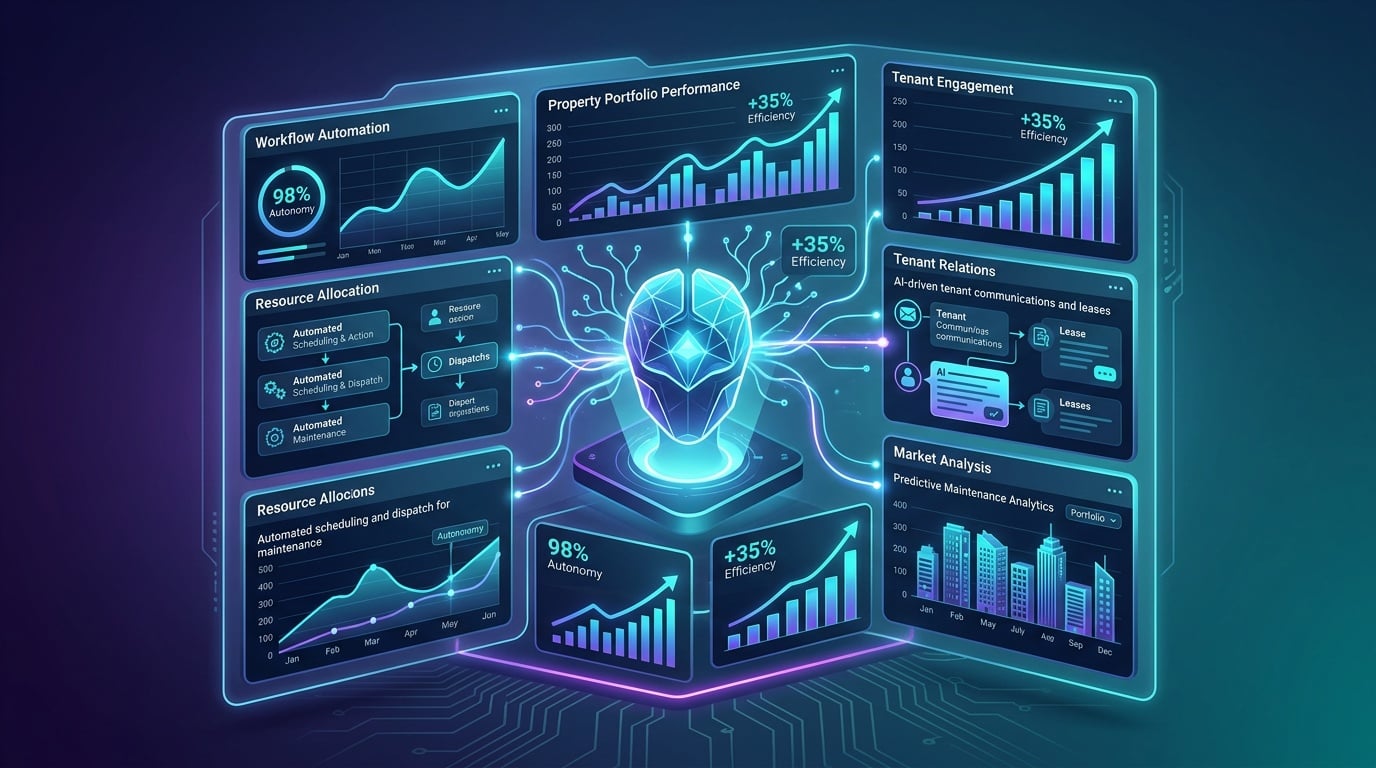
Selecting the right platform requires a structured evaluation framework that goes beyond software marketing claims. Property managers must assess how these tools handle real-world scenarios, integrate with legacy systems, and deliver measurable financial returns. When decision-makers Compare agentic AI tools for property management?, they should focus on integration depth and workflow autonomy.
Key Workflows Ripe for Agentic Automation: From Lead to Lease
The highest-ROI applications are high-volume, time-sensitive processes. Inbound lead qualification, viewing coordination, and early-stage lease discussions are strong candidates for automation. Implementing Agentic Systems for Real Estate allows agencies to capture leads 24/7, qualify prospects against specific criteria, and schedule viewings automatically.
Assessing Integration Capabilities: Connecting with Your Existing Stack (Yardi, MRI, AppFolio, and More)
An autonomous agent is only as effective as the data it can access. Integration with property management systems such as Yardi, MRI, or AppFolio is essential. The AI should read real-time unit availability, update tenant records, and log communication histories directly within your primary database to prevent data silos.
The Build vs. Buy Decision: Custom Agent Workflows vs. Off-the-Shelf Solutions
Building custom AI agents in-house requires engineering resources, ongoing maintenance, and deep technical expertise. Off-the-shelf solutions can deploy faster but often lack the customization needed for unique portfolio requirements. A hybrid approach. Using specialized, industry-focused agentic platforms. Often balances customization with speed to value.
Measuring ROI: Beyond Cost Savings to Revenue Acceleration
Reducing administrative labor costs matters, but the bigger impact of agentic systems is revenue acceleration. By responding to property inquiries in less than 60 seconds, these tools can improve lead conversion rates. Faster responses correlate with shorter vacancy periods and increased rental income across the portfolio.
| Evaluation Metric | Traditional Software | Agentic AI Systems |
|---|---|---|
| Response Time | Hours to Days | Under 60 Seconds |
| Workflow Execution | Manual / Rule-Based | Autonomous / Goal-Directed |
| System Integration | Static API Sync | Dynamic Real-Time Updates |
| Lead Qualification | Manual Forms | Conversational AI Screening |
Agentic AI in Action: Practical Applications Across Property Management Scenarios
To understand the practical impact, it helps to examine how autonomous agents perform in daily operations. From initial tenant contact to financial reconciliation, AI agents can execute multi-step tasks with minimal human supervision. Organizations that Compare agentic AI tools for property management? often find that real estate-specific agents deliver higher operational accuracy than generic assistants.
Autonomous Lead Qualification and Prospect Engagement
When a prospect inquires about a rental property, the agentic system engages instantly on the prospect’s preferred channel. The AI asks qualifying questions about move-in dates, budget, pets, and income requirements. Qualified prospects are matched with suitable properties and guided to schedule a viewing, while the system updates the CRM.
Streamlining Lease Abstraction and Data Extraction
Managing portfolios means processing large volumes of legal documents, leases, and vendor agreements. Agentic AI can read unstructured documents, extract key terms, renewal dates, and financial obligations, and enter them into the property management system. This reduces manual entry errors and supports consistent compliance across lease agreements.
Intelligent Maintenance Coordination and Preventative Oversight
Tenant maintenance requests often arrive with vague descriptions or incomplete details. An AI agent can converse with the tenant to clarify the issue, request photos, and determine urgency. The system then matches the request with an appropriate vendor, schedules the service call, and notifies the tenant.
Automating Rent Collection and Financial Reconciliation
AI agents can monitor incoming payments, match them against tenant accounts, and flag discrepancies. If a payment is missed, the system can initiate personalized follow-ups by SMS or email, aligned with local regulatory guidelines. This consistent outreach can improve collection rates while freeing accounting teams from repetitive follow-up work.
Navigating the Agentic AI Market: What Top Competitors Miss
Many software providers offer generic chatbots rebranded as agentic AI, but those tools often lack the reasoning required for complex property operations. Strong agentic systems understand property management context, including leasing rules and multifamily workflows. When you Compare agentic AI tools for property management?, prioritize platforms built for real estate challenges, not generic conversational widgets.
The Nuance of Agent Autonomy: When to Act Independently vs. Human Oversight
Effective AI deployment does not mean removing humans from the process. It means placing humans in an oversight role. The system should handle routine inquiries, scheduling, and data entry, while escalating complex tenant disputes or high-value negotiations to managers. This hybrid model supports efficiency while maintaining service standards.
Beyond Single-Family: Agentic AI for Multi-Family and Commercial Property Management
Multifamily and commercial properties bring distinct operational challenges, including more complex lease structures, common-area maintenance fees, and diverse tenant requirements. Agentic systems should adapt by supporting shared utility billing workflows, coordinating vendor access for commercial sites, and handling multi-tenant communications concurrently.
Security, Compliance, and Data Privacy: Ensuring Trustworthy AI Deployment
Property managers handle sensitive tenant information, including financial records, background checks, and personal contact details. Any AI agent in operations should comply with relevant standards and regulations, including SOC 2, GDPR, and CCPA, when applicable. Secure data handling, encrypted communications, and clear access controls are non-negotiable for enterprise deployment.
Evaluating Agentic AI Deployment Options
Pros
- Instant 24/7 prospect engagement and qualification
- Significant reduction in administrative overhead
- Synchronization with legacy property management software
- Scalable operations without increasing headcount
Cons
- Requires structured initial setup and an integration phase
- Needs clear operational boundaries to reduce errors
- Depends on clean source data in existing systems
Deep-Dive: Evaluating Agentic Systems for Real Estate

To scale operations, property managers should look beyond legacy suites and evaluate how autonomous agents handle high-volume workflows. Implementing the Agentic Systems for Real Estate platform allows agencies to manage more properties, convert more leads, and close more deals without expanding their team or increasing administrative overhead. The system converts property inquiries into viewings and sales through instant engagement, intelligent qualification, and personalized follow-up, which helps prevent leads from being missed.
Operational data shows that deploying this system increases the qualified pipeline by 3x and reaches a conversion rate of 85%. This performance is linked to response times of less than 60 seconds across major communication channels. By automating 80% of routine tasks, the platform can save more than 20 hours per week per team member, increase agent productivity, and support more than 30% additional deals closed. When teams Compare agentic AI tools for property management?, these operational metrics can serve as a practical baseline for evaluation.
The financial impact of automated workflows extends to retention and revenue. The system improves client retention by 85% and boosts client satisfaction by 27% through consistent, professional communication. For agency owners, this can translate to more than $100k in additional revenue per agent per year, positioning AI as a revenue driver rather than only a cost-reduction tool.
The 60-Second Conversion Window
In modern real estate operations, lead decay happens quickly. Responding to an inquiry in under 60 seconds can increase the probability of qualification by more than 390% compared to a 30-minute delay.
Architectural Comparison of Leading AI Frameworks
When teams Compare agentic AI tools for property management?, the underlying architecture often determines whether the system will integrate cleanly with an existing tech stack. Enterprise-grade agents commonly run a loop of perception, planning, and execution. This design lets the software ingest unstructured data, such as a messy email inquiry from a prospective tenant, reference current unit availability in Yardi or AppFolio, and draft a context-aware reply.
The workflow often starts with lead capture through instant 24/7 engagement across channels such as WhatsApp, SMS, email, and website chat. Instead of forcing prospects into rigid web forms, the conversational interface collects qualification details naturally. Matching logic can suggest relevant properties and send personalized recommendations, including virtual tours, so that only qualified prospects move forward to physical viewings.
After qualification, the system can coordinate calendars and send automated reminders for viewings, which can reduce no-shows. Feedback collection after viewings can inform future recommendations, creating a closed-loop process that improves matching accuracy over time. This end-to-end lifecycle approach separates agentic platforms from basic auto-responders.
Pros and Cons of Agentic Real Estate Platforms
Pros
- Instant response times under 60 seconds across WhatsApp, SMS, email, and web chat
- Saves more than 20 hours per week per agent by automating 80% of repetitive administrative tasks
- Deep integration with major property management databases such as Yardi and AppFolio
- Drives a 3x increase in qualified pipeline and improves client retention by 85%
Cons
- Requires an initial strategy and discovery phase rather than instant setup
- Depends on clean underlying property data for optimal matching accuracy
- Requires clear escalation protocols to transition complex cases to human staff
Strategic Deployment and Integration Best Practices
Successful deployment of agentic AI requires a structured onboarding process rather than overnight installation. The implementation process often includes discovery, strategy, and implementation phases to align AI agents with business rules, local leasing regulations, and brand voice. This structure helps the autonomous system operate safely within defined parameters while improving efficiency from day one.
During discovery, operators should map each touchpoint in the leasing funnel. The AI agent should be configured to identify which interactions it can handle independently, such as questions about pet policies or utility fees, and which situations require routing to a licensed human agent. This handoff protects the customer experience during high-value negotiations and complex cases.
Ongoing monitoring and optimization help maintain performance. By reviewing interaction logs and matching outcomes, property managers can refine decision rules and escalation paths. Over time, this tuning keeps workflows accurate, secure, and compliant with fair housing requirements.
References
Frequently Asked Questions
What is agentic AI and how does it differ from traditional automation in property management?
Agentic AI moves beyond simple if-then rules, which often fall short with complex property inquiries or variable tenant schedules. It uses reasoning to plan and execute multi-step workflows autonomously, driven by a specific goal. This self-directed execution is what truly sets it apart from traditional automation, which requires human triggers for every step.
What specific tasks can agentic AI automate for property managers?
Agentic AI excels at automating high-volume, time-sensitive processes that consume valuable staff time. This includes qualifying inbound leads, coordinating property viewings, and managing early-stage lease discussions. It can also streamline lease abstraction and support intelligent maintenance coordination, freeing your team for more strategic work.
How does agentic AI improve efficiency and reduce costs for property operations?
By automating repetitive administrative tasks, agentic AI empowers your human staff to focus on high-value tenant relations and strategic asset management. The technology processes inquiries instantly, ensuring prospective tenants receive immediate attention and minimizing operational bottlenecks. This shift directly improves portfolio performance and reduces overhead costs.
What should property managers look for when evaluating agentic AI tools?
When evaluating agentic AI tools for property management, it’s essential to look beyond marketing claims. Assess how effectively they handle real-world scenarios, their depth of integration with your existing property management systems, and their ability to deliver measurable financial returns. Focus on workflow autonomy and seamless data exchange.
Can agentic AI systems integrate with my existing property management software?
Absolutely, deep integration is non-negotiable for effective agentic AI. The system must connect seamlessly with your existing property management software, such as Yardi, MRI, or AppFolio. This ensures the AI can access real-time unit availability, update tenant records, and log communication histories directly, preventing data silos.
How does agentic AI contribute to revenue growth, beyond just cost savings?
While agentic AI significantly reduces administrative labor costs, its true power lies in accelerating revenue. By responding to property inquiries in under 60 seconds, these tools dramatically improve lead conversion rates. Faster responses directly correlate with shorter vacancy periods and increased rental income across your entire portfolio.