

Compare agentic AI for lead gen vs marketing automation?
In this competitive market, generating high-quality leads efficiently is paramount for sustained business growth. Many companies rely on established marketing automation platforms, which offer scalability and efficiency through rule-based workflows. Agentic AI, however, offers a sophisticated alternative and complement to traditional automation, demanding more than just automated sequences; it requires intelligent, adaptive engagement that mirrors human interaction. Understanding the fundamental differences between these two approaches is key to making informed decisions about your lead generation strategy.
Key Takeaways
- Agentic AI for lead generation adapts in real time to prospect behavior, unlike traditional marketing automation that follows fixed, rule-based sequences.
- Traditional marketing automation scales well with predefined workflows but lacks the ability to mimic human-like, contextual engagement.
- The core distinction lies in how each approach handles uncertainty: agentic AI adjusts dynamically, while marketing automation relies on consistent, predictable triggers.
- Choosing between these tools depends on whether your lead generation strategy requires flexibility for complex interactions or efficiency through repeatable processes.
- Agentic AI can complement marketing automation by taking over high-touch lead nurturing where contextual understanding and adaptive responses are needed.
This article aims to clarify these distinctions, helping you compare agentic AI for lead gen vs marketing automation. We’ll explore their core mechanics, where agentic AI excels in personalization and intelligence, and how these capabilities translate into tangible business outcomes. By the end, you’ll have a clearer picture of which technology, or combination thereof, best suits your business objectives and sales cycle.
How Agentic AI and Marketing Automation Differ in Lead Generation
Defining Marketing Automation: Rule-Based Workflows at Scale
Marketing automation platforms have transformed how businesses manage repetitive marketing and sales tasks. At their core, these systems operate on predefined rules and triggers. You set up workflows, email sequences, lead scoring based on specific actions (like website visits or form submissions), and segment your audience based on static criteria. When a prospect meets a certain condition, the system automatically executes a pre-programmed action, such as sending a follow-up email or assigning a task to a sales representative. This approach is excellent for managing large volumes of leads, nurturing them through consistent messaging, and ensuring no prospect falls through the cracks due to manual oversight. It provides a reliable framework for predictable outreach and qualification processes, making it a staple for many organizations.
The strength of marketing automation lies in its scalability and consistency. For campaigns requiring mass communication and standard follow-ups, it delivers significant efficiency gains. Such as, a real estate agency might use automation to send out new listing alerts to segmented email lists or to schedule initial follow-up messages after a website inquiry. Similarly, a recruitment firm could automate the sending of job descriptions to candidates matching specific criteria. While effective for repetitive tasks and broad-stroke personalization, its limitations become apparent when dealing with nuanced buyer journeys or requiring highly dynamic, individualized interactions. The system executes what it’s told, without genuine understanding or adaptation beyond its programmed logic.
Defining Agentic AI: Autonomous, Adaptive Lead Engagement
Agentic AI, on the other hand, represents a significant leap forward. Unlike rule-based systems, agentic AI employs artificial intelligence to act autonomously and adaptively. These AI agents are designed to understand context, make decisions, and execute complex tasks with a degree of autonomy that mimics human intelligence. They can process information in real-time, learn from interactions, and adjust their strategy on the fly to achieve specific objectives. For lead generation, this means an AI agent can engage a prospect, understand their unique needs through natural conversation, qualify them based on dynamic criteria, and personalize outreach far beyond what static automation can achieve. It’s about creating a responsive, intelligent interaction rather than just a triggered sequence.
Agentic AI systems unify workflow automation with real-time decision-making, as noted by Netcore Cloud. This allows them to handle more complex scenarios. Imagine an AI agent interacting with a potential investor for a fundraising campaign. It can gauge their interest level, answer specific questions about the project based on vast amounts of data, and tailor its pitch in real-time. In hospitality, an agent could manage booking inquiries, understand guest preferences for room types or amenities, and offer personalized upgrades or recommendations instantly. This adaptive capability is what sets agentic AI apart, enabling it to handle a wider range of lead interactions and drive higher engagement rates through truly personalized experiences.
Core Differences: Static Rules vs. Dynamic Decision-Making
The fundamental divergence between marketing automation and agentic AI lies in their operational paradigms: static rules versus dynamic decision-making. Marketing automation relies on a predetermined, logical flow. If X happens, then do Y. This is predictable and excellent for volume, but lacks flexibility. If a prospect’s needs or questions deviate from the expected path, the automation might falter or resort to generic responses. Agentic AI, but, operates on a foundation of understanding and adaptation. It perceives the situation, reasons about the best course of action, and executes it, often learning from the outcome to improve future interactions. This is akin to a skilled human salesperson who can adapt their approach based on a prospect’s verbal cues, tone, and specific inquiries.
This difference translates directly into lead qualification and engagement quality. Marketing automation might assign a lead a score based on pages visited, but an agentic AI can discern genuine interest through conversational nuances. Such as, dynamic lead scoring, which evolves in real-time based on a broader set of interactions, is a hallmark of agentic systems, contrasting with static point-based systems in traditional automation, as highlighted by Madison Logic. This adaptability means agentic AI can identify high-value prospects more accurately and engage them with personalized messaging tailored to their immediate needs, leading to more meaningful conversations and, ultimately, better conversion rates. This capability is precisely why businesses are exploring how to compare agentic AI for lead gen vs marketing automation.
Feature Comparison: Agentic AI vs. Marketing Automation
| Feature | Marketing Automation | Agentic AI |
|---|---|---|
| Core Logic | Rule-based workflows, triggers, predefined sequences | Autonomous decision-making, adaptive learning, contextual understanding |
| Personalization | Template-based, segment-driven, static personalization | Dynamic, conversational, real-time tailored messaging |
| Lead Qualification | Static scoring based on predefined actions | Dynamic scoring based on nuanced understanding and interaction |
| Adaptability | Limited; follows programmed path | High; adjusts strategy based on interaction and data |
| Engagement Style | Broadcast or sequenced messaging | Conversational, human-like interaction |
| Learning Capability | Minimal; relies on manual rule updates | Continuous learning from interactions to improve performance |
| Use Case Example | Automated email nurture campaigns, bulk lead distribution | Intelligent lead qualification, personalized sales outreach, complex query resolution |
Where Agentic AI Wins: Real-Time Personalization and Smarter Lead Scoring
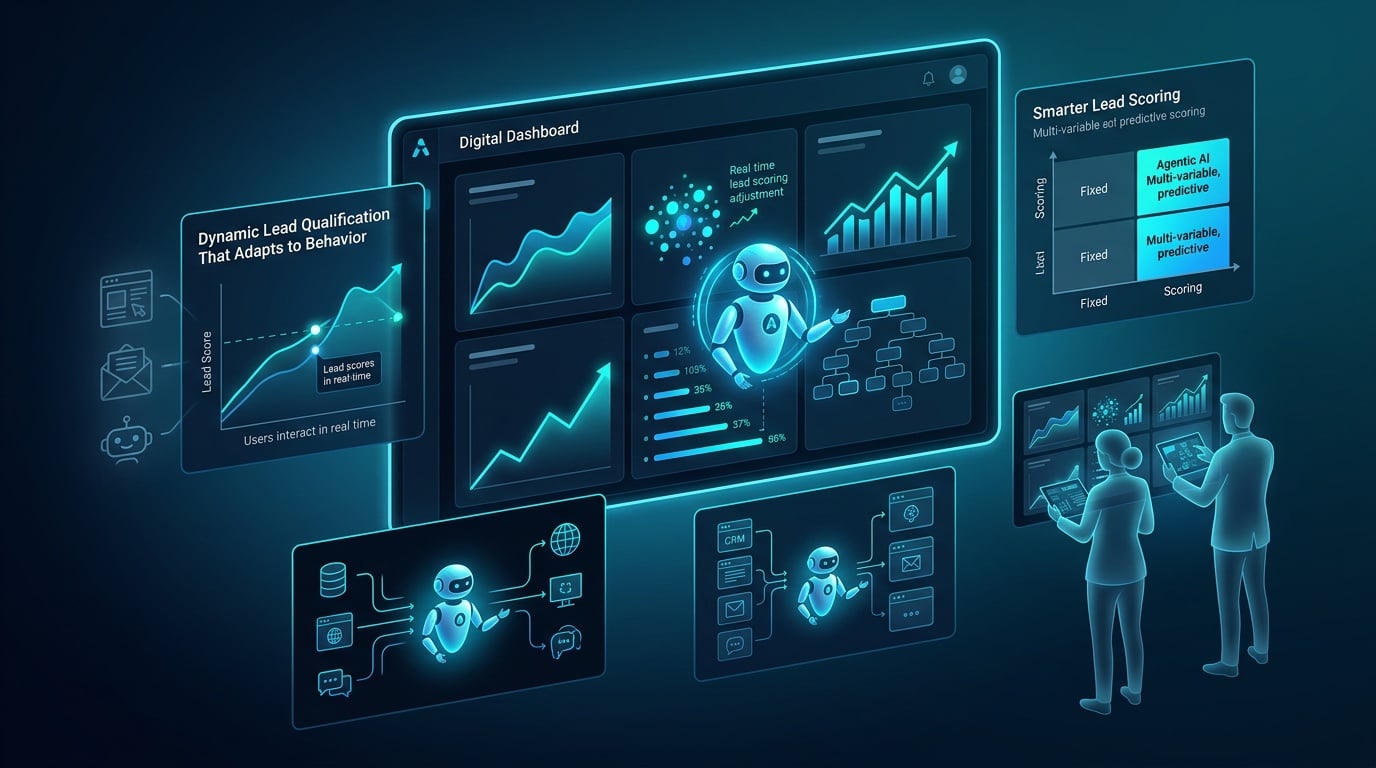
Dynamic Lead Qualification That Adapts to Behavior
Traditional marketing automation often qualifies leads based on a fixed set of actions and demographic data. A lead might score higher if they visit pricing pages or download a whitepaper, but this system can miss important intent signals or misinterpret engagement. Agentic AI excels by moving beyond static criteria to dynamic qualification that truly adapts to a prospect’s behavior and conversational cues. An AI agent can engage in natural language dialogue, asking probing questions to understand a lead’s specific pain points, budget, and timeline. The system then processes this information in real-time, adjusting the lead’s qualification score and determining the most effective next step. This is a significant advantage for complex sales cycles where understanding nuanced needs is essential.
Consider the real estate vertical. A lead inquiring about a property might be passively browsing or actively looking to buy. Marketing automation might send a generic follow-up. An agentic AI, but, can ask clarifying questions like, “What is your ideal move-in date?” or “What specific features are you prioritizing in your next home?” Based on the responses, the AI can dynamically qualify the lead, recognizing urgency and specific needs. This level of adaptive engagement ensures that sales teams focus their efforts on prospects who are genuinely ready to engage, significantly improving efficiency. U.S. Bank saw this impact, accelerating deal closing by 25% and improving conversion by 260% through predictive lead scoring powered by agentic AI (MarTech).
Personalized Outreach at Scale Without Human Template-Swapping
One of the biggest challenges in lead generation is delivering truly personalized outreach at scale. Marketing automation often resorts to merging fields like `[First Name]` or `[Company Name]` into pre-written templates, which can feel impersonal and easily detected as automated. Agentic AI offers genuine personalization by crafting messages and interaction strategies tailored to each individual prospect, in real-time, without human intervention for every variation. This means the AI can reference specific details learned during a conversation, adapt its tone, and offer solutions that directly address the prospect’s stated needs. This level of bespoke communication fosters deeper engagement and builds stronger rapport.
For recruitment agencies, this means an AI agent can converse with a candidate, understand their career aspirations, and tailor the presentation of job opportunities accordingly, rather than just sending a generic job alert. In fundraising, an agent can personalize outreach to potential donors by referencing their past giving history or specific program interests. This capability is particularly powerful for high-value interactions where a personalized touch is expected. The system converts property inquiries into viewings and sales through instant engagement, intelligent qualification, and personalized follow-up, a core benefit of Vynta AI’s solutions. The qualified pipeline increases by 3x and the conversion rate is 85%. Response time to inquiries is less than 60 seconds.
Expert Insight: “Traditional automation is like sending a form letter to everyone. Agentic AI is like having a conversation with each person, understanding their unique needs, and responding intelligently. This shift from broadcast to dialogue is what drives superior results in lead generation.” – Anas Moujahid, Operations Director, Vynta AI
The Learning Loop: How Agentic AI Improves Over Time
A critical advantage of agentic AI is its inherent ability to learn and improve. Unlike marketing automation, which requires manual updates to workflows and rules, agentic AI systems are designed with a continuous learning loop. Every interaction, successful or unsuccessful, provides data that the AI uses to refine its strategies, improve its understanding of prospect behavior, and optimize its communication. This means the AI gets smarter and more effective over time, leading to progressively better lead qualification, engagement, and conversion rates. This self-improvement mechanism ensures that your lead generation efforts remain cutting-edge without constant manual reconfiguration.
This iterative process is invaluable for identifying what truly drives engagement and conversion within specific industries. For example, an agentic AI in the hospitality sector might learn which upsell offers are most effective based on guest profiles and booking patterns, or which phrasing leads to more confirmed reservations. In recruitment, it can learn to identify candidate profiles that are most likely to accept an offer based on subtle conversational cues. This ongoing optimization means that the AI not only performs better but also uncovers new insights into your target audience, driving strategic improvements across your entire lead generation funnel. This constant evolution is a key differentiator when you compare agentic AI for lead gen vs marketing automation.
Agentic AI’s Adaptive Learning Cycle
Visual representation of AI learning loop: Data Input -> Analysis -> Decision Making -> Action -> Feedback -> Refinement. (Note: Actual infographic cannot be generated in text-only HTML, but this placeholder indicates where one would be placed).
Cost and ROI: Comparing Agentic AI vs. Marketing Automation Investments
Upfront and Ongoing Costs: Platforms, Setup, and Maintenance
Evaluating the financial commitment for either agentic AI or marketing automation requires looking beyond the sticker price. Traditional marketing automation platforms often involve subscription fees based on contact volume or feature sets, with costs potentially escalating as your database grows. Setup can range from straightforward configuration for basic features to complex integration projects for advanced workflows, often requiring dedicated staff time or external consultants. Ongoing maintenance involves regular updates to rules, email content, and lead scoring logic, which demands continuous internal resources or agency support. The total cost of ownership can be substantial, especially for businesses with large contact lists and complex automation needs.
Agentic AI solutions, while potentially appearing more advanced, can offer a different cost structure. Initial setup might involve a more involved discovery and strategy phase to define objectives and train the AI, but this investment is aimed at creating highly adaptable systems. Vynta AI’s approach focuses on delivering enterprise-grade AI agents specifically designed for verticals like real estate, recruitment, fundraising, and hospitality. The ongoing costs are often tied to performance or usage metrics rather than sheer contact volume, aligning expenses more closely with tangible business outcomes. The goal is to democratize sophisticated AI for mid-market SMEs, meaning solutions are engineered for efficiency and measurable results, rather than simply adding complexity.
ROI Metrics That Matter: Conversion Rates, Time Savings, Revenue per Lead
When comparing agentic AI for lead gen vs marketing automation, the return on investment (ROI) is the ultimate arbiter of value. Marketing automation excels at improving efficiency by automating repetitive tasks, leading to time savings and potentially higher output from existing teams. Metrics often focus on email open rates, click-through rates, and the volume of leads passed to sales. However, the impact on conversion rates and revenue per lead can be less direct if personalization is limited. The focus is often on process optimization and lead volume management.
Agentic AI, by contrast, directly targets improvements in conversion rates and revenue per lead through its adaptive, personalized engagement. The U.S. Bank example, where agentic AI was used for predictive lead scoring, demonstrated an acceleration of deal closing by 25% and an improvement in conversion by 260% (MarTech). This indicates a higher ROI driven by the quality of engagement and qualification. Such as, the system converts property inquiries into viewings and sales through instant engagement, intelligent qualification, and personalized follow-up. The qualified pipeline increases by 3x and the conversion rate is 85%. Response time to inquiries is less than 60 seconds, freeing up agent productivity by automating 80% of tasks, saving over 20 hours per week, and resulting in over 30% more deals closed. These outcomes suggest a higher value derived from more effective lead nurturing and conversion, rather than just workflow automation.
A Real-World Cost Experiment: What $35 Bought in Agentic AI Outreach
To illustrate the potential cost-effectiveness of agentic AI, consider a real-world experiment. One user on Reddit reported building a custom outbound lead generation workflow using agentic AI tools for an investment of just $35. This low-cost setup managed to generate 86 high-quality leads. This scenario highlights how, with the right tools and application, agentic AI can deliver substantial lead generation volume and quality at a remarkably low cost per lead, especially when compared to more traditional, often higher-priced, marketing automation solutions that may require larger upfront investments and ongoing subscription fees.
This experiment underscores the power of agentic systems to unify workflow automation with real-time decisioning, as noted by Netcore Cloud. When applied strategically, agentic AI can automate complex outreach sequences with intelligent personalization, achieving significant results without the need for extensive manual effort or expensive platform licenses. This approach is particularly appealing for mid-market SMEs looking for measurable business outcomes without prohibitive costs. For businesses in competitive sectors like real estate, recruitment, fundraising, or hospitality, this cost-efficient lead generation can be a game-changer, driving revenue growth and operational efficiency.
Cost and ROI Comparison: Agentic AI vs. Marketing Automation
| Factor | Marketing Automation | Agentic AI |
|---|---|---|
| Typical Platform Cost | Monthly/Annual subscription based on contacts/features. Can scale expensively. | Often usage-based or outcome-aligned. Can be cost-effective for high-volume/high-value leads. |
| Setup & Implementation | Varies. Can be DIY for basic use or costly for complex integrations. | Requires strategic planning and training; investment focused on adaptive system creation. |
| Ongoing Maintenance | Frequent manual updates to rules, content, and scoring. Resource-intensive. | AI learns and optimizes; requires less manual intervention for rule changes. |
| Primary ROI Focus | Efficiency, task automation, lead volume. | Conversion rates, revenue per lead, deal acceleration, time savings. |
| Example ROI Metric | Higher email open rates, more leads passed to sales. | 260% improvement in conversion rates (U.S. Bank via MarTech), 3x qualified pipeline. |
| Cost per Lead Potential | Can be moderate to high depending on plan and efficiency. | Potentially very low with optimized systems (e.g., $35 for 86 leads reported on Reddit). |
Strategic Note: While marketing automation offers predictable costs for predictable tasks, agentic AI’s investment is geared towards unlocking higher conversion rates and revenue per lead, often at a more efficient cost per outcome for complex sales cycles.
Decision Framework: When to Use Agentic AI, Marketing Automation, or Both
Scenario 1: High-Volume, Low-Touch Campaigns (Stick with Automation)
For businesses focused on campaigns that involve a large number of prospects with relatively simple needs and straightforward conversion paths, traditional marketing automation remains a highly effective tool. Think of sending out bulk promotional emails, distributing standard content updates like newsletters, or qualifying leads based on clear, predefined actions such as filling out a basic contact form. In these scenarios, the primary goal is often broad reach and consistent messaging. Marketing automation’s rule-based workflows ensure that every prospect receives the same standardized communication, reducing the risk of human error and guaranteeing predictable execution at scale. This is particularly relevant for introductory lead nurturing where the immediate objective is brand awareness or information dissemination.
If your sales cycle is short, your product or service is commoditized, or your primary objective is to maintain a consistent presence with a large audience without requiring deep, individual interaction, then investing heavily in agentic AI might be an overreach. Marketing automation platforms are designed precisely for this purpose: managing large contact databases, segmenting audiences based on static criteria, and executing automated email sequences or SMS campaigns reliably. They provide the necessary infrastructure for mass communication, ensuring that a high volume of leads are processed efficiently through predefined funnels. For organizations prioritizing sheer volume and predictable, standardized outreach, sticking with or optimizing existing marketing automation is often the most practical and cost-effective choice.
Scenario 2: Complex, High-Value Deals (Agentic AI Wins)
When dealing with complex sales cycles, high-value transactions, or niche markets where personalized engagement is essential, agentic AI demonstrates its superior capabilities. Sectors like enterprise software sales, bespoke financial services, or specialized B2B services often require nuanced conversations to understand unique client needs, address specific objections, and build trust. In these situations, the adaptive, conversational nature of agentic AI far surpasses the limitations of static, rule-based automation. An AI agent can engage prospects in dynamic dialogue, ask relevant probing questions, provide tailored information, and adapt its approach based on real-time feedback, much like a skilled human representative.
For instance, in real estate, closing a significant property deal involves understanding a buyer’s specific financial situation, lifestyle needs, and preferences. Agentic Systems for Real Estate are designed precisely for this, converting property inquiries into sales through instant engagement, intelligent qualification, and personalized follow-up. The system handles AI-driven qualification, automated property matching, and calendar coordination, ensuring that high-value leads receive the focused, personalized attention they require. Similarly, for fundraising, personalized investor outreach that boosts conversion is a key benefit of agentic AI. When the stakes are high and each lead represents significant potential revenue or partnership value, the intelligent decision-making and adaptive communication of agentic AI are indispensable for maximizing conversion and ROI.
Scenario 3: The Hybrid Approach. Combining Autonomy with Reliability
The most strategic approach for many businesses is not an either/or decision but rather a hybrid model that leverages the strengths of both marketing automation and agentic AI. This combines the broad reach and consistent, predictable execution of automation with the deep engagement and intelligent personalization of agentic AI. For example, marketing automation can handle the initial lead capture, initial qualification based on basic criteria, and broad nurturing campaigns. Once a lead shows a higher level of engagement or meets certain advanced criteria, they can be handed off to an agentic AI for more sophisticated, personalized interaction, qualification, and sales enablement.
This integrated strategy ensures that no leads fall through the cracks while maximizing the quality of engagement at critical touchpoints. Agentic AI can then focus its advanced capabilities on the most promising segments of your audience, such as high-value prospects or those exhibiting complex buying signals. This allows your human sales team to concentrate on closing deals, armed with highly qualified and engaged leads. It’s about using automation for scale and efficiency in the early stages, and agentic AI for depth and conversion in the later, more critical stages. This blended approach provides a comprehensive solution that can compare agentic AI for lead gen vs marketing automation by showing how they can work in concert to achieve superior business outcomes across all four of Vynta AI’s core verticals.
Choosing Your Path: A Quick Decision Framework
- Consider Your Lead Volume: High volume, low-touch? Automation excels. Moderate volume, high-touch? Agentic AI or hybrid.
- Evaluate Your Sales Cycle Complexity: Simple, short cycles? Automation is sufficient. Complex, long cycles? Agentic AI is key.
- Assess Required Personalization: Standardized messaging? Automation. Deep, adaptive, conversational personalization? Agentic AI.
- Analyze Deal Value: Low-value, high-volume transactions? Automation. High-value, strategic deals? Agentic AI.
- Review Your Resources: Limited budget/staff for complex setup? Explore cost-effective agentic AI solutions. Need to automate repetitive tasks? Maximize automation.
- Identify Synergies: Can automation capture and pre-qualify, with agentic AI taking over for deeper engagement? A hybrid model is often optimal.
Agentic AI in the Field: Real Results from Real Estate, Recruitment, Fundraising, and Hospitality
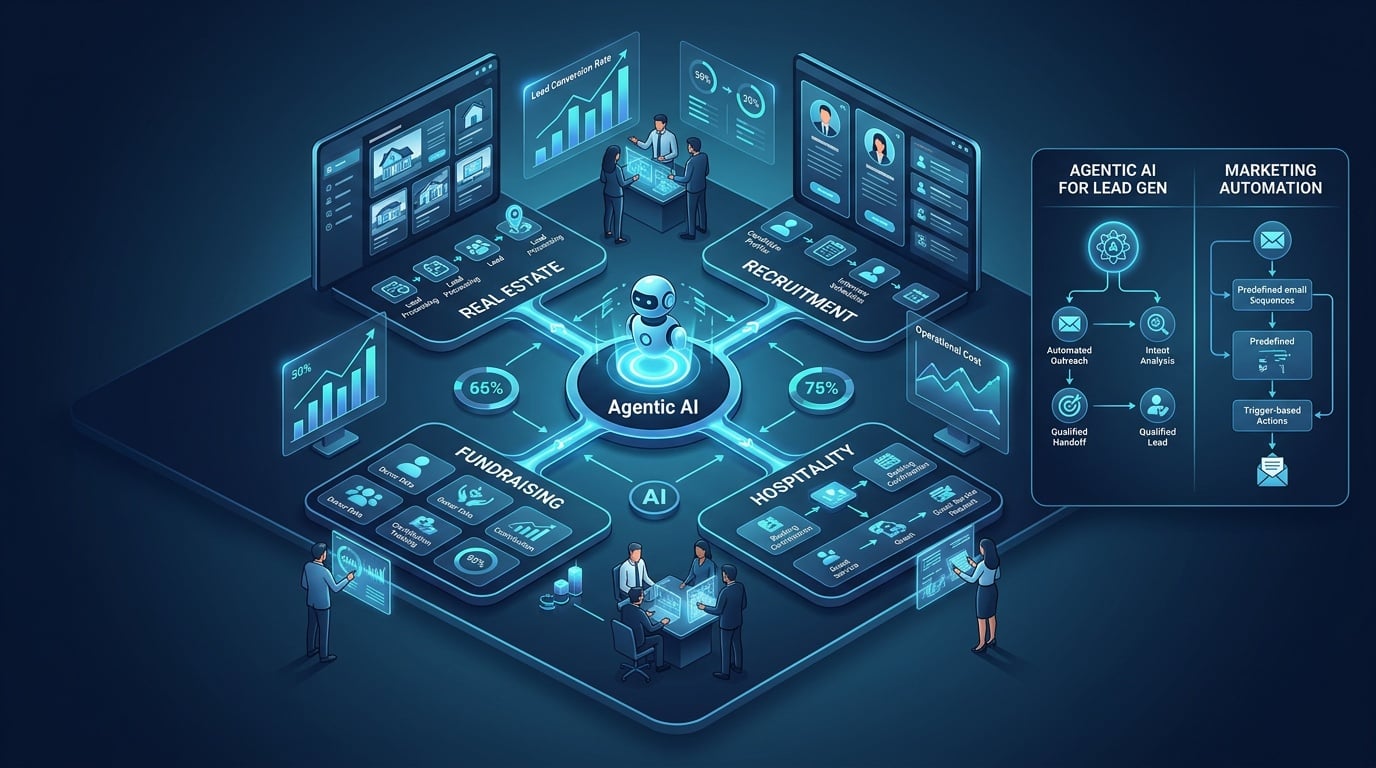
Moving from theory to practice reveals the tangible impact of agentic AI across distinct industries. When organizations compare agentic AI for lead gen vs marketing automation, the results often favor the adaptive capabilities of AI agents in verticals requiring nuanced engagement. Vynta AI has deployed enterprise-grade solutions tailored to the unique workflows of real estate, recruitment, fundraising, and hospitality. These implementations demonstrate how autonomous agents augment human teams, driving revenue growth and operational efficiency without expanding headcount.
Real Estate: From Unqualified Leads to Property Showings in Record Time
Real estate agencies face high volumes of inquiries with varying levels of intent. Traditional automation often struggles to distinguish a casual browser from a serious buyer. Agentic Systems for Real Estate resolves this by converting property inquiries into viewings and sales through instant engagement, intelligent qualification, and personalized follow-up. The system captures leads across WhatsApp, SMS, email, and website chat within seconds, ensuring response time to inquiries is less than 60 seconds. This speed significantly impacts conversion, as the qualified pipeline increases by 3x and the conversion rate is 85%. Advanced matching algorithms suggest relevant properties and virtual tours, while automated reminders reduce no-shows.
Agent productivity is maximized by automating 80% of tasks, saving over 20 hours per week, and resulting in over 30% more deals closed. The system improves client retention by 85%, client satisfaction by 27%, and generates over $100k in additional revenue per agent per year. By handling AI-driven qualification, automated property matching, and calendar coordination, agents can dedicate their time to closing deals and building relationships. This structured approach ensures that high-value prospects receive the focused, personalized attention they require, transforming cold inquiries into warm appointments.
Recruitment: Cutting Time-to-Hire with Autonomous Candidate Screening
Recruitment agencies spend significant resources screening resumes and scheduling interviews. Agentic AI streamlines this by autonomously engaging candidates, assessing fit based on conversation, and managing scheduling logistics. An AI agent can conduct initial screenings via natural dialogue, asking probing questions to evaluate soft skills and availability. This reduces the administrative burden on recruiters, allowing them to focus on high-value interactions with shortlisted candidates. The system’s ability to handle AI-driven qualification and calendar coordination ensures that top talent moves quickly through the pipeline. By automating routine outreach and qualification, agencies can cut time-to-hire while maintaining a personalized candidate experience that boosts acceptance rates.
Beyond screening, the AI agent manages the entire pre-interview lifecycle. It can schedule interviews across multiple time zones, send tailored preparation materials to candidates, and coordinate feedback loops between hiring managers. This autonomy ensures that no candidate is left waiting and that the best talent receives a white-glove experience from the first touchpoint. The learning loop allows the system to refine its screening criteria based on successful placements, continuously improving match quality and reducing the risk of bad hires.
Fundraising: Personalized Investor Outreach That Boosts Conversion
Fundraising organizations require deep, personalized relationships with investors and donors. Generic email blasts rarely convert high-net-worth individuals. Agentic AI strengthens this process by delivering hyper-personalized outreach tailored to each prospect’s history and interests. Agents can analyze past giving patterns, research donor interests, and craft messages that align with specific causes. The system handles the initial engagement, answering questions and guiding prospects toward donation opportunities. This ensures every interaction feels bespoke. The learning loop allows the AI to refine its approach based on donor responses, optimizing messaging for maximum impact. This targeted engagement results in higher conversion rates and increased lifetime value for each investor relationship.
The system also handles complex donor journeys. For multi-year campaigns, agents can track milestone anniversaries and craft personalized appreciation messages. They can segment audiences dynamically based on engagement depth, ensuring that high-potential donors receive direct outreach while broader audiences benefit from automated nurturing. This strategic segmentation maximizes the efficiency of fundraising efforts, allowing organizations to scale their outreach while preserving the personal touch that drives major gifts.
Hospitality: Guest Experience Automation That Drives Repeat Bookings
In hospitality, guest experience directly impacts revenue and loyalty. Agentic AI transforms guest interactions by providing 24/7 instant support and personalized recommendations. Whether managing booking inquiries or upsell opportunities, AI agents adapt to guest preferences in real-time. An agent can suggest room upgrades based on booking history or recommend amenities aligned with guest profiles. This level of service drives repeat bookings and increases average revenue per booking. The system collects feedback after interactions to refine future suggestions, ensuring continuous improvement. By automating routine service tasks, hospitality staff can dedicate more time to on-site guest care, elevating the overall experience while maintaining operational efficiency.
Upselling represents a significant revenue opportunity. Agentic AI identifies moments to suggest upgrades, such as late checkouts or spa packages, based on guest behavior. For example, a guest booking a conference room might receive an offer for AV equipment or catering tailored to their event size. These proactive suggestions increase ancillary revenue without adding pressure to the guest experience. The system’s ability to process preferences and deliver relevant offers instantly creates a seamless journey that encourages guests to return and recommend the property to others.
Real-World Impact: Agentic Systems for Real Estate
A mid-market real estate agency implemented Agentic Systems for Real Estate to manage inbound property inquiries. Within three months, the agency reported that agent productivity is maximized by automating 80% of tasks, saving over 20 hours per week, and resulting in over 30% more deals closed. The system improves client retention by 85%, client satisfaction by 27%, and generates over $100k in additional revenue per agent per year. By converting property inquiries into viewings and sales through instant engagement, intelligent qualification, and personalized follow-up, the qualified pipeline increases by 3x and the conversion rate is 85%. Response time to inquiries is less than 60 seconds.
References
Frequently Asked Questions
What is marketing automation for lead generation?
Marketing automation for lead generation uses predefined rules and triggers to manage repetitive tasks at scale. These systems execute programmed actions, like sending follow-up emails or scoring leads based on specific website visits or form submissions. This approach ensures consistent outreach and qualification processes for large volumes of prospects.
How does agentic AI work for lead generation?
Agentic AI for lead generation acts autonomously and adaptively, using artificial intelligence to understand context and make decisions. These AI agents engage prospects through natural conversation, qualify them based on dynamic criteria, and personalize outreach in real-time. They learn from interactions to achieve specific lead generation objectives.
When should I use agentic AI versus marketing automation for lead generation?
Use marketing automation for predictable, high-volume outreach and standard follow-ups where consistency is key. Opt for agentic AI when you need highly personalized, adaptive engagement that mimics human interaction to handle nuanced buyer journeys and complex qualification scenarios.
What is the main difference between agentic AI and marketing automation?
The main difference lies in their operational approach: marketing automation relies on static, rule-based workflows, while agentic AI uses dynamic decision-making and adaptation. Marketing automation follows a set path if X, then Y, whereas agentic AI perceives, reasons, and executes actions, often learning from outcomes.
How does agentic AI improve lead qualification?
Agentic AI improves lead qualification by discerning genuine interest through conversational nuances and dynamic criteria, unlike static scoring in marketing automation. It can identify high-value prospects more accurately by understanding immediate needs and engaging them with tailored messaging for more meaningful conversations.
Can agentic AI offer personalized lead engagement?
Yes, agentic AI offers advanced personalized lead engagement by understanding unique prospect needs through natural conversation. It can adjust its strategy in real-time, tailoring outreach and responses far beyond what static automation can achieve. This creates a more responsive and intelligent interaction.
What are the benefits of using agentic AI for lead generation?
Agentic AI enables autonomous, adaptive lead engagement that mirrors human interaction, leading to higher engagement rates through truly personalized experiences. It can handle more complex scenarios by unifying workflow automation with real-time decision-making, driving better business outcomes.