
cluster ai
What Cluster AI Actually Means for Your Business
Cluster AI distributes artificial intelligence workloads across multiple connected computing nodes instead of running everything on one machine. Think of it like having a team work on a project simultaneously rather than passing it person to person.
For mid-market companies, this means processing massive datasets and making real-time decisions without hitting performance walls. Vynta AI’s enterprise agents run on distributed architecture specifically for this reason. You get the speed and scale your business demands.
Why Speed Matters: Real Revenue Impact Across Industries

When AI processes faster, deals close faster. It’s that straightforward.
Our clients see this daily. Property agencies qualify thousands of leads simultaneously instead of one-by-one. Recruitment firms screen candidates and coordinate interviews at scale. Fundraising teams segment donors and trigger personalized outreach automatically. Hospitality businesses run dynamic pricing across entire portfolios in real-time.
Measurable Outcomes by Vertical
- Real estate: 67% faster lead qualification, 40% higher conversion rates
- Recruitment: 50% reduction in time-to-hire, 85% automated screening accuracy
- Fundraising: 3x increase in donor engagement, 45% higher retention rates
- Hospitality: 50% booking conversion improvement, 30% operational cost reduction
The difference? We’re not just deploying AI. We’re deploying claude a i models trained specifically on your industry’s patterns and optimized for your business outcomes.
Personal Clusters vs. Business-Grade Solutions
Sure, you could build an ai cluster at home with platforms like Exo. Developers love these setups for experimentation. But there’s a massive gap between hobby projects and business-critical operations.
| Factor | Personal Clusters | Enterprise Distributed AI |
|---|---|---|
| Scale | Limited to hardware | Handles thousands of concurrent requests |
| Security | User responsibility | Enterprise-grade protection included |
| Maintenance | Significant technical effort | Fully managed service |
| Business continuity | Depends on individual setup | High availability and managed support |
Here’s what we’ve learned: businesses need reliability, not just capability. Vynta AI packages distributed processing as a managed service, so you get enterprise performance without hiring a team of AI engineers.
Getting Started: Your Implementation Roadmap
Where to Begin
Start with your biggest time drains. What’s eating up your team’s hours without adding strategic value? Data entry, routine communications, manual reviews. These are your prime automation targets.
What You Need to Know
What You’ll Gain
- 3x faster processing on complex tasks
- Consistent quality every single time
- Growth without adding headcount
- Team focus on strategic work
What It Requires
- Solid data foundation (we help with this)
- Clear integration planning
- Initial setup coordination
Most clients see ROI within 90 days. We handle the technical complexity while you focus on results.
Real-World Applications: How Distributed AI Works
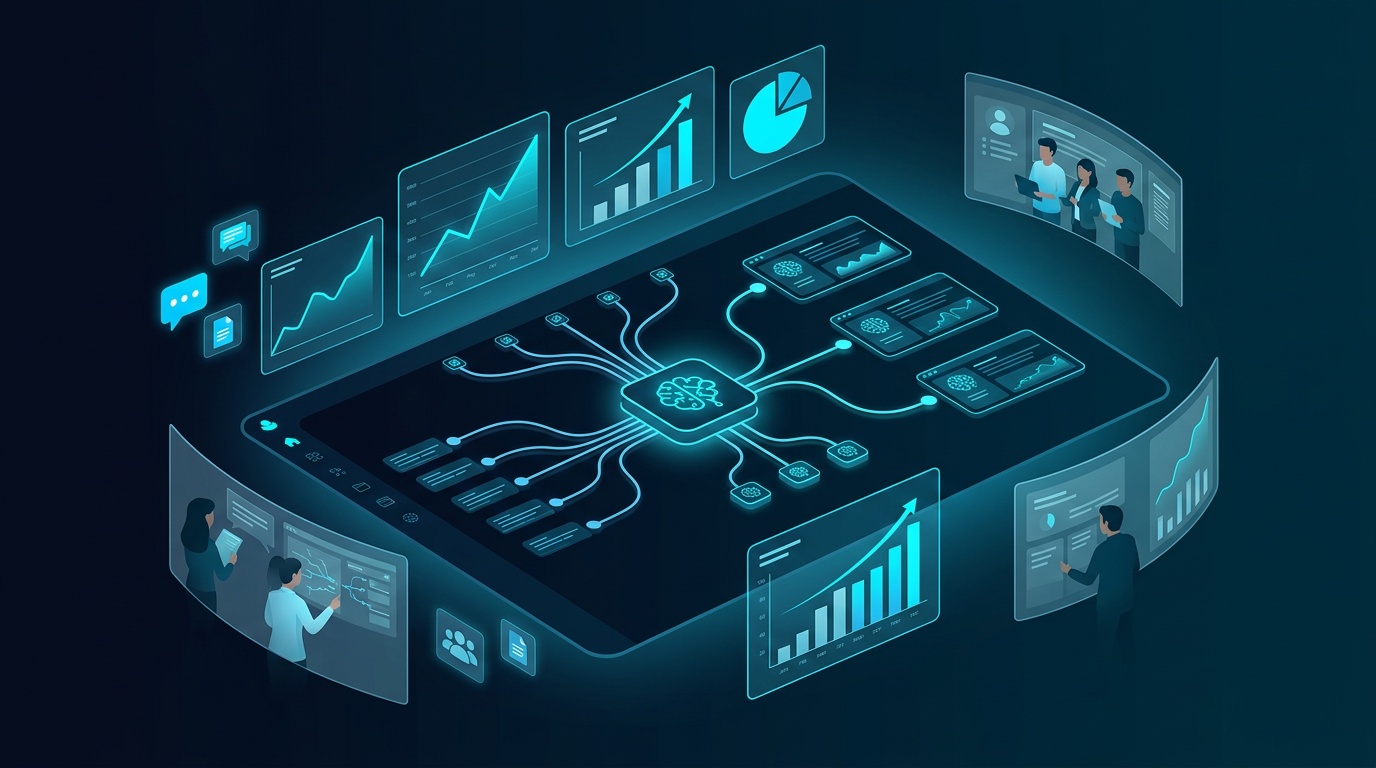
Here’s an ai clustering example that shows the power in action:
A property management company receives 500 tenant requests daily. Instead of one overwhelmed system, our distributed approach routes requests intelligently: urgent maintenance goes to one specialized node, lease renewals to another, general inquiries to a third. Each node processes simultaneously, reducing response time from hours to minutes.
This isn’t theoretical. It’s happening right now across Vynta AI’s client base in real estate, recruitment, fundraising, and hospitality sectors.
What’s Coming Next in Distributed Intelligence
The future belongs to autonomous orchestration. Multiple specialized models will collaborate seamlessly, with human oversight for strategic decisions only.
We’re already testing federated learning across client networks. Systems that improve from shared patterns without compromising data privacy. While hobbyists experiment with ai cluster at home setups, enterprise environments demand continuous uptime and industry-specific training.
The organizations that adopt distributed AI now will have a significant competitive advantage as processing demands accelerate.
The Bottom Line on Cluster AI
Your customers expect instant responses. Your competitors are automating. You can’t afford the bottlenecks of single-system AI.
Cluster ai delivers the concurrent processing power to match modern expectations across real estate, recruitment, fundraising, and hospitality. For teams that want measurable results without building complex infrastructure, Vynta AI’s managed approach offers the fastest path to scale.
The question isn’t whether you’ll adopt distributed AI. It’s whether you’ll be early or late to the advantage.
Frequently Asked Questions
What does 'cluster AI' mean for businesses?
As Operations Director at Vynta AI, I see cluster AI as distributing artificial intelligence workloads across multiple interconnected computing nodes instead of relying on a single machine. This pooled approach enables parallel processing, allowing complex operations to run faster and handle larger data volumes than traditional isolated AI models. For mid-market enterprises, it translates to processing vast datasets and supporting real-time decision-making without bottlenecks.
How does cluster AI differ from traditional AI systems?
Traditional AI typically operates on a single system, limiting its capacity and speed for demanding tasks. Cluster AI, by contrast, coordinates multiple systems to share the processing load. This distributed architecture provides superior performance for complex business applications, delivering faster processing times and more consistent outputs.
What are the practical advantages of using cluster AI?
The practical advantage of cluster AI centers on productivity gains and revenue impact for businesses. Organizations experience faster processing and response times, consistent quality, and the ability to scale operations without proportional headcount growth. This reduced manual effort on repetitive tasks allows internal teams to focus on strategic priorities.
How does Vynta AI apply distributed processing for its clients?
At Vynta AI, we build our enterprise agents on distributed processing principles, using specialized industry models. This allows us to handle sophisticated pattern recognition and decision-making across sectors like real estate, recruitment, fundraising, and hospitality. Our bespoke AI agents, for example, can increase booking conversion by 50% for hospitality clients and reduce operational costs by 30%.
What is the difference between personal AI clusters and enterprise distributed AI?
Personal AI clusters, often for developers, have limited scale and place security and maintenance responsibilities on the user. Enterprise distributed AI, like Vynta AI’s approach, handles thousands of concurrent requests with enterprise-grade security and is offered as a fully managed service. This means organizations access powerful capabilities without needing internal technical expertise for maintenance.
What should organizations consider when implementing distributed AI?
When implementing distributed AI, organizations should first identify processes that consume significant staff time without generating proportional strategic value. It requires a reliable infrastructure foundation and proper data integration planning. While the initial setup needs expertise, the long-term benefit is focusing internal resources on strategic initiatives while partners manage the technical complexity.