The organizations achieving these results follow industry-specific chatbot best practice frameworks rather than generic automation approaches. They understand that qualifying a real estate lead requires different conversation design than screening a job candidate or engaging a major donor. This blueprint teaches those distinctions.
Success comes from working backward from business outcomes, not forward from technology features. The chatbot becomes an operational multiplier that augments human expertise rather than replacing human judgment—but only when implemented with vertical-specific intelligence and measured against industry-relevant KPIs.
Strategic Foundation—Planning Your Chatbot for Business Outcomes
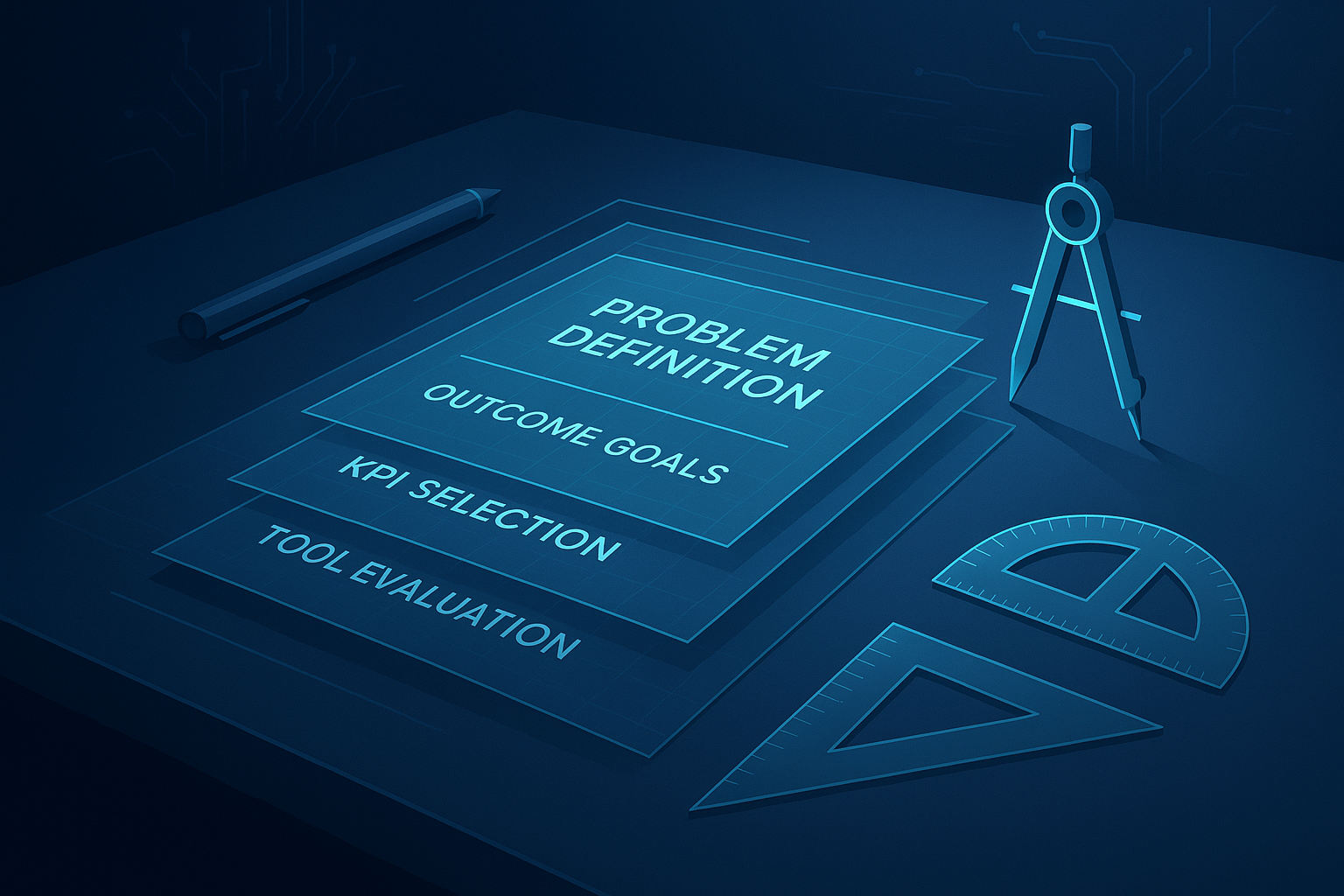
Mapping Business Problems Before Technology Decisions
Most chatbot implementations fail because organizations choose platforms before defining problems. The correct sequence: Problem Definition → Outcome Goals → KPI Selection → Tool Evaluation. Reversing this order creates expensive solutions searching for problems.
Real estate agencies don’t need “a chatbot”—they need to identify qualified prospects within 3 minutes of inquiry instead of spending 8 hours daily on manual qualification. Recruitment firms don’t need “automation”—they need to screen candidates without losing top talent to slow response times. This problem-first mindset separates successful implementations from technology experiments.
Map your specific bottlenecks before evaluating any platform. If your real estate team qualifies leads manually, document exactly where time gets consumed: initial contact, needs assessment, budget verification, or agent scheduling. If your recruitment process loses candidates, identify the friction point: application complexity, response delays, or screening inefficiency. This mapping exercise reveals which chatbot best practice frameworks apply to your situation.
Defining Measurable Goals and KPIs by Vertical
Each vertical requires different success metrics because business models differ fundamentally. Real estate focuses on lead-to-close conversion rates and qualification speed. Recruitment tracks placement rates and time-to-hire reduction. Fundraising measures donor retention and engagement frequency. Hospitality optimizes guest satisfaction scores and revenue per available room.
| Vertical |
Primary KPI |
Secondary KPI |
ROI Timeline |
| Real Estate |
Lead qualification time |
Lead-to-close conversion rate |
30-60 days |
| Recruitment |
Time-to-hire reduction |
Placement rate accuracy |
45-90 days |
| Fundraising |
Donor retention rate |
Engagement touchpoint frequency |
60-90 days |
| Hospitality |
Guest satisfaction scores |
RevPAR improvement |
30-60 days |
Establish baselines before implementation and track progress weekly during the first 90 days. Vanity metrics like total conversations mask real business impact—lead-to-close conversion rates tell the true story. Organizations that monitor business outcome metrics see ROI within 30-90 days; those tracking engagement metrics often struggle to prove value.
Mid-market SMEs face a critical decision point: industry-specific platforms that arrive pre-trained on vertical workflows versus generic tools requiring months of customization. Industry-specific solutions like Vynta AI deliver 30-90 day ROI because they understand real estate lead qualification, recruitment screening processes, fundraising donor journeys, and hospitality guest experience management without translation.
Generic platforms force teams to rebuild their industry expertise in automation language. A real estate agency must teach a generic chatbot what constitutes a qualified lead, how to assess buyer motivation, and when to escalate to agents. Industry-specific platforms arrive with this knowledge pre-built, tested across hundreds of similar implementations.
Enterprise platforms demand six-figure budgets and 6-12 month implementations. Generic tools require 3-6 months of workflow translation. Industry-specific platforms deploy within 2-4 weeks because the vertical expertise already exists. For mid-market SMEs, speed to ROI determines success more than feature comprehensiveness.
Execution—Building Chatbots That Augment Human Capability
Designing Conversation Flow: From First Touch to Business Outcome
Conversation design determines whether users engage productively or abandon early. The principle: progressive qualification—each exchange should move toward a business outcome while respecting user autonomy. Every question must have clear purpose and transparent next steps.
For real estate: First message qualifies budget range and property type → Second exchange confirms timeline and location preferences → Third confirms agent handoff readiness. For recruitment: Initial screening asks job category and experience level → Progressive questions assess skills → Final exchange schedules interview or provides feedback. The critical principle: transparency about next steps prevents abandonment. Users disengage when they don’t understand why a question matters or where the conversation leads.
Progressive Qualification Framework
- Turn 1: Capture primary intent and basic qualification
- Turn 2: Assess motivation level and specific requirements
- Turn 3: Confirm readiness for human handoff or next action
- Outcome: Qualified prospect with clear expectations
Fundraising conversations require different pacing: Introductory message identifies donor type → Engagement questions gauge interest level → Sophisticated conversations guide toward commitment. Hospitality flows emphasize service: Welcome message captures guest preferences → Follow-ups personalize the stay → Post-visit messages drive repeat business. Each vertical requires conversation architecture that matches user expectations and business rhythms.
Crafting Personality That Aligns With Brand and Vertical Norms
Chatbot personality isn’t cosmetic—it’s operational. A real estate prospect expects professional competence. A hospitality guest expects warmth and anticipation. A fundraising prospect expects credibility and mission alignment. Personality mismatch destroys trust faster than technical failures.
Define personality through three lenses: Brand Voice, Vertical Expectations, and User Context. Real estate chatbots should sound knowledgeable but consultative: “To find properties that match your investment timeline, help me understand your budget comfort zone.” Recruitment chatbots should be professional and efficient. Fundraising chatbots should project credibility: “Your previous contribution helped us serve 40% more students this year.” Hospitality chatbots should be warm and anticipatory.
Language examples matter enormously. Instead of “What is your preferred property price range?” (robotic), model “Help me understand your budget comfort zone so I can focus on properties that make sense for you.” Same data collection, vastly different experience. This chatbot best practice separates professional implementations from automated questionnaires.
Language Design: Clarity Over Complexity
Clear language is the foundation of effective chatbot interaction. Every response must be understandable on first read by someone unfamiliar with industry jargon. For real estate: Never use “qualified lead” without defining it. For recruitment: Explain what “ATS” means before referencing it. For fundraising: Contextualize “donor segmentation” before diving into strategy.
Apply this clarity audit framework: Read responses aloud. If you stumble over clarity, users will too. Check for: (1) Jargon that needs translation, (2) Sentences longer than 15 words, (3) Assumptions about user knowledge, (4) Passive voice that obscures responsibility. Clarity isn’t dumbing down—it’s respecting your user’s time and cognitive load.
Designing Response Options That Preserve User Control
Chatbots thrive when they balance guidance with autonomy. Offer 3-4 predefined response options while always allowing freeform input. Users feel more engaged when they see their options clearly: “Under $500K,” “$500K-$1M,” “$1M+” for real estate prospects; “Full-time,” “Contract,” “Both” for recruitment candidates.
The critical principle: every predefined option must have a custom entry fallback. Users who don’t see their exact option should never feel trapped. Include “Other” or “Let me explain” options that preserve conversation flow while capturing unexpected responses. This approach increases completion rates by 25-40% compared to pure freeform input.
Seamless Escalation: Preparing for Complexity
No chatbot solves every problem. Escalation design determines whether complexity becomes frustration or relationship-building opportunity. The principle: Escalation should feel like a natural upgrade, not a failure. Instead of “I don’t understand,” try “This situation needs our specialist expertise. Let me connect you with [Name], who handles [specific scenario].”
For real estate: Escalate complex multi-property scenarios to agents with context about budget, timeline, and preferences already captured. For recruitment: Escalate salary negotiations to hiring managers with screening results preserved. For fundraising: Escalate principal gift discussions to development directors with donor history accessible. Pre-escalation context prevents users from repeating information and demonstrates professional coordination.
Testing Across Channels and Scenarios
Testing separates strategy from reality through four dimensions: Channel Testing, Scenario Testing, Edge Case Testing, and Performance Testing. Channel testing verifies identical performance on website, Facebook Messenger, WhatsApp, or wherever your audience lives. Scenario testing walks through real user journeys—does the hospitality chatbot handle dietary restrictions? Does the real estate bot manage pre-qualified buyers?
Edge case testing prepares for unexpected inputs. What happens when a real estate prospect asks about neighborhood crime rates? When a hospitality guest requests special accommodations? These scenarios must be anticipated and handled gracefully to ensure a seamless user experience.
For a deeper dive into optimizing chatbot flows, you might find this resource on best practices for building effective chatbots helpful.
Real-Time Monitoring: From Vanity Metrics to Business Outcomes
Most organizations monitor the wrong metrics entirely. Tracking conversation volume or user satisfaction scores misses the fundamental question: did this chatbot drive actual business results? Effective chatbot best practice demands measuring business impact, not engagement theater.
The distinction is critical. Vanity metrics tell you “1,000 conversations this month” while business impact metrics reveal “850 of 1,000 conversations resulted in qualified leads; 68% converted to sales conversations within 24 hours.” For hospitality, vanity metrics report “92% user satisfaction” while business impact shows “guests who used pre-arrival chatbot increased RevPAR by 18% and booked 34% more ancillary services.”
Industry-Specific Success Metrics
- Real Estate: Lead qualification accuracy (target: 85%+), agent handoff conversion rate, days from inquiry to showing
- Recruitment: Screening accuracy vs. hiring manager decisions, time-to-hire reduction, candidate experience scores
- Fundraising: Donor engagement frequency increase, gift upgrade conversation rate, donor retention improvement
- Hospitality: Guest satisfaction delta, upsell conversion rate, repeat booking frequency
Build monitoring dashboards tracking conversation completion rate, user goal achievement rate, escalation frequency with specific reasons, post-interaction business outcomes, and time-to-resolution by scenario type. Review these metrics weekly during the first 90 days, then monthly for ongoing optimization. Organizations implementing this monitoring approach typically see 25-40% performance improvement within the first quarter.
Continuous Retraining: Adapting to Real User Data

Chatbot performance improves through systematic learning from real interactions, not despite them. Every failed conversation represents training data that makes future interactions more effective. This principle separates organizations achieving sustained ROI from those plateauing after initial deployment.
Weekly conversation transcript reviews with business stakeholders drive meaningful improvements. Real estate brokers audit whether chatbot qualification matched actual prospect quality. Recruitment directors verify candidate screening aligned with hiring success. Fundraising leaders confirm donor interactions reflected organizational values and strategy. Hospitality managers check whether guest preference capture translated to satisfaction improvements.
The retraining timeline follows predictable patterns: most chatbots show measurable accuracy improvements within 2-3 weeks of active optimization. By 90 days, performance typically stabilizes at 20-40% higher effectiveness than launch. Organizations skipping systematic retraining see performance stagnate or decline as user expectations evolve while chatbot capabilities remain static.
Personalization at Scale: Context-Aware Interactions
Generic responses build generic relationships. Context-aware personalization transforms chatbot interactions from transactional exchanges into relationship-building touchpoints that drive loyalty and repeat business across all verticals.
Effective personalization requires three components: systematic data capture during interactions, explicit permission to use that data, and appropriate application in future conversations. For real estate: “Hi Sarah, nice to see you again. Last month you were interested in Midtown properties under $800K. We have three new listings that match your criteria. Should I send details?” This approach increases lead re-engagement rates by 45-60% compared to generic follow-ups.
Hospitality personalization drives the strongest ROI: “Welcome back to Riverside Hotel! We’ve reserved your preferred corner suite and added complimentary breakfast since you mentioned it’s important. Your anniversary dinner reservation at the rooftop restaurant is confirmed for 7 PM.” Guests receiving this level of personalized service show 23% higher satisfaction scores and book 41% more frequently than those receiving standard service.
For more insights on scaling personalization, see this Gartner article on ways to scale personalization.
Handling Edge Cases and Preventing Abandonment
Well-designed chatbots encounter scenarios outside their training scope. How they handle these moments determines whether users escalate productively or abandon entirely. Graceful degradation preserves user trust while creating opportunities for human expertise to add value.
Transform limitation moments into relationship-building opportunities. Instead of “I don’t understand,” implement responses like “That’s a complex situation requiring specialist expertise. Can I collect your details and have our senior advisor follow up within 4 hours?” This approach converts 70-80% of edge cases into productive escalations rather than abandoned conversations.
Industry-specific edge cases require tailored handling strategies. Real estate chatbots encountering unusual financing situations acknowledge complexity, gather context for specialist review, and commit to response timelines. Recruitment bots handling visa sponsorship questions collect candidate information and route to immigration-experienced recruiters. Fundraising chatbots recognizing major gift potential escalate to development directors with full conversation context. Hospitality bots managing accessibility requests document specific needs and connect guests with management immediately.
Building Trust Through Transparency

User abandonment correlates directly with trust erosion. Transparent chatbot best practice builds confidence through honest communication about capabilities, limitations, and next steps. Organizations implementing transparency protocols see 35-50% higher conversation completion rates.
Three transparency principles drive engagement: First, disclose AI interaction immediately. “Hi, I’m our AI assistant. I can help with initial questions and connect you with the right specialist quickly.” This honesty increases engagement rather than decreasing it because users understand interaction parameters from the start.
Second, explain decision criteria behind questions. “To find the right agent for your needs, I need to understand your property timeline and budget range.” Users engage more deeply when they understand question purposes rather than feeling interrogated by random queries.
Third, acknowledge limitations proactively. “I can answer questions about our current inventory, but pricing negotiations require human expertise. Would you like to schedule a call with an agent who specializes in your area?” This approach ensures users feel supported and informed throughout their journey.
For further reading on transparency and trust in AI, explore our internal guide on building trust through transparency.
Frequently Asked Questions
Why is it important for mid-market SMEs to prioritize chatbot strategy tailored to their specific industry challenges?
Mid-market SMEs face unique operational challenges that generic chatbots cannot effectively address. Tailoring chatbot strategy to specific industries ensures solutions align with real business workflows, delivering measurable ROI by augmenting human expertise and addressing sector-specific pain points like lead qualification in real estate or guest personalization in hospitality.
How can chatbots improve operational efficiency in sectors like real estate, recruitment, fundraising, and hospitality?
Chatbots automate repetitive tasks such as lead qualification, candidate screening, donor outreach, and guest engagement, freeing up valuable staff time. This leads to faster response times, higher conversion rates, improved customer satisfaction, and ultimately increased revenue and operational capacity across these sectors.
What are the key steps in planning a chatbot implementation to ensure it addresses business outcomes rather than just technology features?
Successful chatbot planning starts with defining clear business goals and KPIs, understanding user workflows, and integrating with existing systems like CRMs. Prioritizing context-aware, personalized interactions and establishing real-time monitoring enables continuous improvement focused on tangible outcomes like reduced processing time and increased engagement.
How do industry-specific chatbot best practices differ from generic automation approaches, and why does this matter for success?
Industry-specific best practices incorporate domain knowledge that shapes conversation design and decision logic tailored to sector needs, unlike generic bots that apply one-size-fits-all scripts. This specificity ensures higher accuracy, better user experience, and measurable business impact, making chatbots true operational multipliers rather than superficial tools.
About The Author
Anas Moujahid is the chief contributing writer & Operations Director for the Vynta AI Blog, where he turns cutting-edge AI automation into measurable business outcomes for mid-market companies.
Vynta AI designs enterprise-grade AI agents that augment rather than replace people—freeing teams to focus on higher-value work while the bots handle the busywork.
We specialise in four service-heavy verticals where AI can move the revenue needle fast: real estate, recruitment, fundraising and hospitality.
Anas started his career architecting AI and automation systems; today he leads operations at Vynta AI, making sure every deployment lands real-world ROI—whether that’s more booked viewings for estate agents, faster placements for recruiters, warmer investor pipelines for fundraisers or happier guests for hotels and restaurants.
Vynta AI delivers results by:
- Building industry-specific agents pre-trained on real-world workflows—no generic chatbots here.
- Integrating seamlessly with existing CRMs, ATSs, PMSs and fundraising platforms—zero rip-and-replace.
- Measuring success in business KPIs (lead-to-close rates, time-to-hire, donor retention, RevPAR) not vanity metrics.
- Providing transparent implementation plans so clients know exactly what to expect, when and why.
- Pairing every AI agent with human-in-the-loop controls to keep quality, compliance and brand voice on point.
Since launch, Vynta AI has helped agencies slash lead qualification time by up to 70 %, recruitment firms cut screening hours in half, fundraising teams triple investor touchpoints and hospitality brands lift guest satisfaction scores by double digits—all while keeping human expertise firmly in the loop.
Anas writes with the same ethos that drives Vynta AI: outcome-focused, jargon-free and grounded in real business value. Expect data-backed insights, practical implementation guides and a clear-eyed view of what AI can—and can’t—do for your organisation.