Recruitment business services encompass specialized organizations that handle talent acquisition functions for client companies—from boutique agencies focusing on specific industries to technology-enabled platforms that automate entire hiring workflows. These services address critical business needs including candidate sourcing, credential verification, interview coordination, and compliance management, particularly valuable for organizations without dedicated internal recruitment teams.
Each core service connects directly to measurable business outcomes: automated screening reduces manual review time by 85%, AI-powered matching increases candidate quality scores by 30%, and streamlined interview processes cut time-to-hire from weeks to days. The most effective business services examples for recruitment combine industry expertise with automation to deliver both speed and quality improvements.
Core Types of Recruitment Business Services
| Service Type |
Typical Client Need |
Implementation Time |
Measurable Outcome |
| Contingency Search |
Fill mid-level roles quickly |
1-2 weeks |
50% faster placement vs. internal hiring |
| Retained Search |
Executive/specialized positions |
6-12 weeks |
93% retention rate at 12 months |
| RPO Services |
Scale hiring operations |
30-90 days setup |
25-40% reduction in cost-per-hire |
| Contract Staffing |
Immediate workforce flexibility |
24-48 hours |
Same-day deployment for urgent needs |
Contingency and Retained Search Models
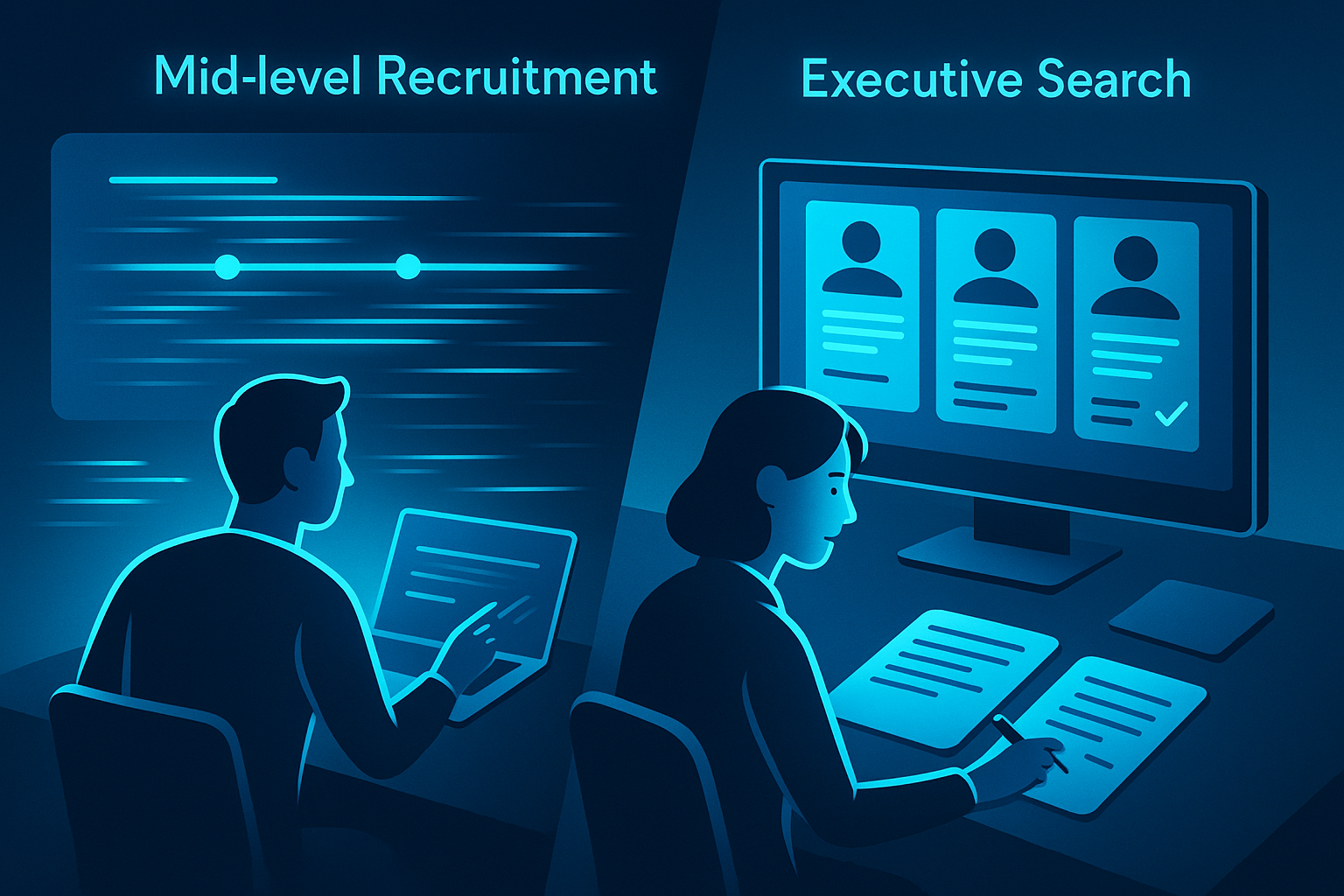
Contingency Search operates on success-based fees, making it ideal for growing firms filling sales, marketing, or operational roles within tight timelines. A hospitality company needing seasonal managers can leverage contingency services to fill five positions in two weeks, eliminating revenue loss from understaffing during peak periods.
Retained Search provides dedicated, high-touch service for C-suite and niche technical roles where industry expertise is critical. Technology firms use retained search to place VPs of Engineering, achieving 93% retention rates by matching both technical skills and cultural fit through comprehensive assessment processes.
RPO and Contract Staffing Solutions
Recruitment Process Outsourcing (RPO) manages end-to-end hiring operations, particularly valuable for companies scaling rapidly. A real estate firm expanding from 20 to 50 agents used RPO services to build their team in 90 days while cutting cost-per-hire by 35% through streamlined processes and bulk sourcing strategies.
Contract Staffing delivers immediate workforce flexibility for project-based needs or seasonal fluctuations. Event management companies rely on contract staffing to deploy hospitality teams within 24 hours, ensuring seamless guest experiences without maintaining year-round overhead costs.
How AI-Enhanced Recruitment Services Operate
The Modern Recruitment Workflow
AI-powered recruitment services follow a structured five-step process that dramatically reduces manual work while improving outcomes. Step 1: Job Definition uses AI analysis of successful placements to refine requirements. Step 2: Automated sourcing scans databases and networks 24/7, delivering initial shortlists within 48 hours. Step 3: AI screening parses CVs and scores candidates, reducing manual review from 3 hours daily to under 30 minutes.
Step 4: Automated interview scheduling resolves 90% of booking conflicts without human intervention, while AI-generated questions ensure consistency. Step 5: Offer management uses templated processes and compliance checks to accelerate final stages. This workflow transforms recruitment from a weeks-long manual process into a streamlined operation delivering qualified candidates in days.
Human-AI Collaboration and Compliance
The most effective business services examples for recruitment leverage human-AI partnership, where agency expertise guides strategic decisions while AI handles data processing and routine communications. Experienced recruiters focus on relationship building and cultural fit assessment, while automated systems manage compliance checks, reference verification, and candidate communication workflows.
Modern recruitment services maintain strict data security protocols and bias-reduction algorithms, ensuring fair candidate evaluation while meeting regulatory requirements across industries. This collaborative approach delivers both the personal touch clients expect and the efficiency gains that drive competitive advantage.
Why Use Business Services for Recruitment? ROI and Competitive Advantage
Organizations leveraging recruitment business services gain immediate access to established talent pipelines and proven methodologies without building internal infrastructure. These services eliminate administrative burden while providing scalability—companies can ramp hiring during growth phases without permanent overhead increases. The business case becomes compelling when considering that manual recruitment processes consume 40+ hours per successful hire versus 15 hours with automated assistance.
Proven ROI Metrics
- 50% reduction in time-to-hire through process automation and AI screening
- 30-40% lower cost-per-hire compared to fully manual, in-house processes
- 25% higher candidate satisfaction with streamlined interview experiences
- 85% improvement in retention rates using predictive matching algorithms
Industry-specific examples demonstrate measurable impact: hospitality businesses use recruitment services to source and onboard seasonal staff within 48 hours, preventing guest service disruptions during peak periods. Technology companies partnering with AI-enhanced agencies double their qualified applicant delivery rates while maintaining quality standards. Real estate firms report 35% faster agent onboarding, directly correlating to increased listing capacity and revenue growth.
The competitive advantage extends beyond speed—recruitment services provide market intelligence, salary benchmarking, and candidate experience optimization that individual companies cannot replicate internally. Organizations using these business services examples for recruitment consistently outperform competitors in talent acquisition metrics and employee retention.
Choosing and Evaluating Recruitment Business Services

Service Provider Selection Process
Step 1: Define measurable outcomes aligned with business goals—faster hiring for seasonal peaks, improved retention for senior roles, or diversity targets for leadership positions. Step 2: Assess industry knowledge by requesting sector-specific case studies and client references from similar organizations. Step 3: Evaluate technology capabilities including ATS integration, AI screening tools, and real-time reporting dashboards that provide visibility into recruitment metrics.
Successful partnerships require clear service level agreements covering time-to-hire targets, candidate quality metrics, and communication protocols. The best business services examples for recruitment provide transparent reporting on key performance indicators including candidate conversion rates, interview-to-offer ratios, and 90-day retention statistics.
Evaluation Checklist and Common Pitfalls
Essential Integration Requirements: Seamless connectivity with existing HRIS systems, calendar platforms, and communication tools. Verify the balance between automation and human oversight—fully automated systems may miss cultural fit while purely manual processes lack efficiency gains. Confirm data security certifications and diversity, equity, inclusion (DEI) compliance protocols.
Warning Signs: Poor candidate fit indicates inadequate intake processes—request a detailed workflow audit and escalation procedures. Cost overruns suggest unclear scope definition—negotiate results-based fee structures with defined deliverables. Switch providers if you experience: consistent missed deadlines, lack of industry expertise, or inadequate communication transparency. For further reading on the evolution and best practices of recruitment, see this overview of recruitment.
Comparing Recruitment Agency Models—Which Fits Your Business?
| Model |
Cost Structure |
Speed |
Best Industry Fit |
Implementation Time |
Key Considerations |
| Contingency |
Success-based fee (15-25%) |
1-3 weeks |
Sales, operations, mid-management |
Immediate |
No upfront cost, volume-focused |
| Retained |
Fixed fee (25-35%) |
6-12 weeks |
Executive, specialized technical |
1-2 weeks setup |
Dedicated resources, thorough vetting |
| RPO |
Monthly retainer + per-hire |
Scalable |
High-volume, multi-location |
30-90 days |
Long-term partnership required |
| Contract Staffing |
Markup on hourly rates |
24-48 hours |
Hospitality, events, seasonal |
Same day |
Flexible workforce, no benefits |
| AI-Enhanced Platforms |
Subscription + success fees |
2-7 days |
Tech-forward, data-driven orgs |
1-2 weeks |
Requires system integration |
Maximizing Results with AI-Driven Recruitment Services
AI-enhanced recruitment services deliver measurable improvements through instant candidate matching, bias reduction algorithms, and predictive hiring analytics. These systems process thousands of applications simultaneously while identifying candidates who meet both technical requirements and cultural fit indicators, reducing manual screening time from hours to minutes.
Implementation Strategy
Start with pilot workflows targeting your biggest bottlenecks—typically interview scheduling or initial screening processes. Monitor key metrics weekly including time-to-hire, candidate quality scores, and satisfaction ratings. Always maintain human oversight for final candidate decisions while leveraging automation for data processing and routine communications.
Real-world applications demonstrate significant impact: a hospitality management company using AI-powered scheduling reduced interview no-shows by 85% while improving staff-guest compatibility scores. The system automatically matches candidate availability with operational needs, ensuring optimal staffing during peak periods without manual coordination. For more on how AI is transforming recruitment, see this SHRM article on artificial intelligence in recruiting.
Success requires balancing automation with human judgment—AI excels at data analysis and pattern recognition, while experienced recruiters provide strategic guidance and relationship management. This collaborative approach ensures both efficiency gains and the personal touch that differentiates quality recruitment services from generic hiring platforms.
Strategic Recommendations and Future Considerations

The evolution of business services examples for recruitment points toward increased specialization and technology integration. Organizations achieving the best results partner with providers who combine industry expertise with advanced automation capabilities, creating sustainable competitive advantages in talent acquisition.
For immediate impact, prioritize recruitment services that offer transparent reporting, measurable outcomes, and seamless integration with existing systems. The most successful partnerships focus on long-term relationship building rather than transactional hiring, creating talent pipelines that support sustained business growth.
Future recruitment services will leverage predictive analytics to anticipate hiring needs, automated compliance monitoring for regulatory requirements, and enhanced candidate experience platforms that strengthen employer branding. Organizations that establish these partnerships now position themselves ahead of competitors still relying on manual recruitment processes.
Vynta AI’s recruitment automation solutions exemplify this next-generation approach, combining industry-specific expertise with AI-powered efficiency to deliver measurable results within 30-90 days. Our platform integrates seamlessly with existing workflows while providing the transparency and control that growing businesses require for strategic talent acquisition.
Frequently Asked Questions
What are the main types of recruitment business services and how do they differ in their approach and outcomes?
The main types include contingency agencies, retained search firms, and Recruitment Process Outsourcing (RPO) providers. Contingency agencies work on a success-fee basis and focus on volume and speed, retained search firms offer specialized, high-touch candidate sourcing for executive roles, and RPO services manage end-to-end recruitment workflows, delivering scalable and cost-efficient hiring solutions with deeper integration into the client’s business.
How does AI-powered automation improve the efficiency and quality of the recruitment process?
AI automation accelerates candidate screening by reducing CV review time from hours to minutes, automates interview scheduling to eliminate booking conflicts, and enhances candidate matching through data-driven algorithms. This leads to faster time-to-hire, higher quality candidate shortlists, and improved retention rates by augmenting human recruiters rather than replacing them.
What measurable benefits can mid-market companies expect by using recruitment business services?
Mid-market companies can expect up to a 50% reduction in time-to-hire, a 25-40% decrease in cost-per-hire with RPO models, and improved candidate quality scores. These services provide immediate access to talent pipelines and proven hiring strategies, resulting in faster placements and higher employee retention compared to fully manual recruitment processes.
How do contingency, retained search, and RPO services compare in terms of implementation time and hiring results?
Contingency agencies offer the fastest implementation with quick candidate delivery but may vary in candidate quality. Retained search involves longer lead times due to deep market research and candidate vetting, yielding higher-quality executive placements. RPO services require more upfront integration time but deliver consistent, scalable hiring results with measurable cost savings and process optimization over time.
About The Author
Anas Moujahid is the chief contributing writer & Operations Director for the Vynta AI Blog, where he turns cutting-edge AI automation into measurable business outcomes for mid-market companies.
Vynta AI designs enterprise-grade AI agents that augment rather than replace people—freeing teams to focus on higher-value work while the bots handle the busywork.
We specialise in four service-heavy verticals where AI can move the revenue needle fast: real estate, recruitment, fundraising and hospitality.
Anas started his career architecting AI and automation systems; today he leads operations at Vynta AI, making sure every deployment lands real-world ROI—whether that’s more booked viewings for estate agents, faster placements for recruiters, warmer investor pipelines for fundraisers or happier guests for hotels and restaurants.
Vynta AI delivers results by:
- Building industry-specific agents pre-trained on real-world workflows—no generic chatbots here.
- Integrating seamlessly with existing CRMs, ATSs, PMSs and fundraising platforms—zero rip-and-replace.
- Measuring success in business KPIs (lead-to-close rates, time-to-hire, donor retention, RevPAR) not vanity metrics.
- Providing transparent implementation plans so clients know exactly what to expect, when and why.
- Pairing every AI agent with human-in-the-loop controls to keep quality, compliance and brand voice on point.
Since launch, Vynta AI has helped agencies slash lead qualification time by up to 70 %, recruitment firms cut screening hours in half, fundraising teams triple investor touchpoints and hospitality brands lift guest satisfaction scores by double digits—all while keeping human expertise firmly in the loop.
Anas writes with the same ethos that drives Vynta AI: outcome-focused, jargon-free and grounded in real business value. Expect data-backed insights, practical implementation guides and a clear-eyed view of what AI can—and can’t—do for your organisation.