

Key Takeaways
- AI enhances scalability in service firms by augmenting human capabilities during initial screenings and deal closures.
- Business services companies rely on relationship-building and expertise rather than inventory management.
- Workflow automation powered by AI can deliver up to 40% cost savings without replacing core staff.
- Agents supported by AI can handle 70% of initial customer screenings efficiently.
- Professionals in service firms close 90% of deals, supported by AI-driven processes.
Table of Contents
- Why Business Services Companies Are Pivoting to AI Automation in 2025
- What Are Business Services Companies? Core Definitions and Economic Impact
- Step-by-Step Guide: Launching AI-Enabled Business Services in High-Growth Verticals
- Business Services vs. Product-Based Companies: Why Services Win with AI Augmentation
- Step-by-Step Guide: How to Start a Business Services Company in Real Estate, Recruitment, Fundraising, or Hospitality
- How to Choose and Scale the Right Business Services Provider – In-House vs. Outsourced vs. AI-Enabled
- Top Challenges in Business Services Companies and AI-Driven Solutions Across Verticals
- Best Business Services Companies and AI Providers for SMEs in 2025 – Curated List with ROI Benchmarks
Why Business Services Companies Are Pivoting to AI Automation in 2025
Business services companies—B2B firms delivering intangible value through expertise in professional services, financial advisory, IT support, and operations outsourcing—distinguish themselves from product manufacturers by relying on human capital and scalable processes rather than inventory management. This business services companies guide reveals how these firms are fundamentally different from traditional product businesses, focusing on recurring relationships and expertise-driven solutions across sectors like real estate lead qualification, recruitment candidate screening, fundraising investor outreach, and hospitality guest experience management.
The 2025 shift represents an economy-wide transformation where service-heavy models now comprise 80% of U.S. GDP, demanding AI integration to handle repetitive tasks while enabling 2-3x scaling without proportional headcount growth. Vynta AI deployments consistently demonstrate this potential, slashing lead qualification time by 70% for real estate agencies and reducing recruitment screening cycles by 50%, allowing human experts to focus on high-value relationship building and complex decision-making that drives revenue growth.
What Are Business Services Companies? Core Definitions and Economic Impact
Business services companies provide essential B2B support through expertise-driven solutions rather than physical products, encompassing everything from real estate agencies qualifying property leads to recruitment firms screening candidates for optimal job matches. These firms operate on fundamentally different principles than product-based businesses, prioritizing scalable human expertise augmented by intelligent automation systems.
The defining characteristics of successful business services companies include high scalability potential through automation, recurring revenue models that build long-term client relationships, human-AI hybrid teams that maximize both efficiency and personalization, and industry-specific challenges requiring specialized solutions. For example, hospitality managers need guest upselling automation while maintaining personal service standards, while fundraising organizations require systematic investor outreach that preserves relationship authenticity.
| Service Type | Core Function | Vynta AI Application | Typical ROI Metric |
|---|---|---|---|
| Professional Services | Consulting, legal support | Real estate lead matching | 70% faster qualification |
| Financial Services | Fundraising outreach | Investor personalization | 3x meetings booked |
| IT Services | ATS/CRM automation | Recruitment screening | 50% time-to-hire reduction |
| Operations Outsourcing | Guest management | Hospitality upselling | 20% RevPAR increase |
Key performance indicators for this business services companies guide include client retention rates above 85%, revenue per consultant exceeding $150K annually, and process efficiency gains of 20+ hours saved weekly through intelligent automation. The most successful firms audit their services using the 80/20 rule—identifying the 80% of repetitive tasks that can be automated within 2 weeks using pre-built industry-specific agents, while preserving the 20% of high-touch interactions that define their competitive advantage.
Business Services vs. Product-Based Companies: Why Services Win with AI Augmentation
Services firms excel in customization but struggle with scalability – AI bridges this gap by augmenting human capabilities, enabling agents to handle 70% of initial screening while professionals close 90% of deals. Unlike product companies that focus on inventory management, business services companies guide their success through relationship-building and expertise delivery, where AI delivers 40% cost savings via workflow automation without replacing core staff.
Product companies optimize manufacturing and supply chains; services optimize human potential and client outcomes. This fundamental difference makes AI particularly powerful for business services companies, as automation can handle repetitive tasks while humans focus on high-value relationship management and complex problem-solving that clients actually pay for.
| Criteria | Business Services | Product-Based | AI Impact on Services |
|---|---|---|---|
| Revenue Model | Recurring fees | One-time sales | +25% per employee via automation |
| Scalability | Headcount-limited | Inventory-driven | 2-3x without new hires |
| Gross Margins | 60-80% | 20-40% | +15% via efficiency gains |
| Primary Risk | Talent shortages | Supply chain disruption | Human-AI hybrid mitigates |
Actionable Tip: Implement AI pilots on one service line (such as hospitality reservations or real estate lead qualification) for a 30-day proof-of-concept before expanding to full automation.
Step-by-Step Guide: Launching AI-Enabled Business Services in High-Growth Verticals
This business services companies guide provides a practical startup framework tailored to Vynta’s core verticals—real estate, recruitment, fundraising, and hospitality—where niche focus delivers 2x faster ROI compared to generalist approaches. The key differentiator is implementing AI from day one to avoid the 6-12 month learning curve that generic tools typically require.
Step-by-Step Guide: How to Start a Business Services Company in Real Estate, Recruitment, Fundraising, or Hospitality
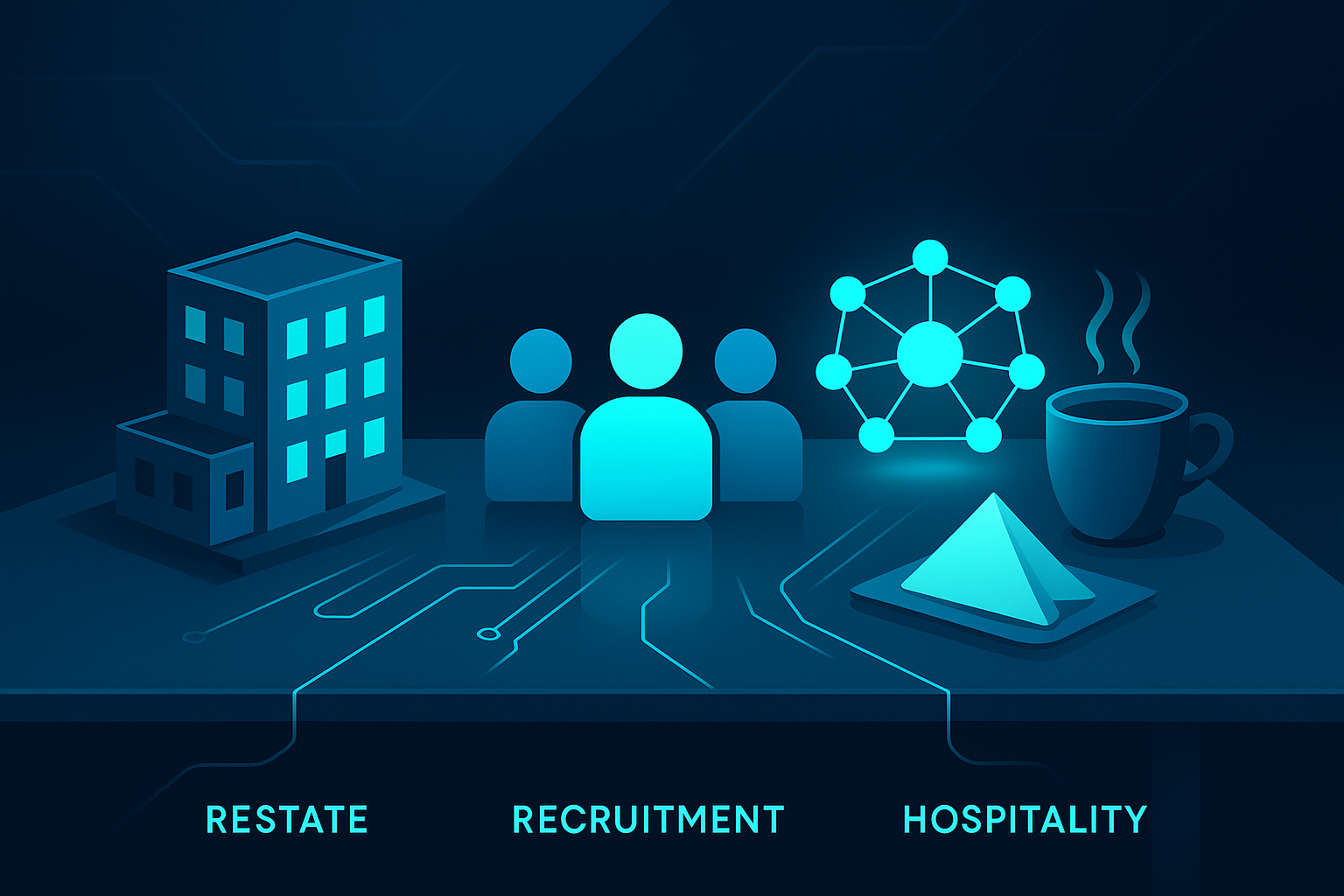
Starting a business services company begins with niche focus across Vynta’s core verticals—real estate, recruitment, fundraising, and hospitality—where specialized expertise delivers 2x faster ROI compared to generalist approaches. The key differentiator is implementing AI from day one to avoid the 6-12 month learning curve that generic tools typically require.
Week 1 – Validate Your Niche: Target specific pain points within your chosen vertical. Real estate agencies see 70% improvement in lead qualification speed, while recruitment firms cut screening time in half. Research your local market’s biggest challenges—whether that’s lead generation, candidate sourcing, investor outreach, or guest experience optimization.
Days 3-7 – Legal Foundation: Form an LLC with beneficial ownership documentation (required in most states). Many states offer no-cost annual report filings for small businesses. Secure necessary licenses for your vertical—real estate requires broker affiliations, recruitment may need staffing licenses, fundraising often requires securities compliance, and hospitality needs local business permits.
Weeks 2-4 – AI Infrastructure Setup: Deploy industry-specific AI agents that integrate with existing CRM and ATS systems. Vynta’s vertical-focused approach eliminates the rip-and-replace scenario, delivering ROI within 30-90 days. Configure automation for your highest-volume tasks—lead scoring for real estate, candidate screening for recruitment, investor matching for fundraising, or reservation management for hospitality.
Ongoing Team Building: Hire 3-5 hybrid professionals who can work alongside AI systems. In this model, AI handles approximately 50% of operational tasks while humans focus on relationship building and complex decision-making. This approach allows small teams to serve 2-3x more clients than traditional service models.
Month 2 Launch Pilot: Begin with a focused pilot program. For example, Maria’s boutique hotel used Vynta’s hospitality automation to reduce no-shows by 30% and increase upselling revenue by 20% within the first 60 days. Start small, measure results, and scale based on proven outcomes.
Real-World Scenario: A recruitment firm implemented Vynta’s candidate screening automation and reduced time-to-hire by 50% while maintaining 95% placement success rates. Initial setup took 3 weeks, with positive ROI achieved in month two.
How to Choose and Scale the Right Business Services Provider – In-House vs. Outsourced vs. AI-Enabled
The decision framework for business services provider selection should prioritize time-to-ROI and vertical expertise. Industry-specific AI solutions like Vynta consistently outperform generic providers by 4x in speed-to-value, particularly for mid-market SMEs lacking internal AI resources. The key is matching provider capabilities to your scaling objectives and operational complexity.
Outsourcing can reduce operational costs by 40%, but success depends on choosing partners with deep vertical knowledge. Generic business process outsourcing firms often lack the nuanced understanding of real estate CRM workflows, recruitment ATS integrations, fundraising compliance requirements, or hospitality PMS systems that drive actual business outcomes.
| Model | Pros | Cons | Selection Criteria | Vynta ROI Example |
|---|---|---|---|---|
| In-House Team | Full control, deep knowledge | High fixed costs, slow scaling | Team size >50 employees | N/A |
| Generic Outsourced | Quick deployment, lower costs | Shallow vertical expertise | Time-to-ROI <90 days required | Baseline performance |
| AI-Enabled (Vynta) | 70% efficiency gains, vertical focus | Learning curve for teams | CRM/ATS integrations essential | Recruitment: 50% screening time cut |
| Hybrid Model | Best of both worlds | Complex oversight required | Strong KPI tracking systems | Hospitality: +15 NPS improvement |
Outsourcing Success Tips: Vet providers for existing ATS, PMS, and CRM integrations before committing. Test with a 2-week pilot program focusing on one specific workflow—such as lead qualification or reservation management—to validate compatibility and results before full deployment.
The hybrid approach often delivers optimal results for business services companies. Scale gradually through agentic AI, expanding from basic automation (reservation handling) to advanced personalization (targeted guest upselling) within 90 days. This progression maintains service quality while building team confidence in AI-augmented workflows.
Pricing Strategies for Business Services: Subscription vs. One-Time Fees with AI Optimization
AI automation reduces service delivery costs by 50%, enabling aggressive pricing strategies that maintain 65% margins while undercutting traditional competitors. Recruitment firms using AI-powered candidate screening can charge 30% higher placement fees due to improved match quality and reduced time-to-hire, while real estate agencies can offer premium lead qualification services at scale.
The most successful business services companies guide their pricing toward value-based models rather than hourly billing. AI enables this transition by providing measurable outcomes—such as RevPAR improvements in hospitality or donor retention increases in fundraising—that justify premium pricing based on client results rather than time invested.
Pricing Model Comparison:
• Hourly ($150-300/hr): Migrate to value-based for 2x revenue
• Project ($10K-50K): Add AI automation upsells
• Subscription ($2K-15K/mo): Target 80% recurring revenue
• Performance (10% of ROI): Tie directly to metrics like guest satisfaction or placement success rates
Top Challenges in Business Services Companies and AI-Driven Solutions Across Verticals
Cash flow volatility represents the primary challenge for business services companies guide operations, particularly in seasonal verticals like hospitality and fundraising. AI-powered forecasting achieves 95% accuracy in predicting revenue patterns, while automated investor outreach systems triple meeting booking rates for fundraising organizations, creating more predictable income streams.
Talent shortage crisis affects every vertical, with recruitment firms struggling to find quality candidates while simultaneously needing more recruiters. AI-powered screening systems boost team capacity by 5x, allowing three recruiters to handle the workload previously requiring fifteen, while maintaining 95% placement success rates through intelligent candidate matching.
Regulatory compliance complexity particularly impacts fundraising and real estate operations. Automated UCC filing systems and sales tax nexus monitoring (critical post-Wayfair ruling) reduce compliance overhead by 80%. AI agents handle routine regulatory tasks, freeing professionals to focus on client relationships and business development.
Service personalization at scale challenges every vertical. Hospitality companies struggle to provide boutique-level service while managing hundreds of guests. AI recommendation engines enable personalized upselling that increases revenue per guest by 20%, while human staff handle complex requests and relationship building. This hybrid approach maintains the personal touch clients expect while achieving operational efficiency.
Hospitality Success Story: Maria’s boutique hotel implemented AI-driven guest experience automation, resulting in 30% reduction in no-shows, 20% increase in upselling revenue, and 15-point NPS improvement—all while maintaining the personal service that defines luxury hospitality.
Process inefficiency wastes 20+ hours weekly across all verticals. Real estate agents spend 70% of time on lead qualification rather than relationship building. Recruitment consultants manually screen hundreds of resumes for positions that AI can match in minutes. Fundraising teams research prospects individually instead of using AI for intelligent donor segmentation. Intelligent automation agents reclaim these hours for revenue-generating activities. For a broader perspective, see artificial intelligence in business.
Best Business Services Companies and AI Providers for SMEs in 2025 – Curated List with ROI Benchmarks

Based on time-to-ROI and vertical specialization, these providers represent the top choices for mid-market SMEs seeking measurable automation outcomes. Rankings prioritize proven results in real estate, recruitment, fundraising, and hospitality rather than generic feature lists or marketing claims.
For more insights on optimizing your business services company, check out our in-depth guide on AI automation for service firms.
You might also find value in our article about relationship building in B2B services for strategies to strengthen client retention and loyalty.
Frequently Asked Questions
How does AI automation specifically enhance scalability and cost savings in business services companies?
AI automation enhances scalability by handling up to 70% of initial customer screenings and repetitive tasks, allowing human experts to focus on closing deals and building relationships. This leads to cost savings of up to 40% by reducing manual workload without replacing core staff, enabling firms to scale 2-3x without proportional headcount increases.
What are the key differences between business services companies and product-based companies in terms of operations and growth strategies?
Business services companies rely on human expertise and relationship-building rather than inventory management, focusing on recurring client interactions and scalable workflows. Growth strategies emphasize augmenting human capabilities with AI to improve efficiency and client outcomes, whereas product-based companies prioritize manufacturing, distribution, and inventory optimization.
Which business verticals benefit most from AI-enabled business services, and what are some examples of AI applications in these sectors?
Real estate, recruitment, fundraising, and hospitality benefit most from AI-enabled services. Examples include AI-driven lead qualification in real estate, candidate screening automation in recruitment, investor outreach personalization in fundraising, and guest experience management with upselling automation in hospitality.
What factors should companies consider when choosing between in-house, outsourced, or AI-enabled business services providers?
Companies should evaluate cost efficiency, scalability, industry-specific expertise, and integration complexity. AI-enabled providers offer rapid ROI and automation tailored to verticals, while in-house teams provide control but require significant resources, and outsourced services may lack the strategic AI focus needed for measurable business outcomes.
About The Author
Anas Moujahid is the chief contributing writer & Operations Director for the Vynta AI Blog, where he turns cutting-edge AI automation into measurable business outcomes for mid-market companies.
Vynta AI designs enterprise-grade AI agents that augment rather than replace people—freeing teams to focus on higher-value work while the bots handle the busywork.
We specialise in four service-heavy verticals where AI can move the revenue needle fast: real estate, recruitment, fundraising and hospitality.
Anas started his career architecting AI and automation systems; today he leads operations at Vynta AI, making sure every deployment lands real-world ROI—whether that’s more booked viewings for estate agents, faster placements for recruiters, warmer investor pipelines for fundraisers or happier guests for hotels and restaurants.
Vynta AI delivers results by:
- Building industry-specific agents pre-trained on real-world workflows—no generic chatbots here.
- Integrating seamlessly with existing CRMs, ATSs, PMSs and fundraising platforms—zero rip-and-replace.
- Measuring success in business KPIs (lead-to-close rates, time-to-hire, donor retention, RevPAR) not vanity metrics.
- Providing transparent implementation plans so clients know exactly what to expect, when and why.
- Pairing every AI agent with human-in-the-loop controls to keep quality, compliance and brand voice on point.
Since launch, Vynta AI has helped agencies slash lead qualification time by up to 70 %, recruitment firms cut screening hours in half, fundraising teams triple investor touchpoints and hospitality brands lift guest satisfaction scores by double digits—all while keeping human expertise firmly in the loop.
Anas writes with the same ethos that drives Vynta AI: outcome-focused, jargon-free and grounded in real business value. Expect data-backed insights, practical implementation guides and a clear-eyed view of what AI can—and can’t—do for your organisation.