

Best practices for implementing recruitment automation
Recruitment teams lose valuable time to CV sorting, interview scheduling, candidate follow-ups, and status updates. The right automation program addresses those bottlenecks without removing the judgment that makes a strong hire possible. The best practices for implementing recruitment automation begin with process mapping, clear ownership, reliable data, and measurable outcomes such as time-to-hire, recruiter productivity, candidate response rates, and placement volume.
Key Takeaways
- Recruitment teams lose valuable time to CV sorting, interview scheduling, candidate follow-ups, and status updates.
- The right automation program addresses those bottlenecks without removing the judgment that makes a strong hire possible.
- The best practices for implementing recruitment automation begin with process mapping, clear ownership, reliable data, and measurable outcomes such as time-to-hire, recruiter productivity, candidate response rates, and placement volume.
For mid-market agencies, the goal is not to add another disconnected application. It is to connect automation with the existing applicant tracking system, job boards, communication channels, and consultant workflows. This gives recruiters more capacity for candidate relationships, client communication, and final selection decisions.
What is Best practices for implementing recruitment automation?
Recruitment automation uses software and AI agents to handle repeatable steps across sourcing, application processing, screening, scheduling, engagement, and reporting. A well-designed workflow collects applications, applies agreed screening criteria, updates records, sends timely messages, and routes qualified candidates to a recruiter. Human consultants remain responsible for nuanced assessment, relationship management, compliance decisions, and hiring recommendations.
The most effective implementation starts with a defined process rather than a technology purchase. Document how applications arrive, where candidate data is stored, which questions determine eligibility, who reviews exceptions, and how applicants receive updates. Then select one high-volume workflow, establish a baseline, and test it with recruiter oversight. This approach exposes data-quality issues, duplicate records, unsuitable filters, and candidate-experience gaps before wider deployment.
Research shows why structured adoption matters. The 2025 Lever Recruiter Nation Report found that 55% of talent teams say AI and automation have accelerated time-to-hire, while 49% report higher recruiter productivity. IBM also reports that 99% of hiring managers use AI in hiring, with automation capable of reducing time-to-hire by up to 30%. These findings support practical adoption, not unattended decision-making.
Vynta AI helps mid-market SMEs implement recruitment automation around existing ATS infrastructure. Agentic Systems for Recruitment collects and processes applications from CV Library, Indeed, Reed, TotalJobs, and LinkedIn. AI processes over 100,000 CVs per day and screens candidates in under 10 seconds, while candidate matching accuracy is 85%. These capabilities are most valuable when qualification criteria, escalation rules, and review responsibilities are defined before launch.
Benefits of Best practices for implementing recruitment automation
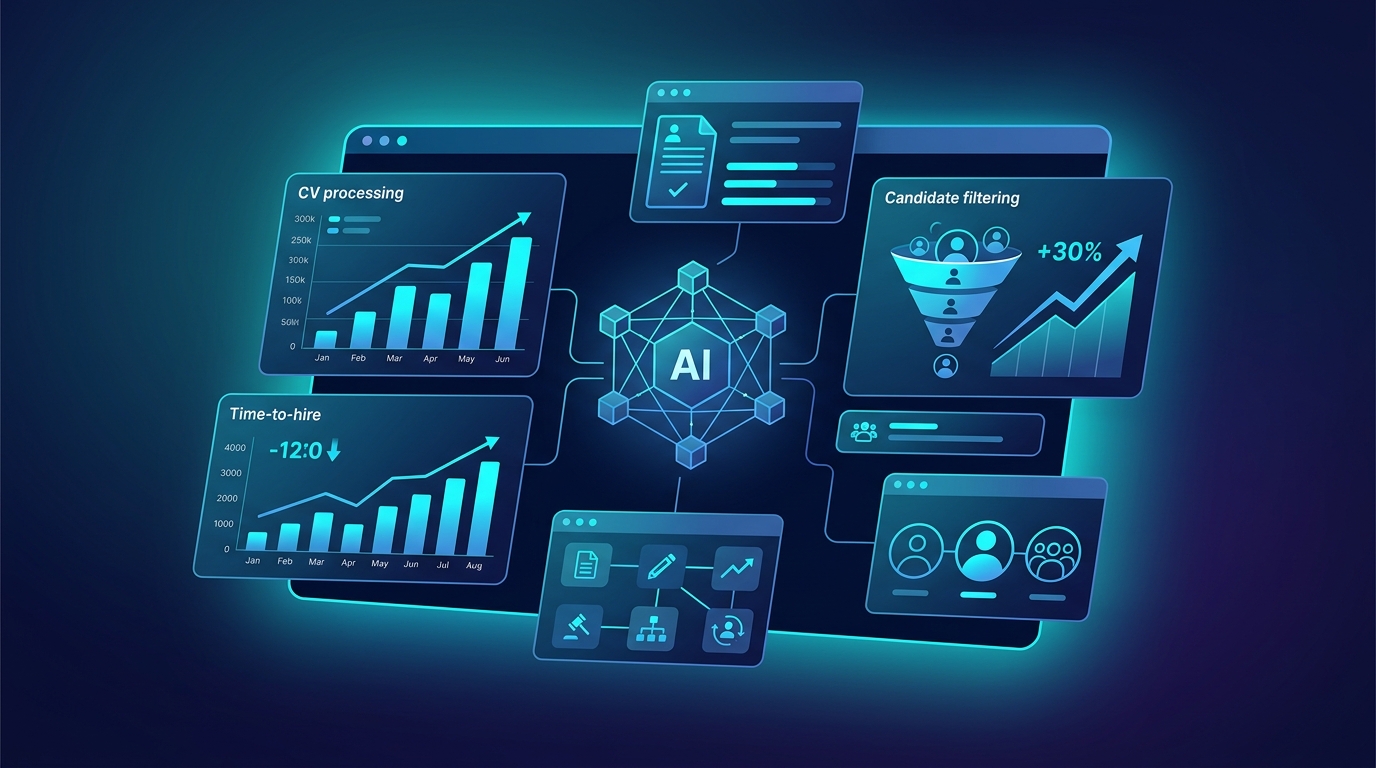
The first benefit is greater recruiting capacity without an immediate increase in headcount. Automated CV processing and candidate filtering reduce repetitive review work, allowing consultants to focus on interviews, client requirements, offer discussions, and placement relationships. Agentic Systems for Recruitment save approximately 2 hours per hire and reduce the hiring cycle by over 60%. Placements increase by over 50% after implementing the system. These outcomes depend on suitable ATS integration, accurate criteria, and active operational management.
Speed also affects candidate retention. Automated acknowledgments, qualification questions, reminders, and interview booking reduce waiting periods that can cause qualified applicants to accept another offer. Agentic Systems provide 24/7 automated candidate engagement through WhatsApp Business API and other communication channels. Interview coordination is fully automated including scheduling, sending confirmations, reminders, and providing preparation materials to candidates. Recruiters can still intervene when a candidate raises a sensitive question or requires a tailored response.
Consistent communication supports employer reputation and gives recruitment leaders better process visibility. Standardized messages reduce missed follow-ups, while dashboards can show application volume, screening outcomes, response times, interview attendance, source performance, and conversion from candidate to placement. Dormant ATS database reactivation can help teams revisit existing talent records rather than relying only on new advertising.
Governance is another direct benefit of disciplined automation. The Lever research found that 59% of HR decision-makers rank data privacy as the top factor when evaluating AI recruitment software, while 58% identify human oversight as a leading consideration. Recruitment leaders should define access permissions, retention policies, audit trails, consent handling, and review checkpoints aligned with GDPR and CCPA obligations. Automation should support fair, documented decisions, with recruiters retaining responsibility for context, exceptions, and candidate care.
How to Choose Best practices for implementing recruitment automation
The Best practices for implementing recruitment automation start with selecting a workflow that solves a measurable operational problem. Map the current recruitment process from job intake through placement, recording handoffs, approval points, duplicate data entry, candidate response times, and manual exceptions. Prioritize high-volume activities such as CV processing, candidate screening, interview scheduling, follow-up messages, and ATS reactivation. Set a baseline for time-to-hire, recruiter hours per hire, qualified-candidate conversion, interview attendance, and placement volume before introducing software. This gives your team a practical way to assess progress rather than relying on activity counts or general impressions.
Tool selection should follow process requirements, not the other way around. Confirm that the platform connects with your existing applicant tracking system, job boards, email, calendar, messaging tools, and reporting stack. Ask how records are synchronized, how duplicate candidates are handled, and whether recruiters can review or correct automated actions. Screening rules should be visible and adjustable, with clear escalation paths for incomplete applications, unusual work histories, accessibility requests, and sensitive candidate questions. A recruitment agency also needs controls for client-specific criteria, candidate consent, data retention, permissions, and audit history.
Agentic Systems for Recruitment, built for agency throughput
Best for: Mid-market recruitment firms that need more candidate processing and engagement capacity without expanding administrative headcount.
Agentic Systems for Recruitment is a strong fit when an agency wants one connected operating model across sourcing, screening, communication, scheduling, and client submission. The system automates CV processing by collecting and processing applications from multiple job boards including CV Library, Indeed, Reed, TotalJobs, and LinkedIn. AI processes over 100,000 CVs per day and screens candidates in under 10 seconds. The candidate matching accuracy is 85%. These capabilities should be assessed against your actual qualification framework, ATS configuration, job volume, and recruiter review process.
Implementation planning should also account for the human side of hiring. Automated workflows can manage repeatable administration, while consultants retain responsibility for relationship-building, nuanced evaluation, compliance decisions, and placement recommendations. Request a workflow demonstration using representative vacancies and anonymized candidate records. Check how the system handles rejected applicants, candidate withdrawals, rescheduling, recruiter overrides, and communication preferences. Vynta AI helps mid-market SMEs implement recruitment automation with operational guidance, integration planning, and outcome tracking rather than treating software activation as the finish line.
| Evaluation criterion | What to verify | Why it matters |
|---|---|---|
| ATS and source connectivity | Two-way synchronization with the ATS and named job boards | Prevents isolated records and repeated data entry |
| Screening governance | Editable criteria, explainable matches, recruiter approval, and exception routing | Supports consistent decisions without removing professional judgment |
| Candidate communications | Templates, response monitoring, consent controls, and human handoff | Protects candidate experience and employer reputation |
| Scheduling operations | Calendar access, confirmations, reminders, rescheduling, and preparation materials | Reduces coordination delays and missed interviews |
| Privacy and security | Access permissions, retention settings, audit logs, GDPR and CCPA support | Reduces exposure from unnecessary or poorly governed candidate data |
| Performance reporting | Time-to-hire, response rate, screening volume, source quality, and placements | Connects automation activity to commercial outcomes |
Roll out the chosen workflow in stages. Begin with one recruiting team, role category, or application source, then compare results with the baseline. Monitor false positives, false negatives, candidate complaints, recruiter overrides, and time saved per hire. Give recruiters training on approval rules and provide candidates with a clear contact route for human support. Review the workflow regularly as hiring criteria, privacy requirements, client expectations, and labor market conditions change. This measured approach makes the Best practices for implementing recruitment automation actionable: start with a defined bottleneck, connect the right systems, protect candidate data, and scale only after the evidence supports expansion.
Frequently Asked Questions
What is recruitment automation, and how does it work?
Recruitment automation uses software, workflow rules, and AI agents to manage repeatable activities across the hiring process. Depending on the configuration, it can collect applications, process resumes, identify potential matches, send candidate messages, coordinate interviews, update the applicant tracking system, and produce recruitment reports. The system follows defined criteria and escalation rules, while recruiters retain responsibility for professional judgment, relationship management, sensitive conversations, and final recommendations.
Where should a recruitment agency start automating?
Start with a process that has high volume, clear inputs, and a measurable delay. Resume processing, interview scheduling, candidate reminders, application acknowledgments, and dormant database reactivation are common starting points. Before selecting a workflow, document the current steps, systems, handoffs, approval points, and failure patterns. Record a baseline for time-to-hire, recruiter hours per hire, response rates, interview attendance, and placement conversion. A focused pilot makes it easier to identify data-quality problems and prove operational value before wider adoption.
What tasks should never be fully automated?
Tasks involving nuanced judgment, sensitive personal circumstances, complex qualification decisions, candidate complaints, and final hiring recommendations should retain human involvement. An automated screening result should not be treated as an unquestionable decision. Recruiters need a way to inspect the reasoning, override an outcome, record context, and escalate unusual cases. Human review is also necessary for potential bias, accessibility concerns, privacy requests, and situations in which a candidate’s experience does not fit a simple rule. Automation is most effective when it removes administration while preserving accountability.
How do I choose the right recruitment automation tool?
Assess integration, governance, usability, and reporting before comparing feature lists. The platform should connect with your existing ATS, job boards, calendars, email, and approved messaging channels. Confirm how it handles duplicate profiles, consent, data retention, permissions, audit logs, recruiter overrides, and failed synchronization. Ask for a demonstration using representative vacancies and anonymized records rather than a generic presentation. The workflow should also support branded candidate communication, status visibility, scheduling changes, and a clear route to human assistance.
For agencies seeking connected support across sourcing, screening, engagement, and coordination, Agentic Systems for Recruitment is designed for mid-market operating environments. It works with existing ATS infrastructure and supports application processing from multiple job boards, automated candidate engagement, interview coordination, and candidate profile creation. The system also automatically generates branded candidate profiles and ‘Go-To-Market’ documents for client submissions, removing hours of manual documentation work. Vynta AI helps teams define qualification criteria, establish review checkpoints, and track outcomes rather than treating implementation as a software-only project.
How can teams protect candidate data during automation?
Build privacy controls into the workflow before processing live applications. Limit access according to role, collect only necessary information, define retention periods, document candidate consent, and establish procedures for correction or deletion requests. Review vendor security practices and confirm how data moves between the ATS, job boards, communication platforms, and reporting tools. GDPR and CCPA obligations may apply based on the people and locations involved. The 2025 Lever Recruiter Nation Report found that 59% of HR decision-makers rank data privacy as a top evaluation factor for AI recruitment software.
How should recruitment automation success be measured?
Measure business outcomes, process quality, and candidate experience together. Useful indicators include time-to-hire, time spent per hire, qualified-candidate rate, recruiter productivity, interview attendance, response time, source quality, placement volume, and candidate satisfaction. Add control measures such as manual overrides, inaccurate matches, duplicate records, privacy incidents, and unresolved communication requests. Review results by role type, client, source, and recruiter team so averages do not conceal weak performance. Agentic Systems for Recruitment can support this measurement model by connecting automated activity with candidate and placement records.
Does recruitment automation replace recruiters?
Well-governed automation is intended to support recruiters, not remove the human expertise required for strong hiring decisions. It can reduce repetitive administration, improve response speed, and give consultants more time for candidate relationships, client discovery, interviews, negotiation, and placement care. IBM reports that 99% of hiring managers use AI in hiring, showing that adoption is already broad. The strongest operating model combines machine-supported processing with transparent rules, human review, and clear ownership for every consequential decision.