

Best options for AI agents in beach club operations.
Best Options for AI Agents in Beach Club Operations
Beach club operators lose thousands in revenue every night when guests try to book VIP tables or cabanas after hours and get no response. Best options for AI agents in beach club operations. include systems that complete transactions in real time by processing reservations, payments, and upsells while your staff sleeps. Unlike chatbots that deflect inquiries to business hours, AI agents act as autonomous booking systems that convert late-night interest into confirmed revenue.
AI Agents vs. Chatbots: Why Beach Clubs Need Action-Taking Automation
The Chatbot Limitation: Deflection Instead of Conversion
Traditional chatbots answer questions but stop short of completing transactions. A guest messaging at midnight about cabana availability gets basic information and a promise that someone will follow up tomorrow. By morning, that guest has booked elsewhere or lost interest. You’ve deflected an inquiry, not captured revenue.
How AI Agents Complete Transactions
AI agents pull live inventory from your property management system, quote pricing based on party size and date, process payment through integrated gateways, and confirm bookings instantly. When a group of eight asks about VIP tables for Saturday night, the agent checks availability, suggests bottle service packages, collects payment details, and sends confirmation with access instructions. Three minutes. Zero human involvement.
| Capability | Traditional Chatbot | AI Agent |
|---|---|---|
| Answers availability questions | Yes | Yes |
| Processes payment | No | Yes |
| Confirms reservation | No | Yes |
| Updates calendar systems | No | Yes |
| Suggests upsells based on guest profile | No | Yes |
Why 2 AM Bookings Matter
Hospitality data shows that 40% of online booking attempts happen outside business hours. Beach clubs with DJ events and nightlife programming see even higher percentages. Every missed inquiry represents lost revenue that competitors with automated booking capture while you sleep. AI agents convert these opportunities into confirmed reservations with zero staff involvement.
Core Capabilities: What AI Agents Actually Do for Beach Club Operations
Availability and Booking Management
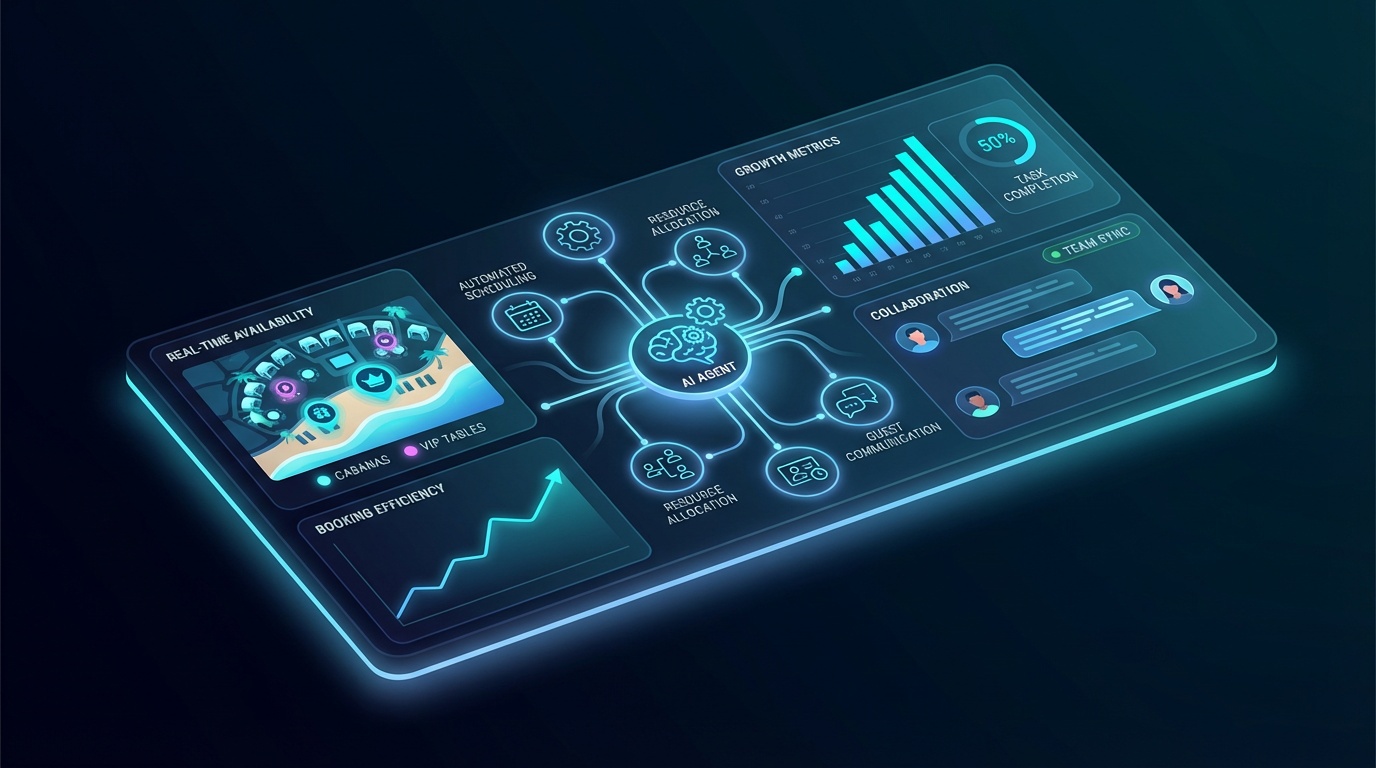
AI agents connect directly to reservation systems and pull current cabana availability, VIP table status, and event capacity. When a guest requests a beachfront cabana for four people next Saturday, the agent checks inventory, confirms availability, and holds the reservation pending payment. Updates sync across all channels simultaneously, preventing double bookings.
Payment Processing and Confirmation
Integrated payment gateways let agents collect deposits or full payment during the booking conversation. The agent generates secure payment links, processes transactions, and sends confirmation emails with booking details, VIP access instructions, and pre-arrival information. No manual back-and-forth. No confirmation delays that increase cancellation risk.
Intelligent Upselling Based on Context
AI agents analyze booking details to suggest relevant add-ons. A party of six booking a cabana receives offers for bottle service packages. Guests booking on DJ event nights see VIP table upgrades. Repeat visitors get personalized offers based on previous purchases. This contextual approach increases average order value without aggressive sales tactics.
After-Hours Handling and Calendar Synchronization
The system operates 24/7, capturing bookings during peak inquiry times when staff is unavailable. All confirmations sync automatically with property management systems, point-of-sale platforms, and staff scheduling tools. Morning staff arrive to find completed bookings ready for fulfillment rather than inquiry backlogs requiring follow-up.
The Revenue Impact: Real Numbers From Beach Club and Hospitality Operations
Converting Inquiries to Confirmed Reservations
Hospitality operators using AI agents report 18% higher conversion rates compared to manual inquiry handling. Wyndham Hotels achieved review-completion cycles that were 20 times faster through automated engagement. Speed of response directly impacts booking completion–delayed responses give guests time to choose alternatives. hospitality operators who invest in automation maintain competitive advantage during peak booking windows.
Incremental Revenue Per Booking
Automated upselling generates a 3.4% average revenue uplift per transaction in hospitality operations. AI agents suggest add-ons at optimal moments–when guests are already committed. A beach club with 500 monthly bookings averaging $200 gains $3,400 monthly from systematic upselling. That’s more than $40,000 annually from software that never sleeps.
Revenue Recovery: Vacation rental operators using AI agents reduced inquiry response time from more than eight hours to under 60 seconds, recovering an estimated 60% of after-hours bookings previously lost to competitors. Beach clubs face identical patterns with comparable recovery potential.
Fewer Manual Touchpoints
Automating routine reservation tasks frees staff for on-site guest experience and event coordination. This efficiency lets beach clubs handle seasonal volume spikes without proportional staffing increases. One operator manages the reservation volume that previously required two or three team members.
What Hospitality Operators Are Seeing
PwC research documents that AI agents in hospitality can achieve 85% task automation rates for routine inquiries and bookings. Organizations implementing Agentic Systems for Real Estate report 3x qualified pipeline growth and 85% conversion rates through instant engagement and structured follow-up. Beach clubs applying equivalent systems to reservations see similar gains in booking completion and guest satisfaction metrics. For further reading on technological adoption in hospitality operations, see this recent research article.
Best options for AI agents in beach club operations. consistently show measurable lifts in conversion rates, average order values, and operating efficiency–especially during seasonal peaks when revenue concentration is highest.
Integration Requirements: Connecting AI Agents to Your Tech Stack
Property Management System Connectivity
AI agents need direct API connections to your property management system to access live inventory data. For beach clubs, this means connecting to platforms that track cabana availability, VIP table assignments, and event capacity. The agent queries this data when guests ask about specific dates, ensuring accurate availability statements. Without this integration, the system can’t complete bookings autonomously and reverts to inquiry capture. Most modern PMS platforms offer API access, though legacy systems may require middleware. Data governance and compliance, as discussed in health information systems, inform best practices here (read more).
Payment Gateway and Point-of-Sale Integration
Transaction completion requires secure connections to payment processors. The AI agent transmits payment information, receives authorization confirmations, and triggers booking confirmations after successful transactions. Beach clubs using Stripe, Square, or hospitality payment platforms typically set up these connections through existing API frameworks. The integration also supports refund processing, deposit collection for reservations, and payment plan management for seasonal memberships. Security compliance remains your responsibility–the agent processes transactions through established, PCI-compliant pathways.
Smart Lock and Access Control for VIP Services
Premium beach club experiences include private lounges, storage lockers, or exclusive areas requiring access control. AI agents generate unique access codes upon booking confirmation and deliver them via SMS or email. This eliminates manual code distribution and reduces front-desk congestion during peak arrival times. The system coordinates with smart lock platforms to activate codes at check-in and deactivate them at checkout, maintaining security while automating guest access.
Data Governance and Brand Policy Enforcement
AI agents operate within defined guardrails that protect brand voice and operational policies. Beach club operators set escalation rules that route complex requests to human staff–large group bookings needing custom packages or guest complaints requiring immediate attention. The system logs interactions for quality review and compliance monitoring. This governance layer keeps the agent consistent with brand standards while handling routine transactions independently. You retain control over pricing rules, cancellation policies, and service offerings through administrative interfaces.
Custom vs. Off-the-Shelf AI Agents: Why Beach Clubs Need Industry-Specific Solutions

The Generic AI Platform Problem
Off-the-shelf chatbot platforms provide templated responses designed for general customer service scenarios. These systems struggle with beach club complexity–a single inquiry might involve availability checks across multiple asset types (cabanas, tables, event tickets), dynamic pricing by day and season, and upsell logic tied to party size and guest history. Generic platforms need extensive configuration to cover these workflows, which leaves gaps requiring staff intervention.
Beach Club-Specific Workflows
Beach clubs run business models that generic AI tools rarely support without custom development. Seasonal membership programs require the agent to verify member status, apply discounts, and track benefit usage limits. Event coordination for DJ nights or private parties involves capacity management across zones, special pricing tiers, and coordination with external vendors. VIP table assignment requires awareness of premium positioning, guest preferences from previous visits, and availability of preferred locations. Best options for AI agents in beach club operations. cover these workflows with purpose-built logic rather than generic templates.
Workflows Built Around Your Operations
Custom AI agents map directly to your operating model. Agentic Systems for Real Estate shows this approach in property operations, where agents handle property-specific workflows such as viewing coordination and offer management. Applied to beach clubs, custom agents understand your inventory, pricing structure, and service packages. The system learns from booking patterns to improve upsell recommendations and refine qualification questions that identify high-value guests. This tailored approach delivers faster time to value than ongoing configuration of generic platforms.
Implementation Timeline and Change Management
Custom agent deployment typically spans six to eight weeks from initial assessment to full operation. This timeline includes workflow discovery, integration with existing systems, staff training, and pilot testing. Beach clubs benefit from launching during off-season periods when booking volume allows controlled testing without revenue risk. A phased approach minimizes disruption while building staff confidence in the system. Mid-market operators access enterprise-grade automation without six-month implementation cycles and large upfront costs.
Getting Started: Implementation Roadmap for Beach Club Operators
Assessment Phase: Mapping Current Bottlenecks
Implementation begins with identifying where manual processes create revenue leakage or operating friction. Common bottlenecks include inquiries that go unanswered until the next business day, repetitive availability questions that consume staff time during peak periods, and inconsistent upselling that depends on which team member handles the booking. We document inquiry volume by channel, conversion rates by response time, and average order values to set baseline metrics for AI agent performance.
Pilot Phase: Starting with One Revenue Stream
Initial deployment focuses on a single, high-value booking category to prove ROI before expanding. VIP table reservations are strong pilot candidates–they represent high transaction values, follow predictable workflows, and produce clear before-and-after metrics. The pilot runs four to six weeks while you monitor booking completion rates, guest satisfaction scores, and staff time savings. This contained approach reduces risk while demonstrating value that supports broader deployment.
Scaling Phase: Expanding to Full Guest Journey Automation
After pilot success, the system expands to additional booking types, pre-arrival communications, and post-visit follow-up. The agent begins handling cabana reservations, event ticket sales, and membership inquiries. Integration extends to post-booking upsells such as early arrival options or premium amenity packages. Guest feedback collection runs automatically, providing operating insight without added staff workload.
Measurement: Tracking KPIs That Matter
Success measurement focuses on four metrics: booking completion rate (percentage of inquiries that become confirmed reservations), average order value (revenue per booking including upsells), response time (seconds from inquiry to first substantive response), and late-night conversion rate (bookings completed outside business hours). Beach clubs implementing Best options for AI agents in beach club operations. often see booking completion rates improve by 15% to 20%, average order values increase by 3% to 5%, and late-night conversions rise from near zero to 25% to 30% of total inquiry volume. These metrics translate directly to revenue impact and justify ongoing system refinement.
Frequently Asked Questions
What kind of AI agents are most effective for beach club operations?
As Operations Director at Vynta AI, I see that AI agents completing transactions in real time are most effective for beach clubs. These systems autonomously process reservations, payments, and upsells, converting late-night interest into confirmed revenue. This action-taking automation is key for measurable business outcomes.
How do AI agents differ from standard chatbots in a beach club setting?
The fundamental difference is conversion versus deflection. Traditional chatbots answer questions but do not complete transactions, often deferring to business hours. AI agents, however, act as autonomous booking systems, pulling real-time inventory, quoting pricing, processing payments, and confirming bookings instantly. This captures revenue efficiently.
What specific capabilities do AI agents bring to beach club operations?
AI agents provide real-time availability and booking management, integrated payment processing, and intelligent upselling based on guest profiles. They also handle after-hours reservations and synchronize automatically with calendar systems. These capabilities ensure consistent revenue capture and streamline operations.
How do AI agents help beach clubs recover lost revenue from after-hours inquiries?
Hospitality data indicates a significant portion of online booking attempts occur outside business hours, which beach clubs often miss. AI agents convert these late-night inquiries into confirmed reservations by providing instant booking and payment processing. This recovers revenue that would otherwise be lost to competitors, directly impacting your bottom line.
Can AI agents suggest additional services or upsells to beach club guests?
Yes, AI agents are designed for intelligent upselling to maximize revenue per booking. They analyze booking details, such as party size or event night, to suggest relevant add-ons like bottle service packages or VIP table upgrades. This contextual upselling increases average order value without aggressive sales tactics.
What is the typical revenue impact for beach clubs using AI agents?
Beach clubs can experience significant revenue impact, including higher conversion rates for inquiries into confirmed bookings. Automated upselling can generate a measurable revenue uplift per transaction, often around 3.4%. Additionally, automating routine reservation tasks reduces operational costs, allowing staff to focus on guest experience and event coordination.