
Best AI agents for operational efficiency in luxury restaurants.
Best AI Agents for Operational Efficiency in Luxury Restaurants
Luxury restaurants operate on razor-thin margins despite premium pricing. The difference between profit and loss often comes down to operational precision: minimizing no-shows, optimizing table turns, reducing food waste, and ensuring every guest interaction justifies the price point. AI agents built for fine dining don’t replace the white-glove service that defines your restaurant. They eliminate administrative friction that prevents your team from delivering it consistently.
Key Takeaways
- AI agents directly address the thin margins in luxury dining by optimizing operations.
- Precision in managing no-shows, table turns, and food waste is essential for profit.
- AI solutions remove administrative burdens, freeing staff to deliver exceptional guest service.
- Implementing AI helps maintain consistent, high-quality experiences that justify premium pricing.
Manual reservation management, inventory forecasting, and staff scheduling consume hours that general managers could spend refining service standards. AI handles these repetitive tasks with accuracy manual processes can’t match, freeing your team to focus on what guests actually pay for: exceptional hospitality.
Why Luxury Restaurants Need AI Agents for Operations (Not Just Front-of-House)
The Hidden Cost of Manual Operations in Fine Dining
Labor represents 30-35% of revenue in upscale dining, but administrative tasks consume 40% of management time. Your managers spend hours on reservation confirmations, schedule adjustments, and inventory counts instead of coaching staff or building guest relationships. No-shows cost luxury restaurants an average of $150-300 per missed reservation. Manual confirmation calls catch only 60-70% of potential cancellations.
Where AI Agents Create Measurable ROI in Upscale Venues
AI agents deliver immediate returns in three areas: reservation management cuts no-shows by 40-60%, inventory optimization reduces waste by 15-25%, and staff scheduling decreases overtime by 20-30%. A boutique restaurant implementing AI-driven reservation management saw table turn rates increase 24% during peak service while maintaining service quality standards.
ROI Reality Check: Most luxury restaurants see payback within 90-120 days through reduced no-shows and labor optimization alone, before accounting for improved guest satisfaction and upselling opportunities.
How AI Supports Rather Than Replaces Hospitality Excellence
Intelligent automation handles transactional interactions while preserving human judgment for relationship-building. Your host shouldn’t spend 15 minutes on hold confirming tomorrow’s reservations when an AI agent can send personalized SMS confirmations and handle responses automatically. That saved time goes directly into greeting regulars by name and anticipating preferences.
For tailored solutions, explore our specialized Vynta AI Agents for Hospitality designed to meet the unique demands of luxury dining operations.
AI Agents for Reservation Management and Revenue Optimization
Dynamic Booking: Minimizing No-Shows and Maximizing Table Turns
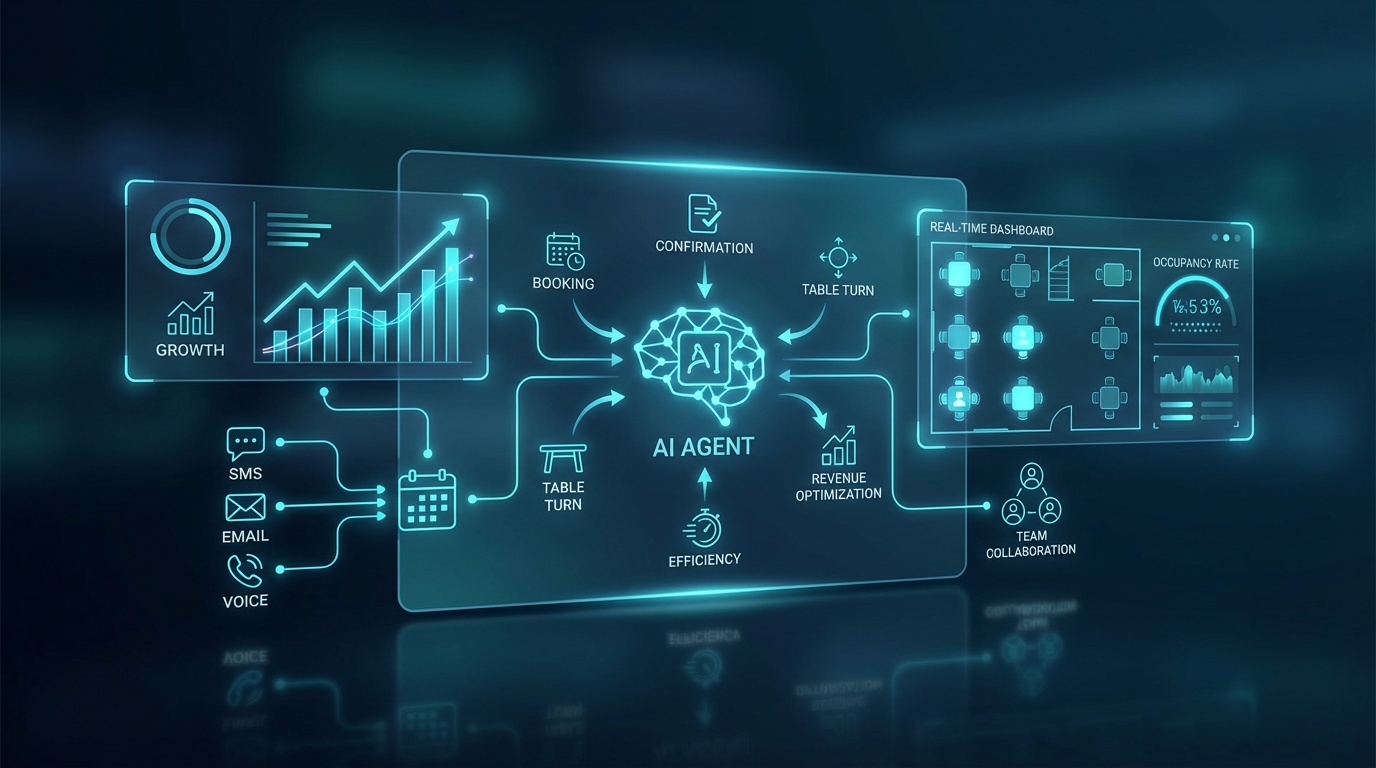
AI reservation agents send multi-channel confirmations–SMS, email, voice–at optimal times based on guest behavior patterns. They detect cancellation risk through response timing and booking history, automatically offering waitlisted guests those slots. This dynamic management fills 85-90% of canceled reservations versus 40-50% with manual processes.
Personalized Upselling Through Guest Data Intelligence
AI agents analyze past orders, occasion tags, and spending patterns to suggest relevant upsells during confirmation calls. A guest celebrating an anniversary receives wine pairing suggestions based on previous selections. Someone who ordered the tasting menu during a prior visit hears about the month’s chef collaboration. These targeted recommendations convert at 3-4 times the rate of generic upselling scripts.
Real-Time Capacity Optimization During Peak Service
Smart booking systems adjust table availability based on actual service pace, not static time blocks. If the kitchen’s running 10 minutes behind, the system automatically spaces incoming reservations. When a party leaves early, it releases that table to waitlisted guests immediately. This real-time optimization increases nightly covers by 15-20% without compromising service quality.
| Workflow Stage | Manual Process | AI-Driven Process |
|---|---|---|
| Reservation Confirmation | Staff calls 24 hours prior; 30% unreachable; 15 minutes per confirmed booking | Automated SMS/email at optimal time; 92% response rate; instant processing |
| Cancellation Management | Lost revenue; 4-6-hour lag to fill a slot; manual waitlist calls | Instant waitlist notification; 85% fill rate within 60 minutes |
| Upselling Opportunities | Generic script; 8-12% conversion; inconsistent execution | Personalized recommendations; 28-35% conversion; data-driven timing |
Operational Efficiency: From Kitchen to Customer Service
Inventory Forecasting and Waste Reduction in Fine Dining
AI agents analyze historical sales data, weather patterns, local events, and seasonal trends to predict demand with 85-90% accuracy. This precision reduces over-ordering of perishable ingredients while ensuring availability of signature items. A Michelin-starred restaurant using predictive inventory reduced monthly waste costs by $8,000 while maintaining menu consistency. More details on accurate inventory forecasting can be found in recent studies.
Smart Scheduling That Respects Peak Demand and Staff Preferences
AI scheduling systems balance labor costs against service requirements, factoring in individual staff skills, availability preferences, and historical performance data. The system predicts busy periods based on reservation patterns and adjusts staffing levels automatically. Staff satisfaction improves when the system respects their availability preferences while reducing overtime expenses.
Order Accuracy and Kitchen Communication via AI Voice Agents
Voice-enabled AI agents capture special requests, dietary restrictions, and modifications with 98% accuracy, transmitting them directly to kitchen display systems. This eliminates handwriting interpretation errors and ensures allergy information reaches the line immediately. Order accuracy improvements of 30-40% directly reduce food waste from incorrect preparations and support guest safety protocols.
| Use Case | Manual Approach | AI Agent Solution | Measurable Impact |
|---|---|---|---|
| Staff Scheduling | Weekly manager review; reactive adjustments; overtime surprises | Predictive scheduling with preference integration; real-time adjustments | 20-30% reduction in overtime costs |
| Inventory Management | Weekly counts; ordering based on intuition; 20-30% waste rate | Daily automated forecasting; predictive ordering; waste tracking | 15-25% reduction in food waste |
| Kitchen Communication | Handwritten tickets; verbal modifications; 15-20% error rate | Voice-to-digital order capture; automated allergy flagging | 30-40% improvement in order accuracy |
To understand the operational impact in more detail, consider our insights on restaurant reputation management and how efficient operations enhance guest experiences.
Preserving the Luxury Experience: AI as a Service Enabler
How AI Handles Routine Tasks So Staff Can Focus on Personalized Hospitality
Intelligent automation eliminates transactional friction without touching guest-facing moments that define luxury dining. Your sommelier shouldn’t spend 20 minutes updating reservation notes when an AI agent can capture dietary preferences, occasion details, and wine preferences automatically during confirmation. That reclaimed time goes directly into tableside service and personalized recommendations.
Guest Data Integration Without Sacrificing Privacy or Exclusivity
AI systems maintain comprehensive guest profiles, tracking preferences, spending patterns, and special occasions while respecting privacy boundaries. The system flags VIP arrivals, suggests relevant menu items based on past orders, and alerts staff to dietary restrictions automatically. This intelligence feels like exceptional memory, not surveillance, because it informs rather than replaces human interaction.
Training and Onboarding Staff on AI-Assisted Service Workflows
Successful implementation requires 2-3 weeks of staff training on AI-assisted workflows. Teams learn when to trust AI recommendations and when to override them based on situational context. The strongest programs position AI as a service assistant that handles administrative tasks, freeing staff to focus on relationship-building and problem-solving that justifies luxury pricing.
Implementation and ROI: From Pilot to Full-Scale Automation
Selecting the Right AI Agents for Your Operational Priorities
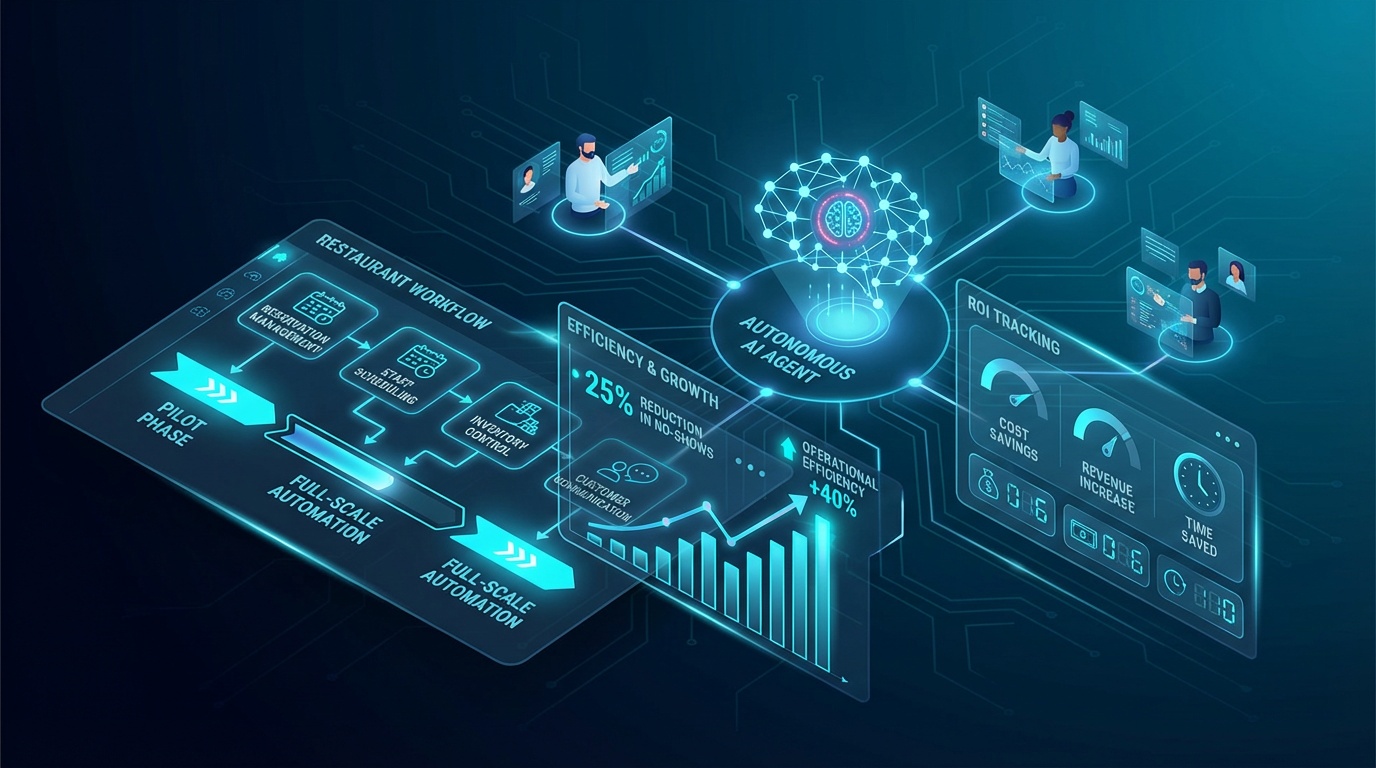
Start with your highest-cost pain point. Restaurants with 25%+ no-show rates should prioritize reservation management AI. Venues struggling with food waste above 20% need inventory forecasting first. Operations spending 15+ hours weekly on scheduling benefit most from workforce optimization agents. Effective AI solves specific problems, not generic automation promises.
Evaluate platforms on three criteria: integration capability with existing POS and reservation systems, customization depth for luxury service standards, and vendor support during implementation. Generic automation tools lack the hospitality-specific intelligence that fine dining requires. Your AI agent needs to understand the difference between a business dinner and an anniversary celebration.
Measuring Success: KPIs That Matter for Luxury Restaurants
Track no-show rates, average table turn time, food waste percentage, labor cost as a percentage of revenue, and guest satisfaction scores. Establish baselines before implementation and measure monthly. Most luxury restaurants see meaningful improvement within 60-90 days across all operational metrics.
Revenue per available seat hour (RevPASH) provides the clearest ROI picture. AI-driven optimization typically increases RevPASH by 18-25% within six months through better table management, reduced no-shows, and improved upselling conversion. A 50-seat restaurant averaging $180 per cover can see $125,000-175,000 in additional annual revenue from a 20% RevPASH improvement.
Integration with Existing POS, CRM, and Reservation Systems
Modern AI agents connect via API to major restaurant platforms: OpenTable, Resy, Toast, Square, and Aloha. Implementation requires 2-4 weeks for technical integration, data migration, and staff training. Cloud-based solutions minimize IT overhead, but plan for 40-60 hours of initial setup including workflow customization and testing.
Data synchronization matters more than you’d expect. Your AI agent needs real-time access to reservation status, menu availability, and guest history. Batch updates create service gaps. Insist on live integration that updates across all systems instantly when a guest modifies a reservation or a dish sells out.
Common Pitfalls and How to Avoid Them
The biggest implementation failure? Deploying AI without adequate staff training. Your team needs to understand what the system does, when to trust its recommendations, and how to override them when context demands. Allocate three weeks for training and workflow adjustment, not three days.
Avoid over-automation of guest-facing interactions. AI should handle confirmations, reminders, and routine inquiries. Complex special requests, VIP communications, and service recovery require human judgment. The strongest implementations automate 70-80% of transactional tasks while preserving human control over relationship-critical moments.
Implementation Checklist:
- Identify the top three operational pain points with quantified costs
- Verify API compatibility with existing POS, CRM, and reservation platforms
- Establish baseline KPIs: no-show rate, RevPASH, labor cost percentage, waste rate
- Allocate 40-60 hours for technical setup and 20-30 hours for staff training
- Plan a 90-day measurement period before scaling to additional use cases
- Budget for ongoing optimization: monthly workflow reviews for the first six months
AI agents built for luxury restaurants deliver measurable returns within 90-120 days. Success requires matching AI capabilities to your specific operational priorities, thorough integration with existing systems, and comprehensive staff training. Start with one high-impact use case, measure results rigorously, and expand once you’ve proven ROI. AI supports exceptional hospitality by eliminating administrative friction that prevents your team from delivering the personalized service that justifies luxury pricing.
Recent research on operational efficiency and AI in hospitality provides valuable context for these outcomes. For an in-depth technical analysis, see operational impact in AI-powered restaurant management.
Frequently Asked Questions
Which AI solutions are most effective for luxury restaurants seeking operational efficiency?
For luxury restaurants, the most effective AI solutions are specialized AI agents designed for operational precision. These agents, like Vynta AI Agents for Hospitality, automate tasks such as reservation management, inventory forecasting, and staff scheduling. This approach frees your team to deliver the exceptional guest experiences that define fine dining.
How do AI agents improve operational efficiency in luxury restaurants?
AI agents significantly boost efficiency by automating repetitive administrative tasks. They reduce no-shows by 40-60%, cut food waste by 15-25% with accurate inventory forecasting, and decrease overtime costs by 20-30% via smart staff scheduling. This allows your team to focus on guest relationships and service quality.
Are there specific "top" AI agents that luxury restaurants should consider?
While there isn’t a universal “big 4” or “top 5” list of generic AI agents, the most impactful solutions for luxury restaurants are those tailored to hospitality operations. These include AI agents for dynamic reservation management, predictive inventory optimization, and intelligent staff scheduling. Our Vynta AI Agents, for example, are specifically designed to meet these unique demands.
Is there a "30% rule" related to AI in luxury restaurant operations?
There isn’t a universal “30% rule” specifically for AI in restaurants. However, the article notes that labor often represents 30-35% of revenue in upscale dining, with administrative tasks consuming a large portion of management time. AI agents can reduce overtime costs by 20-30% and improve other metrics, demonstrating clear financial returns.
How do AI agents support hospitality excellence without replacing human staff?
AI agents handle transactional interactions, freeing your human team to focus on relationship-building and personalized service. For example, an AI agent can manage reservation confirmations, allowing your host to greet regulars by name and anticipate their preferences. This ensures human judgment is preserved for the moments that truly define luxury hospitality.