
best Agentic Systems for Recruitment 2026
What Are Agentic Systems and Why They Matter for Recruitment in 2026
Agentic systems are changing recruitment operations. Unlike traditional automation tools that execute single tasks on command, these systems plan multi-step workflows, make decisions based on learned criteria, and adapt without constant oversight. For recruitment directors managing high-volume pipelines, your AI orchestrates entire hiring workflows–from outreach through interview scheduling to client submission.
Defining Agentic AI in Business Terms
Agentic AI operates with goal-directed autonomy. You define the outcome–place qualified candidates faster–and the system determines the action sequence: query job boards, screen against learned criteria, engage candidates via preferred channels, schedule interviews, update your ATS. This autonomy separates agentic systems from workflow automation, which requires mapping every conditional branch upfront.
Modern systems process over 100,000 CVs daily and complete screening in under 10 seconds. That’s scale manual review can’t match.
Shift from Traditional Tools to Autonomous Workflows
Traditional recruitment tools wait for instructions. Agentic systems spot opportunities and act.
When a new role opens, the system immediately searches CV Library, Indeed, Reed, TotalJobs, and LinkedIn. It matches candidates against qualification criteria learned from your successful placements, initiates personalized outreach, and manages the entire communication thread. Your team focuses on relationship building and negotiation, not inbox management.
Key Outcomes in Talent Acquisition
Recruitment agencies deploying these systems report measurable improvements: 50%+ placement increases, 60%+ faster hiring cycles, and roughly 2 hours saved per hire. Candidate matching accuracy reaches 85%, meaning most screened candidates advance to interviews.
24/7 engagement through WhatsApp Business API and other channels ensures qualified candidates don’t go cold. 18% of dormant ATS contacts reactivate when the system re-engages past applicants for new roles, turning your existing database into a revenue driver.
ROI Reality: Agentic systems help recruitment firms screen more candidates, schedule more interviews, and place more talent without expanding the team or increasing administrative costs. The technology supports your consultants rather than replacing their expertise in candidate evaluation and client relationships.
Top Agentic Systems for Recruitment: Features and Performance Comparison
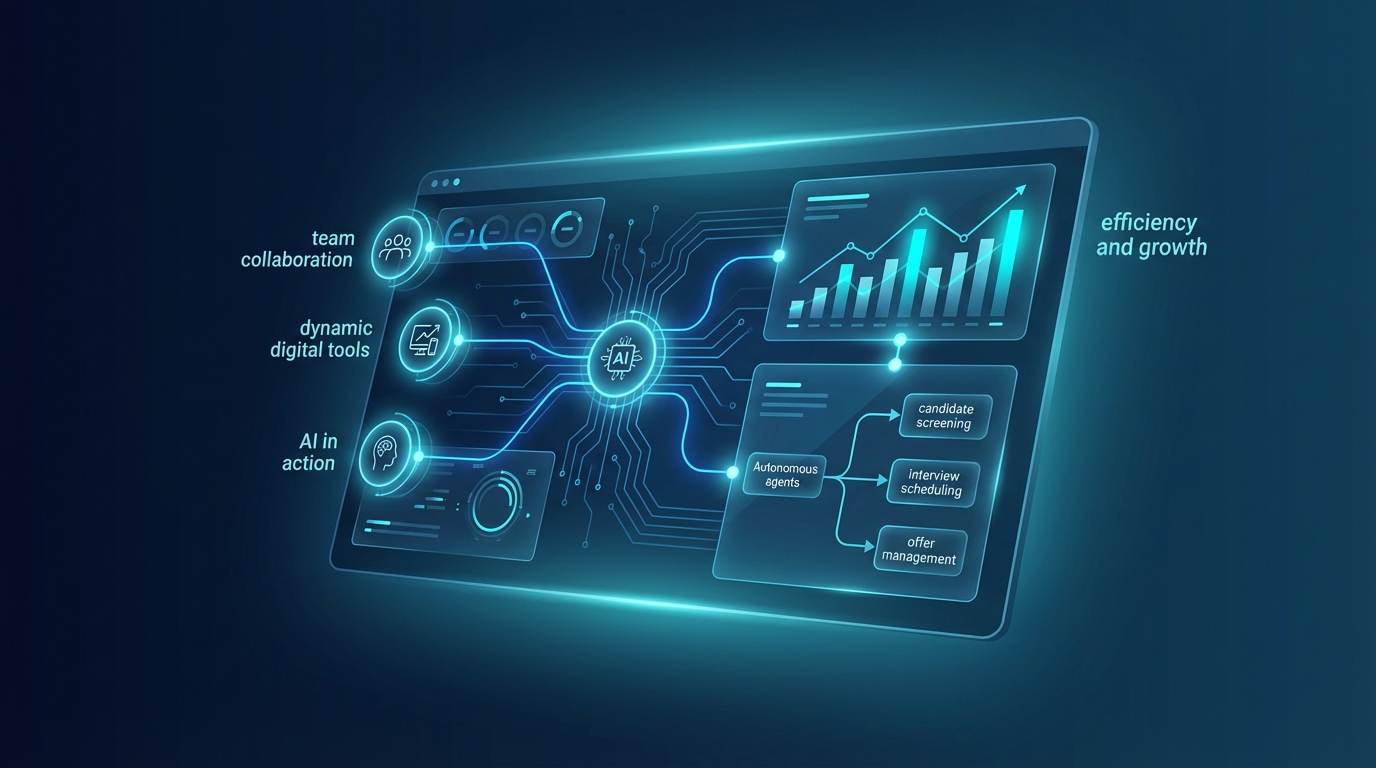
The most effective agentic recruitment systems share three characteristics: deep ATS integration, multichannel candidate engagement, and adaptive learning from your placement history. Here’s how different architectures deliver specific outcomes.
System 1: End-to-End Workflow Automation
Comprehensive platforms orchestrate the full recruitment lifecycle. They collect applications from multiple job boards simultaneously, apply learned screening criteria, generate branded candidate profiles for client submission, and manage follow-up communication. The workflow runs continuously until a candidate requires human judgment for final evaluation.
This approach works best for high-volume agencies placing in established verticals where qualification patterns are consistent.
System 2: Multi-Agent Screening and Scheduling
Specialized multi-agent architectures deploy separate AI agents for distinct functions: one sources candidates, another screens CVs, a third coordinates interviews. These agents communicate through your ATS, creating redundancy and allowing each to optimize its specific task.
Interview coordination agents automate scheduling, send confirmations and reminders, and provide prep materials to candidates. This modular approach offers flexibility for agencies with complex workflows or multiple service lines.
System 3: ATS-Integrated Candidate Matching
Deeply integrated systems operate as ATS extensions, learning qualification criteria from historical placement data and consultant feedback. The AI processes applications as they arrive, scores candidates against role requirements, and surfaces top matches for review.
These systems excel at reactivating dormant database contacts–automatically identifying past candidates who now match new roles. Integration depth determines effectiveness; surface-level connections limit the AI’s ability to learn your agency’s unique placement patterns.
Recruitment-Specific ROI Metrics
Evaluate systems based on time-to-hire reduction, placement volume increase, and administrative time savings. Top performers deliver 60%+ faster hiring cycles, 50%+ more placements, and roughly 2 hours saved per hire. Matching accuracy should exceed 80% to justify the investment.
Systems that reactivate dormant ATS contacts at rates above 15% generate additional revenue from existing assets without new sourcing costs.
| System Type | Best For | Key Strength | Integration Requirement |
|---|---|---|---|
| End-to-End Workflow | High-volume agencies | Complete lifecycle automation | Full ATS integration |
| Multi-Agent Architecture | Complex workflows | Specialized task optimization | Moderate ATS connection |
| ATS-Integrated Matching | Established databases | Historical data learning | Deep ATS integration |
Real-World Recruitment Use Cases Driving Business Results
Agentic systems deliver measurable impact across the candidate lifecycle. Here’s how autonomous workflows translate into faster placements, higher conversion rates, and more consultant capacity.
Candidate Sourcing and Outreach at Scale
Agentic systems monitor CV Library, Indeed, Reed, TotalJobs, and LinkedIn simultaneously, identifying candidates who match role requirements within seconds of profile updates. The AI initiates personalized outreach through email, SMS, or WhatsApp Business API based on candidate preferences learned from historical engagement data.
This continuous sourcing operates 24/7. Agencies report 50%+ placement increases because the system engages qualified candidates before competitors see the profiles. Your consultants receive pre-screened, interested candidates ready for substantive conversations about role fit and career goals.
Automated Screening with Human Oversight
The AI screens each candidate against qualification criteria it learned from your successful placements. The technology doesn’t replace consultant judgment–it removes the administrative burden of initial CV review.
Consultants receive ranked candidate lists with AI-generated summaries highlighting relevant experience, skills alignment, and potential concerns. This human-AI collaboration saves time while maintaining the relationship expertise that closes placements. Your team focuses on candidate coaching and client negotiation, not inbox sorting.
For more detail on how these systems work autonomously, see this explainer on agentic AI in HR.
Interview Scheduling and ATS Updates
Interview coordination runs autonomously. The system checks consultant and candidate availability, sends calendar invitations, delivers confirmations and reminders, and provides prep materials–all without human input. Every interaction syncs to your ATS in real time, maintaining complete workflow visibility.
The AI also generates branded candidate profiles and submission documents automatically, removing hours of manual documentation work. When roles don’t fill immediately, the system queries your dormant ATS database, reactivating past candidates for new opportunities. This database reactivation turns existing assets into revenue without sourcing costs.
Case Study: 40% Reduction in Time-to-Hire
One mid-market recruitment agency cut time-to-hire from 15 days to 6 days by automating candidate sourcing, screening, and interview scheduling. Administrative tasks dropped 33%, freeing consultants to handle 40% more active searches simultaneously.
The system learned qualification criteria by analyzing historical placement data. Candidates reported seamless experiences, often unaware they were engaging with AI during initial outreach and scheduling. The technology supported consultant performance without diminishing the personal touch that defines successful recruitment relationships.
Pros
- Processes 100,000+ CVs daily with 85% matching accuracy
- Operates 24/7 across multiple job boards and communication channels
- Reduces hiring cycle time and saves approximately 2 hours per hire
- Reactivates dormant ATS contacts automatically
- Increases placements without expanding team size
Cons
- Requires deep ATS integration to maximize effectiveness
- Needs a learning period to adapt to agency-specific qualification patterns
- Consultants must establish clear escalation rules for edge cases
- Initial setup demands workflow mapping and criteria definition
Implementation Guide: Deploy Agentic Systems for Maximum ROI
Successful deployment requires structured onboarding, clear guardrails, and continuous measurement against recruitment KPIs. These steps ensure the technology supports your consultants’ work while maintaining quality standards.
Onboarding and Integration Steps
Begin with ATS integration. The system must access historical placement data to learn your qualification criteria and successful candidate patterns.
Map your current workflows: candidate sourcing channels, screening criteria, communication sequences, and interview scheduling processes. Configure the AI to run these workflows autonomously, starting with high-volume roles where qualification patterns are consistent.
Test the system on a limited set of roles before full deployment. This allows consultants to verify candidate quality and provide feedback that improves matching accuracy. Most agencies reach operational effectiveness once the AI has analyzed enough placement history and incorporated consultant corrections.
Setting Guardrails and Escalation Rules
Define when the system operates autonomously and when it escalates to consultants. Common guardrails include candidate quality thresholds (only advance candidates scoring above 80%), communication boundaries (AI handles initial outreach and scheduling; consultants manage offer negotiations), and client-specific requirements (certain clients always receive consultant-reviewed submissions).
Establish escalation triggers: unusual candidate requests, salary expectations outside role parameters, or scheduling conflicts that require judgment calls. These rules preserve the human oversight that protects your agency’s reputation while allowing the AI to handle repetitive administrative tasks.
Measuring Success with Recruitment KPIs
Track time-to-hire, placement volume, candidate matching accuracy, and administrative time savings. Baseline these metrics before deployment, then measure weekly.
Monitor candidate experience through feedback surveys. Strong agentic systems maintain or improve satisfaction scores because 24/7 availability and fast responses often outperform manual coordination. Calculate ROI by comparing placement volume increases against system costs. Agencies typically achieve positive ROI when placements increase by 30% or time-to-hire drops by 40%, whichever occurs first.
The concept of an intelligent agent is closely related and worth exploring in parallel for those interested in agentic AI capabilities (intelligent agent).
Common Pitfalls and Solutions
Don’t deploy without clear qualification criteria. The AI learns from your data and instructions–vague requirements produce inconsistent results.
Don’t eliminate human oversight entirely. Consultants should review high-stakes decisions like final candidate selection and client submissions. Address consultant resistance by showing how the system reduces administrative load, not placement expertise. Position the technology as a way for consultants to spend more time on relationship building and strategic candidate coaching.
Maintain ATS data hygiene. System performance depends on accurate historical data; incomplete or outdated records limit learning quality.
Implementation Reality: Agentic systems require integration into existing workflows, not workflow replacement. Success comes from defining clear autonomy boundaries, measuring against recruitment-specific KPIs, and positioning the technology as supporting consultant capabilities rather than replacing human judgment in candidate evaluation and client relationships.
Why Vynta AI Delivers Agentic Recruitment Solutions
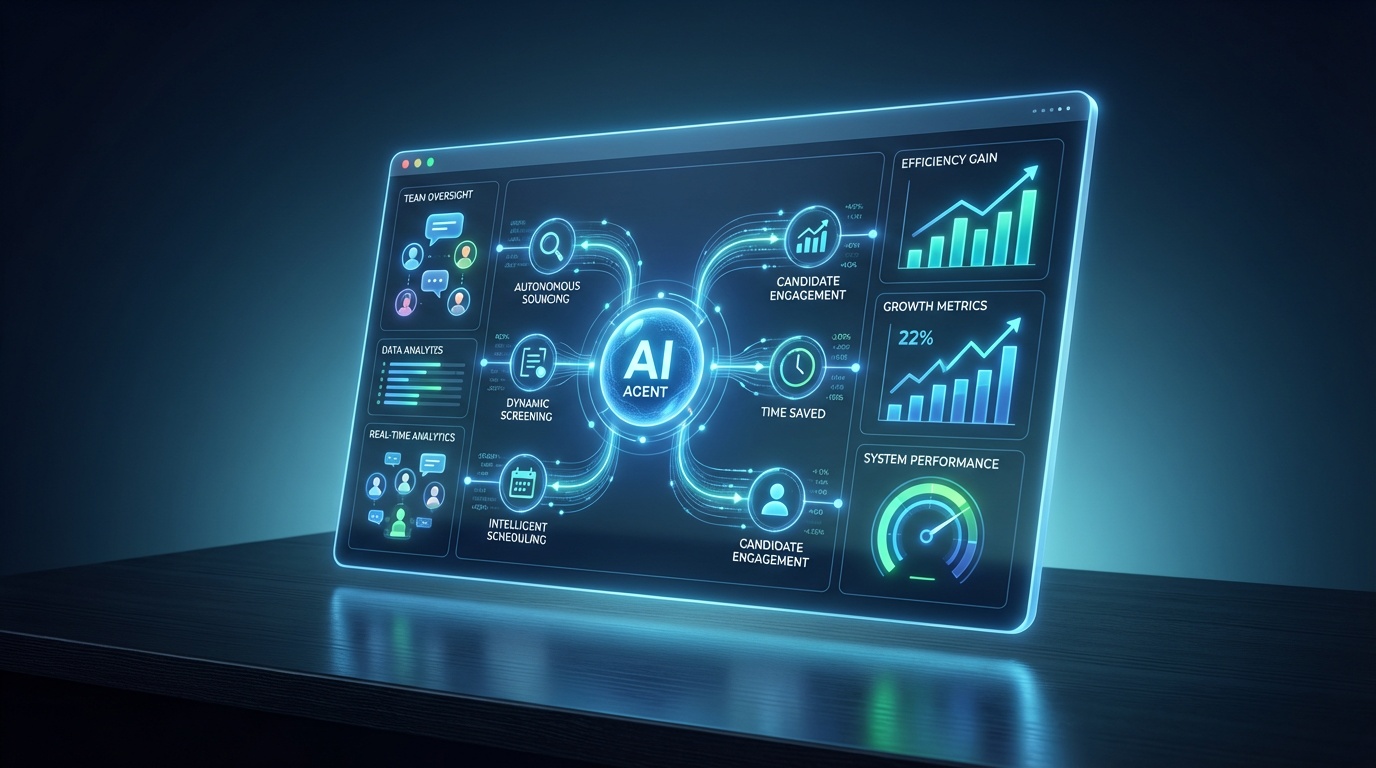
Vynta AI specializes in agentic systems built for mid-market recruitment agencies. Generic automation platforms require extensive customization. Many enterprise suites are cost-prohibitive. We deliver recruitment workflows that integrate with your existing ATS and run within your established operating model.
Learn more about our agentic systems for recruitment designed to scale your placement capabilities. For research on agentic AI in recruitment, see this article on agent autonomy and efficiency in hiring systems (agentic systems for recruitment).
Tailored for Mid-Market Recruitment Agencies
Mid-market agencies face distinct challenges: high candidate volumes without enterprise resources, pressure to compete with larger firms on speed, and the need to maintain personal relationships that close placements.
Vynta AI addresses these constraints through preconfigured workflows for candidate sourcing, screening, engagement, and interview coordination. The system learns your qualification criteria from historical placement data. Integration with CV Library, Indeed, Reed, TotalJobs, and LinkedIn completes through standard connectors, reducing custom development effort.
Your consultants maintain control over final candidate evaluation and client relationships while the AI handles the administrative tasks that consume 33% of their time.
Proven Results Across Screening and Placement
Agencies using Vynta AI report 60%+ reductions in hiring cycle time, 50%+ increases in placements, and 85% candidate matching accuracy. Database reactivation reaches 18%, turning dormant contacts into revenue without sourcing costs.
These outcomes come from recruitment-focused training. The system identifies candidate quality signals, communication patterns that drive engagement, and workflow sequences that move candidates from application to placement.
Partner Approach to Long-Term Transformation
Vynta AI works as a strategic partner, not a technology vendor. Implementation includes workflow mapping, ATS integration support, consultant training, and ongoing optimization based on your placement data.
The system adapts as your agency grows, learning new qualification criteria as you enter different sectors or role types. Support teams focus on recruitment outcomes–time-to-hire and placement rates–rather than technical specifications.
If you’re evaluating agentic recruitment systems, prioritize autonomous workflow execution paired with recruitment operations expertise and measurable KPIs.
Frequently Asked Questions
What are agentic systems for recruitment?
Agentic systems for recruitment represent a significant evolution in how agencies manage talent acquisition. Unlike simple automation, these systems plan and execute multi-step hiring workflows autonomously, making decisions based on learned criteria. They orchestrate processes from initial candidate outreach to interview scheduling, adapting to conditions without constant human direction.
How do agentic systems differ from traditional recruitment automation?
Traditional recruitment automation tools typically execute single tasks based on predefined instructions. Agentic systems, by contrast, operate with goal-directed autonomy, meaning you define the desired outcome, and the system plans and executes the necessary sequence of actions. This allows them to identify opportunities and act proactively, rather than waiting for manual commands.
What measurable benefits can recruitment agencies expect from agentic systems?
Agencies deploying agentic systems for recruitment report significant improvements, including over a 50% increase in placements and over a 60% reduction in hiring cycle time. These systems can save approximately 2 hours per hire and achieve candidate matching accuracy of 85%. Additionally, they reactivate dormant ATS contacts, turning existing databases into revenue drivers.
How do agentic systems engage with candidates?
Agentic systems engage candidates through personalized outreach and manage entire communication threads across various channels, including the WhatsApp Business API. They provide 24/7 engagement, ensuring qualified candidates receive timely responses and remain active in the pipeline. This continuous interaction helps prevent candidates from going cold.
What are the main types of agentic systems for recruitment?
The article highlights three primary types of agentic systems for recruitment: End-to-End Workflow Automation, which orchestrates the full lifecycle; Multi-Agent Screening and Scheduling, which deploys specialized AI agents for distinct functions; and ATS-Integrated Candidate Matching, which extends your existing ATS to learn from historical data. Each type offers specific strengths depending on an agency’s operational needs.
How do agentic systems integrate with existing Applicant Tracking Systems (ATS)?
Effective agentic systems require deep integration with existing Applicant Tracking Systems. This integration allows the AI to learn qualification criteria from your historical placement data and consultant feedback, processing applications as they arrive. The depth of this connection is critical, as it directly impacts the AI’s ability to understand and adapt to your agency’s unique placement patterns.
Do agentic systems replace human recruiters?
Agentic systems are designed to support and empower human recruiters, not replace them. By automating high-volume administrative tasks like CV screening, initial outreach, and interview scheduling, these systems free up consultants. This allows your team to focus their expertise on relationship building, candidate evaluation, and client negotiation, where human judgment is irreplaceable.