

Best agentic systems for multifamily real estate?
Multifamily operators face a significant choice as artificial intelligence moves from basic chatbots to autonomous agents. Manual leasing processes and slow response times to prospects continue to drain resources and limit portfolio growth. To solve this, many firms are asking, “What are the best agentic systems for multifamily real estate?” These advanced platforms move beyond simple scripted replies to deliver proactive, revenue-driving results across the entire resident lifecycle.
Key Takeaways
- Agentic systems in multifamily real estate automate leasing workflows and prospect follow-ups, reducing manual effort for operators.
- These platforms use autonomous AI to deliver instant, personalized responses to inquiries, accelerating the leasing cycle.
- Advanced agentic solutions manage the full resident lifecycle, from prospect engagement to renewal, without human intervention.
- Operators who adopt these systems free up resources for strategic growth while increasing portfolio performance.
- The move from simple chatbots to proactive AI agents marks a fundamental shift in how multifamily firms drive revenue and efficiency.
What Makes an Agentic System Different from a Chatbot or GenAI?
Agentic Definition: An agentic system is an autonomous AI framework capable of reasoning, planning, and executing multi-step workflows across software environments to achieve specific business goals without constant human prompting.
From Reactive to Proactive: The Agentic Shift
Traditional chatbots and generative AI tools operate on a reactive loop. A user asks a question, and the system provides an answer based on its training data. In contrast, agentic AI identifies a goal, such as filling a vacant unit, and determines the necessary steps to reach it. These systems proactively initiate contact with leads, schedule viewings, and follow up with personalized messages. According to Morgan Stanley, 37% of real estate tasks are currently automatable, yet most firms still rely on tools that wait for human input. Agentic systems bridge this gap by acting on behalf of the team, ensuring no inquiry sits unanswered for more than a few minutes. For a deeper dive into AI’s role, explore our AI For Nonprofits post, which touches on broader applications.
Beyond Conversational: Planning, Reasoning, and Acting
The core difference lies in the “action” layer. While a standard GenAI tool might write a compelling property description, an agentic system integrates with your CRM to identify which prospects should receive that description and then handles the email delivery and calendar booking simultaneously. Gartner predicts that by 2028, one-third of enterprise software will include agentic AI capabilities, a massive leap from the current 1% adoption rate. These systems use sophisticated reasoning to navigate complex property management scenarios, such as adjusting rental rates based on real-time market data or triaging maintenance requests based on urgency and technician availability. Understanding the nuances of chatbot development frameworks can provide context for how these advanced systems are built.
Top Agentic Systems for Multifamily Real Estate: A Head-to-Head Comparison

Selecting the right platform requires a clear understanding of how each system handles the unique demands of property management. When evaluating the best agentic systems for multifamily real estate, leaders must look at integration depth, the ability to handle multi-step workflows, and proven ROI in lead conversion. The following comparison highlights the top platforms currently shaping the industry, from enterprise-grade suites to specialized leasing automation tools.
| Platform | Primary Focus | Agentic Capability | Best For |
|---|---|---|---|
| Vynta AI | End-to-End Automation | High (Reasoning & Action) | SMEs seeking measurable ROI |
| Yardi | Property Management Suite | Medium (Task Automation) | Large-scale enterprises |
| Funnel Leasing | Leasing Automation | High (Cross-property Reasoning) | Leasing-centric teams |
| EliseAI | Resident Engagement | Medium (Conversational) | High-volume communication |
| RealPage | Operations & Revenue | Medium (Data-driven Actions) | Operational efficiency |
| AppFolio | All-in-One Management | Low to Medium | Mid-sized portfolios |
Agentic Systems for Real Estate – End-to-End Workflow Automation
Best for: Mid-market SMEs focused on lead conversion and operational efficiency.
Vynta AI provides a specialized approach to multifamily automation by focusing on the entire lead-to-lease lifecycle. Unlike platforms that only handle one aspect of the business, our Agentic Systems for Real Estate manage 80% of routine tasks, allowing agents to close over 30% more deals. The system captures inquiries across SMS, email, and website chat, responding in under 60 seconds. By automating 80% of tasks, we help firms save more than 20 hours per week per agent. Our focus remains on augmenting human capabilities, ensuring that every qualified lead receives instant, personalized attention while your team focuses on high-value relationships and property tours.
Yardi: Enterprise-Grade Property Management with Agentic Capabilities
Best for: Large property management firms with complex accounting and operations needs.
Yardi integrates AI into its vast ecosystem, offering automation for rent collection, maintenance, and marketing. Its agentic features focus on streamlining back-office operations and ensuring data consistency across large portfolios. While powerful, the implementation requires significant technical resources and is often better suited for enterprises than for agile mid-market firms.
Pros
- Comprehensive suite
- Strong accounting features
Cons
- Steep learning curve
- High implementation cost
Funnel Leasing: Dedicated Leasing Automation
Best for: Teams prioritizing a renter-centric data structure and cross-property insights.
Funnel Leasing utilizes a Renter-Centric data structure that allows its AI to reason across different properties. This enables the system to identify qualified leads even if they initially inquired about a different unit. Their workflows are designed to reduce the time from inquiry to lease signing by automating the entire nurturing process through a unified CRM.
Pros
- Strong CRM integration
- Cross-property reasoning
Cons
- Focused primarily on leasing
- Less emphasis on maintenance ops
EliseAI: Conversational AI for Leasing and Resident Engagement
Best for: Operators looking to automate high volumes of resident and prospect communication.
EliseAI specializes in human-like conversational interfaces that handle everything from initial inquiries to ongoing resident requests. The platform is highly effective at managing the “noise” of multifamily communication, ensuring that every email and chat is answered promptly. It acts as a 24/7 assistant for on-site teams, significantly reducing administrative burden.
Pros
- Excellent NLP capabilities
- 24/7 availability
Cons
- Limited operational planning
- Less focus on revenue management
RealPage: Integrated Operations and Revenue Management
Best for: Firms seeking to optimize rental income through AI-driven pricing and operational insights.
RealPage applies agentic principles to revenue management and operational efficiency. Its AI analyzes market trends to suggest optimal pricing and automates workflows related to utility management and spending. The platform is a staple in the enterprise space, providing deep data analytics that inform strategic decision-making for large-scale portfolios. For broader business automation, consider our AI Automation Services.
Pros
- Advanced revenue management
- Deep data analytics
Cons
- Complex user interface
- Can be costly for smaller firms
AppFolio: All-in-One for Mid-Sized Portfolios
Best for: Mid-sized managers who want a single platform for accounting, management, and basic AI.
AppFolio has evolved from a simple management tool to a platform with growing AI capabilities. Its “Realm-X” AI assistant helps users navigate the software and automate specific reporting tasks. It is an excellent choice for firms that want an all-in-one solution without the complexity of integrating multiple niche agentic systems.
Pros
- User-friendly interface
- Strong mobile app
Cons
- AI features are still developing
- Limited third-party integrations
Muvan: Specialized in Lead Response and Qualification
Best for: Agencies that need to drastically improve lead response times and initial qualification.
Muvan focuses specifically on the top of the funnel. Its agentic system is designed to engage leads the moment they express interest, qualifying them based on budget, move-in dates, and preferences. By specializing in lead response, Muvan ensures that no high-intent prospect is lost due to slow follow-up, a common pain point in the industry.
Pros
- Fast implementation
- High lead conversion focus
Cons
- Narrower scope than full suites
- Requires external CRM for full lifecycle
Decision Matrix: If your priority is enterprise-level accounting, Yardi or RealPage are strong contenders. However, if your goal is to maximize leasing velocity and automate the entire lead-to-lease workflow with measurable ROI, Vynta AI offers the most focused agentic capabilities for mid-market growth.
Use Cases That Deliver Real ROI: Leasing, Operations, and Maintenance
The theoretical advantages of agentic AI become tangible when mapped to the daily challenges of multifamily property management. Every minute a prospect waits for a reply, every unaddressed maintenance ticket, and every missed follow-up carries a quantifiable cost. The following use cases demonstrate how these systems convert potential losses into measurable gains across leasing, operations, and maintenance.
24/7 Leasing: Capture and Qualify Leads Around the Clock
The single largest expense in multifamily marketing is the lost prospect. When a property’s leasing office closes at 6 p.m., that is when many renters begin their search after work hours. Agentic systems solve this by engaging leads immediately, regardless of time or day. Cortland’s AI tool, for example, handles 95 to 97 percent of inbound email and chat messages autonomously (Multi-Housing News). This level of coverage guarantees that no inquiry sits unanswered for more than 60 seconds.
Beyond speed, these systems qualify leads intelligently. Using advanced matching algorithms, the AI determines budget compatibility, move-in timing, and preferred unit features before routing high-intent prospects to human agents for tours. This reduces the time wasted on unqualified leads and increases the conversion rate. When evaluating the best agentic systems for multifamily real estate, the ability to operate around the clock with accurate qualification is a primary differentiator. One operator using Vynta AI’s Agentic Systems for Real Estate reported a 3x lift in their qualified pipeline and an 85% conversion rate from AI-handled inquiries.
ROI Callout: According to Vynta AI client data, agentic leasing systems save over 20 hours per week per agent by automating lead response, qualification, and property matching. This results in more than 30% additional deals closed and generates over $100,000 in additional revenue per agent per year.
Operations Automation: Streamline Resident Communication and Work Orders
Once a lease is signed, the volume of resident requests often overwhelms on-site staff. Agentic systems manage this constant flow by triaging communications through SMS, email, and resident portals. Instead of a human agent reading every request, the AI classifies each message: a billing question goes to accounting, a neighbor noise complaint gets logged for the property manager, and a common-area issue receives an automated acknowledgment with an estimated resolution time.
This approach eliminates data silos between CRM and property management systems. RealPage, for instance, applies agentic workflows to automate utility management and spending reviews, but the highest impact often comes from reducing the friction in tenant communication. When residents receive instant, relevant responses, satisfaction scores improve by as much as 27% while staff can focus on complex issues that require human judgment. This is a key point in the best agentic systems for multifamily real estate: they augment, not replace, the human touch. For insights into customer service scenarios, check out our Scenarios Of Customer Service blog post.
Case Study: Mid-Sized Portfolio Regains 40 Hours per Week
A property management firm overseeing 1,200 units across five communities deployed an agentic system to handle all resident communications and work order triage. Before implementation, three leasing agents spent 60% of their day responding to repetitive emails and phone calls. After deploying the AI, response times dropped from 45 minutes to under 2 minutes. The firm reclaimed 40 hours of staff time per week, redirected those hours to proactive resident engagement and property inspections, and saw a 15% reduction in tenant turnover in the first six months. The system also automated follow-ups for lease renewals, contributing to a 22% increase in renewal rates.
Predictive Maintenance: Reduce Downtime and Energy Costs
Maintenance is a major operational cost and a primary driver of resident dissatisfaction. Agentic systems move beyond reactive ticket management by analyzing historical data, sensor inputs, and weather patterns to predict equipment failures before they cause disruptions. For example, an HVAC unit nearing the end of its service life can be flagged for preventive service rather than waiting for a tenant complaint in the middle of summer.
Gartner predicts that by 2028, one-third of enterprise software applications will include agentic AI capabilities, many of which will focus on predictive maintenance and energy optimization. The practical outcome is lower downtime, fewer emergency repair costs, and reduced energy consumption. Funnel Leasing’s Renter-Centric data structure, for instance, allows cross-property reasoning that identifies patterns across communities, enabling property managers to schedule maintenance more efficiently. For any firm researching the best agentic systems for multifamily real estate, predictive maintenance capabilities represent a long-term cost-saving lever that compounds as the portfolio grows.
How to Choose the Right Agentic System for Your Property Portfolio
Selecting the best technology for your portfolio requires more than a simple feature comparison. Because agentic AI operates with a level of autonomy that traditional software lacks, the selection process must focus on how well the system integrates into your existing operational workflows. For mid-market SMEs, the goal is often to find a solution that provides immediate ROI without requiring a massive internal engineering team. Identifying the best agentic systems for multifamily real estate? starts with a clear-eyed assessment of your current bottlenecks and growth targets.
Step 1: Define Your Primary Use Case and Portfolio Size
The first step in your selection journey is to pinpoint where automation will have the most significant impact. Are you struggling with lead response times during peak leasing seasons, or is your team bogged down by repetitive resident inquiries? Smaller portfolios of 500 to 2,000 units often benefit most from lead-to-lease automation, while larger enterprise portfolios may prioritize back-office efficiency or revenue management. Understanding whether you need a specialized tool like Muvan or a comprehensive solution like Agentic Systems for Real Estate is essential for ensuring the technology aligns with your business objectives.
Step 2: Evaluate Integration with Your Existing Tech Stack
An agentic system is only as effective as the data to which it has access. You must evaluate how seamlessly a potential vendor integrates with your current Property Management System (PMS) and CRM. If the AI cannot pull real-time unit availability or push lead data directly into your resident portal, it creates more work for your team instead of reducing it. Look for platforms that offer native integrations with industry standards such as Yardi, RealPage, or AppFolio. This connectivity ensures that the AI can act on the information it receives, such as updating a lead status or scheduling a viewing on a shared calendar without human intervention.
Step 3: Assess Data Readiness and Human Oversight Requirements
Before deployment, you must determine if your internal data is organized enough for an AI agent to use effectively. Agentic systems require structured information about floor plans, pricing, and community amenities to respond accurately to prospects. Furthermore, you must decide the level of human oversight required for your operations. While these systems can automate 80% of tasks, certain high-stakes interactions, such as lease negotiations or complex resident disputes, still benefit from a human touch. The best agentic systems for multifamily real estate? are those that allow for a “human-in-the-loop” model, where the AI handles the volume and the staff manages the exceptions.
Step 4: Compare Total Cost of Ownership and Scalability
Look beyond the initial implementation fee to understand the long-term costs and potential for scale. A system that seems affordable today may become prohibitively expensive as you add more properties to your portfolio. Evaluate the pricing model: is it per unit, per lead, or a flat monthly fee? More importantly, calculate the projected ROI. If the system can generate over $100,000 in additional revenue per agent per year, as seen with Agentic Systems for Real Estate, the initial investment becomes a secondary concern compared to the growth it facilitates. Ensure the vendor has a roadmap that supports future expansion into different asset classes or geographic regions.
Selection Framework Checklist
- Identify the top three manual tasks that consume the most staff time.
- Verify API compatibility with your current CRM and accounting software.
- Request a demonstration showing how the AI handles a complex, multi-step resident request.
- Confirm the vendor’s data security protocols and compliance with fair housing regulations.
- Establish clear KPIs, such as a 30% reduction in cost per lead, to measure success after 90 days.
Risks, Pitfalls, and How to Avoid Them
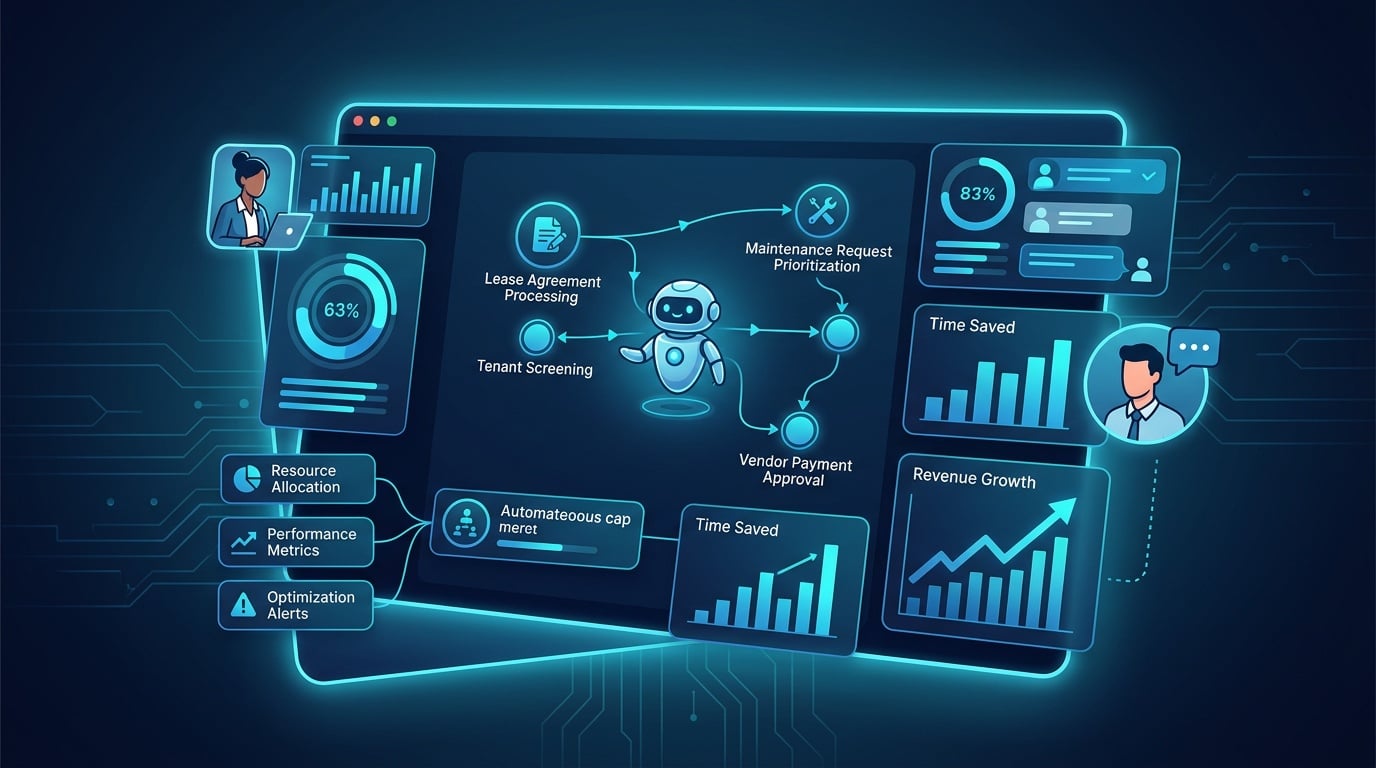
While the benefits of automation are significant, adopting autonomous systems introduces new challenges that property managers must navigate. Success depends on a strategic approach that balances technical efficiency with the high-touch service that residents expect. Understanding the common mistakes made during implementation will help you maintain a competitive edge while protecting your brand reputation.
Data Privacy and Compliance in Multifamily Operations
In the real estate sector, data privacy is not just a technical requirement but a legal obligation. Agentic systems handle sensitive resident information, including financial records and personal contact details. You must ensure that any vendor you select adheres to strict data protection standards, such as SOC2 compliance. Additionally, the AI must be programmed to comply with the Fair Housing Act, ensuring that its responses and qualification criteria do not inadvertently discriminate against protected classes. Regular audits of the AI’s decision-making logic are necessary to maintain compliance and avoid costly legal repercussions.
The Over-Automation Trap: When Automation Hurts Resident Experience
A significant risk is the “over-automation trap,” where the desire for efficiency leads to a sterile and frustrating resident experience. If a resident with an urgent emergency, such as a burst pipe, is forced to navigate a series of automated chat prompts without a clear path to a human, satisfaction will plummet. To avoid this, use agentic AI to handle repetitive, low-priority tasks while keeping human agents available for complex or emotional situations. The goal is to improve client satisfaction by 27% through faster responses, not to replace the empathy and problem-solving skills of your professional team. For context on customer service, see our Service In Hotels post.
Vendor Lock-In: Ensuring Flexibility and Future-Proofing
As the market for the best agentic systems for multifamily real estate? continues to evolve, you want to avoid being tied to a single vendor whose technology may become obsolete. Vendor lock-in occurs when your data is trapped in a proprietary format that is difficult to migrate. To future-proof your investment, prioritize systems with open APIs and standardized data formats. This flexibility allows you to swap components of your tech stack as better solutions emerge or as your business needs change. A transparent partnership with your AI provider should focus on long-term outcomes rather than restrictive contracts that limit your agility. Consider exploring Business Services Companies for broader operational support.
Warning: Never deploy an agentic system without a testing phase. Even the most advanced AI can produce “hallucinations” or incorrect information if its knowledge base is outdated. Conduct a 30-day pilot program to verify accuracy before allowing the system to interact with your entire prospect database.
Common Questions About Agentic Real Estate Systems
Will agentic AI replace my leasing team? No. These systems assist agents by automating 80% of routine tasks, such as lead qualification and scheduling, which allows your team to focus on closing deals and building resident relationships.
How long does implementation take? Implementation is not instant. It involves discovery, strategy, and technical setup phases to ensure the AI understands your specific property rules and integrates with your CRM.
Can the AI handle multiple languages? Many top-tier systems offer multi-channel engagement across SMS, email, and chat, often with translation capabilities to support diverse resident populations.
References
Frequently Asked Questions
What is the best agentic platform for multifamily real estate?
The best agentic platform for multifamily real estate depends on your portfolio size and goals. Vynta AI excels for mid-market firms seeking end-to-end lead-to-lease automation, while Yardi is ideal for large enterprises needing comprehensive property management. Funnel Leasing and EliseAI also offer strong capabilities for leasing and resident engagement respectively.
What is an example of agentic AI in real estate?
An example of agentic AI in real estate is a system like Vynta AI that autonomously captures inquiries from SMS, email, and website chat, responds in under 60 seconds, schedules viewings, and sends personalized follow-ups. It plans and executes multi-step workflows to fill vacancies without waiting for human prompts, driving faster conversions.
How does agentic AI differ from a traditional chatbot in property management?
Agentic AI differs from chatbots by moving beyond reactive replies to proactive goal-oriented action. While a chatbot waits for a user to ask a question, an agentic system like those used in multifamily real estate reasons about objectives, such as leasing a unit, then autonomously coordinates outreach, scheduling, and follow-ups across your CRM.
Which agentic system is best for small to medium multifamily operators?
For small to medium multifamily operators, Vynta AI is often the best choice because it focuses on the entire lead-to-lease lifecycle and delivers measurable ROI. It automates 80% of routine tasks, saves agents over 20 hours per week, and helps close 30% more deals by providing instant, personalized responses to every inquiry.
Can agentic AI systems integrate with existing property management software?
Yes, the best agentic systems for multifamily real estate are built to integrate with your existing tools. Vynta AI, for example, connects with CRMs to sync lead data across SMS, email, and web chat, while Yardi and AppFolio embed automation directly into their management suites. This ensures seamless data flow without manual entry.
Who is the leader in agentic AI for real estate?
Leadership in agentic AI for real estate depends on the use case. For end-to-end leasing automation with high reasoning and action capabilities, Vynta AI stands out among mid-market firms. For enterprise-scale property management, Yardi is a leader due to its comprehensive suite and task automation across large portfolios.