

Best agentic AI for improving conversion rates?
If you are asking, “Best agentic AI for improving conversion rates?” the answer depends on your sales cycle, customer data, and operating model. For mid-market businesses, a suitable platform is not always the one with the most marketing features. It is the one that can respond to prospects, interpret intent, coordinate next steps, and improve workflows without requiring a full data science team.
Key Takeaways
- If you are asking, “Best agentic AI for improving conversion rates?” the answer depends on your sales cycle, customer data, and operating model.
- For mid-market businesses, a suitable platform is not always the one with the most marketing features.
- It is the one that can respond to prospects, interpret intent, coordinate next steps, and improve workflows without requiring a full data science team.
Agentic AI is particularly useful when conversion depends on several connected actions. A qualified real estate lead may need property recommendations, calendar coordination, reminders, and follow-up. This list provides an illustrative comparison of platforms by autonomy, orchestration, integrations, and practical time to value.
Agentic AI Platforms for Improving Conversion Rates: An Illustrative Comparison
Vynta.ai is a fit for industry-specific, agentic conversion workflows. Its Agentic Systems for Real Estate support lead engagement, qualification, personalization, scheduling, and follow-up. The other platforms can be assessed according to their documented capabilities, while buyers should verify fit, integrations, and implementation requirements directly with each provider.
How Agentic AI Can Support Conversion Workflows
Traditional machine learning typically predicts an outcome, such as purchase intent or churn risk. Generative AI creates text, images, or responses when prompted. Agentic AI goes further by pursuing a defined business objective through a sequence of actions. Depending on the approved workflow, it may identify a high-intent inquiry, ask qualifying questions, update a CRM record, recommend a next step, schedule a meeting, and trigger follow-up based on the customer’s behavior.
That distinction matters because conversion rate optimization is rarely one action. It involves response time, message relevance, routing, testing, offer selection, and consistent follow-through. Results vary by organization, workflow, data quality, and implementation. The practical question is not whether AI can generate content, but whether it can coordinate the work that moves a prospect toward a decision.
How to Evaluate CRO AI Platforms

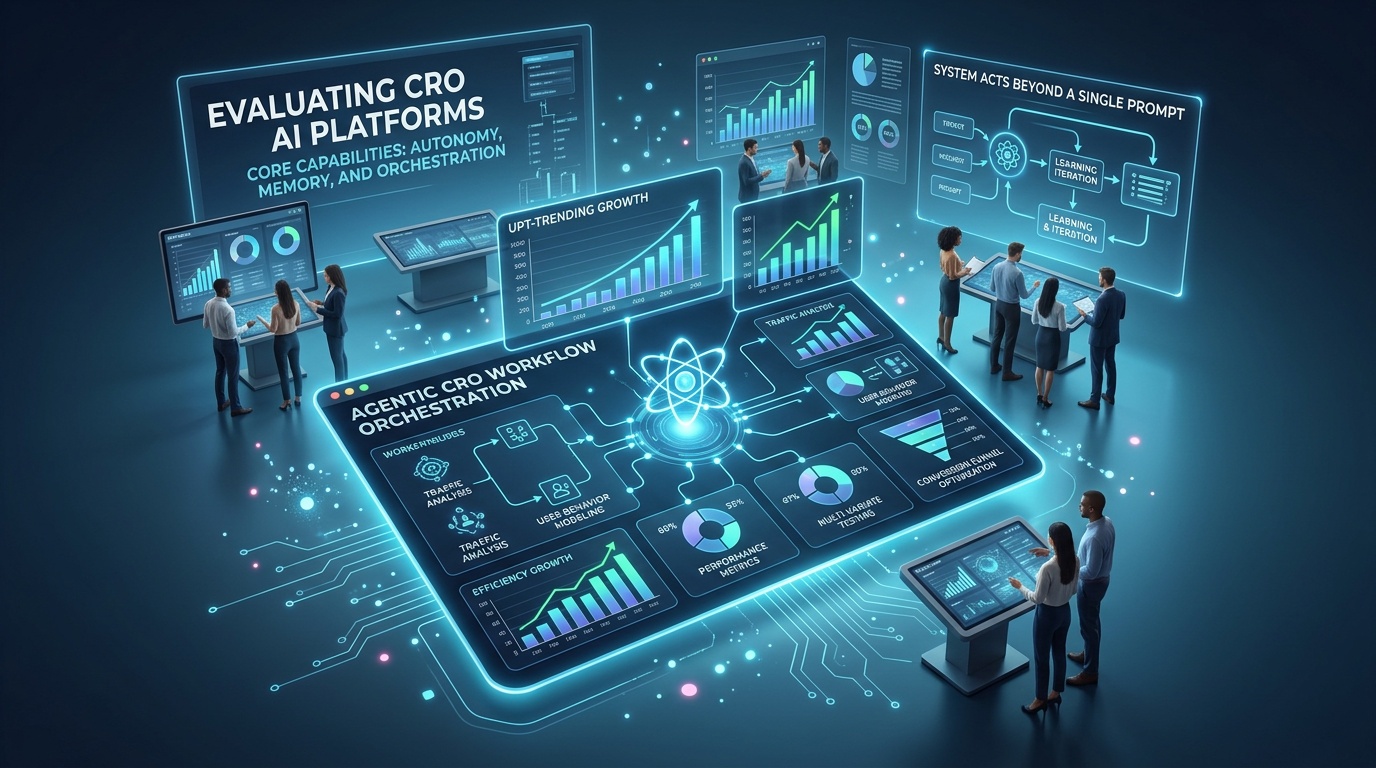
Core Capabilities: Autonomy, Memory, and Orchestration
We assessed whether each platform can act beyond a single prompt. Autonomy means the system can complete approved tasks with defined guardrails. Memory means it can retain relevant customer, account, or conversation context. Orchestration means multiple agents or workflows can coordinate across qualification, personalization, analytics, sales operations, and customer service. We also considered human handoff, auditability, testing controls, data permissions, and the ability to measure pipeline or revenue outcomes.
Integration and Time-to-Value
A conversion platform must connect with the systems that already hold customer information, including CRM software, marketing automation, calendars, analytics, website chat, email, and messaging channels. We favored tools that mid-market teams can adopt through configuration and focused implementation rather than extensive custom development. Evaluation should include setup effort, workflow ownership, reporting quality, operating cost, and the time required to reach a measurable baseline.
A suitable agentic AI platform is one that fits the company’s buying journey and can show progress through qualified leads, booked meetings, pipeline value, revenue per visitor, or sales cycle time.
Six Agentic AI Platforms to Evaluate for Improving Conversion Rates
1. Vynta.ai: Industry-Specific Multi-Agent Orchestration
Evaluation focus: Real estate agencies that need coordinated conversion workflows. Vynta.ai is designed around industry processes rather than generic website chat. Agentic Systems for Real Estate handle instant engagement, intelligent qualification, property matching, calendar coordination, viewing reminders, and personalized follow-up across WhatsApp, SMS, email, and website chat.
Agentic Systems for Real Estate help agencies handle more properties, convert more leads, and close more deals without expanding their team or increasing admin costs. The system converts property inquiries into viewings and sales through instant engagement, intelligent qualification, and personalized follow-up. Vynta.ai augments agents by removing repetitive coordination while keeping people involved in high-value conversations.
2. VWO AI: Evaluation Considerations
Evaluation focus: Teams considering website experimentation and conversion workflows should verify the platform’s documented testing, segmentation, analysis, traffic allocation, integration, and implementation capabilities directly with the provider.
3. Optimizely Opal: Evaluation Considerations
Evaluation focus: Organizations considering enterprise marketing workflows should verify the platform’s documented planning, content, audience, campaign, governance, implementation, and integration capabilities directly with the provider.
4. Kore.ai: Evaluation Considerations
Evaluation focus: Organizations considering conversational workflows should verify the platform’s documented virtual-assistant, dialog-management, enterprise-integration, qualification, deployment, and ownership requirements directly with the provider.
5. Docket: Evaluation Considerations
Evaluation focus: Sales teams considering meeting-continuity workflows should verify the platform’s documented preparation, notes, follow-up, action-item, account-context, routing, and integration capabilities directly with the provider.
6. 1Mind: Evaluation Considerations
Evaluation focus: Businesses considering cross-session customer journeys should verify the platform’s documented memory, personalization, integration, escalation, governance, and staff-workflow capabilities directly with the provider.
| Platform | Evaluation area | Potential buyer context | Key consideration |
|---|---|---|---|
| Vynta.ai | Industry-specific multi-agent workflows | Real estate agencies | Verify operational conversion-journey fit |
| VWO AI | Testing and traffic workflows | Growth and experimentation teams | Verify documented capabilities and implementation needs |
| Optimizely Opal | Marketing workflow evaluation | Marketing organizations | Verify platform scope and implementation requirements |
| Kore.ai | Conversational workflow evaluation | Inquiry-handling teams | Verify conversation and integration requirements |
| Docket | Meeting workflow evaluation | Sales teams | Verify scope and integration coverage |
| 1Mind | Customer-context workflow evaluation | Businesses with longer customer journeys | Verify data governance and staff workflows |
For a company comparing agentic AI platforms, the buying decision should follow the revenue process. Choose experimentation software for page-level testing, conversational software for inquiry handling, or an industry-specific orchestration platform when conversion depends on many connected tasks and human handoffs.
Matching Agentic AI to Your Industry Vertical
The right agentic AI platform depends on how prospects become customers. A real estate agency needs rapid inquiry response and property matching. Other businesses may need candidate screening, booking support, or investor outreach, but those capabilities require separate product verification. Generic ecommerce tools may improve a product page, but they do not always manage the operational steps that determine conversion.
We recommend assessing the full customer journey. Look at response time, qualification quality, meeting or booking completion, follow-up consistency, pipeline progression, and revenue per customer. Agentic systems should handle repetitive coordination while employees retain responsibility for judgment, relationship building, and sensitive decisions.
Real Estate: Accelerating Lead Qualification
Agentic Systems for Real Estate are designed for agencies managing property inquiries across WhatsApp, SMS, email, and website chat. The workflow engages prospects, asks qualification questions, identifies preferences, matches suitable properties, and coordinates viewing appointments. Automated reminders reduce no-shows, while post-viewing feedback helps refine future recommendations. This gives agents more complete context before a conversation begins.
Agentic Systems for Real Estate help agencies handle more properties, convert more leads, and close more deals without expanding their team or increasing admin costs. The system converts property inquiries into viewings and sales through instant engagement, intelligent qualification, and personalized follow-up. These capabilities support agents rather than replacing them, allowing human staff to focus on negotiations, property advice, and client relationships.
Recruitment: Screening Workflow Considerations
Recruitment conversion is measured through more than applications. The progression may run from candidate interest to qualification, interview attendance, placement, and acceptance. Any agentic workflow used for recruitment should be verified for its ability to review application data, ask approved screening questions, identify missing information, and route suitable candidates to a recruiter.
The recruiter remains responsible for evaluating nuance, discussing career goals, checking cultural fit, and presenting opportunities accurately. Where approved, AI may support structured intake, scheduling, reminders, status updates, and database enrichment. Useful measurements include qualified candidates per recruiter, response time, interview show rate, submission-to-interview ratio, placement rate, and hours spent on manual screening.
Hospitality: Workflow Considerations
Hospitality businesses may apply agentic AI before, during, and after a stay. A verified conversational workflow could answer questions about rooms, amenities, dining, transportation, and policies, then guide a visitor toward a booking or route a complex request to staff. Any reservation or guest-service capability should be validated before being presented as a product feature.
Hotels and hospitality groups should monitor direct booking rate, abandoned booking sessions, average booking value, upgrade acceptance, ancillary revenue, response time, and guest satisfaction. Employees should manage exceptions and personal interactions.
Fundraising: Workflow Considerations
Fundraising organizations need relevance and trust throughout investor outreach. A verified workflow could organize prospect records, classify investors by sector and stage, research approved information, draft tailored messages, and schedule follow-up based on engagement. It should also flag replies that require human attention, such as requests for financial details, due diligence materials, or a meeting with leadership.
Human fundraisers should control messaging standards, relationship strategy, compliance review, and sensitive conversations. Any AI support for contact schedules, stalled opportunities, or staff preparation should be validated against the organization’s requirements.
How to Implement Agentic AI Without a Data Science Team


A suitable agentic AI platform for a mid-market business is a system that can be implemented around existing processes, customer data, and staff responsibilities. A focused implementation can begin with one conversion bottleneck, such as slow lead response, incomplete qualification, missed appointments, abandoned bookings, or inconsistent follow-up.
Build vs. Buy vs. Strategic Partnership
Building internally offers maximum control, yet it requires product management, data engineering, security review, conversation design, model monitoring, integration work, and ongoing maintenance. That route makes sense for companies with a dedicated technical team and a highly differentiated workflow. Buying a packaged tool can shorten procurement and provide familiar functions, such as website testing, chat, CRM updates, or campaign analysis. The tradeoff is that a general platform may not reflect the terminology, approval rules, customer journey, or handoffs of a specific industry.
A strategic partnership may be a practical choice for an SME without internal AI resources. A strategic partner may support discovery, workflow design, system configuration, testing, staff training, and performance review, while business leaders retain control of goals and operating policies. Implementation should proceed through discovery, strategy, configuration, testing, and a monitored rollout. Agentic Systems for Real Estate are a useful example of this approach, connecting inquiry response, qualification, property matching, scheduling, reminders, and follow-up into one operating process. Agentic Systems for Real Estate support agents by handling repetitive coordination, while staff remain responsible for advice, negotiations, and client relationships.
- Choose one measurable conversion objective and establish its current baseline.
- Map data sources, including CRM records, website forms, calendars, messaging, analytics, and email.
- Define which actions AI may complete independently and which actions require employee approval.
- Write escalation rules for sensitive questions, poor data quality, complaints, and high-value opportunities.
- Test responses, routing, personalization, permissions, reporting, and human handoff before launch.
- Review pilot results regularly and adjust prompts, workflows, audience rules, and follow-up timing.
Key Performance Indicators (KPIs) to Track
Measurement should connect activity to commercial progress. Start with operational indicators that show whether the workflow is functioning: first-response time, qualified inquiry rate, task completion, routing accuracy, follow-up completion, appointment show rate, and employee hours saved. These metrics reveal whether the system is reducing friction before a revenue outcome appears. Segment results by channel, campaign, customer type, location, property, role, or booking source so that a strong average does not conceal weak performance in a valuable segment.
Next, track conversion and financial indicators. Depending on the business model, these may include landing-page conversion, booked meetings, viewing-to-offer rate, candidate placement rate, direct booking rate, investor meeting rate, pipeline value, average deal value, revenue per visitor, customer acquisition cost, and sales cycle duration. Compare the pilot group with a reliable baseline, and document the period, audience, and workflow changes behind each result.
At the checkpoint, leadership should be able to state which workflow was automated, which employees own exceptions, what changed against baseline, and whether the next investment is justified. This disciplined approach turns AI adoption into a managed conversion program rather than an open-ended technology experiment.