
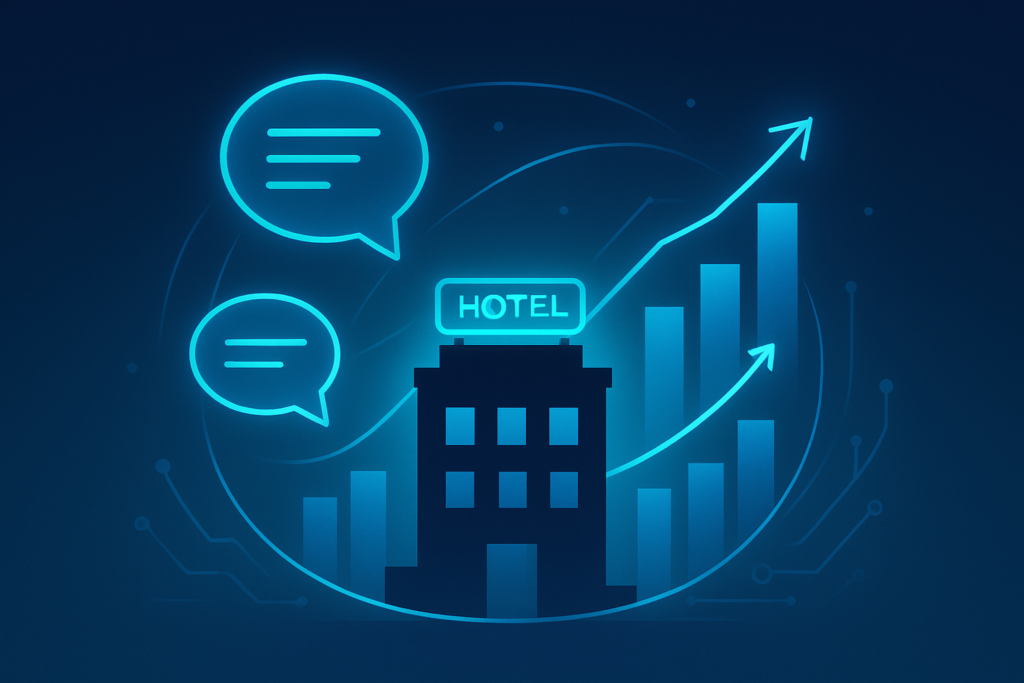
Auto Chats: The Game-Changer for Hotel Revenue in 2025
Quick Answer
Auto chats can boost hotel revenue by up to 35% through automated upselling, instant guest support, direct booking conversions, personalized recommendations, reduced no-shows, 24/7 concierge services, and streamlined check-in processes. Hotels implementing comprehensive auto chat strategies typically see ROI within 3-6 months.
Key Takeaways
- Auto chats can increase hotel revenue by up to 35% through various automated services.
- They enable automated upselling and personalized recommendations to enhance guest experience.
- Instant guest support and 24/7 concierge services improve customer satisfaction and engagement.
- Auto chats help reduce no-shows and streamline check-in processes for operational efficiency.
- Hotels typically achieve return on investment within 3-6 months after implementing auto chat strategies.
Table of Contents
The hospitality industry is experiencing a digital transformation that's reshaping how hotels interact with guests and drive revenue. Auto chats have emerged as one of the most powerful tools for hotels looking to enhance guest experience while significantly boosting their bottom line in 2025.
As a hospitality manager, you're constantly balancing the need to provide exceptional personalized service with operational efficiency and cost management. The challenge becomes even more complex when you're trying to scale your operations without compromising the human touch that defines great hospitality. This is where intelligent automation becomes your strategic advantage.
Auto chats represent far more than simple chatbots responding to basic inquiries. Today's sophisticated auto chat systems integrate seamlessly with your property management system, understand guest preferences, and can handle complex conversations that directly impact your revenue streams. From the moment a potential guest visits your website to long after they've checked out, auto chats work around the clock to maximize every revenue opportunity.
Industry data shows that hotels using comprehensive auto chat strategies see an average revenue increase of 25-35% within the first year of implementation. The key lies in deploying these systems strategically across your entire guest journey, not just for basic customer service.
The seven revenue-boosting strategies we'll explore go beyond traditional chatbot applications. We're talking about intelligent systems that can upsell room upgrades during the booking process, recommend personalized dining experiences based on guest history, reduce costly no-shows through automated confirmation sequences, and even handle complex concierge requests that typically require human intervention.
What makes 2025 particularly exciting for hotel auto chats is the convergence of advanced natural language processing, seamless integration capabilities, and guest expectations for instant, personalized service. Your guests now expect the same level of immediate response they get from other digital services, but with the warmth and attention to detail that only hospitality can provide.
Seven Revenue-Boosting Auto Chat Strategies for Hotels
vynta.ai/wp-content/uploads/2025/07/seven_glowing_neon_cyan_orbs_connected_above_abstr.webp" alt="Seven glowing neon cyan orbs connected above abstract pathways representing a tech-driven hotel guest journey." />
Modern auto chat systems deliver measurable revenue impact through strategic implementation across your guest journey. Here are the seven proven strategies that consistently drive the highest ROI for hotels in 2025.
1. Automated Upselling and Room Upgrades
Smart auto chat bot systems can increase upselling revenue by 40-60% by presenting personalized upgrade offers at optimal moments. These systems analyze guest profiles, booking history, and real-time inventory to present compelling upgrade opportunities during the booking process and pre-arrival communications.
The key is timing and personalization. Auto chats can detect when a guest books a standard room but their profile indicates they've previously stayed in suites, then automatically offer relevant upgrades with dynamic pricing based on occupancy levels.
- Dynamic pricing integration for real-time upgrade offers
- Guest history analysis for personalized recommendations
- A/B testing capabilities for optimal messaging
- Seamless payment processing for instant bookings
2. Instant Guest Support and Service Recovery
Response time directly correlates with guest satisfaction and spending. Hotels using auto chats for immediate issue resolution see 25% higher guest satisfaction scores and 18% more ancillary revenue per stay. When guests receive instant responses to concerns, they're more likely to book additional services and return for future stays.
Auto chat WhatsApp integration is particularly effective here, as 89% of travelers prefer messaging over phone calls for hotel communications. These systems can handle common issues like Wi-Fi passwords, amenity information, and room service orders while escalating complex problems to human staff with full context.
Pro tip: Configure your auto chat to proactively reach out 30 minutes after check-in with a "How's everything going?" message. This simple touchpoint catches issues early and demonstrates proactive service that guests remember.
3. Direct Booking Conversion Optimization
Auto chats can increase direct booking conversions by 35-50% by addressing visitor concerns in real-time and offering exclusive perks for booking direct. These systems detect when visitors are comparing prices or hesitating during the booking process, then automatically engage with personalized incentives.
The most effective approach combines rate matching with value-added benefits that OTAs can't offer - like free breakfast, late checkout, or room upgrades. Auto chats can calculate and present these offers instantly while the guest is still engaged on your website.
| Conversion Strategy | Average Lift | Implementation Complexity |
|---|---|---|
| Rate matching + perks | 45% | Medium |
| Scarcity messaging | 28% | Low |
| Personalized packages | 52% | High |
| Abandoned cart recovery | 38% | Medium |
4. Personalized Experience and Service Recommendations
Revenue per guest increases by 22-30% when hotels use auto chats to deliver personalized recommendations for dining, spa services, and local experiences. These systems analyze guest preferences, weather conditions, local events, and booking patterns to suggest relevant add-on services.
For example, if a guest books a weekend stay and their profile indicates interest in wellness, the auto chat can recommend spa packages, healthy dining options, and local hiking trails - complete with easy booking links and special pricing for hotel guests.
5. Automated Reservation Management and No-Show Prevention
No-shows cost hotels an average of $150-400 per room per night in lost revenue. Auto chat systems can reduce no-show rates by 45-65% through strategic pre-arrival communications and flexible rebooking options.
These systems automatically send confirmation messages, pre-arrival instructions, and gentle reminders 48 and 24 hours before check-in. When guests indicate they can't make their reservation, auto chats can instantly offer rebooking options or transfer credits, converting potential losses into future bookings.
- Automated confirmation and reminder sequences
- Real-time rebooking and credit transfer options
- Weather and travel alert integrations
- Flexible cancellation policy presentations
6. Group and Event Booking Coordination
Group bookings generate 3-4x higher revenue per reservation but require intensive coordination. Auto chats streamline this process by handling room block management, coordinating arrival times, and managing group dining reservations automatically.
The system can send personalized messages to each group member with their specific room assignments, welcome information, and event schedules. This reduces front desk workload while ensuring every guest receives detailed, accurate information about their stay.
Hotels using automated group coordination see 28% faster check-in times and 35% higher satisfaction scores for group events, leading to increased repeat bookings and referrals.
7. Loyalty Program Engagement and Guest Retention
Auto chats can increase loyalty program engagement by 60-80% through personalized point updates, exclusive offer notifications, and milestone celebrations. These systems track guest loyalty status and automatically deliver relevant benefits and upgrade opportunities.
The most effective implementations use auto chat WhatsApp to send birthday messages with special offers, anniversary stay recognition, and exclusive member-only promotions. This personal touch drives emotional connection while delivering measurable business results.
| Loyalty Engagement Strategy | Engagement Increase | Revenue Impact |
|---|---|---|
| Milestone celebrations | 72% | +$85 per stay |
| Exclusive early access | 58% | +$120 per stay |
| Personalized offers | 65% | +$95 per stay |
| Point balance updates | 43% | +$40 per stay |
Implementation Best Practices for Maximum ROI
Successful auto chat implementation requires strategic planning and continuous optimization. Start with one high-impact use case - typically upselling or direct booking conversion - then expand systematically based on performance data.
The most successful hotels integrate their auto chat bot systems with existing PMS, CRM, and revenue management platforms. This creates a unified guest experience while providing the data necessary for personalization and optimization.
Focus on mobile-first design, as 78% of hotel guests prefer messaging on mobile devices. Ensure your auto chat system works seamlessly across all devices and integrates with popular messaging platforms like WhatsApp, where guests are already comfortable communicating.
Measuring Success: Key Metrics That Matter
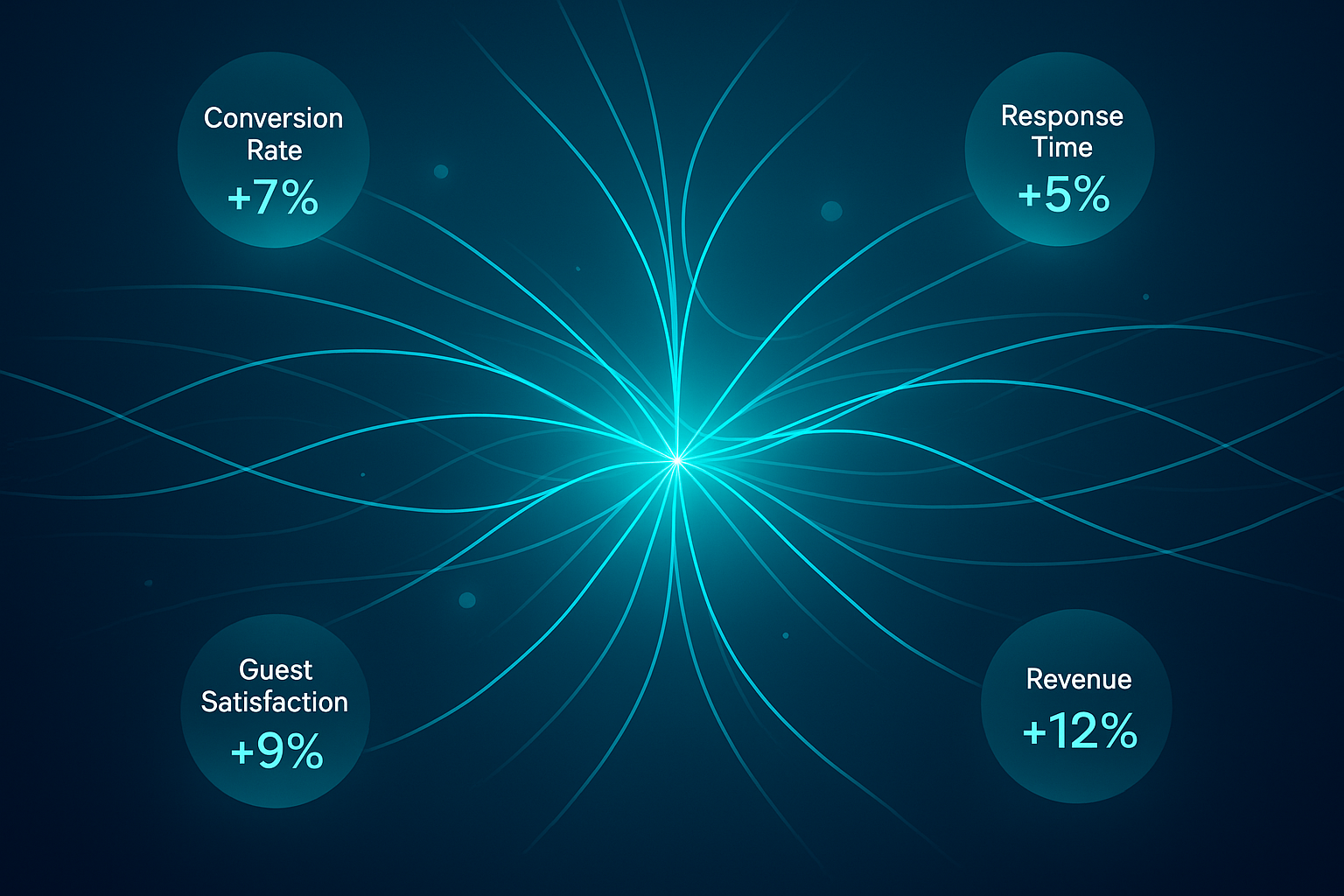
Track conversion rates, response times, guest satisfaction scores, and revenue per guest to measure auto chat effectiveness. The most successful implementations see 25-40% increases in direct bookings, 30-50% improvements in upselling revenue, and 20-35% higher guest satisfaction scores within 90 days.
Monitor conversation completion rates and escalation frequency to optimize your auto chat flows. Systems with completion rates above 85% and escalation rates below 15% typically deliver the strongest ROI across all seven revenue-boosting strategies. For more insights on industry benchmarks and trends, review these hotel revenue optimization strategies.
Auto chats are transforming hotel guest communication by shifting from reactive service to proactive revenue generation. Hotels that adopt these seven strategies systematically can boost their 2025 revenue while laying the groundwork for a sustainable competitive advantage in an increasingly automated hospitality landscape. For hotels looking to understand how automation can drive results, explore our insights on automated hotel. For a broader perspective on future trends, see 8 revenue optimization trends and challenges for 2025.
Frequently Asked Questions
What is auto chat?
Auto chat refers to an automated messaging system that initiates and manages conversations with users without manual intervention. It is commonly used in customer service and sales to provide instant responses, qualify leads, or guide users through processes, enhancing engagement and operational efficiency.
Do chatgpt chats auto delete?
ChatGPT conversations do not auto-delete by default; however, users can manually delete chat history or enable settings that manage data retention. Transparency around data usage and retention is important to maintain user trust and comply with privacy standards.
How to auto chat in Roblox?
Auto chatting in Roblox typically involves scripting within the Roblox Studio environment using Lua to create bots or NPCs that send predefined messages automatically. This automation can enhance gameplay interaction but must comply with Roblox’s community guidelines to avoid spam or disruptive behavior.
What is the difference between chat and chat bot?
Chat is the real-time exchange of messages between humans, while a chat bot is an AI-powered system designed to simulate human conversation by responding automatically. Chat bots augment human interactions by handling routine queries or tasks, improving response times and scalability.
What is an automated chat?
An automated chat is a system where conversations are managed by software without the need for human agents to respond manually. It leverages AI or rule-based logic to deliver instant replies, guide users, and perform tasks like booking, troubleshooting, or lead qualification, driving efficiency and consistent service delivery.
What's the difference between a chat message and a text message?
A chat message is typically exchanged over internet-based platforms allowing real-time, often multi-party conversations with multimedia support and presence indicators. A text message (SMS) is sent through cellular networks, usually limited to plain text and one-to-one communication, with different latency and cost implications.
About The Author
Anas Moujahid is the chief contributing writer & Operations Director for the Vynta Blog, where he turns cutting-edge AI automation into measurable business outcomes for mid-market companies.
Vynta designs enterprise-grade AI agents that augment rather than replace people—freeing teams to focus on higher-value work while the bots handle the busywork.
We specialise in four service-heavy verticals where AI can move the revenue needle fast: real estate, recruitment, fundraising and hospitality.
Anas started his career architecting AI and automation systems; today he leads operations at Vynta, making sure every deployment lands real-world ROI—whether that’s more booked viewings for estate agents, faster placements for recruiters, warmer investor pipelines for fundraisers or happier guests for hotels and restaurants.
Vynta delivers results by:
- Building industry-specific agents pre-trained on real-world workflows—no generic chatbots here.
- Integrating seamlessly with existing CRMs, ATSs, PMSs and fundraising platforms—zero rip-and-replace.
- Measuring success in business KPIs (lead-to-close rates, time-to-hire, donor retention, RevPAR) not vanity metrics.
- Providing transparent implementation plans so clients know exactly what to expect, when and why.
- Pairing every AI agent with human-in-the-loop controls to keep quality, compliance and brand voice on point.
Since launch, Vynta has helped agencies slash lead qualification time by up to 70 %, recruitment firms cut screening hours in half, fundraising teams triple investor touchpoints and hospitality brands lift guest satisfaction scores by double digits—all while keeping human expertise firmly in the loop.
Anas writes with the same ethos that drives Vynta: outcome-focused, jargon-free and grounded in real business value. Expect data-backed insights, practical implementation guides and a clear-eyed view of what AI can—and can’t—do for your organisation.