

Alternatives to AI agents for beach club bookings.
Why Beach Clubs Seek Non-AI Booking Alternatives
Common Pain Points with AI Agents in Hospitality
Alternatives to AI agents for beach club bookings attract serious attention because AI adoption in seasonal hospitality carries real friction. Staff turnover is high, training windows are short, and guests expect instant, accurate responses. When AI agents misread seasonal availability or fail to handle membership-tier pricing, the operational damage is immediate and visible.
Business Goals for Reservation Management
Beach club operators prioritize three outcomes: minimizing no-shows, maximizing cabana and daybed utilization, and capturing upsell revenue on food and beverage packages. Any booking system gets evaluated against those metrics. Many operators find that purpose-built AI agents for hospitality deliver those outcomes without the configuration complexity that generic AI platforms require–but that’s not where every operator should start.
When Traditional Systems Deliver Clear Wins
Traditional systems are often a better fit when speed, predictable pricing, and simple staff workflows matter more than proactive guest outreach. That describes most seasonal venues: tight launch timelines, lean teams, and operations held together by deposits and capacity controls.
Traditional Booking Tools: Honest Assessment
Pros
- Setup measured in hours, not weeks
- Staff training requires minimal technical background
- Predictable flat-rate pricing fits seasonal budgets
- Direct integrations with payment processors and POS systems
- Proven reliability during peak-season traffic spikes
Cons
- No automated guest communication or follow-up sequences
- Manual upselling depends entirely on staff availability
- Limited ability to personalize repeat-guest experiences
- Scalability plateaus at high reservation volumes
Top Non-AI Booking Systems for Beach Clubs
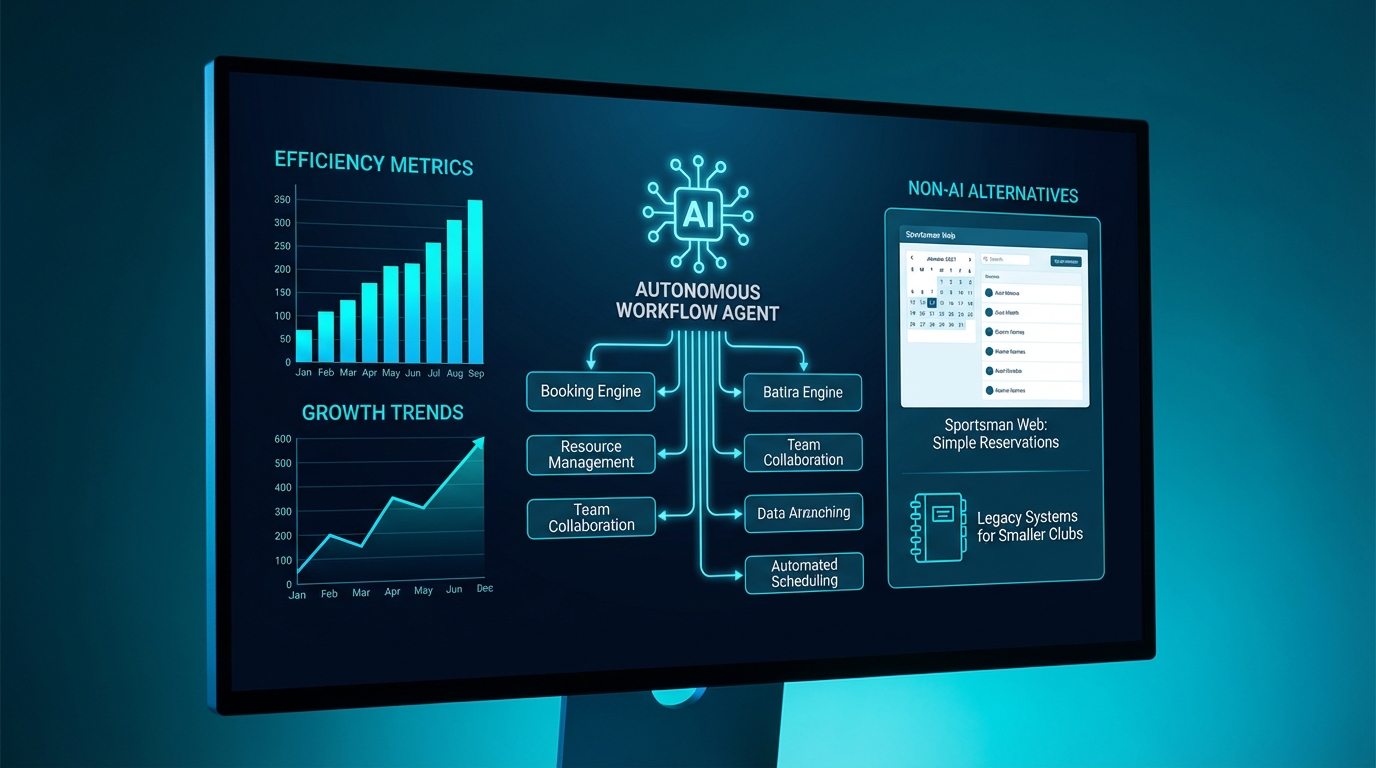
Sportsman Web: Simple Recreation Reservations
Sportsman Web targets recreation facilities and works well for smaller beach clubs managing cabana blocks, equipment rentals, and event slots. Its calendar-based interface requires minimal onboarding and handles deposit collection natively.
Visual ClubMate: Mobile-First Member Access
Visual ClubMate focuses on member-based venues, making it a strong fit for private beach clubs. Members self-manage reservations via a mobile app, which cuts front-desk volume while preserving the exclusivity that membership models depend on.
Cloudbeds: Scalable Property Management
Cloudbeds suits beach clubs attached to boutique hotels or resort properties. Channel management, rate automation, and reporting tools give operations managers clear visibility into revenue per available unit–a metric that ties directly to profitability.
Reservio and Vagaro: Affordable Entry Options
Both platforms offer entry tiers under $50 per month. Reservio handles multi-resource scheduling cleanly. Vagaro adds built-in marketing tools–email campaigns and loyalty tracking–giving small beach clubs more capability per dollar spent.
| Platform | Best Fit | Starting Price | Mobile App | Upsell Tools |
|---|---|---|---|---|
| Sportsman Web | Small recreation clubs | Custom quote | Limited | No |
| Visual ClubMate | Private member clubs | Custom quote | Yes | No |
| Cloudbeds | Resort-attached venues | Custom quote | Yes | Basic |
| Reservio | Multi-resource scheduling | About $19 per month | Yes | No |
| Vagaro | Small clubs with marketing needs | About $30 per month | Yes | Basic email |
Platform selection ultimately depends on venue size, membership model, and whether the property operates independently or as part of a larger hospitality group. There’s no universal right answer–only the right fit for your operation.
Key Features of Traditional Systems for Seasonal Venues
Handling Peak Demand and No-Show Prevention
Traditional booking platforms handle seasonal surges through capacity caps, waitlist queues, and automated deposit requirements. Deposit-on-booking is one of the most effective no-show prevention mechanisms available, and every platform listed above supports it natively. Cloudbeds goes further–overbooking buffers calibrated to historical cancellation rates give revenue managers a data-backed cushion during peak weekends.
Website Integrations and Event Ticketing
Reservio and Vagaro both embed directly into existing websites via widget, cutting the redirect friction that drives booking abandonment. For beach clubs running themed events or holiday packages, Vagaro’s built-in ticketing supports multi-tier pricing without additional software. Visual ClubMate connects to access-control systems, so membership verification happens at the gate rather than at the front desk.
Payment Processing and Staff Training Simplicity
All five platforms integrate with Stripe or Square, keeping payment reconciliation in familiar tools. Staff training averages two to four hours across these systems. That’s a meaningful advantage when seasonal hires join two weeks before opening day.
Traditional vs. AI Agents: Setup Time, Scalability, and ROI Comparison
Quick Setup Wins for Non-AI Tools
Traditional platforms go live in one to three days. No training data to configure, no conversation flows to map, no integration testing for natural language processing. For operators opening a new season with limited runway, that speed is a genuine competitive edge.
Where Traditional Systems Hit Their Ceiling
Traditional systems process reservations efficiently but can’t initiate outreach. When a Saturday cancellation opens a premium cabana at 8 a.m., the system waits for a guest to find it. A bespoke AI agent texts the waitlist, confirms a replacement booking, and triggers a brand-safe upsell offer on a food and beverage package before staff arrives for their shift. That gap compounds across an entire season.
| Capability | Traditional Systems | AI Agents |
|---|---|---|
| Setup time | 1 to 3 days | Phased implementation over several weeks |
| Staff training required | Minimal | Moderate |
| Automated guest outreach | No | Yes |
| Upsell automation | Limited | Yes |
| Personalization at scale | No | Yes |
| Monthly cost range | About $19 per month to custom | Higher, outcome-based |
Where the Revenue Gap Shows Up
Operators using traditional systems report strong utilization rates when staff actively manage waitlists. The measurable gap appears in revenue per guest: properties using automated upsell sequences consistently report higher food and beverage attachment rates than those relying on staff-initiated offers alone. Occupancy stays roughly equal. Spend per head doesn’t.
Choosing the Right Path for Your Beach Club Operations

Decision Framework: Non-AI vs. AI Agents
Start with a traditional system if your venue processes fewer than 150 daily reservations, operates with a lean seasonal staff, or is opening for the first time. The platforms covered in this guide address core operational needs at predictable cost–no surprises mid-season.
The upgrade signal is specific: when manual waitlist management, missed upsell moments, and inconsistent guest communication start producing measurable revenue loss, that’s when AI agents earn their cost. Don’t guess at that transition point. Track it through a 60-day baseline.
Three Metrics That Tell You Where You Stand
Track no-show rate, revenue per reservation, and repeat booking rate from day one. Traditional systems stabilize the first metric through deposit requirements and capacity controls. AI agents move the second and third by automating outreach and personalized offers. If your no-show rate is solid but revenue per reservation and repeat bookings are stalling despite strong occupancy, your system has done its job–and reached its limit.
Next Steps for Revenue-Focused Hospitality Leaders
Treat this comparison as a phased roadmap, not a binary choice. Deploy a traditional system to establish operational stability. Measure against those three core metrics. Upgrade when the data justifies it–not before.
That sequence reduces risk, preserves budget during early seasons, and ensures any AI investment targets a documented gap rather than a theoretical one. Vynta AI’s bespoke AI agents are built for exactly that moment: proactive guest communication, personalized offers tied to guest profiles, and real-time availability management that staff-dependent processes can’t replicate at scale.
Frequently Asked Questions
Will AI agents fully replace human staff for beach club bookings?
For beach club bookings, AI agents primarily automate routine tasks, allowing human staff to focus on VIP guests and complex queries. Systems like Vynta AI are designed to assist staff, not replace them, by handling instant responses and upselling. This approach frees up your team to deliver personalized service where it matters most.
What types of systems can recommend and book for beach clubs?
Beach clubs can use both traditional booking systems and bespoke AI agents for reservations. Traditional tools like Cloudbeds or Vagaro manage bookings and capacity. Bespoke AI agents, such as Vynta AI, not only handle bookings but also personalize upsell recommendations for food and beverage packages, aiming to increase average guest spend.
Which AI agent platform is ideal for beach club bookings?
The ideal AI agent platform for beach club bookings depends on specific operational needs and guest expectations. Vynta AI agents are bespoke, designed for luxury hospitality venues, and focus on increasing booking conversion by 50% and reducing inquiry abandonment by 60%. They also aim to increase average guest spend by up to 25% through tailored upselling.
When are traditional booking systems a better choice for beach clubs?
Traditional booking systems often suit beach clubs that need quick setup, predictable pricing, and simple staff workflows. They are a strong choice for seasonal venues operating with lean teams, prioritizing capacity controls and deposit requirements to manage operations stably. These systems are effective when speed and reliability during peak season are key.
What are the main challenges for beach clubs adopting AI agents?
Beach clubs often face challenges with AI agents due to high staff turnover, short training windows, and the need for instant, accurate guest responses. Issues arise when AI misreads seasonal availability or struggles with membership-tier pricing, leading to immediate operational damage. Bespoke AI solutions address these by being pre-configured to specific business rules.